
全面深化改革

Search documents
李强主持召开国务院“十五五”规划《纲要草案》编制工作领导小组会议
证监会发布· 2025-10-24 14:19
李强指出,要创新思路、务求实效,高质量编制规划纲要,进一步明确"十五五"发展的 施工图、路线图,谋划提出务实管用的发展载体和工作抓手。要培育壮大高质量发展新动 能,围绕成长性强、牵引性强的领域打造一批新产业新赛道。要坚持扩大内需这个战略基 点,充分挖掘强大国内市场的潜力。要通过全面深化改革释放发展动力和活力,围绕重点领 域和关键环节深入研究改革举措。要主动开展对外经贸格局的战略性调整,推出更多自主开 放、单边开放措施。要统筹发展和安全,防范重点领域风险,确保社会大局稳定。 李强强调,纲要草案编制时间紧、任务重,各方面要密切协作、形成合力。要面向社会 公众公开征集意见建议,广泛了解社会期盼、专家意见、基层经验等,认真研究吸纳到纲要 草案中。要加强统筹协调,做好专项规划编制与国家发展规划的衔接,指导地方立足比较优 势编制规划,形成科学有机的规划体系。 张国清、刘国中、吴政隆、谌贻琴参加会议。 来源:新华社 新华社北京10月24日电 10月24日,中共中央政治局常委、国务院总理李强主持召开 国务院"十五五"规划《纲要草案》编制工作领导小组会议并作讲话。 中共中央政治局常委、国务院副总理丁薛祥出席。 会上,国家发展改 ...


【招银研究|政策】高质量发展的新内涵——党的二十届四中全会经济思想学习体会
招商银行研究· 2025-10-24 12:47
Core Viewpoint - The article discusses the outcomes of the Fourth Plenary Session of the 20th Central Committee of the Communist Party of China, emphasizing the strategic opportunities and challenges facing the country in the upcoming "15th Five-Year Plan" period [1][2]. Group 1: Situation Assessment - The meeting praised the significant achievements during the "14th Five-Year Plan" period, highlighting advancements in economic, technological, and comprehensive national strength [2]. - It identified the next five years as a critical period for achieving socialist modernization, while acknowledging the complex and changing development environment [2]. - The meeting reiterated the importance of maintaining a focus on economic construction and emphasized the need for strategic determination and proactive historical engagement [2]. Group 2: Development Goals - Seven main goals for the "15th Five-Year Plan" period were proposed, including significant improvements in high-quality development, technological self-reliance, and national security [3]. - The long-term vision for 2035 includes substantial increases in economic, technological, and national defense strength, with a target for per capita GDP to reach the level of moderately developed countries [3]. - The meeting highlighted the importance of national defense and international influence as new goals, reflecting a focus on security amid global changes [3]. Group 3: Key Work Areas - Twelve key work areas were outlined, with the construction of a modern industrial system prioritized, emphasizing the need for a robust real economy [5]. - Accelerating technological self-reliance and innovation was highlighted as essential for leading new productive forces, with a focus on education, talent, and core technology breakthroughs [6]. - The meeting stressed the importance of expanding domestic demand and establishing a new development pattern, with a focus on enhancing the internal circulation of supply and demand [7]. - High-level openness and cooperation were emphasized, aiming to create a win-win situation in response to global challenges [8]. - The meeting called for optimizing regional economic layouts and promoting coordinated regional development, identifying key growth areas [9]. - Enhancing and improving people's livelihoods was underscored, with a focus on common prosperity and addressing urgent social issues [10]. - The meeting outlined the need for sustained economic policy efforts to achieve annual development goals, with a GDP growth rate of 5.2% in the first three quarters of the year [11].

中共中央新闻发布会丨《建议》明确“十五五”时期经济社会发展主要目标
Yang Shi Xin Wen Ke Hu Duan· 2025-10-24 10:43
Core Points - The article discusses the key objectives for China's economic and social development during the 14th Five-Year Plan period, as outlined by the Central Committee [1] - The goals include significant achievements in high-quality development, advancements in self-reliant technology, and breakthroughs in comprehensive reforms [1][6] - The plan emphasizes improvements in social civilization, quality of life, progress in building a beautiful China, and strengthening national security [1][7] Summary by Categories - **High-Quality Development**: The plan aims for notable results in high-quality economic development [1] - **Technological Self-Reliance**: There is a focus on significantly enhancing the level of technological self-reliance and strength [1][6] - **Reform Breakthroughs**: The initiative seeks to achieve new breakthroughs in comprehensive deepening of reforms [1] - **Social Civilization**: The goal includes a marked improvement in the level of social civilization [1] - **Quality of Life**: Continuous enhancement of people's quality of life is a priority [1] - **Beautiful China**: The construction of a beautiful China is expected to make new significant progress [1][7] - **National Security**: The plan aims to further consolidate the national security barrier [1][7]
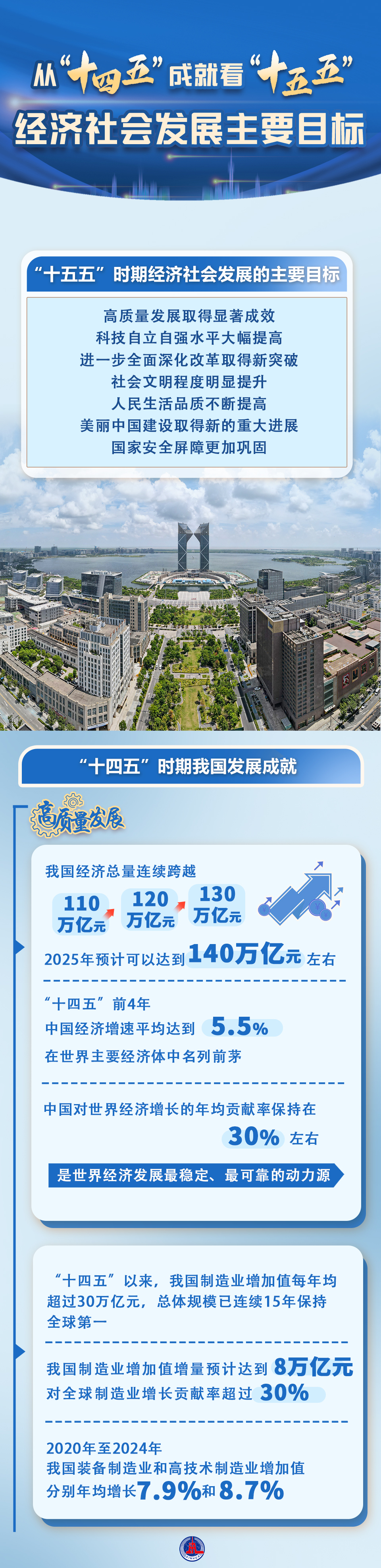
数说中国|从“十四五”成就看“十五五”经济社会发展主要目标
Xin Hua She· 2025-10-24 05:47
Core Points - The article highlights the significant achievements and goals of China's economic and social development during the "14th Five-Year Plan" period, emphasizing high-quality development and technological self-reliance [2][8][40] Economic Growth - China's GDP is projected to reach approximately 140 trillion yuan by 2025, with an average growth rate of 5.5% during the first four years of the "14th Five-Year Plan" [6] - The country has maintained a contribution rate of around 30% to global economic growth, positioning itself as a stable and reliable driver of world economic development [6] Manufacturing Sector - The added value of China's manufacturing industry has consistently exceeded 30 trillion yuan annually, maintaining its status as the world's largest manufacturing sector for 15 consecutive years [7] - The growth rates for equipment manufacturing and high-tech manufacturing sectors are projected at 9% and 8.7% respectively from 2020 to 2024 [7] Domestic Consumption - From 2021 to 2024, domestic demand contributed an average of 86.8% to economic growth, with final consumption expenditure accounting for 59.9% [19][20] - China remains the second-largest consumer market globally and the largest online retail market [20] Technological Innovation - The number of global top 100 technology innovation clusters has reached a leading position, with over 460,000 high-tech enterprises [13] - R&D expenditure is expected to increase by 12 billion yuan, with the intensity of R&D investment rising to 2.68%, nearing the OECD average [14] Social Development - By 2024, the per capita disposable income of rural residents is projected to reach 23,119 yuan, reflecting a steady increase in farmers' income [22] - The urban employment rate remains stable, with over 12 million new jobs created annually [34] Environmental Progress - Forest coverage has increased to over 25%, contributing significantly to global greening efforts [38] - The proportion of good water quality in surface water monitoring points is 90.4%, with air quality maintaining a favorable level [38]
韩文秀介绍关于“十五五”时期我国经济社会发展指导方针|宏观经济
清华金融评论· 2025-10-24 02:28
中国中共中央今天(24日)上午举行新闻发布会,介绍和解读党的二十届四中全会精神。中央财办分管日常工作的副主任、中央农办主任韩 文秀介绍 关于"十五五"时期经济社会发展的指导方针 。 《中共中央关于制定国民经济和社会发展第十五个五年规划的建议》强调,要全面贯彻习近平新时代中国特色社会主义思想,围绕全面建成 社会主义现代化强国、实现第二个百年奋斗目标,以中国式现代化全面推进中华民族伟大复兴,统筹推进"五位一体"总体布局,协调推进"四 个全面"战略布局,完整准确全面贯彻新发展理念,加快构建新发展格局。 《中共中央关于制定国民经济和社会发展第十五个五年规划的建议》提出"五个以""两个推动""一个确保"的要求,即: 坚持以经济建设为中 心 ,以推动高质量发展为主题,以改革创新为根本动力,以满足人民日益增长的美好生活需要为根本目的,以全面从严治党为根本保障,推 动经济实现质的有效提升和量的合理增长,推动人的全面发展、全体人民共同富裕迈出坚实步伐,确保基本实现社会主义现代化取得决定性 进展。 《建议》指出,"十五五"时期经济社会发展必须遵循六项重大原则,即: 坚持党的全面领导、坚持人民至上、坚持高质量发展、坚持全面深 化改 ...

增强必胜信心 赢得战略主动
Xin Hua She· 2025-10-24 00:36
Core Viewpoint - The 20th Central Committee's Fourth Plenary Session has approved the proposal for the 15th Five-Year Plan, outlining China's development blueprint for the next five years, emphasizing the commitment to advancing Chinese-style modernization and achieving socialist modernization [1] Group 1: High-Quality Development - High-quality development is the primary task for building a modern socialist country, with significant achievements expected during the 15th Five-Year Plan [2] - The plan aims to guide scientific deployment across various fields, promoting higher quality, efficiency, equity, sustainability, and safety in development [2][3] Group 2: Modern Industrial System - A modern industrial system is crucial for promoting high-quality economic development, focusing on intelligent, green, and integrated directions [3] - The plan emphasizes optimizing traditional industries, nurturing emerging industries, and enhancing service sectors and infrastructure [3] Group 3: Domestic Market Support - Strong domestic market support is essential for high-quality development, with a focus on improving people's livelihoods and stimulating consumption [4] - The plan aims to release demand in various sectors through proactive macroeconomic policies, making domestic demand a primary driver of economic growth [4] Group 4: Technological Self-Reliance - The level of technological self-reliance and strength is set to significantly increase, with a focus on scientific and technological innovation as a pathway to modernization [5][6] - The plan includes strengthening original innovation and key core technology breakthroughs, integrating technology with education and talent development [7] Group 5: Comprehensive Reform - Comprehensive reform is identified as a fundamental driver for advancing Chinese-style modernization, with a focus on enhancing the socialist market economy [8] - The plan includes specific measures to improve macroeconomic governance and remove deep-seated institutional barriers [8][9] Group 6: High-Level Opening Up - The plan calls for expanding high-level opening up to create a win-win cooperation landscape, promoting trade innovation and investment cooperation [10] - It emphasizes the importance of a market-oriented, law-based, and international business environment to enhance global resource allocation capabilities [10] Group 7: Cultural Development - The session highlights the importance of cultural development, aiming for a significant improvement in social civilization levels [11] - The plan includes promoting cultural innovation and enhancing the influence of Chinese civilization [11] Group 8: Improving People's Livelihoods - The plan emphasizes the need to improve and guarantee people's livelihoods, aiming for common prosperity and addressing urgent social issues [13][14] - Specific measures include promoting quality employment, improving the income distribution system, and enhancing public services [14] Group 9: Ecological Progress - The plan sets a goal for significant progress in building a beautiful China, focusing on green transformation and ecological civilization [15][16] - It includes measures for pollution prevention and ecological system optimization to support high-quality development [17] Group 10: National Security - The plan underscores the importance of national security as a foundation for national rejuvenation, integrating security with social governance [19][20] - It aims to modernize the national security system and enhance public safety governance [19]
续写经济快速发展和社会长期稳定两大奇迹新篇章
Si Chuan Ri Bao· 2025-10-23 22:02
Core Points - The "15th Five-Year Plan" period is crucial for achieving basic socialist modernization and will focus on high-quality development and technological self-reliance [5][6][7] - The recent Fourth Plenary Session of the 20th Central Committee emphasized the importance of unity under Xi Jinping's leadership to tackle challenges and promote national rejuvenation [1][2][4] - The economic achievements during the "14th Five-Year Plan" period include crossing significant GDP milestones and contributing approximately 30% to global economic growth [2][3] Economic Development - Sichuan's economy has seen significant growth, surpassing 5 trillion and 6 trillion yuan, moving from 6th to 5th in national rankings [3] - The average income in certain villages has nearly doubled compared to 2020, indicating improved living standards [3] - The province's industrial sectors, such as the power battery industry, have also reported substantial growth, with outputs exceeding 100 billion yuan for two consecutive years [3] Strategic Goals - The "15th Five-Year Plan" outlines key objectives including enhancing economic quality, deepening reforms, and improving social welfare [5][6] - Specific measures include focusing on the real economy, boosting innovation, and expanding domestic markets [6][7] - The plan aims to create a modern industrial system and promote green transformation across various sectors [6][7] Implementation and Local Initiatives - Local governments and enterprises are committed to implementing the directives from the Fourth Plenary Session, focusing on practical actions to achieve high-quality development [8][9] - Projects such as the Chengdu-Deyang railway are being expedited to enhance regional integration and connectivity [9] - Efforts to optimize the business environment are underway, with initiatives aimed at improving service integration and supporting local economies [9][10]
四中全会公报发布:十五五经济社会发展原则
Yang Shi Xin Wen· 2025-10-23 15:40
Core Viewpoint - The Fourth Plenary Session emphasizes the principles that must be adhered to during the "14th Five-Year Plan" period for economic and social development, highlighting the importance of comprehensive party leadership and high-quality development [1] Group 1 - The session underscores the necessity of adhering to the principle of the Party's comprehensive leadership [1] - It stresses the importance of prioritizing the people in economic and social development [1] - The focus is on maintaining high-quality development as a key objective [1] Group 2 - The session calls for comprehensive deepening of reforms as a fundamental approach [1] - It highlights the need for a combination of effective markets and proactive government [1] - The importance of coordinating development and security is also emphasized [1]
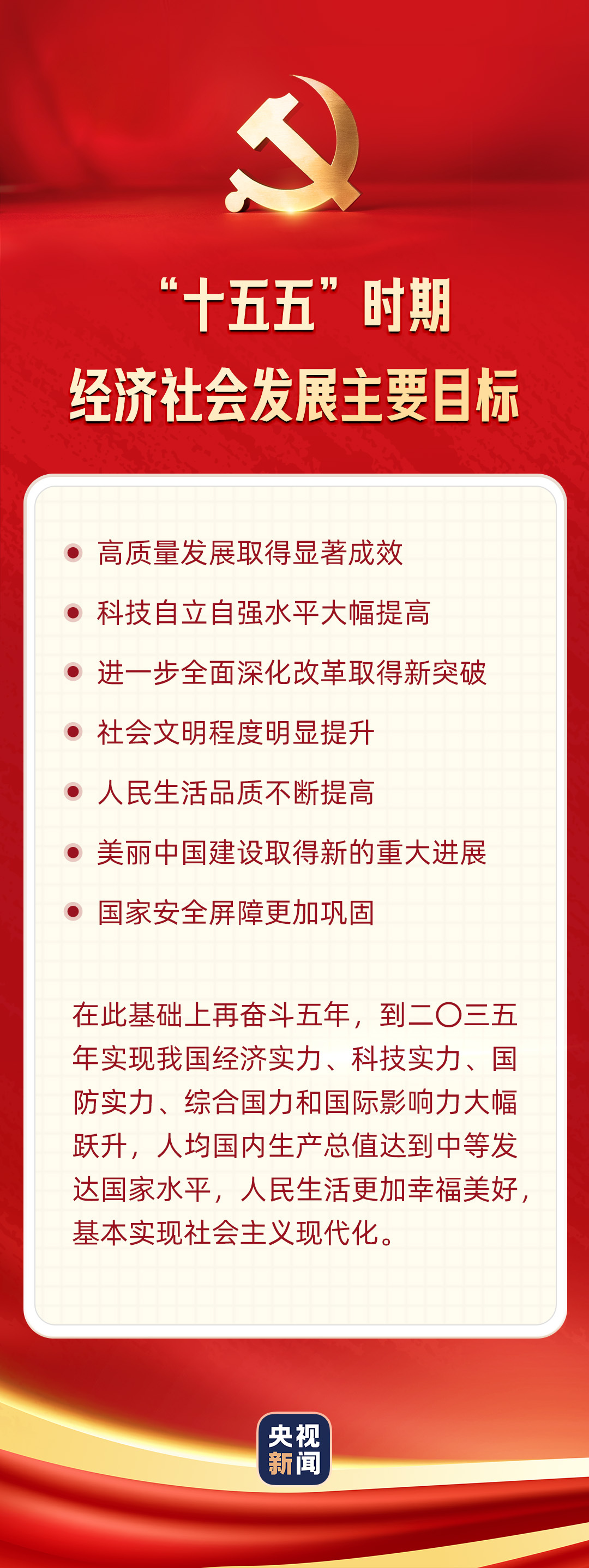
“十五五”主要目标!
中国基金报· 2025-10-23 10:11
Group 1 - The main goals for the "14th Five-Year Plan" period include significant achievements in high-quality development, a substantial increase in technological self-reliance, and breakthroughs in comprehensive reforms [2][4] - There will be a notable improvement in social civilization, enhancement of people's quality of life, and major progress in building a beautiful China [2][4] - By 2035, the aim is to achieve a significant leap in economic strength, technological capability, national defense, comprehensive national power, and international influence, with per capita GDP reaching the level of moderately developed countries [2][4]
X @外汇交易员
外汇交易员· 2025-10-23 09:04
#四中全会 #全文 中国共产党第二十届中央委员会第四次全体会议公报:“十五五”主要目标——高质量发展取得显著成效,科技自立自强水平大幅提高,进一步全面深化改革取得新突破,社会文明程度明显提升,人民生活品质不断提高,美丽中国建设取得新的重大进展,国家安全屏障更加巩固。在此基础上再奋斗五年,到2035年实现我国经济实力、科技实力、国防实力、综合国力和国际影响力大幅跃升,人均国内生产总值达到中等发达国家水平,人民生活更加幸福美好,基本实现社会主义现代化。要大力提振消费,扩大有效投资,坚决破除阻碍全国统一大市场建设卡点堵点;促进重点群体稳定就业,加大欠薪整治力度;加强社会治安整体防控;增补张升民为中共中央军事委员会副主席。 ...