大模型

Search documents
谁在消耗5万亿模型算力?
经济观察报· 2026-03-08 03:49
Core Insights - The article highlights a significant shift in the usage of artificial intelligence (AI) models, particularly in the context of token consumption, indicating a transition from traditional question-answering models to more complex agent-based models that perform multi-step tasks [2][3][6]. Token Consumption Trends - In February 2026, China's AI models achieved a weekly token consumption of 5.16 trillion, surpassing the U.S. models for the first time, reflecting a 127% increase over three weeks [2]. - The OpenRouter platform, which aggregates global AI model interfaces, reported that programming task tokens rose from 11% to over 50% of total token usage, indicating a shift towards more complex applications [6]. Application Shifts - The transition to agent-based models allows for continuous task execution in the background, leading to exponential growth in token consumption per session [6][8]. - Multi-modal applications, such as video generation, significantly increase token consumption, with a 10-second video requiring approximately 350,000 tokens [7][8]. Industry Impact - The surge in token consumption is primarily supported by high-frequency, scalable commercial applications across sectors like internet, finance, cross-border e-commerce, and entertainment [9]. - Key application areas include enterprise-level solutions (e.g., intelligent customer service, marketing automation), content generation services, and AI-generated content tools [9]. Market Dynamics - The competitive landscape is shifting as domestic AI chip manufacturers gain opportunities due to changing procurement standards, moving from a focus on training costs to operational efficiency and cost-effectiveness [4][14]. - The pricing of Chinese AI models is significantly lower than their overseas counterparts, with input prices around $0.3 per million tokens compared to $5 for similar foreign products [10]. Infrastructure Developments - The launch of the Zhengzhou core node, capable of supporting over 30,000 domestic acceleration cards, marks a significant advancement in China's AI computing infrastructure [18]. - The deployment of large-scale AI computing clusters is enabling various applications, including simulations for the automotive industry and support for luxury brands [19]. Financial Performance - Domestic AI chip manufacturers are experiencing explosive growth, with companies like Cambrian achieving a revenue increase of 453.21% in 2025, driven by rising demand for AI computing power [20]. - The market penetration of domestic AI chip brands has increased from approximately 29% in 2024 to 42% in 2025, indicating a shift towards local solutions in the AI sector [21].



Dola能成为下一个TikTok吗?
创业邦· 2026-03-07 10:24
Core Viewpoint - Doubao has emerged as one of the most prominent AI applications in China over the past two years, leveraging ByteDance's strengths in entertainment interaction and content sharing to achieve rapid user growth and high retention rates [5][6]. Group 1: Doubao's Market Position - By Q3 2025, Doubao reached 172 million monthly active users, becoming the top AI application in China, with a peak of 145 million daily active users during the Spring Festival collaboration [5]. - Doubao's emotional interaction is more natural and user-friendly compared to other AI applications, making it suitable for personal short video creation [5]. Group 2: Dola's Development and Strategy - Dola, initially launched as Cici in overseas markets, has low brand recognition in China and is often inaccurately referred to as Doubao's overseas version [6]. - Dola's user base reached 55 million monthly active users by the end of 2025, establishing a stable reputation among young users in Southeast Asia and Latin America [9]. - Dola's strategy focuses on low barriers to entry and impressive image capabilities, targeting emerging markets with high demand for practical tools [7][19]. Group 3: ByteDance's AI Strategy - ByteDance plans to invest 160 billion RMB in AI by 2026, with half allocated for high-end computing chips to support large model development [12]. - The company aims to integrate Doubao and Dola into a cohesive AI assistant strategy, enhancing user experience and leveraging existing services [10][14]. - ByteDance's competitive edge lies in its recommendation algorithms, content scenarios, and user operations, which need to be adapted for AI applications [14]. Group 4: Market Challenges and Opportunities - The AI landscape is increasingly competitive, with major players like OpenAI and Google dominating, necessitating a differentiated approach for Dola [18]. - Dola is positioned as a "one-stop creative assistant," focusing on everyday needs like writing, translation, and image generation, rather than competing directly with high-end AI solutions [19]. - The strategy involves leveraging TikTok's traffic to drive user acquisition for Dola while maintaining a focus on user experience and practical applications [20].

林俊旸发文告别阿里
新华网财经· 2026-03-07 10:23
Core Viewpoint - Lin Junyang, the former head of Alibaba's Qwen, announced his departure from the company, expressing gratitude for the support he received and reflecting on his contributions to the team and the company [1][5]. Group 1: Departure Announcement - Lin Junyang publicly announced his resignation from Qwen on March 4, stating "me stepping down. bye my beloved qwen" [5]. - His farewell post received significant attention, highlighting the emotional response from colleagues and the community [2][5]. Group 2: Company Response - Alibaba's CEO Wu Yongming acknowledged Lin's resignation in an internal email, thanking him for his contributions and stating that the company would continue to support the Qwen project under the leadership of other team members [5][6]. - The company emphasized that the Qwen model team remains stable and that there has not been a collective departure of core team members, despite external speculation [6]. Group 3: Context of Departure - Lin's resignation is reportedly linked to a strategic shift within Qwen, where the company aims to recruit more technical talent, leading to adjustments in Lin's responsibilities [6]. - Lin Junyang, born in 1993, was recognized as Alibaba's youngest P10-level technical expert and has a strong academic background in computer science and language studies [6][7].


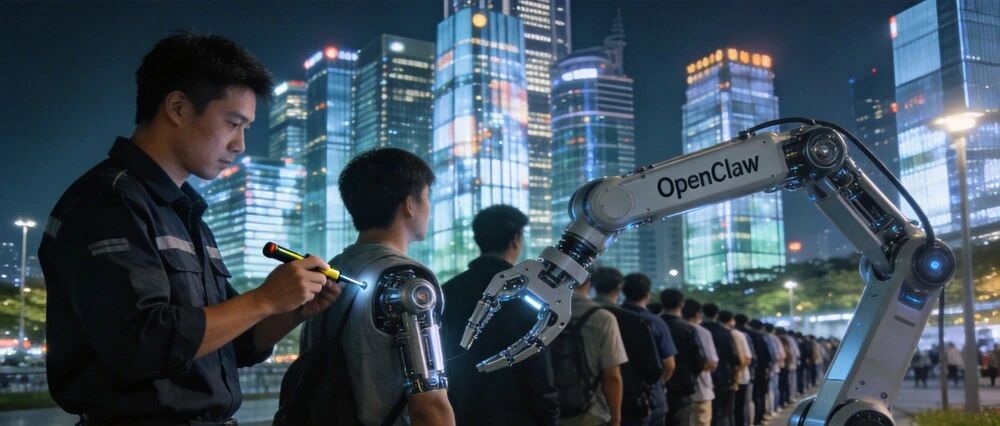
中国正在卷起一场OpenClaw风暴
虎嗅APP· 2026-03-07 10:19
Core Viewpoint - The article discusses the emerging competition among tech giants in the AI space, particularly focusing on the deployment of local agents like OpenClaw, which serve as a new interface for users and a means to generate cash flow through token consumption [7][14][20]. Group 1: AI Agent Deployment - Major companies like Tencent and Xiaomi are actively promoting their local AI agents, with Tencent's OpenClaw being a prominent example, allowing users to automate tasks and interact with various devices [5][6]. - The deployment of these agents is not merely about providing AI tools but represents a strategic move to establish a new "super entry point" for user interactions with digital services [7][20]. Group 2: Cash Flow Generation - The current challenge for tech giants is to create a sustainable business model beyond simple chat interactions, as traditional user engagement does not sufficiently utilize their extensive computational resources [14]. - OpenClaw and similar agents can significantly increase token consumption by breaking down complex tasks, leading to a higher volume of API requests and thus generating substantial cash flow for cloud service providers [15]. Group 3: Data Acquisition - The competition is also about acquiring high-quality task trajectory data, which is crucial for training advanced AI models. This data reflects real-world actions and is more valuable than static text data [17][18]. - By deploying agents on user devices, companies can collect this trajectory data, which can be used to enhance AI capabilities and create a competitive edge in model training [19][20]. Group 4: Changing User Interaction - The introduction of AI agents is expected to transform how users interact with digital platforms, shifting from app-centric engagement to task-oriented interactions where AI decides the best services to use [23][24]. - This shift could diminish the role of traditional apps, relegating them to service nodes while the AI agent becomes the primary interface for users [23][24]. Group 5: Future Implications - The rise of AI agents like OpenClaw may signal a significant shift in the internet landscape, where AI systems evolve from being mere tools to becoming integral parts of users' digital lives [27][28]. - If the AI agent era materializes, it could lead to a new platform level in technology, similar to past innovations that started as niche products but evolved into dominant platforms [28][29].


林俊旸发文告别阿里
财联社· 2026-03-07 09:08
Group 1 - The core point of the article is the resignation of Lin Junyang, the former core leader of Alibaba's Qianwen model, who expressed his emotions and reflections on his departure from Alibaba Cloud [1][3]. - Lin Junyang confirmed his resignation on March 7, stating that he was unaware of the support he received from many people until his last day, which moved him to tears [1][3]. - Alibaba CEO Wu Yongming officially approved Lin's resignation on March 5, indicating a formal transition within the company [1]. Group 2 - Lin expressed a sense of accomplishment in his efforts for his colleagues and the company, despite acknowledging that he could not achieve everything he aimed for [1][5]. - He encouraged his colleagues to continue their efforts, highlighting the ongoing challenges and tasks that remain [1][5].

P10 林俊旸发文告别阿里 + 周靖人才是 Qwen 的灵魂人物
程序员的那些事· 2026-03-07 06:56
Core Viewpoint - The departure of Lin Junyang, the technical head of Qwen, has raised discussions about his influence and the internal dynamics at Alibaba, particularly regarding the company's organizational structure and culture [1][2][5]. Group 1 - Lin Junyang announced his departure from Alibaba on March 7, expressing his support for the company and urging his colleagues to continue their efforts [2]. - His role as a key figure in the Qwen model has been contested, with some internal sources downplaying his significance and attributing the core leadership to Alibaba Cloud's CTO, Zhou Jingren [2][3]. - There have been reports of Lin challenging company protocols, particularly regarding his abrupt resignation announcement without prior communication with management, which was deemed unacceptable by some within the organization [5].

《方略》| 对话大模型第一股智谱CEO:AI 不是取代人,而是加速人进化
雪球· 2026-03-07 01:31
Core Viewpoint - The article discusses the evolution of artificial intelligence (AI) and the significance of large models in the global AI competition, emphasizing the diversity of technology and the commercialization of AI as key industry topics [1]. Group 1: AI Definition and Evolution - AI, or Artificial Intelligence, is defined as the simulation of human intelligence through technology [2]. - The development of AI has experienced several waves, with three recognized waves and currently entering a fourth, highlighting the cyclical nature of progress and setbacks in the field [4]. - The concept of AI has evolved since its inception in the 1950s, with its scope expanding over time while maintaining its core objective [2][4]. Group 2: Historical Milestones in AI - The perceptron, introduced in 1958, laid the foundation for machine learning by enabling machines to learn from data through iterative processes [5][6]. - The first chatbot, Eliza, developed in 1966, marked a significant milestone in AI's ability to engage in human-like conversation [6]. - The 1973 Lighthill report highlighted the limitations of AI, leading to a decline in investment and the first AI winter due to over-optimism and inadequate computational resources [7]. Group 3: Technological Developments - The introduction of GPUs in 1981 significantly enhanced AI capabilities by improving floating-point calculations essential for scientific computing and AI applications [9]. - The second AI winter occurred in the late 1980s and early 1990s due to the limitations of expert systems and the inability to scale knowledge representation effectively [10]. - The victory of Deep Blue over world chess champion Garry Kasparov in 1997 was a landmark event, demonstrating advanced AI capabilities in complex problem-solving [11]. Group 4: Current Trends and Future Directions - The emergence of large models, such as ChatGPT, represents a shift in AI methodologies, moving towards end-to-end solutions that simplify traditional natural language processing tasks [17][18]. - The AI industry is characterized by a dynamic interplay between computational power, data availability, and algorithmic innovation, with ongoing debates about which factor currently poses the greatest challenge to AI development [26][49]. - The market for AI applications is projected to reach significant scales, with estimates suggesting a global market size of $4.8 trillion by 2033 [45]. Group 5: Company Insights and Business Models - The company, Zhiyu, has adopted a Model as a Service (MaaS) approach, transforming AI models into services that can be integrated into various products and systems [39][40]. - The focus on commercializing AI technology has led to partnerships with major internet companies, addressing real-world challenges such as language translation and data privacy [44]. - The competitive landscape for large models is expected to consolidate around a few key players due to high resource demands, but diversity in technology and innovation will remain crucial in the early stages of development [24][26].
基础模型又一关键拼图,腾讯混元发布训练新范式「无相」:引入功能性记忆,打破静态权重枷锁
量子位· 2026-03-06 10:12
Core Insights - The article discusses the HY-WU paradigm proposed by Tencent's Mixyuan team, which addresses the "catastrophic forgetting" problem in large models by allowing real-time generation of personalized parameters without rewriting existing ones [2][5][13]. Group 1: Challenges in Foundation Models - Foundation models face two main challenges: "catastrophic forgetting" when learning new tasks and the need for personalization [5][6]. - Traditional fine-tuning methods often overwrite existing knowledge, leading to conflicts and loss of previously learned capabilities [5][6]. - The "impossible triangle" of parameter space limits the ability to meet diverse user needs without compromising performance [6][7]. Group 2: Limitations of Existing Solutions - Current solutions like PEFT (e.g., LoRA) and context memory still operate within static parameter frameworks, leading to conflicts and overfitting [9][10]. - MoE (Mixture of Experts) models improve fitting for diverse distributions but do not fundamentally resolve the issues of catastrophic forgetting [10]. Group 3: HY-WU Paradigm - The HY-WU paradigm introduces a functional memory framework that allows for dynamic routing of parameters based on input conditions, avoiding the pitfalls of static parameter memory [13][16]. - It utilizes a parameter generator that synthesizes specific operators in real-time, enhancing adaptability without compromising the foundational model's capabilities [16][27]. Group 4: Practical Applications and Performance - HY-WU has been tested in text-guided image editing, demonstrating superior performance in content understanding and instruction adherence compared to traditional methods [3][28]. - The model has shown excellent results in various applications, including social media, gaming, and advertising, outperforming other models in personalization tasks [30][39]. Group 5: Evaluation and Benchmarking - The HY-WU model was evaluated against leading models in comprehensive tests covering over 60 editing tasks, achieving high scores in both human evaluations and automated benchmarks [41][45]. - In GEdit-Bench, HY-WU ranked first among open-source models in semantic consistency and overall quality, showcasing its competitive edge [45]. Group 6: Future Directions - The article outlines future explorations for the HY-WU framework, including online continual learning protocols and cross-modal universality, aiming to enhance the model's adaptability and efficiency [54][56]. - The potential for "memory separation" and "functional modularization" in AI architectures is emphasized as a key area for further research [52].

投资人开抢林俊旸
商业洞察· 2026-03-06 09:28
Core Viewpoint - The sudden departure of Lin Junyang, a key figure behind Alibaba's Qwen AI model, has sparked significant interest and speculation in the AI investment community, highlighting the ongoing competition and talent acquisition in the AI sector [5][9]. Group 1: Lin Junyang's Departure - Lin Junyang, born in 1993, graduated from Peking University in 2019 and joined Alibaba, where he became a core creator of the Qwen model, recently releasing the Qwen3.5 version [3][6]. - His unexpected announcement to step down has led to speculation about internal organizational changes at Alibaba, with the Qwen app stating that the personnel changes reflect tensions between technical ideals and organizational structure [5][12]. - Other key personnel from the Qwen team, including Yu Bowen and Hui Bin, have also left, indicating a broader trend of talent departure from Alibaba [8][9]. Group 2: Qwen's Growth and Impact - Under Lin's leadership, Qwen has become a leading open-source model, achieving over 200,000 derivative models and 1 billion downloads by January 2026, making it the first open-source model to reach this milestone [11][12]. - The Qwen app, launched in November, has rapidly gained traction, reaching 203 million monthly active users and becoming the third-largest AI application globally, with a 552% growth rate [12]. - The app's features, including various everyday functionalities, have contributed to its widespread adoption, with over 200 million transactions recorded shortly after its launch [12]. Group 3: Talent Acquisition in AI - The trend of AI leaders leaving major companies to start their own ventures is becoming increasingly common, with notable examples including former Alibaba and Baidu executives who have successfully raised significant funding for their startups [14][15]. - The competition for top AI talent has intensified, with many investors actively seeking to connect with these individuals to secure early investment opportunities in their new ventures [9][16]. - Over 20 former executives from major tech companies like Alibaba, Baidu, and ByteDance have transitioned into AI entrepreneurship, making them attractive targets for venture capitalists due to their expertise and industry connections [16][17].