
直播电商监管

Search documents
直播电商领域将迎新规,剑指虚假营销等乱象
Xin Hua Wang· 2025-08-12 05:50
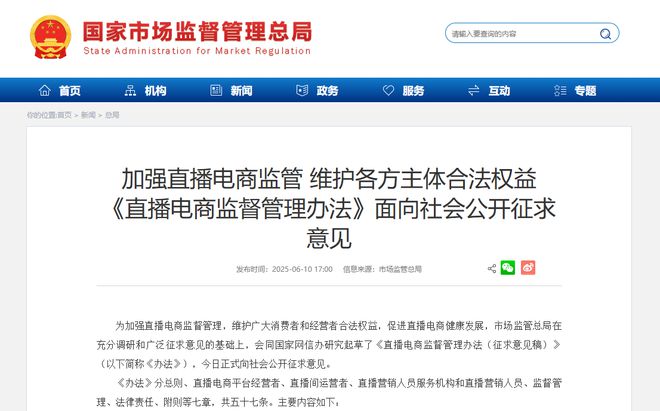
Core Viewpoint - The State Administration for Market Regulation (SAMR) is drafting a new regulation aimed at strengthening the supervision of live e-commerce, addressing issues such as false marketing and ensuring consumer rights [1][2]. Group 1: Regulatory Framework - The new regulation, titled "Live E-commerce Supervision Management Measures (Draft for Comments)," aims to clarify the legal responsibilities of various stakeholders in the live e-commerce ecosystem, including platform operators, live streamers, and marketing personnel [1][2]. - The regulation emphasizes a balanced approach between regulatory compliance and promoting industry development, focusing on problem-oriented measures to address existing issues in the live e-commerce sector [2][3]. Group 2: Responsibilities of Platform Operators - The regulation outlines specific responsibilities for platform operators, including compliance with verification, information reporting, and training mechanisms, to enhance accountability and consumer protection [3][4]. - It aims to establish a collaborative governance model that includes not only platform operators but also live streamers and service agencies, addressing the complexities and risks associated with the live e-commerce model [3]. Group 3: Implementation and Impact - The SAMR assures that the new regulation will not impose additional burdens on stakeholders, as it aligns with existing laws such as the E-commerce Law and Consumer Rights Protection Law [4]. - The regulation will incorporate a blacklist system for non-compliant entities, which is already a common practice among live e-commerce platforms [4][5].
直播电商监督管理办法公开征求意见 直播电商平台经营者将建立黑名单制度
Xin Hua Wang· 2025-08-12 05:50
Core Viewpoint - The draft regulation on live e-commerce aims to clarify the responsibilities and obligations of platform operators, enhancing supervision to protect consumer rights and promote healthy industry development [1][2][5]. Group 1: Responsibilities and Obligations - The draft specifies the responsibilities of live e-commerce platform operators in areas such as violation handling, qualification verification, information reporting, training mechanisms, hierarchical management, dynamic control, and information disclosure [1][5]. - Platform operators are required to establish comprehensive platform agreement rules, strengthen identity verification and qualification audits for live stream operators and marketing personnel, and enhance the handling of illegal activities [1][5][6]. Group 2: Industry Challenges and Regulatory Approach - The rapid growth of the live e-commerce industry has led to issues such as false marketing and counterfeit products, primarily due to inadequate responsibility enforcement among industry participants [2][3]. - The draft aims to implement the Electronic Commerce Law and other regulations, clarifying the legal responsibilities of various stakeholders, including platform operators and marketing personnel, to foster a better online trading environment [2][3]. Group 3: Regulatory Framework and Future Directions - The draft emphasizes the need for a foundational and forward-looking regulatory framework tailored to the characteristics of the live e-commerce industry, establishing basic legal responsibilities and obligations for different entities [3][4]. - It highlights the critical role of platform operators in the ecosystem, aiming to maximize regulatory efficiency by ensuring they fulfill their responsibilities and transmit compliance requirements to other stakeholders [4][5]. Group 4: Consumer Protection and Market Integrity - The draft regulation seeks to enhance product quality oversight through special inspections and stricter enforcement against false advertising, thereby maintaining fair competition and improving online product quality [5][6]. - It addresses public concerns regarding the potential burden on platform operators, clarifying that the draft aligns with existing laws and will not impose additional burdens on stakeholders [6][7].
直播电商顽疾 怎么治?
Yang Shi Wang· 2025-08-02 20:06
Core Viewpoint - The live commerce industry in China is facing significant issues, including a rise in complaints and various forms of misconduct, prompting regulatory authorities to take action [1][2]. Group 1: Industry Issues - The live commerce sector has seen a substantial increase in complaints, with 402,000 cases reported in 2024, marking a 19.3% year-on-year growth [1]. - Five major issues have been identified in the live commerce industry, with "false marketing" being the most prominent [2]. - Specific cases of misconduct include the use of pre-packaged pearls in live demonstrations and misleading consumer interactions through fake reviews [5][6]. Group 2: Regulatory Actions - The State Administration for Market Regulation (SAMR) is conducting special rectifications to address the prominent issues in live commerce [1][2]. - A new regulatory framework, the "Live Commerce Supervision Management Measures," has been drafted to clarify responsibilities among platforms, merchants, and hosts, preventing them from shifting blame [10][12]. - The measures include a "blacklist" system to prevent repeat offenders from continuing their activities under different identities [17]. Group 3: Technological and Monitoring Enhancements - The new regulations will also encompass AI-generated content and digital influencers, holding operators accountable for any violations [14]. - The SAMR plans to promote the use of product coding and establish a monitoring system to enhance regulatory capabilities in live commerce [18].


每日投资策略-20250716
Guodu Securities Hongkong· 2025-07-16 01:41
Group 1: Market Overview - The Hang Seng Index rose by 386 points or 1.6%, closing at 24,590, marking a four-day cumulative increase of 697 points or 2.9% [4][5] - The trading volume for the day was 288.4 billion HKD, with a net inflow of 3.82 billion HKD from northbound trading [4] - Major blue-chip stocks such as HSBC and Tencent saw increases of 1.1% and 3.5% respectively, while Meituan surged by 4.4% [4] Group 2: Economic Indicators - Hong Kong's overall export volume increased by 13.4% year-on-year in May, while import volume rose by 16.5% [8] - The export prices and import prices rose by 1.8% and 1.9% respectively [8] - Exports to Taiwan, Vietnam, India, and mainland China showed significant year-on-year increases of 48%, 39.5%, 37.6%, and 15.9% respectively [8] Group 3: Company-Specific Developments - QiuTai Technology plans to sell 51% of its Indian subsidiary for approximately 4.61 billion RMB, with expected net proceeds of about 3.57 billion RMB for operational funding [13] - Longfor Group reported a 31.51% year-on-year decrease in total contract sales amounting to 35.01 billion RMB in the first half of the year [14] - Air China experienced a 3.9% year-on-year increase in passenger turnover for June, with an average seat occupancy rate of 81.1% [15] Group 4: Regulatory and Policy Updates - The Hong Kong Industrial Federation proposed seven policy initiatives to develop a new industrial strategy focusing on high-end manufacturing [9] - The State Administration for Market Regulation is intensifying efforts to regulate the live e-commerce sector, aiming to address prominent issues and protect consumer rights [10] - New regulations prohibit local asset management companies from creating new hidden debts for local governments [11]
市场监管总局召开专项整治直播电商突出问题部署推进会,要求进一步加大监管执法力度,规范直播电商行业乱象,切实维护广大消费者和经营者的合法权益。
news flash· 2025-07-15 12:33
Group 1 - The State Administration for Market Regulation held a special meeting to address prominent issues in the live e-commerce sector, emphasizing the need for increased regulatory enforcement [1] - The meeting aims to standardize the live e-commerce industry and tackle its chaotic practices, ensuring the protection of consumers' and operators' legitimate rights and interests [1]
直播电商新规征求意见 剑指直播间“套路”
Xin Hua She· 2025-06-27 14:04
Core Viewpoint - The rapid development of live e-commerce in China has played a significant role in boosting consumption and promoting flexible employment, with new regulatory measures expected to further standardize the industry and enhance consumer confidence [1][6]. Industry Overview - The total number of live e-commerce related enterprises in China has approached 360,000 [3]. - The retail sales of live e-commerce are projected to reach 4.3 trillion yuan from January to November 2024 [3]. Consumer Experience Issues - The live e-commerce industry faces challenges such as poor shopping experiences due to a mix of qualified and unqualified operators, with many influencers and small businesses lacking operational, quality control, and after-sales experience [3]. - Reports indicate widespread issues including false advertising and fake reviews, with some live streams employing deceptive practices to mislead consumers [3][5]. Regulatory Developments - The State Administration for Market Regulation has drafted the "Live E-commerce Supervision Management Measures" to address existing issues, requiring operators to establish systems for product selection and error correction to ensure accurate product representation [6]. - Platforms are mandated to take action against violations, including warnings, limiting traffic, suspending broadcasts, and blacklisting severe offenders [6]. AI and Digital Influencers - The use of AI-generated digital influencers in live streams raises concerns, particularly regarding transparency, as many consumers are unaware they are interacting with AI rather than human hosts [5][8]. - The regulatory framework aims to include AI-generated content under supervision to prevent the spread of false information [6]. Future Outlook - As regulatory measures tighten, the industry is expected to undergo a reshuffle, with high-quality influencers and businesses likely to thrive while those relying on deceptive practices may be eliminated [8]. - The emphasis on building a transparent and fair trading environment is seen as essential for the maturity of the live e-commerce sector [8].
信息不对称、投诉多、退货难……多方合力让珠宝电商直播清朗健康
Zhong Guo Qing Nian Bao· 2025-06-16 23:58
Core Viewpoint - The rapid development of live e-commerce, particularly in the jewelry and jade sectors, has led to increased consumer complaints and regulatory scrutiny, highlighting the need for improved oversight and consumer protection measures [1][3][5]. Group 1: Regulatory Developments - The State Administration for Market Regulation and the National Internet Information Office have released a draft for the "Live E-commerce Supervision Management Measures," which clarifies the legal responsibilities of various stakeholders in the live e-commerce ecosystem [1][3]. - The draft emphasizes the responsibilities of live e-commerce platform operators, live room operators, marketing service agencies, and marketers, aiming to strengthen regular supervision [1][3]. Group 2: Consumer Complaints and Issues - A report indicated that live streaming sessions for jewelry and luxury goods ranked fourth in terms of consumer complaints, with issues primarily related to misleading advertising, product quality, and price deception [1]. - As of June 10, there were 5,332 complaints related to "jewelry live streaming" and 1,032 complaints for "pearl live streaming," with common issues including false advertising and refusal to process return requests [1][2]. Group 3: Industry Challenges - Many live streaming sellers are reportedly offering "e-commerce version" products, leading to a decline in product quality as sellers prioritize profit over quality [2]. - The immediacy of live streaming poses risks for consumers, as it is difficult to prove discrepancies between advertised and actual products without recorded evidence [2]. Group 4: Recommendations for Improvement - Experts suggest that e-commerce platforms should establish anti-counterfeiting mechanisms and create strict merchant admission standards to enhance consumer protection [4]. - There is a call for improved regulatory frameworks, including a unified credit record system for online operators and increased enforcement against fraudulent sellers [4][5]. - Consumers are advised to be vigilant, retain evidence of transactions, and choose reputable platforms to mitigate risks associated with impulsive purchases during live streams [5].
直播电商监督管理办法公开征求意见——为直播带货立规明矩
Jing Ji Ri Bao· 2025-06-15 22:00
Core Viewpoint - The State Administration for Market Regulation has released a draft regulation aimed at strengthening the supervision of live e-commerce, protecting consumer and operator rights, and promoting healthy industry development [1][4]. Group 1: Regulatory Framework - The draft regulation seeks to clarify the legal responsibilities and obligations of various stakeholders in the live e-commerce ecosystem, including platform operators, live room operators, marketing personnel, and service agencies [1][3]. - It emphasizes the need for platforms to implement compliance management and to establish a blacklist system to address illegal activities [2][3]. Group 2: Industry Challenges - The complexity of the live e-commerce sector, with multiple participants and extended transaction chains, poses new regulatory challenges, necessitating a robust framework to manage risks [3]. - The regulation aims to enhance the responsibilities of live room operators and marketing personnel, ensuring accurate representation of products and services to prevent misleading advertising [3]. Group 3: Stakeholder Engagement - The formulation of the regulation involved extensive consultations through written research, field studies, and expert discussions to incorporate diverse opinions and suggestions [4]. - The next steps include refining the regulation based on public feedback before its implementation to foster the healthy development of the live e-commerce industry [4].
立规明责不容直播电商野蛮生长
Guang Zhou Ri Bao· 2025-06-11 20:11
Core Viewpoint - The rapid development of live e-commerce in China has led to significant contributions to consumption and economic growth, but it is also plagued by issues such as false advertising and poor consumer trust, prompting the need for regulatory measures [1][2]. Group 1: Industry Overview - Live e-commerce retail sales in China reached 4.3 trillion yuan from January to November 2024, contributing 80% of the e-commerce sector's growth [1]. - Complaints related to live commerce reached 402,000 in 2024, marking a 19.3% year-on-year increase, with social media platforms seeing a threefold increase in complaints [1]. Group 2: Regulatory Measures - The newly drafted "Live E-commerce Supervision Management Measures" aims to address long-standing issues in the industry, including false advertising and unclear responsibilities [2]. - The measures establish a systematic responsibility framework for platforms, hosts, and merchants, requiring platforms to implement dynamic verification mechanisms and a tiered management system for high-risk live streams [2][3]. Group 3: Enforcement and Compliance - The regulations propose a blacklist system for violators, allowing for cross-platform restrictions and public disclosure of serious violations on national credit information systems [3]. - The implementation of these measures is expected to enhance regulatory effectiveness and promote a more sustainable and orderly development of the live e-commerce industry [3].
直播电商监督管理办法公开征求意见 明确责任边界 推动直播电商健康发展
Zheng Quan Ri Bao· 2025-06-11 16:56
Core Viewpoint - The National Market Supervision Administration has drafted the "Live E-commerce Supervision Management Measures (Draft for Comments)" to enhance supervision and management of live e-commerce, aiming to protect consumer and operator rights while promoting healthy industry development [1][3]. Group 1: Key Responsibilities and Obligations - The draft clarifies the responsibilities and obligations of live e-commerce platform operators, live room operators, marketing personnel, and service institutions [1][2]. - It emphasizes the need for live e-commerce platforms to establish multi-dimensional protection mechanisms for account management, transactions, product quality, and consumer rights [2]. Group 2: Regulatory Framework and Challenges - The draft aims to create a comprehensive regulatory framework that addresses the long-standing issues of unclear responsibilities and broken regulatory chains in the live e-commerce industry [2]. - It seeks to balance the interests of consumers, platforms, and MCN institutions, highlighting the complexity of regulation in this new consumption model [2]. Group 3: Future Developments - The National Market Supervision Administration plans to refine the draft based on public feedback and expedite its implementation to establish a regularized supervision system for live e-commerce [3]. - The implementation of the draft is expected to transition the industry from "wild growth" to a more regulated and quality-driven approach [3].