
数字金融

Search documents
强化重点企业金融服务 支持产业链自主可控
Zheng Quan Ri Bao· 2025-08-05 23:17
Core Viewpoint - The People's Bank of China and six other departments issued guidelines to enhance financial support for new industrialization, focusing on improving financial services for key enterprises and ensuring the resilience of industrial supply chains [1][2]. Group 1: Financial Support for Manufacturing - By 2027, a mature financial system supporting the high-end, intelligent, and green development of manufacturing will be established, with a focus on diverse financial products and effective risk prevention [2]. - The guidelines emphasize optimizing financial policy tools to support key technologies and products, particularly in sectors like integrated circuits and advanced materials, through long-term financing [2][3]. Group 2: Modern Industrial System Construction - The guidelines outline five areas for building a modern industrial system, including enhancing financial services for traditional manufacturing, supporting emerging industries, promoting green finance, and integrating digital finance with the real economy [3]. - Support for listed companies in industry consolidation and upgrading through various financial mechanisms is encouraged, alongside the expansion of technology loan offerings [3][4]. Group 3: Regional and Specialized Financial Services - Financial services will be tailored to support the flexible relocation of industries and the development of regional industrial clusters, particularly in central and northeastern China [4]. - The guidelines advocate for local banks to develop loan products that align with regional industrial characteristics, enhancing service specialization [4]. Group 4: Capacity Building and Talent Development - The guidelines stress the importance of building a capable financial support system for new industrialization, including improving internal mechanisms within financial institutions to serve the manufacturing sector [5]. - There is a call for cultivating a workforce with expertise in advanced manufacturing and related technologies to create a composite financial management and service team [5]. Group 5: Policy Coordination - Strengthening the coordination between financial policies and industrial policies is highlighted, with an emphasis on establishing mechanisms for risk prevention and policy incentives [5][6]. - The People's Bank of China and the Ministry of Industry and Information Technology will work together to implement these guidelines effectively [5].
金融活水精准滴灌实体经济
Ren Min Ri Bao· 2025-08-05 22:21
Group 1 - The production line for silicon photonic engines in Wuhan can process over 100,000 units monthly, supporting high-speed network construction essential for data centers and communication bases [1] - The production line's launch was facilitated by a loan from the Construction Bank's Wuhan branch, enabling the company to upgrade its production line with high-precision equipment [1] - The introduction of advanced equipment at Wuhan Special Industrial Pump Factory was supported by a 20 million yuan loan from Zhongbang Bank, aiding in technology research and development [1] Group 2 - As of June 30, the green loan balance in Hubei reached 222.8 billion yuan, an increase of 38.9 billion yuan since the beginning of the year [2] - Wuhan Zhongbang Bank is enhancing its support for technology finance by developing specialized credit products for tech enterprises, focusing on intellectual property and core technology [2] - The Construction Bank's "Shan Ying Loan" product aims to assist small agricultural enterprises and individual businesses facing funding shortages in rural areas [2] Group 3 - The Agricultural Bank of China's Jingmen branch provided a 4 million yuan loan to Kang Le Nursing Home to support its expansion and meet the growing demand for elderly care services [3] - The focus on five key financial areas—technology finance, green finance, inclusive finance, elderly finance, and digital finance—is crucial for supporting high-quality economic development [3]




为推进新型工业化提供高质量金融服务
Ren Min Ri Bao· 2025-08-05 22:21
Core Viewpoint - The People's Bank of China and several government departments have jointly issued guidelines to enhance financial support for new industrialization, aiming to deepen financial supply-side structural reforms and promote high-quality financial services for the development of new productive forces by 2027 [1][2][3]. Group 1: Financial Support Measures - The guidelines propose targeted support measures for key technology products and breakthroughs, enhancing financial services for key enterprises in the industrial chain, and improving the resilience of supply chains [2][3]. - Development of technology finance, green finance, and digital finance is emphasized, with a focus on supporting traditional industries' transformation and nurturing emerging industries [2][3]. Group 2: Structural Reforms - The guidelines aim to optimize the funding supply structure, providing loans, bonds, and equity financing to support new industrialization [3]. - A comprehensive, differentiated, and specialized financial service system is to be established, with a focus on supporting core technology breakthroughs and the development of emerging industries [3]. Group 3: Regional and Cross-Border Financial Services - The guidelines include mechanisms for credit management and financial products to support the transfer of industries to central and western regions, promoting the aggregation of financial resources towards industrial clusters [2][3]. - Initiatives to facilitate cross-border financial services, including trade settlement and fund management, are also outlined to support reasonable industrial layout and expansion [2].
湖北做好金融“五篇大文章” 金融活水精准滴灌实体经济
Ren Min Ri Bao· 2025-08-05 21:58
Group 1 - The production line for silicon photonic engines in Wuhan can process over 100,000 units monthly, supported by a loan from China Construction Bank for equipment upgrades [1] - Wuhan Special Industrial Pump Factory has introduced advanced equipment and received a 20 million yuan loan from Zhongbang Bank for technology research and development [1] - The synergy between technology and finance is crucial for alleviating financing difficulties for tech enterprises and driving high-quality economic development in Hubei Province [1] Group 2 - As of June 30, the green loan balance in Hubei reached 222.8 billion yuan, an increase of 38.9 billion yuan since the beginning of the year [2] - Wuhan Zhongbang Bank is enhancing its support for tech finance by developing specialized credit products for innovative enterprises [2] - Agricultural Bank of China in Hubei is focusing on the "Agricultural Bank Elderly Care" service brand to meet the needs of the aging population [2] Group 3 - The Kangle Nursing Home in Jingmen, Hubei, received a 4 million yuan loan from Agricultural Bank of China to expand its facilities to meet growing demand [3] - The focus on technology finance, green finance, inclusive finance, elderly care finance, and digital finance is essential for supporting high-quality development of the real economy [3]
加快券商数字金融建设 投身行业智能发展变革 ——专访浙商证券党委书记、总裁钱文海
Zheng Quan Shi Bao· 2025-08-05 18:59
Core Viewpoint - The company is committed to embracing the trend of digital finance and intelligent development in the securities industry, contributing to the healthy and stable development of the capital market [1] Group 1: Digital Finance Development - The company identifies three dimensions for developing digital finance capabilities: enhancing the digitalization level of financial institutions, strengthening digital financial regulatory capabilities, and aligning with the trends of technological revolution [2] - A dedicated Financial Technology Committee has been established to implement over ten specific measures aimed at transitioning from digitalization to intelligence [2] Group 2: Digital Financial Service System - The company aims to innovate and upgrade its digital financial service system, including accelerating the development of digital financial products and creating a leading one-stop comprehensive securities financial service platform for institutional clients [3] - The company is focusing on deepening AI technology applications across various scenarios, including intelligent investment research and advisory services [3] Group 3: Regulatory Technology System - The company is constructing an industry-leading regulatory technology system to ensure its internal control digitalization exceeds regulatory standards and requirements [3] Group 4: Trends in the Securities Industry - The digital finance construction in the securities industry is showing four major trends: productization, socialization, ecological integration, and strategic elevation [4] - Productization reflects the innovation of technology-driven financial products, while socialization indicates a revolution in customer interaction in retail scenarios [4] Group 5: Investment in Technology - The company has allocated 417 million yuan for information technology investment in 2024, marking a new high in recent years [5] - The company has completed the construction of its information system and digital capabilities, entering a new phase of intelligent transformation [5] Group 6: Risk Management - The company has established a comprehensive risk management system supported by a risk data marketplace and multiple risk control models [5] - The focus is on enhancing the foundational capabilities of the risk data marketplace to support high-quality data resources for comprehensive risk system construction [5] Group 7: Commitment to Digital Finance - The company will continue to deepen its technology strategy, aiming to become a technology-driven securities firm that enhances service quality and risk management capabilities [6]

中国人民银行等七部门联合印发《关于金融支持新型工业化的指导意见》 强化重点企业金融服务 支持产业链自主可控
Zheng Quan Ri Bao· 2025-08-05 15:44
Core Viewpoint - The People's Bank of China and several government departments have issued guidelines to enhance financial support for new-type industrialization, focusing on the integration of finance and manufacturing to foster technological innovation and sustainable development [1][2]. Financial Support for Industrialization - The guidelines emphasize the importance of financial services for the real economy and risk prevention, aiming to deepen financial supply-side structural reforms and enhance the synergy between industrial and financial policies [1][4]. - By 2027, a mature financial system supporting the high-end, intelligent, and green development of manufacturing is expected, with increased access to various financial instruments for manufacturing enterprises [1][2]. Enhancing Technological Innovation and Supply Chain Resilience - Financial policies will be optimized to support key technologies and products, particularly in critical sectors such as integrated circuits and medical equipment, through long-term financing [2][3]. - The guidelines encourage collaboration between financial institutions and technology service providers to facilitate diverse financing models and accelerate the transformation of technological achievements [2]. Modern Industrial System Construction - The guidelines outline five key areas for building a modern industrial system, including optimizing financial services for traditional manufacturing, enhancing the quality of technology finance, promoting green finance, and deepening financial services for industrial chains [2][3]. Industry Integration and Upgrading - Support for listed companies to engage in industry consolidation and upgrading through various financial mechanisms is highlighted, along with the need for diversified technology finance service models [3][4]. - Financial institutions are encouraged to utilize advanced technologies like big data and AI to improve service efficiency for manufacturing, especially for small and medium-sized enterprises [3][4]. Regional and Cross-Border Financial Services - The guidelines stress the importance of flexible financial services to support industrial transfer and regional optimization, particularly in less developed areas [3][4]. - Enhancements in cross-border financial services are also emphasized to expand high-level open development spaces for manufacturing [3]. Capacity Building for Financial Support - Financial institutions are urged to integrate support for new-type industrialization into their long-term strategies and improve the coordination of various financial tools [4]. - The guidelines call for the cultivation of a talent pool with expertise in advanced manufacturing and related technologies to strengthen financial management and services [4]. Implementation and Collaboration - The People's Bank of China and relevant departments will work together to ensure the implementation of these guidelines, aiming to provide robust financial support for advancing new-type industrialization [5].
金融支持新型工业化路径明确!优化资金供给结构 提供贷款、债券、股权等融资支持
Mei Ri Jing Ji Xin Wen· 2025-08-05 14:20
Core Viewpoint - The People's Bank of China and seven other departments have jointly issued guidelines to enhance financial support for new industrialization, aiming to provide high-quality financial services to accelerate the development of new productive forces while preventing excessive competition [1][2]. Financial Support Structure - The guidelines emphasize optimizing the funding supply structure at the macro level, providing loans, bonds, and equity financing to support new industrialization [1][2]. - By 2027, the financial system supporting the high-end, intelligent, and green development of the manufacturing industry is expected to be fundamentally mature, with a richer array of products and improved service adaptability [2][3]. Technology and Innovation Financing - The guidelines advocate for the introduction of long-term funds and patient capital to accelerate the transformation of technological achievements, encouraging collaboration between financial institutions and technology intermediaries [3][4]. - A "technology-industry finance integration" initiative is proposed to enhance investment in hard technology and support small and medium-sized enterprises in going public [3][4]. Supply Chain and Regional Financial Services - The guidelines call for improved financial services for supply chains, encouraging financial institutions to provide financing services based on "data credit" and "physical credit" for small and medium-sized enterprises [3][4]. - Financial institutions are urged to optimize resource allocation to support the transfer of industries to central and western regions, enhancing information sharing and service coordination [4][5]. Cross-Border Financial Services - The guidelines aim to enhance the convenience of cross-border financial services and expand the scope of high-level bilateral open development [5][6]. - Support for small and medium-sized enterprises in overseas operations is emphasized, along with the facilitation of cross-border fund pooling and trade settlement [5][6]. Long-term Mechanism for Financial Support - The guidelines propose strengthening the capacity and long-term mechanisms for financial services, ensuring a reasonable investment ratio in the manufacturing sector [6][7]. - Financial institutions are encouraged to develop differentiated credit policies tailored to specific industries and stages of enterprise growth [6][7].
银行业助力企业推进数智化转型
Zhong Guo Jing Ying Bao· 2025-08-05 13:44
Core Viewpoint - The banking industry is accelerating the layout of scenario-based financial services, aiming to build a new service ecosystem by deeply embedding into enterprise operational scenarios [1] Group 1: Service Development - China Postal Savings Bank launched the "Postal Financial Management +" series of services to assist enterprises in establishing a "system collaboration" in an efficient manner [1] - The "Postal Financial Management +" integrates various services such as treasury cloud, enterprise collection, payment, operation, connection, and management, providing a systematic service for financial funds, assets, and resource coordination, serving over 200,000 enterprise clients [2] - The service features inclusiveness, intelligence, and openness, innovatively creating a product system that meets the full lifecycle needs of enterprises, showcasing the responsibility of state-owned banks in financial service [2] Group 2: Digital Transformation - In the context of enterprise digital transformation, banks are accelerating the construction of intelligent financial asset management systems [3] - A certain joint-stock bank in Guangzhou launched a "financial asset management cloud product system" to assist enterprises in digital transformation, optimizing financial management processes and enhancing operational efficiency [3] - Another joint-stock bank in Shanghai focuses on treasury system construction as a breakthrough for financial management digital transformation, helping state-owned enterprises enhance efficient and secure fund management [3] Group 3: Challenges and Strategic Focus - Enterprises face three unavoidable challenges during digital transformation: data silos, efficiency bottlenecks, and security risks, which necessitate the development of a financial management digital service system by banks [4] - The banking service model has shifted to focus on the ecological scenarios of enterprise operations, requiring a customer demand-oriented approach and breaking down product chain barriers [4]

重磅!七部门印发,大利好!
Zhong Guo Ji Jin Bao· 2025-08-05 12:00
Core Viewpoint - The People's Bank of China and six other departments have jointly issued the "Guiding Opinions on Financial Support for New-Type Industrialization," which aims to enhance financial support for key industries and promote technological innovation and industrial upgrading [1][12]. Group 1: Financial Support for Key Industries - Financial institutions are encouraged to provide medium- and long-term financing for key manufacturing sectors such as integrated circuits, industrial mother machines, medical equipment, servers, and advanced materials [5][14]. - The policy aims to enhance the financing accessibility for small and micro enterprises in the manufacturing sector [6][20]. Group 2: Support for Emerging Industries - The guidance supports financing for emerging industries like new-generation information technology, smart vehicles, renewable energy, and biomedicine in multi-tiered capital markets [7][18]. - It emphasizes the importance of long-term capital and patient investment to accelerate the transformation of technological achievements into commercial applications [15][18]. Group 3: Enhancing Financial Services for Traditional Manufacturing - Financial institutions are directed to optimize credit policies to support the high-end, intelligent, and green development of traditional manufacturing [17][24]. - The guidance encourages the use of diverse financial tools, including loans, bonds, and insurance, to support the digital transformation of manufacturing enterprises [17][24]. Group 4: Green Finance and Sustainable Development - The policy promotes the establishment of a financial standard system to support the green and low-carbon transformation of high-carbon industries [19][26]. - It encourages the development of green financial products and the application of green credit and bonds in manufacturing [19][26]. Group 5: Strengthening Digital Financial Services - Financial institutions are urged to leverage technologies like big data and blockchain to enhance service efficiency for manufacturing, especially for small and medium-sized enterprises [20][21]. - The guidance supports the construction of digital financial service platforms to facilitate financing and cash management for the manufacturing sector [20][21]. Group 6: Policy Coordination and Risk Management - The document emphasizes the need for coordination between financial and industrial policies to create a supportive environment for new-type industrialization [26][27]. - It calls for the establishment of a joint risk assessment mechanism to monitor and manage financial risks associated with industrial projects [27][28].
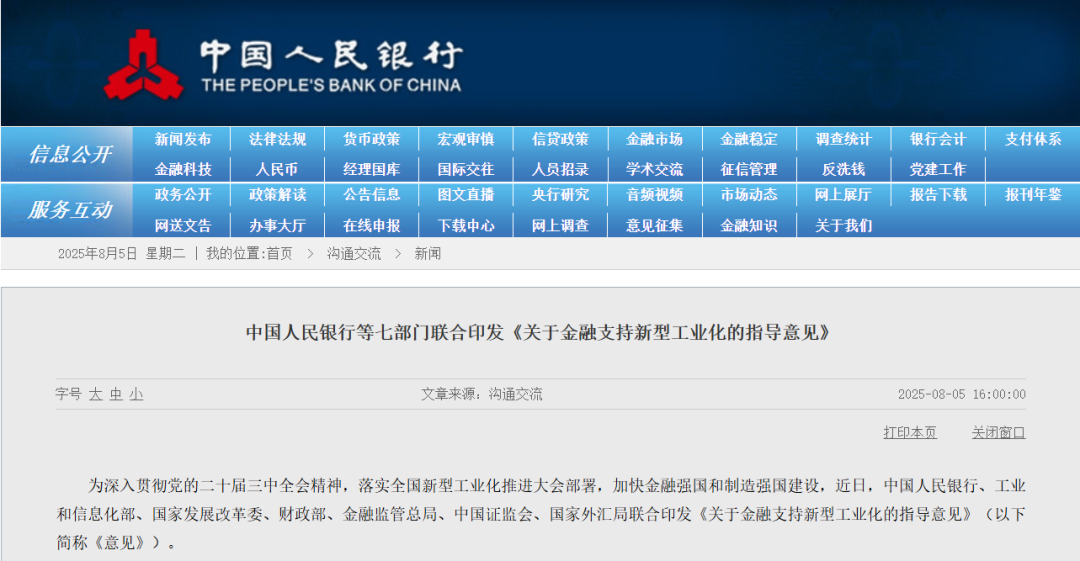
七部门印发金融支持新型工业化指导意见
Zhong Guo Xin Wen Wang· 2025-08-05 09:54
原标题:七部门联合印发《关于金融支持新型工业化的指导意见》 《意见》聚焦新型工业化重大战略任务,以需求牵引深化金融供给侧结构性改革,强化产业政策和金融 政策协同,为推进新型工业化、加快发展新质生产力提供高质量金融服务,坚持分类施策、有扶有控, 推动产业加快迈向中高端,防止"内卷式"竞争。到2027年,支持制造业高端化智能化绿色化发展的金融 体系基本成熟,服务适配性有效增强。 《意见》对照新型工业化重点领域,提出针对性支持举措。优化金融政策工具支持关键技术产品和攻 关,多渠道为科技成果转化引入耐心资本,强化产业链重点企业综合金融服务,提升产业科技创新能力 和产业链供应链韧性。发展科技金融、绿色金融、数字金融等五篇大文章,深化基于"数据信用"和"物 的信用"的产业链金融服务模式,支持传统产业转型升级和培育壮大新兴产业。健全中西部承接产业转 移有关授信管理机制和金融产品服务,推动金融资源向产业集群聚集和专业化发展,推进贸易结算、资 金管理、投融资等一系列跨境金融服务便利化举措,支持产业合理布局和拓展发展空间,促进做强国内 大循环。 《意见》加强金融服务能力和长效机制建设,促进保持制造业合理比重投入。健全金融机构服务 ...