全球安全倡议

Search documents
新时代的中国军控、裁军与防扩散
Xin Hua She· 2025-11-27 02:30
Core Viewpoint - The white paper titled "China's Arms Control, Disarmament and Non-Proliferation in the New Era" emphasizes China's commitment to peace, development, and international cooperation in arms control and disarmament, while addressing the complex global security landscape and advocating for a multilateral approach to security governance [4][5]. Group 1: International Security and Arms Control Situation - The current international security landscape is characterized by increased geopolitical tensions, arms races, and regional conflicts, necessitating a renewed focus on multilateral arms control efforts [6][7]. - Major powers are competing for strategic advantages, leading to heightened military expenditures and regional instability, particularly in the Asia-Pacific region [6][7]. - The erosion of international arms control frameworks due to unilateral actions by certain countries poses significant challenges to global security [7]. Group 2: China's Policy Position on Arms Control - China's arms control policy is rooted in its cultural values of peace and cooperation, aiming to establish a world of lasting peace and universal security [9][10]. - The country advocates for a new type of international relations based on mutual respect, fairness, and win-win cooperation, emphasizing the importance of global governance [9][10]. - China maintains a defensive national defense policy, rejecting hegemonism and arms races, while promoting transparency in defense spending [10][11]. Group 3: Constructive Participation in International Arms Control - China actively engages in multilateral arms control processes, particularly in nuclear, biological, and chemical weapons, and adheres to international treaties [13][14]. - The country promotes the principle of no first use of nuclear weapons and advocates for nuclear disarmament and non-proliferation [15][19]. - China supports the establishment of a fair and just international arms control system, opposing double standards and unilateral actions that undermine global security [11][24]. Group 4: Emerging Areas of International Security Governance - China emphasizes the importance of governance in emerging security domains such as outer space, cybersecurity, and artificial intelligence, advocating for international cooperation and the establishment of norms [39][40]. - The country opposes the militarization of outer space and promotes the peaceful use of space, calling for comprehensive governance frameworks [39][40]. - China is committed to enhancing global biosecurity governance and actively participates in international efforts to prevent the misuse of biological technologies [30][31]. Group 5: Strengthening Non-Proliferation and Peaceful Use of Technology - China advocates for the peaceful use of nuclear energy and opposes the politicization of nuclear cooperation, supporting the rights of developing countries to access nuclear technology [27][28]. - The country emphasizes the need for a balanced approach to non-proliferation, urging all nuclear-armed states to commit to disarmament and non-proliferation obligations [24][25]. - China actively participates in international discussions on arms trade and supports measures to prevent the illicit transfer of conventional weapons [37][38].
中华人民共和国和汤加王国联合声明
Ren Min Ri Bao· 2025-11-26 22:21
Core Viewpoint - The state visit of King Tupou VI of Tonga to China from November 21 to 27, 2025, signifies a deepening of bilateral relations and cooperation between China and Tonga, focusing on mutual respect and development, as well as addressing international and regional issues of common concern [1][2]. Group 1: Bilateral Relations - Both parties highly evaluate the long-term development of bilateral relations over the past 27 years and recognize the significant opportunities for further development in the new era, which will benefit both peoples and promote peace, stability, and development in the Pacific island region [1]. - Tonga congratulated China on its significant achievements during the 14th Five-Year Plan and expressed confidence that the 15th Five-Year Plan will provide new strategic guidance for modernization and development opportunities for all countries, including Tonga [1]. Group 2: Diplomatic Engagement - Both sides agreed to continue leveraging high-level diplomatic engagement to enhance bilateral relations, increasing exchanges across various levels and sectors, including government, legislative bodies, political parties, and local governments [2]. - The two parties reaffirmed their commitment to enhancing political mutual trust and supporting each other's core interests, with Tonga reiterating its adherence to the One China principle [2]. Group 3: Economic Cooperation - Both parties celebrated the signing of the Economic Partnership Framework Agreement, looking forward to mutually beneficial outcomes from negotiations, and China welcomed more quality products from Tonga in its market [3]. - They agreed to strengthen cooperation in various sectors, including trade, investment, agriculture, infrastructure, and clean energy, aligning the Belt and Road Initiative with Tonga's national development strategies [2][3]. Group 4: Social and Cultural Exchange - Both sides agreed to expand cooperation in education, healthcare, tourism, sports, youth, media, and local exchanges to enhance mutual understanding [3]. - China will continue to send medical teams to Tonga and support Chinese language education, as well as provide scholarships and training opportunities [3]. Group 5: Environmental Cooperation - Both parties recognized climate change as a global challenge and committed to multilateralism, aiming to implement the Paris Agreement effectively [4]. - China expressed willingness to cooperate on green and low-carbon initiatives, including expanding collaboration on wind power projects in Tonga [4]. Group 6: Global Governance - Tonga supports President Xi Jinping's global governance initiative, emphasizing its relevance in promoting a fair and reasonable global governance system [4][5]. - Both parties agreed to strengthen communication and cooperation in international and regional affairs, advocating for shared values of peace, development, fairness, justice, democracy, and freedom [5].
中华人民共和国和汤加王国联合声明(全文)
Xin Hua She· 2025-11-26 08:37
Core Points - The visit of King Tupou VI of Tonga to China from November 21 to 27, 2025, was initiated by an invitation from President Xi Jinping, highlighting the importance of bilateral relations and cooperation under the Belt and Road Initiative [2][3] - Both parties emphasized the significant opportunities for further development in China-Tonga relations, which have progressed over 27 years, aiming to enhance mutual respect and comprehensive strategic partnership [2][3] - Tonga congratulated China on its achievements during the 14th Five-Year Plan and expressed confidence that the 15th Five-Year Plan will provide new opportunities for development, including for Tonga [2] Bilateral Cooperation - The leaders agreed to enhance diplomatic relations through various levels of engagement, including government, legislative, and local exchanges, while sharing governance and development experiences [3] - Both sides reaffirmed their commitment to mutual political trust and respect for each other's core interests, with Tonga reiterating its adherence to the One China principle [3] - The signing of the Economic Partnership Framework Agreement aims to promote mutually beneficial outcomes and increase the presence of Tongan products in the Chinese market [4] Sectoral Collaboration - There is a mutual agreement to expand cooperation in education, healthcare, tourism, sports, youth, media, and local exchanges, with a focus on enhancing people-to-people connections [4] - China will continue to send medical teams to Tonga and support Chinese language education, while also providing scholarships and training opportunities [4] - Both nations agreed to collaborate on ocean-related initiatives, including marine observation, disaster prevention, and blue economy development [4] Climate Change and Global Governance - Both parties recognized climate change as a global challenge and committed to multilateral cooperation in line with the Paris Agreement [5] - China expressed willingness to align with Tonga's energy roadmap and expand cooperation in green and low-carbon initiatives [5] - Tonga supported China's global governance initiatives, emphasizing the need for a fair and just global governance system, and both sides agreed to strengthen communication in international and regional affairs [6]
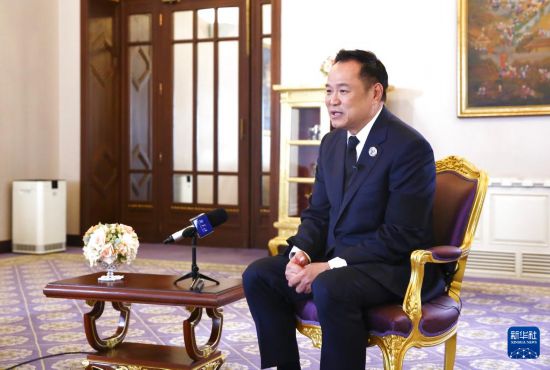
高端访谈丨愿泰中关系永续友好——访泰国总理阿努廷·参威拉军
Xin Hua She· 2025-11-26 06:52
Group 1 - The core message emphasizes the deep-rooted friendship and historical ties between Thailand and China, marking the 50th anniversary of diplomatic relations as a significant milestone [2][3] - Thai Prime Minister Anutin Charnvirakul highlighted the recent state visit of the Thai King to China as a new chapter in bilateral relations, showcasing the mutual respect and friendship between the two nations [2] - The Chinese side has committed to expanding imports of high-quality Thai agricultural products and enhancing cultural exchanges, reflecting a mutually beneficial and forward-looking relationship [2][3] Group 2 - Since taking office in September, Anutin has actively participated in China-related activities, reinforcing the concept of "Thailand and China as one family" and ensuring prompt and sincere communication between the two countries [3] - The cooperation between Thailand and China has yielded fruitful results in trade and cultural sectors, with Thailand receiving support from China in high-speed rail technology and infrastructure development [3] - Anutin expressed interest in exploring further cooperation in technology, particularly in disaster management, logistics, online education, and artificial intelligence, which could benefit the Thai populace [3] Group 3 - Thailand, as the current co-chair of the Lancang-Mekong Cooperation, maintains strong collaborative relationships in various sectors, including industry, energy, and agriculture, contributing to global food security [4] - The Thai government is actively combating cybercrime, particularly online fraud, through close cooperation with domestic and international partners, emphasizing a zero-tolerance policy towards such criminal activities [4] - Anutin expressed heartfelt sentiments about the friendship between the Thai and Chinese peoples, highlighting their cultural and traditional connections and wishing for the continued prosperity of both nations [4]

驻几内亚比绍大使杨仁火同几比总统恩巴洛共同出席援几比安检设备交接仪式
Shang Wu Bu Wang Zhan· 2025-11-25 05:09
Group 1 - The core event is the handover ceremony of modern security inspection equipment from China to Guinea-Bissau, attended by Chinese Ambassador Yang Renhuo and President Embalo [1][2] - The modern security equipment is seen as a significant step in implementing global security initiatives and deepening the friendship between China and Guinea-Bissau [2] - Ambassador Yang emphasized the importance of aligning China's 14th Five-Year Plan with Guinea-Bissau's National Development Ten-Year Plan to enhance practical cooperation between the two countries [2] Group 2 - President Embalo expressed heartfelt gratitude for China's valuable assistance, highlighting the equipment as a symbol of the deep friendship between the two nations and its significant role in improving aviation security in Guinea-Bissau [2] - The handover included the signing of a certificate by Ambassador Yang and Guinea-Bissau's Minister of Transport, Barbeiro, followed by a ribbon-cutting ceremony for the equipment's activation [2] - President Embalo showed interest in observing the operation of the security equipment, praising its precision and advanced technology [2]

学习贯彻党的二十届四中全会精神丨“十五五”时期是承前启后、继往开来的重要时期
Ren Min Ri Bao· 2025-11-24 02:23
Core Viewpoint - The "15th Five-Year Plan" period is crucial for achieving basic socialist modernization, serving as a transitional phase that connects past achievements with future goals [1] Group 1: Economic and Social Development - Achieving economic and social development during the "15th Five-Year Plan" is significant for advancing Chinese-style modernization in a phased manner [3] - The plan emphasizes the importance of continuous efforts from the "14th Five-Year Plan" to the "16th Five-Year Plan" to ensure a solid foundation for modernization [3] - The current international environment presents both opportunities and challenges, necessitating a focus on self-reliance and strategic determination [4] Group 2: Adapting to Domestic Changes - The transition from a middle-income to a middle-developed country is a key phase, with economic transformation revealing new characteristics [5] - The domestic market's role is increasingly prominent, with a shift towards optimizing both incremental and stock resources [5] - The aging population and regional demographic shifts will significantly impact economic and social development [5] Group 3: Strengthening Foundations for Modernization - The "15th Five-Year Plan" is a critical period for consolidating and expanding advantages while addressing bottlenecks and weaknesses [6] - The plan aims to leverage China's economic resilience, large market, complete industrial system, and rich talent resources to enhance development [7] - Addressing key bottlenecks in technology, industry, and financial risks is essential for high-quality development [8] Group 4: Ensuring Progress in Modernization - By 2035, achieving a per capita GDP at the level of middle-developed countries is a key indicator of modernization [10] - The focus will be on enhancing quality and efficiency while maintaining reasonable economic growth [10] - The development of a modern industrial system and fostering innovation are critical for achieving strategic goals [11] Group 5: Green Transformation and Sustainability - Green development is a defining characteristic of Chinese-style modernization, with a commitment to peak carbon emissions by 2030 and a reduction of greenhouse gases by 7%-10% by 2035 [13] - The plan aims to integrate carbon reduction with economic growth, promoting a low-carbon circular economy [13] Group 6: Enhancing National Strength - The "15th Five-Year Plan" emphasizes the need to strengthen both hard and soft power, enhancing China's global influence [14] - The plan includes initiatives for international cooperation and participation in global governance [14] Group 7: Development and Security - The integration of development and security is essential, with a focus on ensuring safety in key areas while promoting high-quality development [15] - Strengthening national security capabilities and improving public safety governance are priorities [15]
“十五五”时期在基本实现社会主义现代化进程中具有承前启后的重要地位(学习贯彻党的二十届四中全会精神)
Ren Min Ri Bao· 2025-11-23 22:20
我们党的初心使命是为中国人民谋幸福,为中华民族谋复兴。建党百余年来,党团结带领人民所进行的 一切奋斗,就是为了把我国建设成为现代化强国,让中华民族巍然屹立于世界民族之林。新民主主义革 命时期,经过浴血奋战,实现了民族独立、人民解放,建立了新中国,为现代化建设创造了根本社会条 件。社会主义革命和建设时期,确立了社会主义基本制度,提出努力把我国逐步建设成为一个具有现代 农业、现代工业、现代国防和现代科学技术的社会主义强国。改革开放和社会主义现代化建设新时期, 我们党制定了到21世纪中叶分三步走、基本实现社会主义现代化的发展战略。党的十八大以来,中国特 色社会主义进入新时代,在以习近平同志为核心的党中央坚强领导下,我们全面建成小康社会、实现第 一个百年奋斗目标,迈上了全面建设社会主义现代化国家新征程,正在向第二个百年奋斗目标进军。 "十五五"时期是承前启后、继往开来的重要时期,我们要乘势而上、奋力开创中国式现代化建设新局 面,为基本实现社会主义现代化奠定更加坚实的基础。 (一)做好"十五五"时期经济社会发展工作,对于分阶段有步骤推进中国式现代化意义重大。科学制定 和接续实施五年规划,是我们党治国理政的重要经验,是中 ...
支持非洲现代化合作倡议
Xin Hua She· 2025-11-23 13:39
Core Viewpoint - The "Support for African Modernization Cooperation Initiative" was jointly launched by the governments of China and South Africa during the G20 summit, aiming to assist in the implementation of the African Union's Agenda 2063 and its core visions, while promoting sustainable development in Africa [1][2]. Group 1: Initiative Overview - The initiative emphasizes the importance of modernization as a shared goal and an inalienable right for all nations, calling for international support for Africa's sustainable development [1]. - It highlights China's commitment to global development, referencing President Xi Jinping's previous actions to support African industrialization and the establishment of zero-tariff measures for 53 African countries [2]. Group 2: Cooperation Principles - The initiative calls for adherence to principles such as fairness, openness, people-centered approaches, inclusivity, ecological friendliness, and peace and security in supporting Africa's modernization efforts [4][5]. Group 3: Key Areas of Cooperation - Support for Africa's exploration of modernization paths that align with its unique cultural and developmental needs, advocating for a collaborative approach led by African nations [6]. - Emphasis on enhancing technical assistance to African countries and supporting infrastructure development plans, which are crucial for Africa's integration and industrialization [7]. - Encouragement for international cooperation in green infrastructure and renewable energy projects to ensure sustainable development in Africa [7][8]. - Support for increasing agricultural productivity and health initiatives in Africa, including funding for local pharmaceutical industries and health systems [8][9]. - Promotion of cultural exchange and educational cooperation to foster mutual understanding and respect among civilizations [10][11].
王毅表态:3个绝不允许
Zhong Guo Ji Jin Bao· 2025-11-23 09:06
Core Points - The first strategic dialogue between China and Tajikistan was held, focusing on deepening mutual cooperation and implementing the consensus reached by the leaders of both countries [1][4] - China aims to enhance the comprehensive strategic partnership with Tajikistan, emphasizing high-quality development and the Belt and Road Initiative [1][2] Group 1: Strategic Cooperation - Both countries agreed to establish a strategic dialogue mechanism to strengthen communication and mutual trust in response to new challenges and risks [2][3] - China expressed unwavering support for Tajikistan's development path and national security measures, opposing external interference in Tajikistan's internal affairs [2][4] Group 2: Economic and Cultural Collaboration - The dialogue emphasized the need to enhance economic and trade cooperation, including increasing imports of high-quality Tajik agricultural products and encouraging Chinese investments in Tajikistan [3][4] - Cultural exchanges will be promoted through institutions like Confucius Institutes and health initiatives, aiming to strengthen people-to-people ties [3][4] Group 3: Security and Multilateral Cooperation - Both nations committed to strengthening security cooperation to address various risks and challenges, including terrorism [3][5] - China supports Tajikistan's greater role in international platforms and collaboration within organizations like the Shanghai Cooperation Organization [3][5]
王毅表态:3个绝不允许
中国基金报· 2025-11-23 09:00
Core Viewpoint - The strategic dialogue between China and Tajikistan aims to deepen mutual cooperation and implement the consensus reached by the leaders of both countries, marking a new phase in their bilateral relations [2][4]. Group 1: Strategic Cooperation - China and Tajikistan are described as good friends and partners, with their relationship continuously improving under the strategic guidance of their leaders [4]. - The two countries have held two meetings this year, which have led to new deployments for bilateral relations [4]. - China expresses its commitment to support Tajikistan's development path that aligns with its national conditions and to oppose any external interference in Tajikistan's internal affairs [6][8]. Group 2: Economic and Trade Relations - Both parties aim to enhance the scale of economic and trade cooperation, utilizing platforms like the China-Tajikistan intergovernmental economic cooperation committee [7]. - China is willing to increase imports of high-quality agricultural products from Tajikistan and encourage Chinese enterprises to invest in Tajikistan [7]. Group 3: Cultural and Human Exchange - The two countries plan to enhance cultural exchanges through institutions like Confucius Institutes and health initiatives, aiming to boost local cooperation and friendship [7]. Group 4: Security Collaboration - China and Tajikistan recognize their shared security interests and aim to jointly address various risks and challenges, including terrorism [8]. Group 5: Multilateral Cooperation - China supports Tajikistan's greater role in international platforms like the United Nations and aims to strengthen collaboration within the Shanghai Cooperation Organization and China-Central Asia mechanisms [8].