合规管理

Search documents
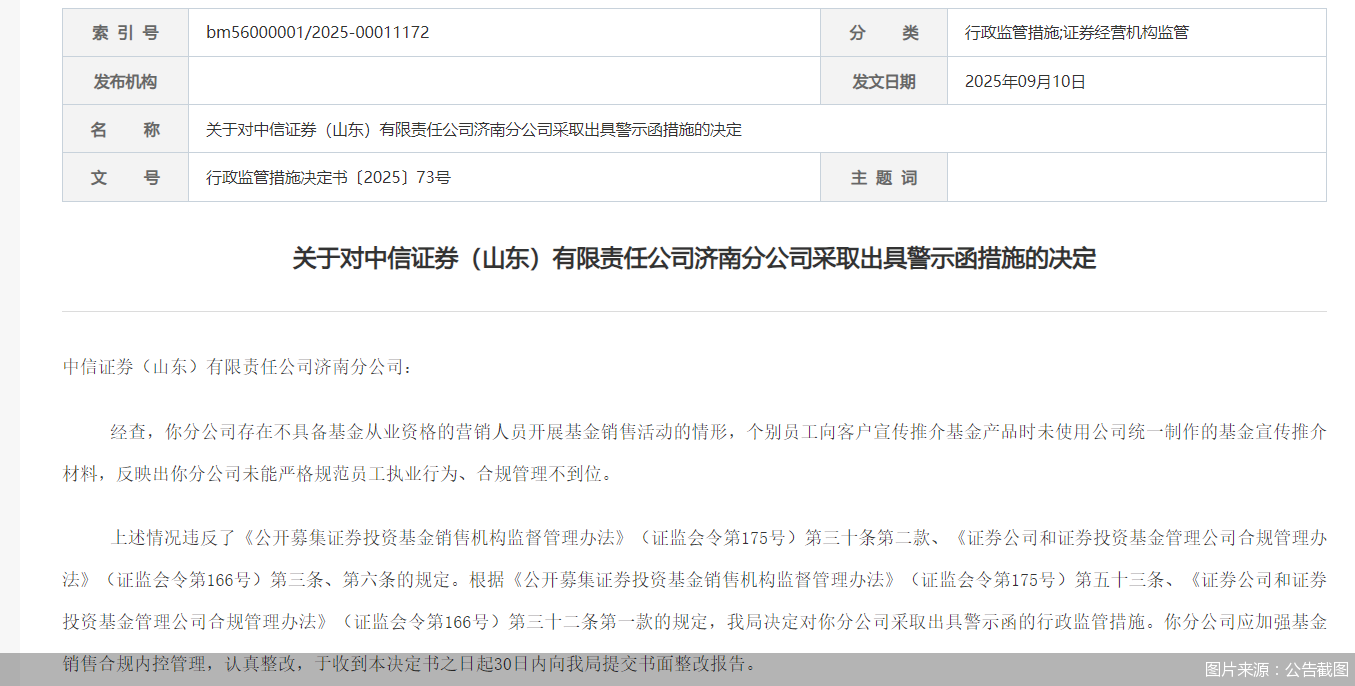
因未能严格规范员工执业行为等问题,中信证券(山东)济南分公司被监管出具警示函
Bei Jing Shang Bao· 2025-09-24 09:56
Group 1 - The Shandong Securities Regulatory Bureau announced that CITIC Securities (Shandong) Co., Ltd. Jinan Branch had marketing personnel without fund qualification engaging in fund sales activities, indicating a lack of compliance management [1] - The branch failed to use the company's standardized promotional materials when promoting fund products, reflecting inadequate employee conduct regulation [1] - As a result of these violations, the Shandong Securities Regulatory Bureau decided to issue a warning letter as an administrative regulatory measure against CITIC Securities (Shandong) Co., Ltd. Jinan Branch [1] Group 2 - Wei Yifan, during his tenure at CITIC Securities (Shandong) Co., Ltd. Jinan Branch, engaged in fund sales activities before obtaining the necessary qualifications and did not use the company's standardized promotional materials [1] - The Shandong Securities Regulatory Bureau also issued a warning letter as an administrative regulatory measure against Wei Yifan for these actions [1]


【锋行链盟】纳斯达克IPO企业VIE架构设计重点
Sou Hu Cai Jing· 2025-09-23 16:49
Core Design Logic - The essence of the VIE structure is to replace equity control with contractual control, addressing two types of contradictions [2] - The VIE structure achieves actual control and financial consolidation of the OPCO through a chain of entities: overseas listing entity → overseas holding layer → domestic WFOE → contractual control of domestic OPCO [2] Key Layer Design - The VIE structure typically includes 4-5 layers, with each layer's registration location, function, and design points precisely matching the objectives such as listing, holding, tax optimization, and compliance [3] - The overseas listing entity is usually a Cayman Islands company, while the overseas holding layer may be a BVI or Cayman intermediary company [3] Functional Design - The Cayman company is preferred for overseas listing due to no corporate income tax and a mature legal system allowing for "dual-class shares" [4] - The BVI company serves as a holding platform for founders, providing privacy and tax benefits [4] - The Hong Kong company acts as an intermediary layer, requiring substantial operations to avoid being classified as a "shell company" [4] Agreement Control System - The contractual control is the "soul" of the VIE structure, requiring 5-7 core agreements to ensure decision-making control, profit transfer, and risk isolation [6] - Key agreements include exclusive technology/service agreements, equity pledge agreements, voting rights entrustment agreements, and exclusive purchase rights agreements [6][8][10][12] Compliance and Risk Prevention - The compliance of the VIE structure directly impacts the ability to pass NASDAQ's listing review and ongoing compliance [18] - The WFOE must have a business scope closely related to the OPCO to avoid being classified as a "shell company" [18] - The OPCO must maintain an "internal capital control" structure to avoid triggering foreign investment restrictions [18] Tax Optimization - The VIE structure's tax design must balance profit transfer efficiency with tax risks, focusing on profit distribution between WFOE and OPCO [19] - The Hong Kong company can benefit from a reduced withholding tax rate of 5% under the "Mainland-Hong Kong Tax Arrangement" if it meets substantial operation requirements [19] Latest Regulatory Trends - The necessity of the VIE structure must be clearly justified in the prospectus to avoid being seen as regulatory evasion [20] - Compliance with data cross-border flow regulations is essential, especially if the OPCO handles user data [20] Industry Differentiation Design - For encouraged industries like renewable energy and biomedicine, a mixed structure of "equity control + contractual control" may be attempted to reduce policy risks [21] - Sensitive industries such as education and fintech require stricter contractual controls and contingency plans for structural adjustments [21]

合规管理不到位!国融证券收警示函
Guo Ji Jin Rong Bao· 2025-09-19 12:13
与此同时,因上述营业部的违规行为,国融证券也收到了罚单。浙江证监局认为,公司对所辖分支 机构合规管理不到位,违反了《证券公司和证券投资基金管理公司合规管理办法》(证监会令第166 号)第三条、第四条的规定,决定对其采取出具警示函的行政监管措施,并记入证券期货市场诚信档 案。 浙江证监局表示,国融证券应当深刻吸取教训,不断完善管理制度和内部控制举措,加强对业务和 人员管理,切实提高合规管理水平。 公开信息显示,国融证券(原日信证券有限责任公司)成立于2002年4月。今年8月,证监会核准西 部证券成为国融证券主要股东,核准陕西投资集团有限公司成为国融证券实际控制人。 9月19日,浙江证监局对国融证券及一营业部开出两张罚单。 一张罚单给到国融证券义乌新科路证券营业部(原国融证券义乌工人北路证券营业部),经查,该 营业部存在发现违法违规行为或者合规风险隐患时未主动及时向合规负责人报告的行为。因此,浙江证 监局决定对该营业部采取责令改正的行政监管措施,并记入证券期货市场诚信档案。 ...
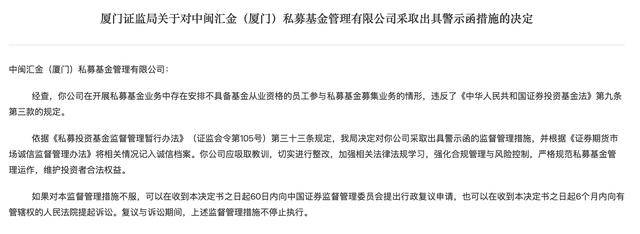
安排“无证”员工参与私募基金募集,中闽汇金被监管警示
Sou Hu Cai Jing· 2025-09-18 14:11
Group 1 - The Xiamen Securities Regulatory Bureau issued a warning letter to Zhongmin Huijin (Xiamen) Private Fund Management Co., Ltd. for allowing unqualified employees to participate in private fund raising activities, violating relevant regulations [1] - The company was established on May 29, 2015, with a registered capital of 10 million yuan and is represented by Wang Jiangming [2] - The regulatory authority emphasized the need for the company to learn from this incident, improve compliance management, and strengthen risk control to protect investors' legitimate rights and interests [1]
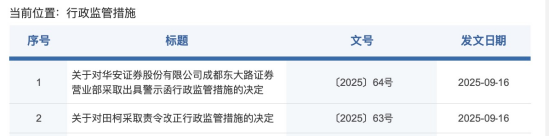
华安证券一营业部收警示函,前员工田柯向客户推介虚假金融产品,给客户造成重大损失被责令改正
Xin Lang Zheng Quan· 2025-09-18 10:17
Core Viewpoint - The Sichuan Securities Regulatory Bureau issued two administrative regulatory measures against Huazhong Securities Chengdu Dongda Road Securities Business Department and its former employee Tian Ke, highlighting issues of compliance management and employee conduct [1][2][3]. Group 1: Regulatory Actions - The Sichuan Securities Regulatory Bureau decided to issue a warning letter to Huazhong Securities Chengdu Dongda Road Business Department for failing to evaluate the integrity of employees during their tenure [2]. - Employee Tian Ke was ordered to rectify his actions for promoting false financial products to clients, resulting in significant losses for them [3]. Group 2: Company Background - Huazhong Securities Chengdu Dongda Road Business Department, a wholly-owned subsidiary of Huazhong Securities, has been operational since 2017 and is located in the financial hub of Chengdu [5]. - The department is known for its professional and efficient securities team, indicating its established presence in the market [5]. Group 3: Financial Performance - According to Huazhong Securities' 2025 semi-annual report, the company achieved operating revenue of 2.808 billion yuan, a year-on-year increase of 43.09%, and a net profit attributable to shareholders of 1.035 billion yuan, up 44.94% year-on-year [7]. - The rapid profit growth raises concerns about potential compliance risks, suggesting that the high-growth narrative in the securities industry should not rely on risk loopholes [7].

华安证券一营业部被监管警示
Guo Ji Jin Rong Bao· 2025-09-16 14:13
Regulatory Actions - Sichuan Securities Regulatory Bureau issued a warning letter to Huazheng Securities Chengdu Dongda Road Securities Business Department for failing to assess employees' integrity during their employment, violating regulations [1] - The bureau also took corrective administrative measures against Tian Ke for promoting false financial products to clients, resulting in significant losses, which contravened compliance management regulations [1] Previous Regulatory Issues - This is not the first regulatory penalty for Huazheng Securities in 2023; in January, the Anhui Securities Regulatory Bureau issued a warning letter to Huazheng Securities Hefei High-tech Zone Securities Business Department for improper employee conduct [2] - The company faced multiple compliance issues, including inadequate execution of private fund custody business regulations and ineffective employee management, reflecting poor compliance management [2] Financial Performance - For the first half of 2025, Huazheng Securities reported operating income of 2.81 billion yuan, a year-on-year increase of 43.1%, and a net profit attributable to shareholders of 1.04 billion yuan, up 44.9% year-on-year [2]
银行业天价罚单涌现!首席合规官密集上任能否破合规困局?
Nan Fang Du Shi Bao· 2025-09-16 12:30
Group 1 - The core viewpoint of the articles highlights the increasing regulatory scrutiny in the financial sector, evidenced by the issuance of 18 fines totaling approximately 1.9 billion yuan, with the highest fine reaching nearly 90 million yuan [2][3][4] - The fines are primarily related to violations in credit operations, anti-money laundering, data reporting, and inadequate internal controls, indicating a focus on enhancing financial risk management [4][5] - The recent surge in penalties reflects a broader trend of financial institutions appointing Chief Compliance Officers to improve compliance management and embed compliance requirements into business processes [8][10] Group 2 - The implementation of the "Compliance Management Measures for Financial Institutions" has prompted banks to establish Chief Compliance Officer positions, with several banks recently announcing such appointments [9][10] - The delay in the issuance of fines is attributed to the complex nature of financial violations, which often require extensive investigation and coordination across departments, leading to a lag in regulatory actions [6][7] - Experts suggest that while the appointment of Chief Compliance Officers can enhance compliance independence, challenges remain in shifting from passive to proactive compliance due to existing organizational cultures and the balance between compliance and business development [10]
百亿私募基金红筹投资存8项违规 被限网下打新6个月
Zhong Guo Jing Ji Wang· 2025-09-15 08:05
Core Viewpoint - Shenzhen Red Chip Investment Co., Ltd. has been placed on a restricted list for offline investors for six months due to multiple compliance failures in its pricing evaluation and decision-making processes [1][6]. Group 1: Compliance Issues - The company failed to follow pricing evaluation and decision-making procedures, with a single researcher determining the final price without collective decision-making [6]. - There was insufficient basis for pricing, as the suggested price range lacked logical reasoning and was determined subjectively by the researcher [6]. - The research report writing mechanism was inadequate, lacking detailed regulations for using the lead underwriter's pricing report and approval processes [6]. Group 2: Internal Control Deficiencies - The company did not establish a necessary investment decision-making mechanism, leading to compliance issues in the pricing decision process [6]. - There was a lack of a comprehensive compliance management system, with inadequate execution of compliance checks [6]. - The company failed to implement a pricing review mechanism, with no written records of the final pricing review [6]. Group 3: Communication and Accountability - The control of communication devices was poorly executed, with no management of devices used by personnel aware of pricing during the inquiry period [6]. - The company did not establish an internal accountability mechanism or performance assessment indicators for pricing risks, failing to verify the objectivity and prudence of pricing retrospectively [6]. Group 4: Regulatory Framework - The violations were found to be in breach of several articles of the "Management Rules for Offline Investors in Initial Public Offerings," including Articles 18, 25, 26, 42, and 43 [1][4][5].
多家银行首席合规官任职资格获批!
Zheng Quan Ri Bao· 2025-09-15 00:22
Core Viewpoint - The establishment of Chief Compliance Officer (CCO) positions in banks is a significant step towards enhancing compliance management in the financial sector, driven by regulatory requirements and the need for improved risk management practices [1][2][3]. Group 1: Regulatory Changes and Compliance Management - On September 11, 2025, Ruifeng Bank's shareholders approved the addition of a Chief Compliance Officer role, reflecting a broader trend among various banks to strengthen compliance management [1]. - The National Financial Supervision Administration's "Compliance Management Measures" mandates that financial institutions establish a CCO position at their headquarters by March 1, 2025, with a one-year transition period for compliance [2]. Group 2: Responsibilities and Impact of CCO - The CCO is responsible for formulating compliance policies, supervising their implementation, identifying compliance risks, and fostering inter-departmental collaboration to integrate compliance into business processes [2][3]. - The introduction of CCOs is expected to standardize and optimize compliance management across the banking sector, reducing compliance gaps and systemic risks, thereby enhancing the overall stability of the financial system [3]. Group 3: Skills and Qualities for CCO Selection - Future selection and training of CCOs will emphasize understanding of banking operations, regulatory interpretation, practical compliance capabilities, and cross-departmental coordination [3][4]. - Key qualities for CCO candidates include strong professional expertise in financial regulations, strategic thinking, independence, excellent communication skills, and a commitment to continuous learning to adapt to evolving regulatory landscapes [4].
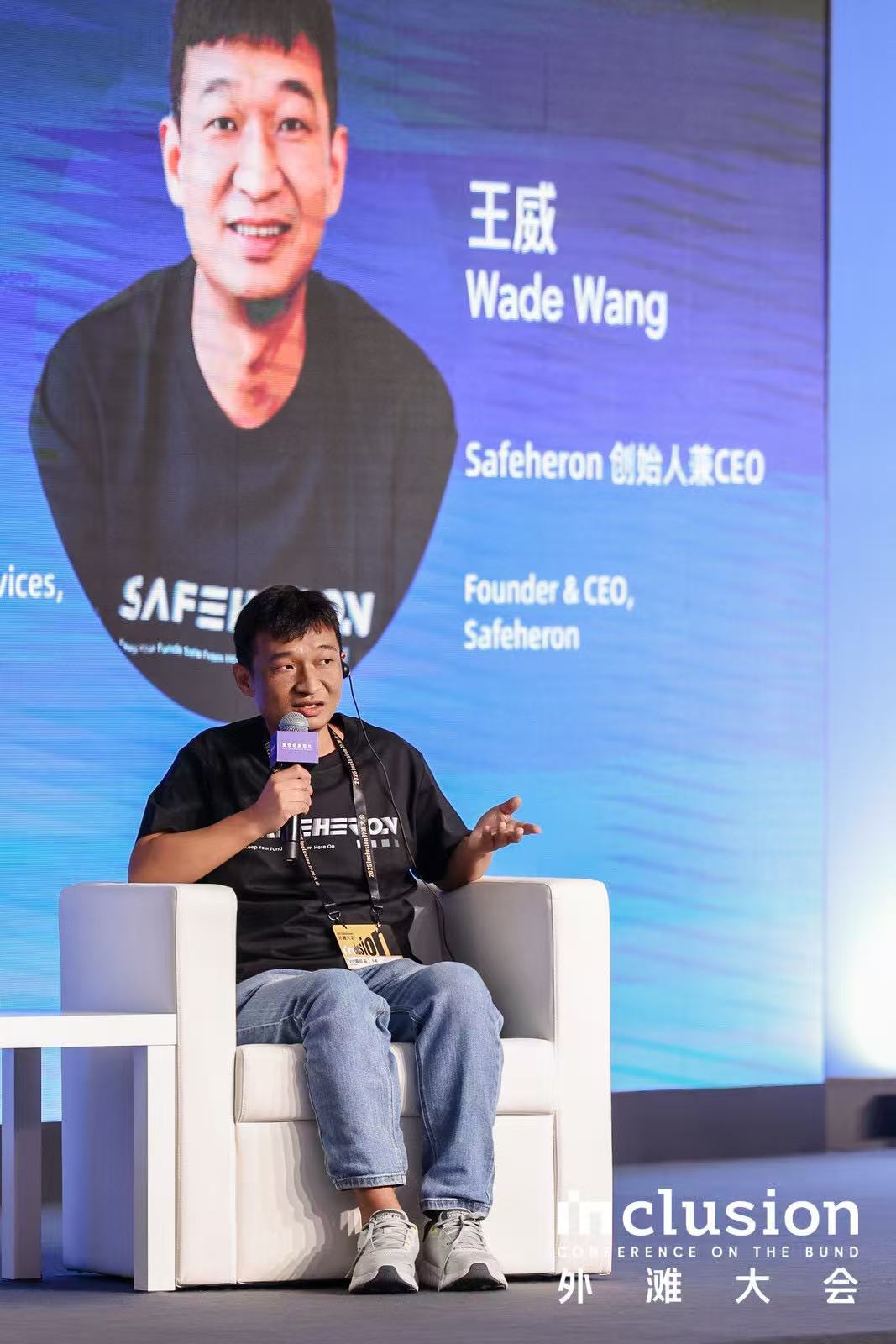
Safeheron创始人王威:基金通证化大规模应用需要安全底座
Guo Ji Jin Rong Bao· 2025-09-13 13:09
Core Viewpoint - The large-scale application of tokenization in funds may face challenges due to the need for a multidimensional infrastructure system that includes blockchain technology, secure custody, compliance management, trading liquidity, data privacy, and user experience [1][4]. Group 1: Infrastructure Challenges - The first challenge is the security and compliance infrastructure. The interaction between investors and managers will heavily rely on on-chain infrastructure, necessitating bank-level security for custody, transfer, and redemption processes to prevent asset loss due to improper private key management or system vulnerabilities [4]. - Different jurisdictions have varying legal definitions and compliance requirements for the digitalization and securitization of fund shares. If the underlying technological infrastructure does not accommodate regulatory compliance, it may face legal and operational risks [4]. - Collaboration with regulatory bodies, traditional finance, and the blockchain ecosystem is crucial to ensure technological scalability and market acceptance [4]. Group 2: Distribution and Liquidity Challenges - The second challenge involves the distribution and liquidity of tokenized funds. While tokenization allows for more efficient and flexible asset distribution, it introduces complexities such as KYC (Know Your Customer) and AML (Anti-Money Laundering) requirements, as well as investor suitability assessments [4]. - Ensuring compliance while achieving efficient share transfer and liquidity is a critical issue that the industry must address [4]. - The security, transparency, and auditability of distribution platforms are key factors in building investor trust [4]. Group 3: Future Outlook - The industry is currently focused on centralized finance (CeFi), but in the next 3-5 years, tokenization will integrate both CeFi and decentralized finance (DeFi) [5]. - The core role of companies in this transition is to empower the entire lifecycle of tokenization from a self-custody and security infrastructure perspective, linking liquidity between CeFi and DeFi in a one-stop solution [5].