
双碳目标

Search documents
山西建邦集团聚焦发展循环经济 多维度挖潜绿色空间(促进民营经济高质量发展)
Ren Min Ri Bao· 2025-11-26 22:09
11时15分,空气湿度78.4%,PM2.5为0.34微克/立方米……日前,记者走进位于临汾市的山西建邦集 团,只见超低排放智能化管控平台上,实时显示着厂区综合原料场的空气质量。"只需通过这个数据平 台,便可追溯厂区每个排放点的排放情况。"建邦集团副总裁田琰介绍。 在500万吨封闭式综合原料场,矿石堆积如山,卸料车往来穿梭。"以前,料场卸料时烟尘飞扬,很不环 保。"料场工段长许林全介绍,现在,料场经过智能化改造后,可实现自动化清洁作业,场内的鹰眼能 自动捕捉、监测产尘点,一旦颗粒物超过设定值,雾炮就会自动启动,瞄准产尘点喷出细密的水雾,吸 附粉尘及颗粒物,净化空气。 "物料存储、装卸所产生的排放,是钢铁企业里典型的无组织排放,其源头分散、数量众多、排放随 机,除了矿料装卸,炼铁、炼钢、轧钢等一系列工序均有不同程度的无组织排放情况,有的环节排放源 多达上百个。要真正实现超低排放,离不开智能化、系统化的治理方式。"田琰说。 2016年以来,建邦集团先后投资35亿元开展超低排放改造等治理工作。建设物料输送全密闭通廊;对炼 钢车间进行全封闭改造,采用高效覆膜袋式工艺除尘;对烧结机机尾、转炉、轧机等高温产尘点进 行"全 ...
利用外资额猛增124%! 金昌经开区领跑全省国家级经开区
Sou Hu Cai Jing· 2025-11-26 21:40
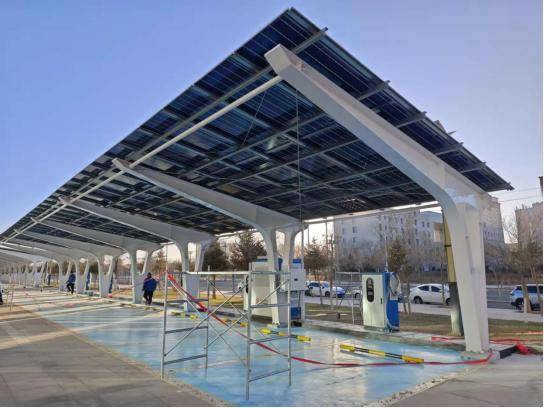
近年来,金昌经开区充分发挥对外开放主阵地的作用,始终将利用外资作为推动经济高质量发展的重要 抓手,不断优化营商环境、提升服务水平,持续加大外资项目引进力度。一方面,构建了全方位、多层 次的服务体系,组建外资企业服务团队,为外资企业提供从项目前期咨询、选址建议,到建设过程中的 协调推进,再到投产后的跟踪服务的全生命周期服务;另一方面,加强外商投资企业人才安居保障,集 成为外资企业高端人才提供便捷就医、人才公寓、子女入学等专属服务,让人才便捷高效享受政策红 利。 △甘肃绿动新能源分布式光伏充电站项目 今年10月,金昌经开区与天津长荣科技集团股份有限公司签署战略合作协议,同步落地甘肃绿动新能源 科技有限公司,该公司由长荣股份(香港)有限公司全资控股,于今年6月在金完成注册,6月、7月分 别实缴400万美元、100万美元注册资本,专注太阳能发电与储能技术服务。此次与长荣集团的合作,既 通过绿动新能源项目补强储能服务环节,又以外资注入优化资本结构。该项目将依托本地77%的原材料 供给率,降低产业链成本,助力打造西北新能源电池产业基地。长荣集团也将充分发挥技术优势,推动 合作项目加速落地,构建"光伏组件生产+电站运营"示 ...

绿色发展理念深入人心 绿色期货产品不断丰富
Qi Huo Ri Bao Wang· 2025-11-26 17:54
Core Viewpoint - The article emphasizes the importance of green development as a foundation for high-quality growth, highlighting China's commitment to green transformation as a response to climate change and a new engine for economic and social development [1]. Group 1: Green Development Initiatives - The 15th National Games showcased a "carbon-neutral" event, with venues in Guangzhou achieving full coverage of green electricity, demonstrating the integration of green development into various aspects of society [1]. - During the event, the Guangdong Provincial Sports Center consumed 15 million kilowatt-hours of electricity, with green electricity supply reducing carbon emissions by 14,200 tons [1]. Group 2: Growth of Renewable Energy - Renewable energy, particularly wind and solar power, has become a crucial part of China's energy structure, with one-third of the total electricity consumption now coming from green electricity [2]. - As of July 2023, China's installed capacity for wind and solar power reached 1.68 billion kilowatts, nearly doubling from 530 million kilowatts in 2020, with an annual growth rate of 28% [2]. Group 3: Challenges in Renewable Energy - The reliance on weather conditions for solar power generation presents challenges, as factors like solar radiation and weather variability can significantly impact output [3]. - The uneven distribution of solar power generation can lead to supply shortages and increased electricity price volatility, affecting industries with high electricity consumption [3]. Group 4: Financial Tools for Weather Risk Management - Companies are increasingly utilizing financial instruments to manage weather-related risks affecting solar power generation, with the first solar radiation index insurance product launched in 2014 [4]. - The global derivatives market has seen a rise in demand for weather risk management tools, with the average daily trading volume of CME weather index futures increasing to 2.6 times that of 2022 by the end of 2023 [4]. Group 5: Development of Solar Radiation Index - The "Central Meteorological Administration - Guangxi Futures Exchange Solar Radiation Index" will be officially released in November 2024, providing a scientific method for assessing solar power generation potential based on various meteorological factors [5][6]. - The index will serve multiple purposes, including aiding in power generation forecasts, evaluating solar power station revenues, and developing related financial products for risk management [6]. Group 6: Future Directions - The Guangxi Futures Exchange plans to continue collaborating with the Central Meteorological Administration to enhance the application of the solar radiation index in financial markets, particularly in futures and derivatives [7].
绿色氢氨醇:“潜力股”如何“见真章”?
Zhong Guo Hua Gong Bao· 2025-11-26 11:39
Core Insights - The green hydrogen and ammonia industry is recognized as a "potential stock" in the new energy sector, with significant developments expected during the 14th and 15th Five-Year Plans [1] - The 20th National Congress of the Communist Party of China emphasizes the need for a forward-looking layout of future industries, promoting hydrogen energy as a new economic growth point [1][2] - Experts highlight the strategic value of hydrogen energy in achieving carbon neutrality goals, with a shift from technical validation to commercial promotion anticipated [2][4] Industry Development Plans - China's "Hydrogen Energy Industry Development Medium and Long-Term Plan (2021-2035)" aims for renewable energy hydrogen production to reach 100,000 to 200,000 tons per year by 2025 [2] - By 2030, a comprehensive hydrogen energy technology innovation system and clean energy hydrogen supply system are expected to be established [2] Technological Innovations - Key technologies such as automated hydrogen production systems, silicon carbide efficiency improvements, and collaborative applications of alkaline and anion exchange membrane electrolyzers are crucial for reducing green hydrogen costs [4] - Low-carbon methanol is proposed as an effective storage and transportation medium for green hydrogen, with a hydrogen yield twice that of liquid hydrogen [4] Supply Chain Challenges - Experts stress the importance of addressing bottlenecks across the entire hydrogen production, storage, transportation, and application chain to achieve high-quality development [4][6] - The average cost of green hydrogen in China is approximately 21 yuan per kilogram, significantly higher than gray hydrogen, necessitating technological advancements to lower costs [4] Policy Recommendations - There is an urgent need for improved policies to support the green hydrogen industry in China, including electricity pricing, market demand stimulation, and industry development encouragement [7][8] - Establishing a comprehensive standard system for green liquid fuels and enhancing market supervision are also recommended to facilitate industry growth [9][10] Collaborative Ecosystem - A collaborative ecosystem involving government, enterprises, industry organizations, and research institutions is essential for overcoming development bottlenecks in the hydrogen energy sector [11] - The Xilin Gol League is highlighted as a model for developing the green hydrogen and ammonia industry, leveraging its abundant renewable energy resources and strategic location [12]
署名文章丨国家能源局副局长何洋:构建电力可靠性管理新格局 推动电力可靠性工作高质量发展
国家能源局· 2025-11-26 10:46
Core Viewpoint - The article emphasizes the importance of enhancing power reliability management in China to support high-quality economic and social development, addressing new challenges and requirements in the context of modern energy systems [2][8]. Historical Achievements - Over the past 40 years, China's power reliability management has evolved significantly, establishing a comprehensive management system that includes government leadership, industry service, and enterprise responsibility [4][5]. - The average unplanned outage frequency for coal and hydropower units has decreased by over 93%, with many coal-fired units operating for more than 1,000 days without interruption [5]. Current Challenges - The transition to a new energy system introduces complexities such as increased randomness and volatility in power generation and consumption, necessitating innovative reliability management methods [9]. - There is a disparity in power reliability statistics, with only 36.14% of wind power and 13.46% of solar power capacity included in reliability assessments, highlighting the need for broader data coverage [10]. Future Directions - The focus is on ensuring reliable power supply to meet the demands of high-quality development, with an emphasis on addressing imbalances in power reliability across urban and rural areas [12][13]. - The article calls for deepening research and pilot projects in power system reliability, enhancing data collection methods, and expanding the coverage of reliability statistics to include emerging energy sources [14][15]. Systematic Improvements - There is a need to establish a robust framework for reliability management, including clear responsibilities at all levels and the development of standardized procedures across various sectors of the power industry [16].

首届“绿智未来”可持续发展全球挑战赛决赛暨颁奖典礼落幕
Zheng Quan Ri Bao Zhi Sheng· 2025-11-26 09:43
Group 1 - The "Green Intelligence Future" global sustainability challenge aimed to discover innovative and commercially viable projects to support global sustainable development goals, focusing on four key areas: industrial decarbonization, energy transition, green agriculture, and pollution reduction [1] - The challenge received over 1,000 high-quality green technology solutions from approximately 70 countries and regions, with 30 projects advancing to the semifinals and 10 projects reaching the finals [1] - Tianjin Feiman Power Technology Co., Ltd. won the Excellence Award with a prize of 2 million yuan, while Shenzhen Daotong New Energy Co., Ltd., ROTOBOOST, and Shenzhen Zhonghe Energy Storage Technology Co., Ltd. received Elite Awards, each with a prize of 1 million yuan [1][2] Group 2 - Tianjin Feiman Power Technology Co., Ltd. focuses on hard technology to promote a "negative carbon future," specializing in CO2 resource utilization and electro-synthetic fuels [2] - Shenzhen Daotong New Energy Co., Ltd. specializes in the efficient recycling of retired lithium iron phosphate batteries [2] - ROTOBOOST is set to implement a methane thermal catalytic cracking pilot project in collaboration with China Baowu Steel Group, targeting emissions reduction in steel and electrolytic aluminum production [2] Group 3 - The director of the Yangtze River Delta National Technology Innovation Center emphasized the importance of integrating technological and industrial innovation, highlighting the need for high-quality technology supply and effective transfer of scientific achievements [2] - The integration of AI and green technology is seen as a unique long-term competitive advantage for China, supported by the country's extensive renewable energy infrastructure for low-carbon operations of data centers [3]

工业领域氧化亚氮控排产学研联盟成立,助力非二温室气体管控
2 1 Shi Ji Jing Ji Bao Dao· 2025-11-26 08:25
Core Insights - The establishment of the Nitrous Oxide Emission Control Research and Production Alliance in the industrial sector aims to address the significant challenge of nitrous oxide emissions, which are a major greenhouse gas with a global warming potential approximately 300 times that of carbon dioxide [1][2] Group 1: Alliance Formation and Objectives - The alliance was officially launched on November 26, 2023, under the guidance of the Ministry of Ecology and Environment, in collaboration with various industry associations, enterprises, and academic institutions [1][2] - The primary goal of the alliance is to reduce the 154 million tons of nitrous oxide emissions from the industrial sector, which accounted for 27.6% of China's total nitrous oxide emissions in 2021 [2][3] Group 2: Emission Control Measures - The action plan outlines specific control measures and targets for nitrous oxide emissions, emphasizing the need for a shift from passive participation to proactive reduction efforts in key industries [2][3] - The alliance will focus on developing monitoring standards for industrial nitrous oxide emissions, conducting research on localized emission factors, and promoting collaborative efforts between academia and industry [3]
中国多举措加强工业领域氧化亚氮控排工作
Zhong Guo Xin Wen Wang· 2025-11-26 08:05
Core Viewpoint - China is taking multiple measures to strengthen the control and reduction of nitrous oxide emissions in the industrial sector, emphasizing the establishment of a collaborative alliance to innovate and standardize monitoring and reduction technologies [1][2] Group 1: Nitrous Oxide Emissions Overview - Nitrous oxide is the third-largest greenhouse gas globally, with a global warming potential approximately 300 times that of carbon dioxide, and it has a stable chemical nature with an atmospheric lifespan exceeding 100 years [1] - In 2021, China's total nitrous oxide emissions were 2.102 million tons, accounting for 4.3% of the country's total greenhouse gas emissions, with industrial processes contributing 580,000 tons, or 27.6% of the total [1] Group 2: Industrial Sources and Reduction Goals - The primary sources of nitrous oxide emissions in China's industrial sector are the production processes of adipic acid, nitric acid, and caprolactam, with the adipic acid industry being the largest contributor [1] - The establishment of the alliance is seen as a crucial step towards achieving China's dual carbon goals, promoting deep integration of production, learning, research, and application to build a green and low-carbon industrial system [1] Group 3: Future Plans and Initiatives - The "Action Plan for Controlling Nitrous Oxide Emissions in the Industrial Sector" aims to improve emission control policies, enhance innovation capabilities for reduction technologies, and strengthen management capabilities by 2030 [2] - The alliance, initiated by the National Center for Climate Change Strategy and International Cooperation and the China Chemical Energy Conservation Technology Association, will accelerate the development of monitoring standards and encourage market mechanisms for emissions reduction [2]
呼伦贝尔市全速推进重点项目建设
Nei Meng Gu Ri Bao· 2025-11-26 07:07
Core Insights - Hohhot City is actively promoting key project construction to achieve high-quality economic development goals, with a focus on renewable energy projects and infrastructure improvements [1][2] Group 1: Project Development - The Inner Mongolia Energy Group's 1 million kilowatt wind storage project in Zhalantun is a key initiative, with significant progress made in both segments of the project [1] - As of October, 493 key projects in the city have resumed work, with a resumption rate of 97.4%, marking an increase of 86 projects compared to the previous year [2] Group 2: Investment and Financial Support - The city has secured 4.235 billion yuan in funding from higher-level development and reform sectors, a year-on-year increase of 6.7%, supporting 78 projects across various sectors [1] - Total investment completed by the end of October reached 30.46 billion yuan, an increase of 5.1 billion yuan compared to the previous year, reflecting a growth rate of 20.1% [2]
中国电机工程学会年会在湖南长沙举行
Zhong Guo Jing Ji Wang· 2025-11-26 06:58
Core Insights - The 2025 China Electromechanical Engineering Society Annual Conference was held in Changsha, Hunan, focusing on "Technological Innovation and Mechanism Reform to Build a New Energy System" [1] - The conference attracted 17 academicians and numerous industry elites, emphasizing the "dual carbon" goals and discussing key technologies and major issues in constructing a new power system [1] - The event featured a series of 45 academic activities and aimed to create a high-end communication platform for deep integration of industry, academia, and research [1] Group 1 - The conference adopted a "month of annual meeting activities" format, with Changsha as the main venue and multiple sub-venues across the country, achieving a concentrated and extended outreach effect [1] - Key topics included the "15th Five-Year Plan for Power," "Clean and Efficient Power Generation Technologies," and the cultivation of interdisciplinary talents in artificial intelligence and electrical engineering [1] - An energy technology innovation achievement exhibition was held, showcasing cutting-edge technologies in the energy and power sector, facilitating deep integration of industry, academia, and research [1] Group 2 - Hunan issued an initiative to "build a high-level energy technology innovation system," leveraging four national key laboratories and five national platforms to enhance collaborative innovation mechanisms [2] - Hunan's provincial leaders highlighted the province's progress in constructing a new power system and the establishment of several demonstration projects with significant achievements [2] - The conference was organized by the China Electromechanical Engineering Society, with joint sponsorship from several major companies, including State Grid Hunan Electric Power Co., China Huaneng Clean Energy Technology Research Institute, Huawei Technologies, and CRRC Zhuzhou Electric Locomotive Research Institute [2]