
商业航天

Search documents
商业航天大消息!刚刚,北京发布
Zhong Guo Ji Jin Bao· 2026-01-24 09:41
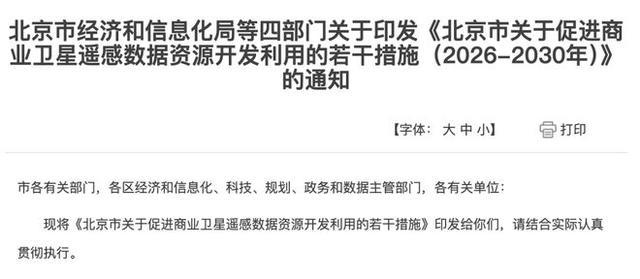
Core Viewpoint - Beijing has released measures to promote the development and utilization of commercial satellite remote sensing data resources from 2026 to 2030, aiming to enhance the satellite application service innovation landscape and support national development strategies [1][3]. Group 1: Infrastructure and Capability Building - The measures focus on five key areas: foundational capability building, common support capability building, technological innovation capability building, optimization of the development and utilization environment, and expansion of application scenarios [3][4]. - Strengthening foundational capabilities involves supporting enterprises in planning and constructing commercial satellite constellations with clear application prospects, enhancing the efficiency of remote sensing data utilization [6][7]. - Encouragement for diverse operational entities, including internet and geographic information companies, to develop value-added services based on commercial satellite data [6][7]. Group 2: Common Support Capabilities - The initiative promotes the standardization and integrated processing of vast remote sensing data resources to break down data silos and improve overall utilization efficiency [8][9]. - Support for the construction of multi-source satellite big data platforms to create a comprehensive data resource system, integrating various data types and enhancing the application of satellite data processing algorithms [8][9]. Group 3: Technological Innovation - The measures aim to enhance technological innovation capabilities by encouraging the development of key technologies related to satellite remote sensing data, such as agile acquisition and intelligent interpretation [10][11]. - Establishment of high-energy innovation platforms, including key laboratories and industry innovation centers, to promote the integration of production, education, and research [10][11]. Group 4: Development Environment Optimization - The measures advocate for the assetization of satellite data, encouraging enterprises to manage data assets effectively and facilitating the registration and circulation of satellite data assets [12][13]. - Emphasis on enhancing data security management systems to ensure the safe acquisition, storage, transmission, and use of satellite data [12][13]. Group 5: Application Scenario Expansion - The initiative aims to leverage artificial intelligence to expand industry-specific applications of remote sensing data, enhancing its value in various sectors such as urban governance and disaster prevention [14][15]. - Support for enterprises to create innovative application cases in key industries, with rewards for solutions that effectively address typical application scenarios [14][15].

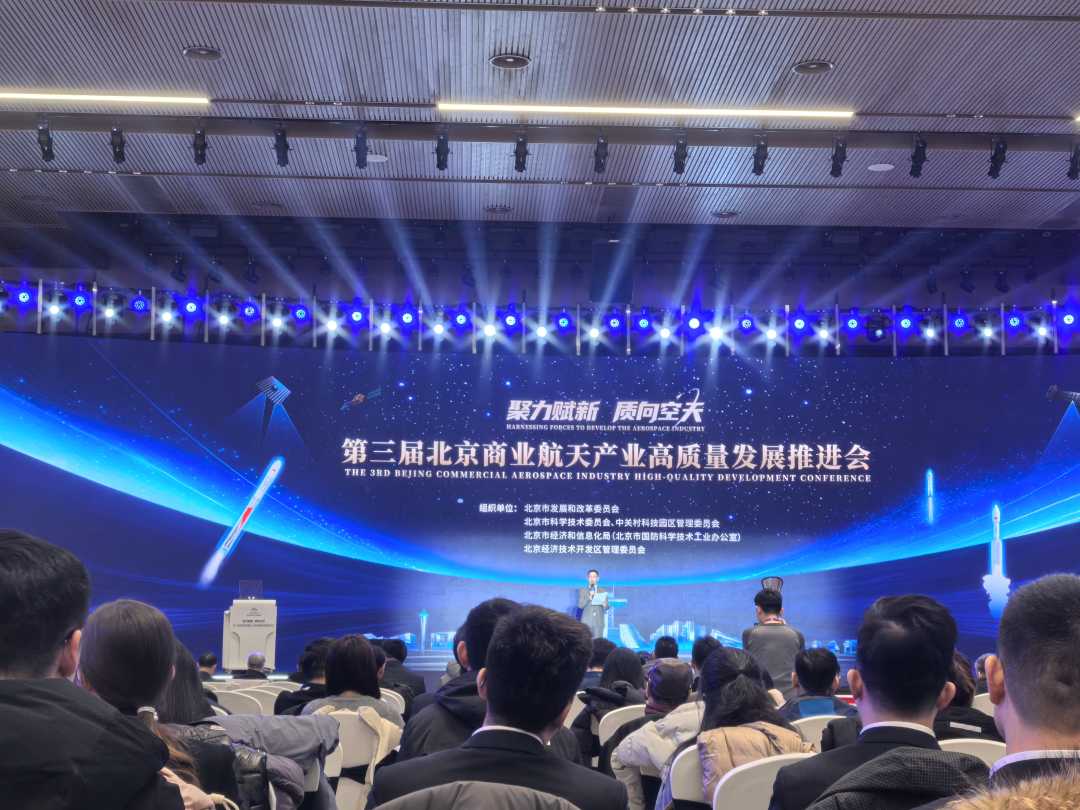
第三届北京商业航天产业高质量发展推进会举办
Xin Lang Cai Jing· 2026-01-24 09:19
Core Insights - The third Beijing Commercial Aerospace Industry High-Quality Development Promotion Conference was held on January 23, focusing on advancing the commercial aerospace sector in Beijing [1][4] - Seven key laboratories in Beijing were awarded, aimed at supporting original innovation and core technology breakthroughs in key industries [2] - A new policy for the development and utilization of commercial satellite remote sensing data resources was announced, targeting the years 2026-2030 [2] Group 1: Key Laboratories and Policies - Seven key laboratories were established, including those focused on low-orbit satellite communication and new power systems [2] - The policy aims to enhance the infrastructure for remote sensing data, optimize the development environment, and expand application scenarios for satellite data [2] Group 2: Investment and Projects - Nine major production capacity projects and six satellite projects were announced, with total investments exceeding 15 billion yuan (approximately 2.3 billion USD) [2] - The Beijing Economic and Technological Development Area will initiate the construction of a satellite internet supply chain industrial park by 2025 [2] Group 3: Support for Commercial Aerospace - The establishment of six common platforms for commercial aerospace research and production is set to support high-quality development and safety [3] - The Beijing Economic and Technological Development Area aims to provide comprehensive support for commercial aerospace enterprises through policy, investment, and space [3]
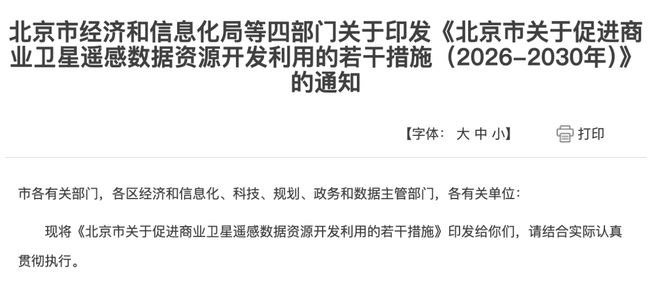
商业航天大消息!刚刚,北京发布!
Zhong Guo Ji Jin Bao· 2026-01-24 08:50
Core Viewpoint - Beijing has released measures to promote the development and utilization of commercial satellite remote sensing data resources from 2026 to 2030, aiming to enhance the satellite application service innovation landscape and support national development strategies [1][5]. Group 1: Basic Capability Construction - The measures emphasize strengthening the basic capabilities of remote sensing data resources by providing market support, technical backing, and resource guarantees for the satellite data industry [3][6]. - Encouragement is given to internet and geographic information companies to develop value-added services based on commercial satellite data, fostering integrated business entities [6]. - Support for the construction of differentiated commercial satellite constellations is highlighted, along with the integration of new information technologies like cloud computing and artificial intelligence [6][7]. Group 2: Common Support Capability Construction - The initiative aims to standardize and integrate the processing and sharing of diverse remote sensing data, breaking down data silos to enhance overall utilization efficiency [4][7]. - Support for the construction of multi-source satellite big data platforms is encouraged, promoting the development of algorithms and models for satellite data processing [7]. - The establishment of urban spatiotemporal digital foundations is promoted to integrate various information technologies and create comprehensive urban information models [7]. Group 3: Technological Innovation Capability Construction - The measures focus on enhancing technological innovation capabilities in remote sensing data, encouraging key technology breakthroughs and strengthening the innovation position of enterprises [9][10]. - Support for agile acquisition, efficient processing, and intelligent interpretation of satellite remote sensing data is emphasized, along with funding for technology research and development [9][10]. Group 4: Optimization of Development and Utilization Environment - The measures promote the assetization of satellite data, encouraging enterprises to manage data assets and facilitating their registration and circulation [11]. - Strengthening inter-departmental sharing of remote sensing data resources and exploring cooperative mechanisms with research institutions and enterprises is encouraged [11]. - The establishment of a robust data security management system is highlighted to ensure the safe handling of satellite data [12]. Group 5: Application Scenario Expansion - The measures advocate for the use of artificial intelligence to expand industry-specific applications of remote sensing data, aiming to convert data into practical productivity [13]. - Support for the development of innovative application cases in key industries such as urban governance, agriculture, and disaster prevention is emphasized, with rewards for exemplary solutions [13][14]. Group 6: Support Measures - Coordination with national policies and major projects is emphasized to ensure the successful implementation of satellite remote sensing data resource development projects [14][15]. - Financial support and investment in quality projects related to remote sensing data resources are encouraged [14].
苏试试验(300416):2025年业绩预告点评:归母净利润同比+7%~16% 符合预期,关注航天、半导体等高端赛道
Soochow Securities· 2026-01-24 08:45
Investment Rating - The investment rating for the company is "Accumulate" [1] Core Views - The company is expected to achieve a net profit attributable to shareholders of 250 to 270 million yuan in 2025, representing a year-on-year growth of 7% to 16% [2] - The fourth quarter of 2025 is projected to see a net profit of 90 to 110 million yuan, with a year-on-year increase of 6% to 30% [2] - The growth in performance is attributed to the recovery of demand in special industries, capacity release in the integrated circuit sector, and increased demand in aerospace [2] - The company is well-positioned in high-barrier testing sectors, with significant growth potential in aerospace, semiconductors, and new energy [4] Financial Performance Summary - Total revenue for 2023 is projected at 2,117 million yuan, with a year-on-year growth of 17.26% [1] - The net profit attributable to shareholders for 2023 is estimated at 314.27 million yuan, reflecting a year-on-year increase of 16.44% [1] - Earnings per share (EPS) for 2023 is expected to be 0.62 yuan [1] - The company anticipates a total revenue of 2,220 million yuan in 2025, with a growth rate of 9.61% [1] - The net profit attributable to shareholders for 2025 is forecasted at 251.42 million yuan, indicating a growth of 9.59% [1] - The projected EPS for 2025 is 0.49 yuan [1]

商业航天大消息!刚刚,北京发布!
中国基金报· 2026-01-24 08:43
Core Viewpoint - The article discusses the release of measures by Beijing to promote the development and utilization of commercial satellite remote sensing data resources from 2026 to 2030, aiming to enhance the satellite application service innovation landscape and support national strategic development [1][3]. Group 1: Strengthening Basic Capability Construction - The measures emphasize the importance of building a strong market and technical support for the satellite data industry, encouraging the development of differentiated commercial satellite constellations and enhancing the efficiency of remote sensing data utilization [3][6]. - Companies are encouraged to engage in mergers and acquisitions to integrate the satellite data application service industry chain, aiming to create globally competitive leading enterprises [6]. - Support will be provided for projects that meet specific criteria, including financial backing for space infrastructure development [6]. Group 2: Enhancing Common Support Capability - The measures aim to standardize and integrate the processing and sharing of diverse remote sensing data, breaking down data silos to improve overall utilization efficiency [4][7]. - The establishment of multi-source satellite big data platforms is encouraged to create a comprehensive data resource system, facilitating the development of satellite data processing algorithms and models [8]. Group 3: Strengthening Technological Innovation Capability - The focus is on enhancing the technological innovation capabilities related to remote sensing data, promoting breakthroughs in key technologies and supporting the establishment of innovation platforms [9][10]. - Funding support will be provided for units engaged in technology research and development, particularly in areas such as agile data acquisition and intelligent interpretation [9]. Group 4: Optimizing the Development and Utilization Environment - The measures promote the assetization of satellite data, encouraging companies to manage data assets effectively and participate in data registration and circulation [10][11]. - Collaboration between government departments and various entities is encouraged to enhance data sharing and cooperation in the field of satellite remote sensing [10]. Group 5: Expanding Application Scenarios - The article highlights the importance of leveraging artificial intelligence to expand industry-specific applications of remote sensing data, aiming to convert data into practical productivity [13][14]. - Support will be provided for enterprises to create innovative application cases in key industries, enhancing the scale and depth of remote sensing data applications [14]. Group 6: Guarantee Measures - The measures emphasize the need for coordination with national policies and plans, encouraging financial support for quality projects in remote sensing data resources [14]. - Talent cultivation in satellite data governance is prioritized, with a focus on integrating education and training to develop skilled professionals in the field [14].

北京市经济和信息化局等四部门关于印发《北京市关于促进商业卫星遥感数据资源开发利用的若干措施(2026-2030年)》的通知
Jin Rong Jie· 2026-01-24 08:38
Core Viewpoint - Beijing has issued measures to promote the development and utilization of commercial satellite remote sensing data resources from 2026 to 2030, aiming to enhance the integration of satellite applications and foster innovation in the industry [2]. Group 1: Strengthening Basic Capabilities - The measures emphasize building strong market entities and infrastructure to support the satellite data industry, encouraging mergers and acquisitions among companies to create globally competitive leaders [3]. - Companies are encouraged to develop differentiated commercial satellite constellations and enhance space infrastructure, with support for projects that meet specific criteria [3]. Group 2: Enhancing Common Support Capabilities - The establishment of multi-source satellite big data platforms is encouraged to integrate various data types and improve overall utilization efficiency [4]. - The construction of urban spatiotemporal digital foundations is promoted to facilitate the integration of information technologies and create urban information models [5]. Group 3: Promoting Technological Innovation - The measures call for the enhancement of technological innovation capabilities in satellite remote sensing, supporting research in key technologies such as agile data acquisition and intelligent interpretation [6]. - The establishment of innovation platforms and laboratories focused on remote sensing data is encouraged to foster collaboration between academia and industry [6]. Group 4: Optimizing the Development Environment - The promotion of satellite data asset management and the establishment of a data asset registration system are highlighted to facilitate data circulation and trading [7]. - Strengthening data security management and encouraging collaboration with cybersecurity sectors are essential to ensure the safe use of satellite data [8]. Group 5: Expanding Application Scenarios - The integration of artificial intelligence in satellite data applications is emphasized to enhance service efficiency in various sectors such as natural resources and disaster management [9][10]. - Support for the development of industry-specific applications in sectors like agriculture, urban governance, and finance is encouraged to deepen the utilization of satellite data [10]. Group 6: Support Measures - Coordination with national policies and financial support for quality projects in satellite data resources is prioritized to ensure successful implementation [11]. - Talent development initiatives are encouraged to cultivate skills in satellite data governance through industry-education integration [11].
商业航天利好!北京发布!
证券时报· 2026-01-24 07:27
Core Viewpoint - The article outlines measures to promote the development and utilization of commercial satellite remote sensing data resources in Beijing from 2026 to 2030, aiming to enhance the integration of satellite applications and foster innovation in data services [2]. Group 1: Strengthening Basic Capabilities - Enhance the foundational capabilities of remote sensing data resources by supporting diverse business entities and infrastructure to improve market efficiency and application effectiveness [3]. - Encourage internet and geographic information companies to develop value-added services based on commercial satellite data, fostering the integration of "satellite data + industry" [3]. - Support the construction of differentiated commercial satellite constellations with clear commercial value and application prospects, integrating new information technologies like cloud computing and AI [4]. Group 2: Common Support Capabilities - Promote the construction of multi-source satellite big data platforms to standardize and integrate various remote sensing data, breaking down data silos and improving overall utilization efficiency [5]. - Encourage the establishment of urban spatiotemporal digital foundations to integrate various data elements and promote the development of digital twin city systems [5]. - Build incentive mechanisms for data resource integration, encouraging participation in remote sensing data resource pools through platforms like the Beijing International Big Data Exchange [6]. Group 3: Technological Innovation Capabilities - Encourage the development of key technologies related to satellite remote sensing data, such as agile acquisition and intelligent interpretation [7]. - Support the establishment of innovation platforms for remote sensing data, promoting collaboration between industry, academia, and research [7]. Group 4: Optimizing Development Environment - Promote the assetization of satellite data, encouraging companies to manage data assets and facilitating their registration and circulation [8]. - Strengthen inter-departmental sharing of remote sensing data resources and explore new cooperative mechanisms with research institutions and enterprises [8]. - Enhance data security management systems to protect the acquisition, storage, transmission, and use of satellite data [9]. Group 5: Expanding Application Scenarios - Accelerate the integration of AI with remote sensing data to enhance application levels in various sectors, including natural resources and disaster prevention [10]. - Support the development of industry-specific innovative application cases to deepen the scale of remote sensing data utilization in key industries [11]. Group 6: Support Measures - Strengthen coordination with national policies and major projects to facilitate the implementation of significant satellite remote sensing data resource projects [12]. - Optimize financial support for quality projects in remote sensing data resources, encouraging investment from local governments and social capital [12].

空天系列报告二:太空碳纤维:黑金时代开启
Guolian Minsheng Securities· 2026-01-24 07:03
Investment Rating - The report does not explicitly state an investment rating for the industry or specific companies [1]. Core Insights - Carbon fiber, referred to as "black gold," is categorized into T series (focused on tensile strength) and M series (focused on tensile modulus), with M series being more suitable for space environments due to its high carbon content and modulus [5][19]. - Carbon fiber is utilized in rockets for critical components such as fairings and landing legs, achieving weight reductions of 20%-50%. The Falcon 9 rocket by SpaceX employs carbon fiber in its structures, while the domestic "Weiguang-1" rocket is expected to achieve over 30% weight reduction with full carbon fiber construction by 2028 [5][34][37]. - In satellites, carbon fiber accounts for approximately 15.1% of materials used, primarily in heat sinks and precision structures. Although aluminum alloys dominate at 36.7%, the penetration of carbon fiber is expected to increase due to its low thermal expansion and weight reduction benefits [5][46]. - The M series carbon fiber has high technical barriers, with key bottlenecks in carbonization and graphitization equipment. Companies like Guangwei Composites have a competitive edge in technology and capacity, while others like Zhongfu Shenying and Heshun Technology are also making strides in the M series carbon fiber sector [5][61]. Summary by Sections 1. Carbon Fiber: "Black Gold" Performance - Carbon fiber can be classified based on precursor type, fiber morphology, bundle specifications, production processes, and mechanical properties. The main categories include PAN-based, pitch-based, and viscose-based fibers [13][15]. - Military applications primarily use small bundles of high-modulus carbon fiber, which are essential in aerospace [15][24]. 2. Rocket Applications of Carbon Fiber - Future applications of carbon fiber in rockets are expected to expand to fairings, interstage sections, and landing legs [7][28]. - The D4 rocket uses carbon fiber composites in various critical components, showcasing the material's advantages over traditional metals [33]. 3. Satellite Applications of Carbon Fiber - The increase in satellite weight is expected to drive higher penetration rates of carbon fiber in satellite structures [41][56]. - Carbon fiber is used in satellite components such as heat sinks, precision structures, solar panel supports, and antenna reflectors, benefiting from its excellent thermal and mechanical properties [45][46]. 4. Related Companies - Guangwei Composites leads in M series carbon fiber production with significant capacity and technological advantages, while Zhongfu Shenying and Heshun Technology are also advancing in this field [61][63].


亿纬锂能:公司目前已与多家头部商业火箭公司和商业卫星公司合作
Zheng Quan Ri Bao Wang· 2026-01-24 03:48
Core Viewpoint - The company emphasizes its commitment to providing comprehensive lithium battery solutions, particularly for the commercial aerospace sector, highlighting its strategic partnerships with leading rocket and satellite companies [1] Group 1 - The company has been developing lithium battery products for commercial aerospace applications for the past two years [1] - The focus is on delivering high-performance, highly reliable, and cost-effective battery energy solutions tailored to extreme operating conditions [1] - The company has established collaborations with multiple top-tier commercial rocket and satellite firms [1]

事关商业航天 蓝箭航天董事长最新发声
Shang Hai Zheng Quan Bao· 2026-01-24 03:26
Core Viewpoint - The commercial aerospace industry in Beijing plays a crucial role in advancing China's overall commercial aerospace sector, with significant achievements and a strong policy framework supporting its growth [1][2]. Group 1: Industry Development - As of now, 70% of China's commercial aerospace achievements originate from Beijing, which is home to over 300 commercial aerospace companies [1]. - The scale of Beijing's commercial aerospace industry has surpassed 100 billion yuan [1]. - The city has transitioned from supporting small and medium enterprises to implementing targeted policies that provide substantial financial support, such as insurance subsidies, to reduce operational costs for companies [1]. Group 2: Technological Advancements - Significant technological milestones have been achieved, including the successful first flight of the Zhuque-3 reusable rocket and the successful connection of mobile phones to satellites, laying a solid foundation for future developments in low Earth orbit infrastructure [2]. - The establishment of a reusable rocket laboratory and action plans for rapid development in commercial aerospace reflect the top-level institutional design in Beijing [2]. Group 3: Future Outlook - The commercial aerospace industry in Beijing is well-prepared for the upcoming "15th Five-Year Plan," with expectations for new achievements driven by innovation and contributions to national rejuvenation through aerospace advancements [2]. - There is a strong commitment from industry leaders to continue contributing to the development of China's aerospace sector, emphasizing a lifelong dedication to the field [2].