
大数据

Search documents
亿田智能(300911) - 300911亿田智能投资者关系管理信息20251113
2025-11-13 06:32
Company Overview - Yitian Intelligent was established on September 25, 2003, focusing on integrated stove business for 20 years, ranking high in national influence and market position [2] - The company aims to enhance brand recognition through multi-platform marketing and celebrity endorsements, emphasizing "Yitian Integrated Technology, Understanding Chinese Kitchens" [2] Strategic Focus - Future strategies include a focus on intelligence, globalization, and sustainability to maintain competitive differentiation in the kitchen appliance market [2] - The company plans to expand into computing power and AI applications in 2023, adhering to a dual-drive model of domestic and overseas chips [2] Investment Initiatives - Yitian Intelligent is collaborating with Lloyd Private Equity to establish the Shanghai Deshu Cloud Private Fund, targeting AI, big data, computing power, and advanced manufacturing sectors [4] - The fund aims to optimize investment structure and enhance operational efficiency, with a focus on creating value for shareholders [4] Financial Insights - The Deshu Cloud Fund has acquired 77.4% equity in a company specializing in AI computing services, with related orders valued between 10 billion to 11 billion RMB over five years [4] - Yitian Intelligent acts as a limited partner in the fund, with potential for significant performance elasticity in future operations [5] Decision-Making Structure - The fund's investment decision-making is managed by a three-member committee, ensuring all decisions are unanimously approved [6] Partnerships and Collaborations - Yitian Intelligent is partnering with domestic chip company Suiyuan Technology, focusing on building a large-scale computing power cluster [7] - The collaboration aims to foster innovation in chip technology and establish a complete domestic computing ecosystem [7] Market Conditions - The integrated stove industry is currently in a "bottoming" phase, with compressed profit margins and inventory challenges [10] - Despite these challenges, Yitian maintains a leading position in brand and channel, providing essential cash flow during the transition period [10] International Expansion - Yitian has signed a distribution agreement with Italian high-end kitchen appliance brand SMEG, enhancing its brand image and filling gaps in the high-end market [11] - The partnership aims to create a comprehensive operational system, integrating SMEG's design advantages with Yitian's local supply chain and service network [11]
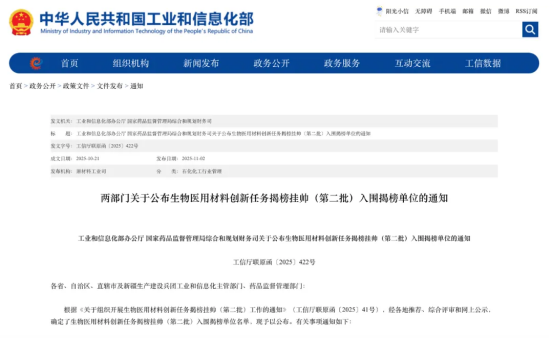
引领生物医用材料特色产业发展!中国药谷工信部“揭榜挂帅”企业+1
Zhong Guo Fa Zhan Wang· 2025-11-13 05:27
Core Insights - The Ministry of Industry and Information Technology and the National Medical Products Administration have announced the second batch of companies selected for the "Innovative Task of Biomedical Materials" initiative, with 14 companies from Beijing, including AoJing Medical Technology Co., Ltd. recognized for its "degradable semi-hydrated calcium sulfate" medical material [1][7] Company Overview - AoJing Medical is focused on the research, development, production, and sales of implantable medical devices for tissue regeneration and repair. The company pioneered the development of mineralized collagen biomimetic bone materials that closely resemble natural human bone tissue in composition and structure, achieving clinical transformation and industrialization [2][4] - The mineralized collagen biomimetic bone material consists of collagen and mineral components, such as hydroxyapatite, offering excellent biocompatibility and mechanical properties. It has been used in over one million clinical cases, demonstrating significant effectiveness in bone defect repair and regeneration [2][4] Industry Development - The Daxing Biomedical Industry Base is actively promoting the construction of specialized industrial parks, focusing on key technology research and development in high polymer materials, metal materials, and inorganic non-metallic materials [4][11] - The "Innovative Task of Biomedical Materials" initiative aims to address critical challenges in the industry, with selected companies receiving support in financing and regulatory reviews to accelerate technology transfer and application [11] - The Daxing Biomedical Industry Base has been officially named the "Zhongguancun (Daxing) Biomedical Materials Industrial Park," emphasizing its role in integrating medical and engineering sectors and fostering innovation in biomedical materials and medical devices [9][11]

财富趋势涨2.04%,成交额1.56亿元,主力资金净流出328.72万元
Xin Lang Cai Jing· 2025-11-13 03:42
Company Overview - Shenzhen Wealth Trend Technology Co., Ltd. is located in Shenzhen, Guangdong Province, and was established on January 25, 2007. It went public on April 27, 2020. The company specializes in providing software products for domestic securities trading systems and securities information services, primarily targeting financial institutions such as securities companies [2]. - The company's main business revenue composition includes: software service revenue 44.78%, securities information service revenue 28.94%, software sales revenue 26.22%, and other revenue 0.07% [2]. - Wealth Trend is classified under the Shenwan industry as Computer - Software Development - Vertical Application Software, and is associated with concepts such as Internet Finance, Artificial Intelligence, Big Data, Domestic Software, and Financial Technology [2]. Financial Performance - For the period from January to September 2025, Wealth Trend achieved operating revenue of 198 million yuan, a year-on-year decrease of 5.71%. However, the net profit attributable to the parent company was 184 million yuan, reflecting a year-on-year increase of 27.91% [2]. - Since its A-share listing, the company has distributed a total of 463 million yuan in dividends, with 263 million yuan distributed over the past three years [3]. Stock Market Activity - As of November 13, the stock price of Wealth Trend increased by 2.04%, reaching 131.21 yuan per share, with a trading volume of 156 million yuan and a turnover rate of 0.47%. The total market capitalization is 33.605 billion yuan [1]. - Year-to-date, the stock price has risen by 7.74%, but it has seen a decline of 5.41% over the last five trading days and a 10.74% decline over the last 20 days [1]. - Wealth Trend has appeared on the "Dragon and Tiger List" once this year, with the most recent appearance on June 25, where it recorded a net purchase of 18.4527 million yuan [1]. Shareholder Information - As of September 30, 2025, the number of shareholders of Wealth Trend was 24,200, an increase of 22.95% compared to the previous period. The average circulating shares per person decreased by 18.66% to 10,603 shares [2]. - Among the top ten circulating shareholders, Hong Kong Central Clearing Limited is the fifth largest with 1.5947 million shares, an increase of 70,800 shares from the previous period. The Huabao CSI Financial Technology Theme ETF ranks seventh with 1.2029 million shares, an increase of 563,600 shares [3].

南京泓崧智能科技有限公司成立 注册资本500万人民币
Sou Hu Cai Jing· 2025-11-13 00:19
Core Insights - Nanjing Hongsong Intelligent Technology Co., Ltd. has been established with a registered capital of 5 million RMB [1] Company Overview - The legal representative of the company is Zhang Ning [1] - The company operates in various sectors including technology services, digital technology services, big data services, and cloud computing equipment manufacturing and sales [1] - The business scope also includes intelligent robot sales, computer system services, artificial intelligence applications, and industrial automation control systems [1] Business Activities - The company is involved in technology transfer, promotion, and consulting, as well as sales of electrical equipment and instruments [1] - It provides services related to network technology, smart control system integration, and environmental protection equipment sales [1] - The company engages in import and export activities, including technology import and export, and domestic trade agency services [1]
游永恒:聚焦“能力矩阵”,改变“一考定终身”
Huan Qiu Wang Zi Xun· 2025-11-12 22:54
Core Viewpoint - The integration of AI and big data has shifted the supply of knowledge from scarcity to abundance, necessitating a transformation in talent assessment from a focus on memorization to a comprehensive evaluation of individual capabilities [1][4] Group 1: New Assessment Paradigm - The traditional talent selection model, which emphasizes static knowledge recall, is becoming less effective and misaligned with societal needs [1][2] - Future talent selection should be based on a matrix of core capabilities, including problem definition, critical thinking, and practical innovation [2][3] - The assessment should focus on the cognitive processes involved in problem-solving rather than merely the final answers [3] Group 2: Implementation Strategies - Future examinations may shift towards open-book formats that simulate real-world research environments, emphasizing information selection and logical reasoning [3] - The design of assessments should prioritize performance evaluation and project-based assessments to gauge collaborative and innovative skills [3] - Establishing a comprehensive personal capability digital portfolio will allow for continuous tracking of an individual's growth and skills beyond traditional scoring [3][4] Group 3: Societal Implications - The shift in assessment philosophy reflects a broader societal change in valuing unique cognitive abilities and creative potential over mere knowledge retention [4] - This transformation aims to cultivate proactive creators who can effectively leverage technology and drive future innovations [4]
多因素驱动ETF市场特色化发展
Zheng Quan Ri Bao· 2025-11-12 16:15
Core Insights - The ETF market has experienced significant growth, with total shares reaching 31.7 trillion and total assets amounting to 5.74 trillion yuan, alongside over 1,300 products available [1] - The market is diversifying, expanding from traditional equity ETFs to include bonds, commodities, currencies, and REITs, while also covering emerging sectors like semiconductors, AI, and carbon neutrality [1][2] - The development of innovative trading strategies and product differentiation is evident, with customized index products for institutional investors and regional theme ETFs aligning with national development strategies [1][2] Market Trends - The ETF market is characterized by a shift towards personalized investment solutions, driven by increasing competition and the need for differentiation among market participants [2] - Institutional investors are demanding customized ETFs that align with their long-term liabilities, leading to the creation of low-volatility and high-dividend index products [2] - Technological advancements, particularly in big data and AI, are facilitating product innovation within the ETF space, making it essential for firms to adapt to these changes [2] Future Outlook - The trend towards specialized and differentiated ETF products reflects a broader shift in the asset management industry from supply-driven to demand-driven strategies [2] - Successful products in the future will be those that can accurately capture industry changes and continuously lower the cost of investor participation [2]
会畅通讯(300578):Q3营收同比改善,加快“AI+云+硬件”全产业布局
Tianfeng Securities· 2025-11-12 15:19
Investment Rating - The investment rating for the company is "Accumulate" [8] Core Views - The company reported a slight improvement in revenue for Q3, with a year-on-year increase of 9.49% to 1.17 billion yuan, although the net profit decreased by 62.76% to 0.02 billion yuan [2] - The company is accelerating its full industry layout of "AI + Cloud + Hardware," focusing on industrial internet, artificial intelligence, cloud computing, and big data [3] - The subsidiary, Tomorrow Industry, is actively launching new products and enhancing its overseas strategy, including the release of various 4K and AI-enabled products [4] - The profit forecast for the company has been adjusted, with expected net profits of 0.16 billion yuan, 0.25 billion yuan, and 0.36 billion yuan for 2025-2027 [5] Financial Summary - For the first three quarters of 2025, the company achieved a revenue of 339 million yuan, a decrease of 0.48% year-on-year, and a net profit of 10 million yuan, down 55.84% [1] - The projected revenue for 2025 is 463.15 million yuan, with a growth rate of 2.24% [6] - The EBITDA for 2025 is estimated at 32.60 million yuan, with a significant increase in the following years [6] - The company’s net profit margin is projected to improve gradually, reaching 6.57% by 2027 [14]
真爱美家控制权将变更,昨日复牌“一字”涨停
Mei Ri Jing Ji Xin Wen· 2025-11-12 14:07
Core Viewpoint - The control of Zhenai Meijia has changed hands from Zheng Qizhong to Li Zhan, the founder and CEO of the unicorn company, Tanjitech, following a series of transactions involving Tanjitech acquiring a significant stake in Zhenai Meijia [1][5]. Group 1: Control Change Details - Zhenai Meijia's controlling shareholder, Zhenai Group, will transfer approximately 43.19 million shares (29.99% of total shares) to Tanjitech at a price of 27.74 yuan per share, totaling nearly 1.2 billion yuan [3][4]. - Tanjitech will initiate a partial tender offer for an additional 21.6 million shares (15% of total shares) at the same price of 27.74 yuan per share, contingent upon the completion of the share transfer [3][4]. - Zhenai Group will relinquish voting rights and commit to accepting the tender offer for approximately 18.73 million shares (13.01% of total shares) to facilitate the acquisition [4]. Group 2: Governance Changes - Following the completion of the tender offer, Tanjitech is expected to hold a total of 44.99% of Zhenai Meijia's shares and voting rights, while Zhenai Group's stake will decrease to 21.61% [4]. - The agreement stipulates that at least 8 out of 9 current board members must resign or the board must be re-elected, allowing Tanjitech to nominate 5 non-independent directors and 3 independent directors [4]. Group 3: Li Zhan's Background - Li Zhan, the new actual controller of Zhenai Meijia, is well-known in the tech investment circle and has received significant backing from top-tier investors like Alibaba and Sequoia [1][5]. - Tanjitech, founded by Li Zhan in 2016, focuses on intelligent sales SaaS solutions, leveraging AI and big data to enhance sales efficiency [6]. - Tanjitech has served over 10,000 enterprises and generated more than 900 million sales leads, with a valuation exceeding 1 billion USD [6].
全名单!2024年北京市科技奖授奖名单正式发布,青年奖26人、一等奖50项
机器人圈· 2025-11-12 10:51
Core Points - The 2024 Beijing Science and Technology Awards recognize significant contributions in various fields, including outstanding contributions, youth awards, international cooperation, and various scientific and technological advancements [2][3]. Group 1: Outstanding Contributions - The "Outstanding Contribution Zhongguancun Award" was awarded to 2 individuals, highlighting their significant impact in their respective fields [3]. Group 2: Outstanding Youth Awards - A total of 26 individuals received the "Outstanding Youth Zhongguancun Award," showcasing the emerging talent in science and technology [3]. Group 3: International Cooperation Awards - The "International Cooperation Zhongguancun Award" recognized 10 individuals, emphasizing the importance of global collaboration in scientific research [3]. Group 4: Natural Science Awards - The "Natural Science Award" included 15 first prizes and 42 second prizes, indicating a robust recognition of research excellence in natural sciences [3]. Group 5: Technological Invention Awards - The "Technological Invention Award" featured 6 first prizes and 18 second prizes, reflecting advancements in technology and innovation [3]. Group 6: Scientific and Technological Progress Awards - The "Scientific and Technological Progress Award" included 29 first prizes and 83 second prizes, demonstrating significant achievements in technological advancements [3].

车路云一体化规模发展时机已至
Zhong Guo Qi Che Bao Wang· 2025-11-12 10:21
Core Insights - The rapid advancement of technologies such as artificial intelligence and big data has positioned intelligent connected vehicles as a new competitive frontier in the global automotive industry [2] - China has made significant progress in the development of vehicle-road-cloud integration, contributing a Chinese solution to the global development of intelligent connected vehicles [2] Industry Progress - From January to July this year, approximately 7.76 million passenger cars with L2-level combined driving assistance functions were sold in China, achieving a penetration rate of 62% [3] - China has opened 35,000 kilometers of testing demonstration roads and issued over 10,000 testing demonstration licenses, with a total testing mileage exceeding 200 million kilometers [3] - The Chongqing pilot area for vehicle-road-cloud integration has expanded to over 5,000 square kilometers, with road mileage exceeding 2,500 kilometers, and has established a standardized urban cloud control platform [3] Technological Advancements - The configuration rate of onboard auxiliary driving systems and communication terminals in China has surpassed 60%, indicating that high-quality collaboration in vehicle-cloud integration has exceeded the threshold for mass production [4] - Distributed intelligence based on vehicle-road-cloud systems is becoming the mainstream solution for AI-enabled autonomous driving, with the need for collaborative intelligence becoming essential as the penetration rate of autonomous driving increases [4] Challenges and Recommendations - Six major challenges remain in the development of intelligent connected vehicles, including product performance recognition, accident scenario simulation testing, and the establishment of a profitable business model [5] - Recommendations include leveraging experiences from the development of new energy vehicles, accelerating key technology research, and promoting the industrialization of foundational platforms [6] - The importance of breaking down industry barriers and establishing an open, collaborative, and win-win industrial ecosystem is emphasized, along with the need for standardized regulations and reliable data-sharing mechanisms [6] Collaborative Initiatives - A historic breakthrough in industry collaboration was marked by a demonstration event involving 15 major domestic and foreign automotive companies, showcasing core mass production application scenarios under a unified cloud control platform [6]
