
科技创新债券

Search documents
科创债年内发行已超8893亿元,市场认购积极
news flash· 2025-06-19 23:38
Wind数据显示,按上市日期计,截至6月19日,年内科创债累计发行规模达8893.47亿元。自今年5月7日 中国人民银行与中国证监会联合发布《关于支持发行科技创新债券有关事宜的公告》后,按上市日期 计,5月7日至6月19日期间,已有222家发行主体发行了299只科创债,总规模达5014.76亿元。(证券日 报) ...
破冰科技金融改革!国信证券助力首批民营创投科创债落地深圳
Nan Fang Du Shi Bao· 2025-06-19 08:49
Group 1 - The core viewpoint of the news is that the successful issuance of the "2025 Annual First Phase Targeted Technology Innovation Bond" by Dongfang Fuhai marks a significant milestone in China's bond market, showcasing innovative financial products and mechanisms for supporting technology innovation [1][2][6] - The bond issuance was led by Guosen Securities, which played a crucial role in facilitating the process, establishing a collaborative working group, and customizing financing solutions for Dongfang Fuhai [2][4] - The bond achieved a subscription rate of 6.325 times, with a total issuance scale of 400 million yuan and a coupon rate of 1.85%, setting multiple records in the bond market [1][3] Group 2 - The issuance is seen as a benchmark for private venture capital institutions, providing a replicable model for direct financing channels and introducing new capital for technology innovation enterprises [2][4] - The bond's structure includes a large issuance scale, long maturity, and low cost, effectively addressing the financing challenges faced by private venture capital institutions [4][6] - The supportive policies from regulatory bodies, such as the People's Bank of China and the China Securities Regulatory Commission, are crucial for easing the financing difficulties of technology-oriented small and medium-sized enterprises [6][7]



申万宏源助力华夏银行股份有限公司2025年科技创新债券(第一期)成功发行
申万宏源证券上海北京西路营业部· 2025-06-19 02:18
Core Viewpoint - The successful issuance of the "Hua Xia Bank Co., Ltd. 2025 Technology Innovation Bond (Phase I)" with a scale of 10 billion yuan and a coupon rate of 1.78% marks a significant achievement in the market for commercial bank technology innovation bonds, reflecting the bank's commitment to supporting technological innovation and the real economy [1]. Group 1 - The bond issuance is the largest 5-year commercial bank technology innovation bond in the market [1]. - The bond has a term of 5 years and a coupon rate of 1.78%, which is the lowest for Hua Xia Bank's financial bonds [1]. - The issuance supports the bank's strategy to enhance financial services in the technology innovation sector, particularly for small and medium-sized enterprises and high-tech companies [1]. Group 2 - The successful issuance strengthens the partnership between the issuer and the underwriter, Shenwan Hongyuan Securities, enhancing the latter's influence in the technology innovation bond sector [1]. - The company aims to continue implementing national development strategies and fulfill its mission as a financial central enterprise [1].



北京发行首单民营创投“科创债”!5年期,规模3亿元
Bei Jing Ri Bao Ke Hu Duan· 2025-06-18 12:03
据悉,此次发行的是君联资本2025年度第一期定向科技创新债券,所募集资金将全部通过基金出资、股 权投资等方式用于科技创新领域,叠加民营机构的市场灵活性,为科技型企业提供更高效的股性资金支 持。债券发行后,将充分发挥资本撬动作用,助力完成百亿元规模的基金设立,直达科技创新"靶心", 成为"科技-产业-金融"良性循环的典型案例。 中关村科技担保相关负责人介绍,北京首单"科技创新债券"是在人民银行北京市分行、北京市财政局、 市科委中关村管委会等单位指导下发行注册的。债券的发行采用了"央地协同、风险共担"双重增信模 式,即由中债信用增进提供全额担保,中关村科技担保作为地方国企代表为项目提供反担保支持,打 造"国家信用-地方增信-机构反哺"三级风险缓冲带、实现长期风险可控,为债券的成功发行夯实基础, 也为专业增信担保机构参与民营股权投资领域科创债发行提供了参考经验。 在今年3月全国两会期间,中国人民银行行长潘功胜提出,将创新推出债券市场"科技板"。5月7日,中 国人民银行、中国证监会联合发布《关于支持发行科技创新债券有关事宜的公告》(简称"新政"),明 确指出,"具有丰富投资经验、出色管理业绩、优秀管理团队的股权投资机 ...
申万宏源助力华夏银行股份有限公司2025年科技创新债券(第一期)成功发行
申万宏源证券上海北京西路营业部· 2025-06-18 03:04
Core Viewpoint - The successful issuance of the "Hua Xia Bank Co., Ltd. 2025 Technology Innovation Bond (Phase I)" signifies a strategic move towards enhancing financial services in the technology innovation sector, with a focus on supporting small and medium-sized enterprises and high-tech companies [1] Group 1 - The bond issuance scale is 10 billion yuan, with a term of 5 years and a coupon rate of 1.78%, marking the lowest coupon rate for Hua Xia Bank's financial bonds [1] - This bond is the largest 5-year commercial bank technology innovation bond currently in the market, reflecting the growing emphasis on technology finance [1] - The issuance supports the bank's strategy to strengthen financial services for technology-driven enterprises, contributing to high-quality development of the real economy [1] Group 2 - The bond represents the first collaboration between the company and the issuer, which has been highly recognized by the issuer, solidifying the partnership and enhancing the company's influence in the technology innovation bond sector [1] - The company aims to continue implementing national development strategies and fulfill its mission as a financial central enterprise [1]

票面利率2.1%、3.58倍认购!民营股权投资机构“科创债”首单落地
Hua Xia Shi Bao· 2025-06-17 23:20
Group 1 - Zhongke Chuangxing successfully issued the first phase of targeted technology innovation bonds in the interbank bond market, with a scale of 400 million yuan and a term of 5+5 years at a coupon rate of 2.10% [2][3] - The bond issuance received a subscription multiple of 3.58 times, indicating strong market confidence in Zhongke Chuangxing's value investment philosophy and optimism towards hard technology sectors [2][3] - The funds raised will be used for investments in hard technology fields such as new generation information technology, artificial intelligence, and semiconductors [3] Group 2 - The issuance of technology innovation bonds has been characterized by large issuance scales, long terms, and low interest rates since the launch of the "technology board" on May 7 [3] - Zhongke Chuangxing aims to continue issuing technology innovation bonds to attract more market-based funds to support technology enterprises and cultivate patient capital [3][5] - The People's Bank of China has introduced risk-sharing tools to support the issuance of low-cost, long-term technology innovation bonds, enhancing risk control through collaboration with local governments and credit enhancement agencies [5] Group 3 - Credit rating agencies are optimizing the credit rating system for equity investment institutions and technology enterprises to better align with the characteristics of technology innovation [5][6] - Far East Credit has launched a new credit rating method for equity investment institutions, focusing on capital operation capabilities, risk management levels, and value discovery efficiency [6] - The new rating method emphasizes investment management capabilities and project quality over traditional metrics like asset size, aiming to enhance the operational resilience and growth potential of equity investment institutions [6]

发行利率1.85%!东方富海成功发行科创债券 发债成本大幅降低
Zheng Quan Shi Bao Wang· 2025-06-17 11:29
Group 1 - The core viewpoint of the news is the successful issuance of the first phase of targeted technology innovation bonds by Dongfang Fuhai, marking a significant milestone in the private equity investment sector in China [1][3] - The total registered scale of the project is 1.5 billion yuan, with the first phase raising 400 million yuan and a bond term of 10 years [1] - The issuance was led by Guosen Securities, with an interest rate of 1.85%, and the subscription reached 6.3 times the amount offered, indicating strong market interest [1][3] Group 2 - The project aligns with the recent policy directives from the central government aimed at enhancing the financing ecosystem for technology enterprises, particularly through the integration of debt and equity financing [2] - The innovative dual guarantee mechanism involving central and local enterprises significantly reduces the cost of bond issuance for private equity firms, facilitating long-term, low-cost funding for technology innovation [2][4] - The bond's design allows for flexible issuance and focuses on the technological attributes rather than traditional asset-based metrics, addressing the challenges faced by private equity firms in obtaining financing [3][5] Group 3 - The successful launch of this bond represents a new financing model for technology enterprises, combining policy guidance with market mechanisms to enhance funding capabilities [5] - The collaboration between central and local entities in risk-sharing is expected to provide a stable funding source for technology innovation, contributing to the long-term development of the sector [4][5] - This initiative is seen as a replicable model for other regions in China, promoting deeper integration between technology innovation and financial capital [5]
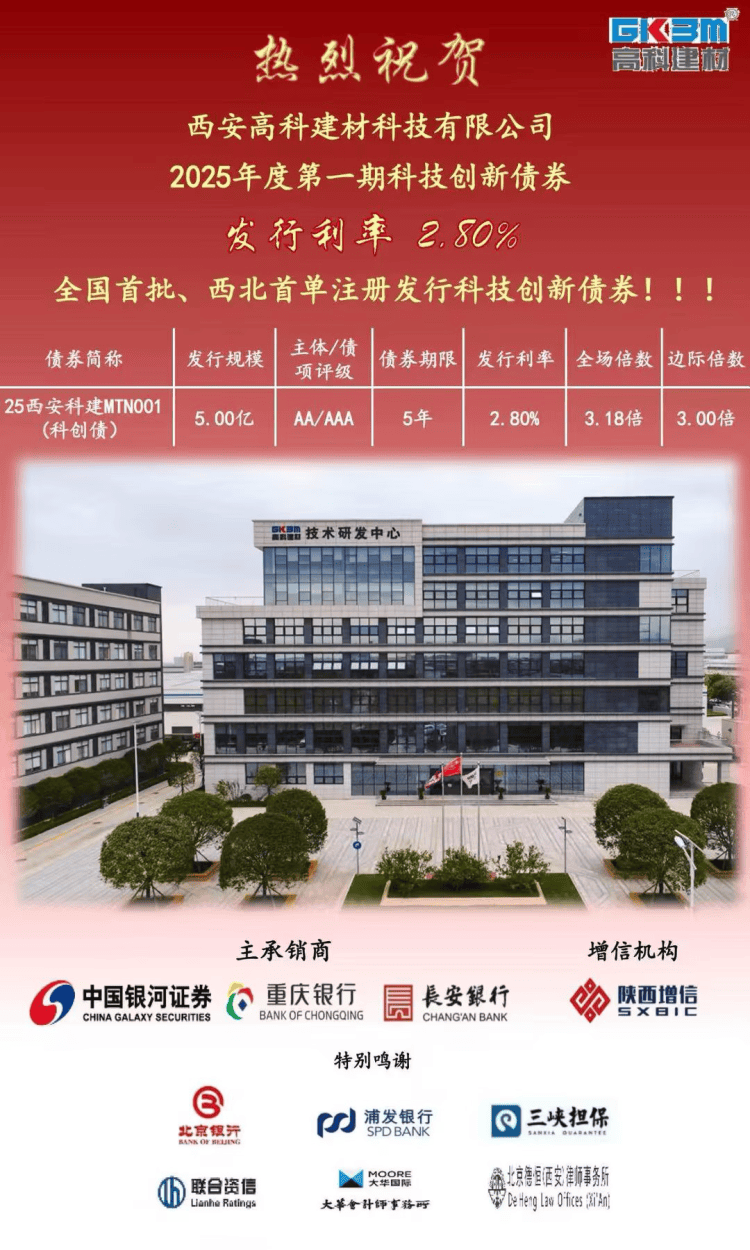
西安高科建材成功注册发行全国首批、西北首单科技创新债券
Sou Hu Cai Jing· 2025-06-17 04:37
Core Viewpoint - Xi'an High-tech Materials Technology Co., Ltd. successfully issued the first phase of its 2025 technology innovation bonds, raising RMB 500 million with a competitive interest rate of 2.8%, marking it as the first registered and issued technology innovation bond in Northwest China and among the first in the country [1][4]. Group 1: Bond Issuance Details - The bond, named "25 Xi'an Science and Technology Construction MTN001," has a total issuance scale of RMB 500 million, a term of 5 years, and an interest rate of 2.8% [2][4]. - The bond was well-received, with a total subscription multiple of 3.18 times and a marginal multiple of 3 times, indicating strong investor interest [2][4]. Group 2: Market Context and Support - The issuance occurred during a favorable policy window, following announcements from the People's Bank of China and the China Securities Regulatory Commission aimed at supporting technology innovation bonds [6]. - Financial institutions such as Beijing Bank, Shanghai Pudong Development Bank, and Sanxia Guarantee Group actively participated in the investment, showcasing strong market support for high-tech enterprises [4][6]. Group 3: Use of Proceeds and Strategic Alignment - The funds raised will primarily support technology innovation in advanced manufacturing and new environmental protection industries, aligning with the company's development strategy and the transformation of traditional industries [7]. - The issuance reflects a strategic partnership between financial institutions and technology enterprises, emphasizing the importance of financing for innovation [7].
申万宏源助力云南锡业集团5亿元科技创新中期票据成功发行
申万宏源证券上海北京西路营业部· 2025-06-16 01:30
Core Viewpoint - The successful issuance of the "Yunnan Tin Industry Group (Holding) Co., Ltd. 2025 First Phase Technology Innovation Medium-Term Notes" marks a significant milestone for Yunnan Province's bond market, establishing a new benchmark for technology board bonds [1][2]. Group 1 - The bond issuance was for a scale of 500 million yuan, with a term of 3 years and a coupon rate of 2.28%, making it the first successful technology board bond in Yunnan Province [1]. - The issuance was in response to the Yunnan Provincial State-owned Assets Supervision and Administration Commission's policy to encourage state-owned enterprises to issue technology innovation bonds to promote industrial upgrades [1]. - Yunnan Tin, as a state-owned enterprise with a 141-year history, leads in technological innovation within the non-ferrous metal industry and has the most complete tin industry chain globally, consistently ranking first in tin metal production and sales [1]. Group 2 - The successful bond issuance demonstrates Shenwan Hongyuan Securities' expertise in developing and pricing industrial bonds, achieving an oversubscription of over 3 times, which reflects strong market recognition [2]. - The partnership between Shenwan Hongyuan Securities and Yunnan Tin has been further solidified through this issuance, with plans for continued innovation in technology financial services to support the development of new productive forces and breakthroughs in key material technologies [2].


中信证券:中国人民银行同意公司发行不超过150亿元科技创新债券,核准额度自该决定书发出之日起两年内有效,有效期内公司可自主选择分期发行时间。
news flash· 2025-06-13 10:33
中信证券:中国人民银行同意公司发行不超过150亿元科技创新债券,核准额度自该决定书发出之日起 两年内有效,有效期内公司可自主选择分期发行时间。 ...
