Artificial General Intelligence (AGI)

Search documents
OpenAI要换CEO?OpenAI权力迎来变数?
首席商业评论· 2025-08-23 10:44
Core Viewpoint - Sam Altman is not leaving OpenAI, but he mentioned he may not be the best CEO for the company if it goes public, indicating a potential leadership transition in the future [2][7]. Group 1: Leadership and Management - Sam Altman discussed the possibility of OpenAI going public and suggested that he might not be the most suitable CEO for that phase [2]. - There are speculations that Fidji Simo could be the future CEO post-IPO, as she has experience from Facebook's growth and leading Instacart to its IPO [3][7]. - Sam Altman is expected to focus on fundraising, infrastructure investments, AGI, and other innovative projects while a new CEO would handle commercialization [2][9]. Group 2: Financial Performance and Commercialization - ChatGPT's mobile application has generated $2 billion in revenue globally since its launch in May 2023, with a significant growth of 673% year-over-year, reaching $1.35 billion in 2025 [7]. - The future commercialization of OpenAI, particularly through advertising and e-commerce, is likely to be led by Fidji Simo, given her familiarity with these business models [3][7]. - OpenAI is expected to accelerate its commercialization efforts and aim for a public listing, indicating a shift from its previous non-profit structure [2][9].


DeepSeek又更新了,期待梁文锋“炸场”
Hu Xiu· 2025-08-21 02:28
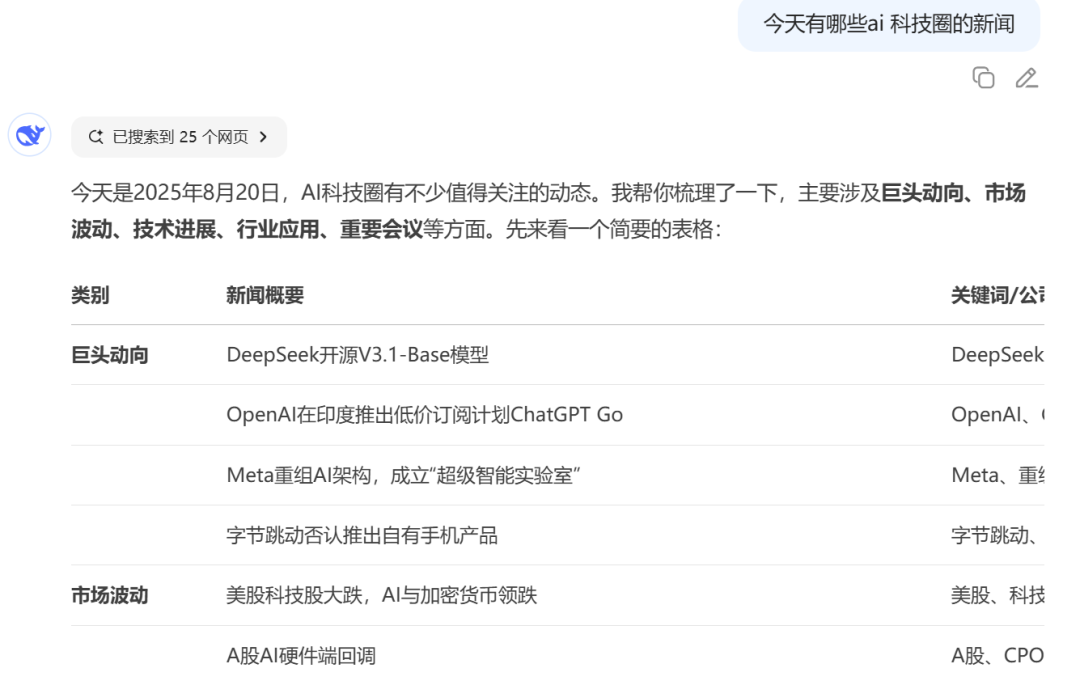
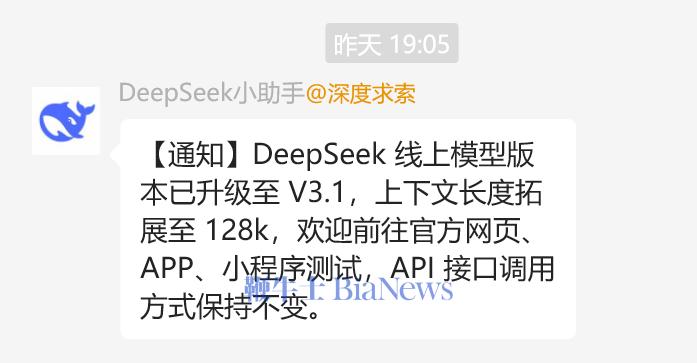
Core Insights - DeepSeek has released an updated version of its model, V3.1, which shows significant improvements in context length and user interaction, although it is not the highly anticipated R2 model [2][4][14] - The model now supports a context length of 128K, enhancing its ability to handle longer texts and improving its programming capabilities [5][10] - The update merges the functionalities of V3 and R1, leading to reduced deployment costs and improved efficiency [13][25] Group 1: Model Improvements - The new V3.1 model has a parameter count of 685 billion, showing only a slight increase from the previous version, V3, which had 671 billion parameters [7] - User experience has been enhanced with more natural language responses and the use of tables for information presentation [8][10] - The programming capabilities of V3.1 have been validated through tests, achieving a score of 71.6% in multi-language programming, outperforming Claude 4 Opus [10] Group 2: Market Context - The release of V3.1 comes seven months after the launch of R1, during which time other major companies have also released new models, using R1 as a benchmark [3][16] - Despite the improvements in V3.1, the industry is still eagerly awaiting the release of the R2 model, which has not been announced [4][20] - The competitive landscape includes companies like Alibaba and ByteDance, which have launched models that claim to surpass DeepSeek R1 in various metrics [17][19] Group 3: Future Outlook - There are indications that the merging of V3 and R1 may be a preparatory step for the release of a multi-modal model [25] - Industry insiders suggest that the focus will shift towards innovations in economic viability and usability for future models [24] - The absence of the R2 model in the current update has heightened expectations for its eventual release, with speculation that it may not arrive until later [21][22]

DeepSeek又更新了,期待梁文锋「炸场」
Xin Lang Ke Ji· 2025-08-21 00:52
Core Viewpoint - The recent upgrade of DeepSeek to version 3.1 has shown significant improvements in context length and user interaction, while also merging features from previous models to reduce deployment costs [1][11][12]. Group 1: Model Improvements - DeepSeek V3.1 now supports a context length of 128K, enhancing its ability to handle longer texts [4]. - The model's parameter count increased slightly from 671 billion to 685 billion, but the user experience has improved noticeably [5]. - The model's programming capabilities have been highlighted, achieving a score of 71.6% in multi-language programming tests, outperforming Claude 4 Opus [7]. Group 2: Economic Efficiency - The merger of V3 and R1 models allows for reduced deployment costs, requiring only 60 GPUs instead of the previous 120 [12]. - Developers noted that the performance could improve by 3-4 times with the new model due to increased cache size [12]. - The open-source release of DeepSeek V3.1-Base on Huggingface indicates a move towards greater accessibility and collaboration in the AI community [13]. Group 3: Market Context - The AI industry is closely watching the developments of DeepSeek, especially in light of the absence of the anticipated R2 model [19]. - Competitors like OpenAI, Google, and Alibaba have released new models, using R1 as a benchmark for their advancements [1][15]. - The market is eager for DeepSeek's next steps, particularly regarding the potential release of a multi-modal model following the V3.1 update [23].
OpenAI总裁透露GPT-5改了推理范式,AGI实现要靠现实反馈
3 6 Ke· 2025-08-18 11:02
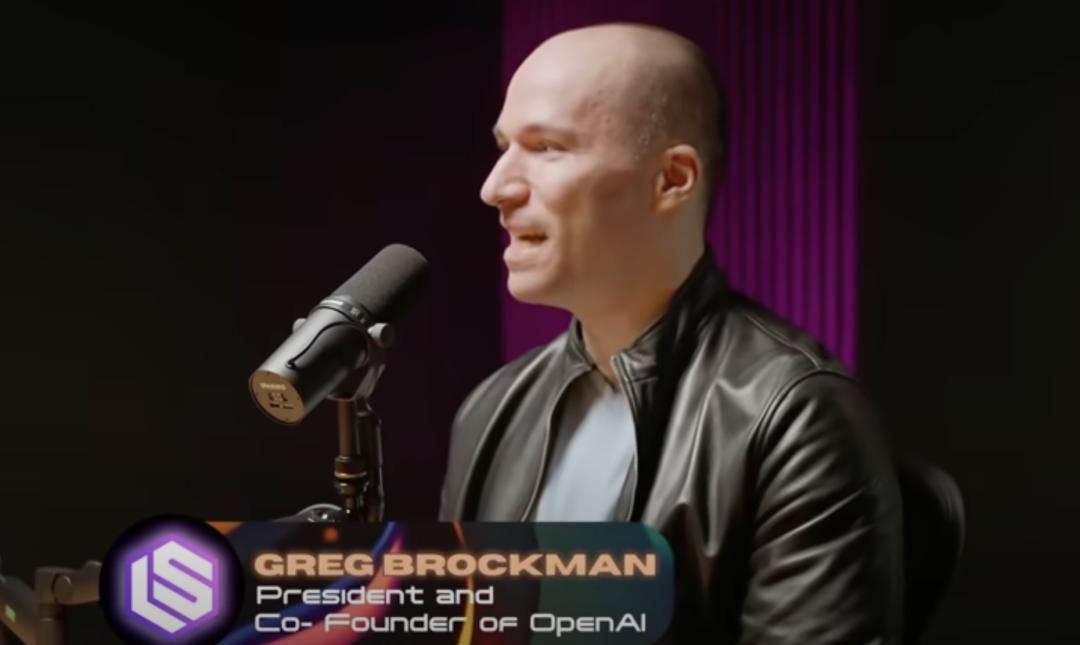
Core Insights - OpenAI is transitioning from text generation to reinforcement learning as a key paradigm for developing AGI, focusing on real-world testing and feedback [1][3] - The company emphasizes the importance of computational resources as a primary bottleneck in AGI development, with the amount of computation directly influencing the speed and depth of AI research [9][11] - OpenAI aims to integrate large models into enterprise and personal workflows, packaging model capabilities into auditable service processes [13][15] Technical Paradigm Shift - The release of GPT-5 marks a significant paradigm shift in AI, being OpenAI's first hybrid model designed to bridge the gap between the GPT series and AGI [4] - OpenAI is adopting a new reasoning paradigm where models learn through supervised data and then refine their capabilities via reinforcement learning in real-world environments [8][10] Computational Capacity - Brockman identifies computational power as the main limitation in AGI development, asserting that increased computational resources can lead to improved model performance [9][11] - The current reinforcement learning approach in GPT-5, while more sample-efficient, still requires extensive computational resources for task learning [10] Model Deployment - OpenAI's goal is to embed large models into production environments, moving beyond research applications to practical implementations [13][15] - The company is developing a dual-layer "defense in depth" structure to ensure the controllability and safety of high-permission agents [15][16] Industry Opportunities - Brockman believes there are vast untapped opportunities in integrating AI into real-world applications across various industries, encouraging developers to understand industry specifics before implementing AI solutions [18][20] - The future of AI will see a high demand for computational resources, making access to and allocation of these resources a critical issue for researchers [12][20]
GPT-5“让人失望”,AI“撞墙”了吗?
华尔街见闻· 2025-08-18 10:44
Core Viewpoint - The release of OpenAI's GPT-5 has not met expectations, leading to disappointment and raising questions about the current limits of generative AI technology, despite ongoing enthusiasm in capital markets for practical applications of AI [1][2][3]. Group 1: Performance and Expectations - Users have reported low-level errors in GPT-5, such as incorrect labeling of the U.S. map, and expressed dissatisfaction with its performance compared to previous models [2][3]. - CEO Sam Altman acknowledged the release was "bumpy," attributing issues to a malfunctioning "automatic switcher" that caused the system to call a weaker model [3][4]. - The optimism surrounding AGI has not materialized with GPT-5, leading to a reassessment of its capabilities and the competitive landscape, as rivals like Google and Anthropic have narrowed the gap with OpenAI [4][6]. Group 2: Scaling Laws and Limitations - The core logic supporting large language models, known as "scaling laws," is approaching its limits, with data exhaustion and physical/economic constraints on computational power being significant challenges [6][8]. - The training of GPT-5 reportedly utilized hundreds of thousands of next-generation Nvidia processors, highlighting the immense energy consumption required for such models [6]. Group 3: Market Dynamics and Investment Trends - Despite concerns about technological stagnation, investment in AI startups and infrastructure remains robust, with AI accounting for 33% of global venture capital this year [7][10]. - The focus of the AI race is shifting from achieving AGI to practical productization, with companies like OpenAI deploying engineers to assist clients in integrating AI models [8][9]. - Investors are increasingly valuing the strong growth of products like ChatGPT, which has generated an annual recurring revenue of $12 billion for OpenAI, rather than the distant promise of AGI [10][11].

Did Meta CEO Mark Zuckerberg Just Hint at Microsoft Investors' Worst Nightmare?
The Motley Fool· 2025-08-12 08:44
Core Viewpoint - Meta's new AI initiative, aimed at developing superintelligence, could potentially disrupt Microsoft's business, particularly its productivity software segment [2][9]. Group 1: Meta's AI Initiative - Meta's CEO Mark Zuckerberg articulated a vision for "personal superintelligence" that aims to enhance individual capabilities and experiences [3][4]. - The company claims to be making progress in developing superintelligence, with indications that its AI systems are beginning to improve themselves [5]. - Zuckerberg suggested that if trends continue, people may spend less time on productivity software and more on creative and social activities [6][9]. Group 2: Microsoft's Business Impact - Microsoft's productivity and business processes segment generated $33.1 billion in revenue for the quarter ending June 30, 2025, accounting for 43% of its total revenue [7]. - A significant portion of this revenue is derived from productivity software, which is critical to Microsoft's business model [8]. - The potential decline in productivity software usage due to Meta's superintelligence could pose a risk to Microsoft's revenue and profits [9]. Group 3: Future Considerations - The impact of Meta's superintelligence on Microsoft largely depends on the success of Meta's initiatives, though skepticism exists regarding the feasibility of such predictions [11]. - A key distinction is made that while people may spend less time using productivity software, it does not necessarily mean that the software itself will be used less, as AI may continue to leverage these tools [12]. - The expectation is that both Meta and Microsoft can coexist and thrive, allowing long-term investors to remain optimistic [13].



GPT-5数字母依然翻车!马库斯:泛化问题仍未解决,Scaling无法实现AGI
量子位· 2025-08-11 10:12
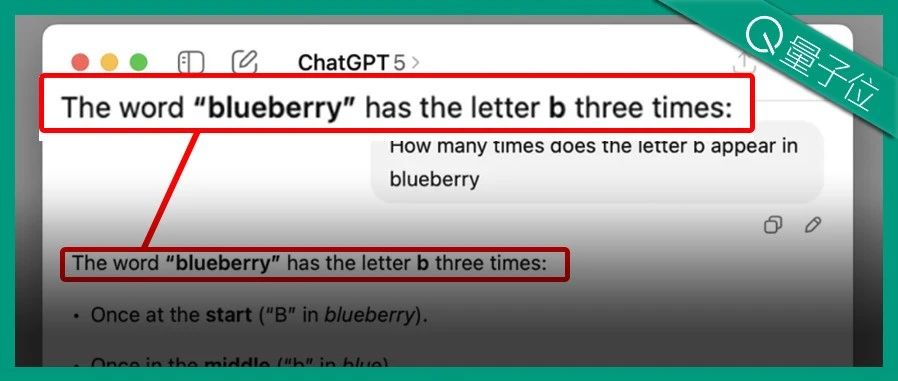
Core Viewpoint - The article discusses the limitations and bugs of GPT-5, particularly its inability to accurately count letters in words, highlighting a specific incident involving the word "blueberry" [2][20][39]. Group 1: GPT-5's Counting Errors - A Duke University professor, Kieran Healy, tested GPT-5 by asking it to count the number of 'b's in "blueberry," to which GPT-5 incorrectly responded with three [2][4]. - Despite multiple attempts to clarify and correct GPT-5's counting, including asking it to spell out the 'b's, the model remained adamant about its incorrect count [8][9][11]. - Eventually, after persistent efforts from users, GPT-5 acknowledged the correct count but claimed the error was due to misinterpreting the word [15]. Group 2: General Bugs and Limitations - Gary Marcus, a notable critic, compiled various bugs found in GPT-5, including failures in basic principles like Bernoulli's principle and chess rules [20][23]. - The model also struggled with reading comprehension, misidentifying images with altered characteristics, such as a zebra with five legs [26][28]. - Marcus argues that the underlying issues with GPT-5 are indicative of broader problems in large models, particularly their inability to generalize effectively, which he attributes to long-standing issues like distribution drift [38][39][41].
深聊GPT-5发布:过度营销的反噬与AI技术突破的困局
硅谷101· 2025-08-11 04:26
GPT-5 Release & Technical Analysis - GPT-5's release is considered a refinement rather than a revolutionary step compared to GPT-4, failing to deliver the expected "ChatGPT moment" [1] - OpenAI's GPT-5 uses a "Real-time Model Router" to integrate different sub-models, which is not a novel technological breakthrough [1] - The industry speculates that the end-to-end training super-large model route has reached its peak, leading OpenAI to use "tricky" technologies to solve product-level problems [1] - OpenAI faces challenges in balancing system cost, development, and application, especially in handling high-frequency, simple user queries [1] - Model training for GPT-5 began early in 2024, but the model was only officially named GPT-5 after reaching a major milestone [4] - Scaling Law has hit a wall due to a lack of high-quality and diverse human-generated data, delaying OpenAI's Orion project [12] - Model training often leads to model crashes, including "catastrophic forgetting" during reinforcement learning [15] Market & Application - OpenAI is targeting education, programming, and healthcare as the three main battlefields for commercialization [2] - The market is questioning how much share of the education market ChatGPT will grab, impacting companies like Duolingo [2] - The global AI medical market is predicted to soar from US$2669 million in 2024 to US$18838 million in 2030, with a compound annual growth rate of 3862% [3] - OpenAI's GPT-5 demonstrates a significant upgrade in coding capabilities, leading to a new round of competition in the coding market [3] Future Development & Alternatives - Reinforcement learning, multimodal capabilities, and exploring alternative framework paradigms are key to optimizing cutting-edge large models [20] - Multimodality and world models will be crucial to the future development of AI, with a focus on video and world models [27][31] - Joint Embedding Predictive Architecture (JEPA) aims to overcome the limitations of large language models and advance AI towards understanding the physical world [38][39]
GPT-5降价反击!OpenAI打响B端争夺战
Di Yi Cai Jing Zi Xun· 2025-08-09 13:01
Core Viewpoint - OpenAI has released its new GPT-5 model, which, despite being touted as a significant advancement, appears to lack groundbreaking capabilities compared to its predecessors, particularly in terms of artificial general intelligence (AGI) [2][4]. Pricing and Market Strategy - GPT-5 is priced lower than its competitors, with input costs reduced from $2.50 to $1.25 per million tokens, while output costs remain at $10 per million tokens, making it more affordable than models from Claude and Gemini [4][5]. - OpenAI aims to target the B2B professional developer market, which is currently dominated by Anthropic [6]. User Growth and Market Position - ChatGPT's user base has surged to 700 million weekly active users, a fourfold increase compared to the previous year, indicating strong C2C growth [7][16]. - In the B2B market, OpenAI's share has dropped to 25%, while Anthropic has gained a leading position with 32% [8][11]. Model Improvements - GPT-5 has shown a significant reduction in "hallucinations," with factual error rates decreasing by approximately 45% compared to GPT-4o and 80% compared to GPT-3 [14][15]. - The model's coding capabilities have improved, achieving a 69.6% success rate in multi-step instruction adherence, surpassing GPT-3's 60.4% [14]. Product Structure and User Experience - GPT-5 is structured as a unified system comprising a base model, a deep reasoning model, and a routing mechanism to optimize responses based on user queries [19][22]. - The updated ChatGPT no longer offers model selection to users, simplifying the interaction and reducing cognitive load [21][22]. Competitive Landscape - OpenAI's recent strategic adjustments aim to reclaim its position in the B2B market, focusing on professional developers who provide valuable feedback for model improvement [15][24]. - The shift towards a more automated model selection process reflects a trend in the industry to streamline user experience while maintaining output stability [22][25].
独家|陈天桥布局端到端Deep Research生态赛道,MiroMind发布全栈开源深度研究项目ODR
Z Potentials· 2025-08-09 04:50
Core Insights - MiroMind aims to build a self-aware digital agent ecosystem, focusing on the continuous evolution of Artificial General Intelligence (AGI) through community collaboration and open-source principles [2][4]. Group 1: Open Source Ecosystem - MiroMind has developed a comprehensive open-source ecosystem that includes the Agent framework (MiroFlow), models (MiroThinker), data (MiroVerse), and training infrastructure (MiroTrain/MiroRL), all of which are open for learning, reuse, and further development [1][8]. - The MiroFlow framework achieved a state-of-the-art (SOTA) score of 82.4 on the GAIA validation set, surpassing existing commercial model APIs [1][12]. - MiroThinker, the core model, reached a SOTA performance of 60.2% on the GAIA-Text-103 dataset, nearing the performance level of OpenAI's Deep Research [1][15]. Group 2: Community Collaboration - MiroMind fosters a developer-centric environment that encourages community participation through data requests, feature customization, and technical challenges, with feedback directly influencing project development [2][22]. - The project organizes various community activities such as competitions, leaderboards, and hackathons to enhance developer engagement and contribution [22]. Group 3: Key Personnel - The project is led by Chen Tianqiao, a renowned entrepreneur known for his strategic vision and significant contributions to brain science and AI [4]. - Dai Jifeng, a key figure in the project, is a professor at Tsinghua University with extensive experience in computer vision and deep learning, having published over 80 papers with significant citations [5][6].