
房地产高质量发展

Search documents
地产行业月报:政策预期有所升温,持续看好优质企业-20251128
Ping An Securities· 2025-11-28 09:21
Investment Rating - Industry investment rating: Real Estate Stronger than the Market (maintained) [1] Core Viewpoints - The report indicates that the sales decline in October and November is expanding due to the high base from the previous year, with a need for macro policies to stabilize residents' income expectations and enhance purchasing power. The report emphasizes the importance of improving residents' willingness and ability to buy homes to stabilize the housing market [2][3] - The report suggests that the key to the housing market's stabilization lies in the improvement of residents' purchasing power and willingness to buy homes, which will ultimately lead to an improvement in supply-demand dynamics [2] - The report highlights the necessity of reducing mortgage rates through measures such as interest rate cuts or government subsidies to enhance the attractiveness of home purchases [2] Summary by Sections Policy - The report discusses the promotion of high-quality development in real estate, emphasizing the "Good House" initiative during the 14th Five-Year Plan, which aims to improve housing standards, design, materials, construction, and maintenance [3][4][5] Financing - The report notes a year-on-year decrease in long-term loans to residents, with a significant drop in new long-term loans in October 2025, amounting to a reduction of 700 billion yuan, which is 1.8 trillion yuan less than the previous year [10][11] Real Estate Market - The report states that the average daily transaction volume of new homes in 50 key cities fell by 31.4% year-on-year in October and by 46.3% in November, while the second-hand housing market also saw significant declines [19][25] - The report indicates that the average land supply in 100 cities was 1.3 million square meters in October, a decrease of 17.2% month-on-month, while the average transaction area increased by 3.4% [26] Real Estate Companies - The report highlights that the sales amount of the top 100 real estate companies fell by 40.6% year-on-year in October, with a cumulative decline of 16.7% for the first ten months of 2025 [34][38] - The report mentions that the average land acquisition ratio for the top 50 real estate companies increased, indicating a rise in land acquisition activity despite the overall sales decline [38] Market Performance - The report notes that the real estate sector underperformed the broader market, with a decline of 2.37% in October, while the current price-to-earnings ratio (P/E) for the real estate sector is 62.32, significantly higher than the 13.92 for the broader market [42]
优质土储增厚核心竞争力 滨江集团24.62亿竞得杭州两宗宅地
Quan Jing Wang· 2025-11-28 07:58
Core Insights - Binjiang Group has successfully acquired two plots of state-owned land in Hangzhou for residential development, enhancing its land reserve and strategic positioning in the core market [1][2] Land Acquisition - The first plot (杭政储出[2025]127号) covers an area of 33,978 square meters with a floor area ratio of 1.2, purchased for a total price of 848.54 million yuan [1] - The second plot (杭政储出[2025]128号) spans 28,869 square meters with a floor area ratio of 2.5, acquired for 1.61345 billion yuan [2] - Both plots are strategically located in prime areas of Hangzhou, with the first plot near Xianghu Lake and the second in a well-connected area of Xiaoshan District [1][2] Strategic Focus - The acquisition aligns with the company's strategy of focusing on high-quality land reserves, which is crucial for sustainable long-term development in the real estate sector [1][2] - As of mid-2025, 73% of the company's land reserves are concentrated in Hangzhou, with 17% in other strong economic cities in Zhejiang Province, and 10% outside the province, indicating a balanced growth strategy [2] Financial Performance - For the first three quarters of 2025, the company reported revenue of 65.514 billion yuan, a year-on-year increase of 60.64%, and a net profit of 2.392 billion yuan, up 60.38% [2] - The company's strong financial performance reflects its operational strength and the value realization of its quality land reserves [2] Industry Context - The "14th Five-Year Plan" emphasizes the need for high-quality development in the real estate sector, shifting focus from quantity to quality and aligning with public welfare [3] - Binjiang Group is positioned to navigate the cyclical changes in the real estate market by enhancing brand strength and product quality, which are critical for maintaining competitive advantage [3][4] Customer Loyalty and Brand Strength - The company employs a strategy focused on quality marketing and customer satisfaction, with over 96% of homeowners willing to recommend its properties [4] - The company's credit rating has improved to AAA, facilitating better financing conditions and lower costs, which supports its growth strategy [4]

58安居客研究院张波:年轻人不想被高房价绑架,房地产新时代是要“服务于人”
Sou Hu Cai Jing· 2025-11-27 02:47
Core Insights - The forum highlighted the transition in China's real estate sector from a focus on property as a wealth generator to a more sustainable model that prioritizes living quality and community needs [2][16] - The "14th Five-Year Plan" emphasizes the need for diversified income sources for urban residents, signaling a shift away from the "property-centric" wealth logic [7][10] Group 1: Real Estate Market Trends - 70% of urban household wealth is tied to real estate, meaning a 10% fluctuation in property prices can impact trillions in household assets [7] - New residential prices in 70 major cities have been declining, with a 0.4% month-on-month drop in September and a 0.6% drop in second-hand housing prices, marking the largest decline since last year's fourth quarter [7][10] - In first-tier cities, second-hand housing prices have decreased by 3.2% year-on-year, with some hot school district properties in Guangzhou and Shenzhen seeing price drops exceeding 20% from peak values [7] Group 2: Land Finance Transformation - Local governments are shifting from "incremental land sales" to "stock operation," indicating a move away from reliance on land finance, which has historically been a significant revenue source [4][10] - Over 80% of local government revenue comes from land sales, but there has been a 10% year-on-year decline in land transfer fees in key cities, while some core cities like Shanghai and Beijing have seen a 19.7% increase in land sales revenue [10][11] - The new model proposed in the "14th Five-Year Plan" focuses on improving existing properties and enhancing their quality and efficiency, such as converting idle office buildings into residential spaces [11] Group 3: Youth Housing Challenges - Young people, particularly those born in the 1990s and 2000s, are increasingly rejecting traditional milestones like homeownership, marriage, and parenthood due to financial pressures, with housing costs consuming over 70% of their average income [12][13] - The "14th Five-Year Plan" aims to address youth housing issues by optimizing affordable housing supply and ensuring quality living conditions, which could encourage young people to consider marriage and family [13][14] - A survey indicated that 68% of young people would consider marriage and children if stable affordable housing were available, highlighting the need for housing solutions that do not compromise their financial freedom [13] Group 4: Future Outlook - The future of real estate will focus on understanding and meeting the needs of residents rather than merely increasing the quantity of housing [15][16] - The "14th Five-Year Plan" serves as a guiding framework for transitioning the real estate sector towards a model that supports sustainable living and community well-being, moving away from the "land myth" [15][16]

万科频现土拍市场 在杭州和武汉连续拿下两宗地块
Cai Jing Wang· 2025-11-26 01:20
Core Insights - Vanke has been actively participating in land auctions, recently acquiring two plots in Hangzhou and Wuhan on November 25, showcasing a strategy of joint ventures and acquiring land at base prices [1][2] - The company is focusing on innovative investment models, emphasizing the importance of good cities, good plots, and good houses through methods like construction agency and collaboration [1][2] Group 1: Recent Land Acquisitions - On November 25, Vanke, in partnership with Hangzhou Anju Construction Investment Group, acquired a plot in the Gongshu District of Hangzhou for a total price of 1.015 billion yuan, with a floor price of 14,931 yuan per square meter [1] - Vanke, in collaboration with Hubei Keti Investment, also secured a residential plot in Wuhan's Optics Valley Financial Port for a base price of 394 million yuan, with a floor price of 6,400 yuan per square meter [1] - Vanke's recent land acquisitions in Chongqing and Chengdu also reflect a strategy of "increasing positions," with a focus on low plot ratios and small land parcels [2] Group 2: Strategic Focus and Resource Management - Vanke's new chairman, Huang Liping, emphasized the need for strategic focus and risk management during a recent shareholders' meeting, aiming for high-quality development in real estate [3] - The company is prioritizing the activation of existing resources, with a reported 22.8 billion yuan in new salable value generated in the first ten months of the year [3] - Vanke's management highlighted the importance of revitalizing historical resources through methods such as resource exchange and optimization, especially in a context of tight funding and limited new investments [3]

发展向前 民生向暖|努力实现“住有优居”
Zhong Guo Jing Ji Wang· 2025-11-25 07:30
Core Viewpoint - The article emphasizes the importance of high-quality development in the real estate sector as a means to improve people's livelihoods and support economic growth, highlighting the shift from a shortage of housing to a balanced supply-demand structure [1][2]. Group 1: Policy Framework - The "14th Five-Year Plan" has laid a solid foundation for high-quality real estate development by achieving approximately 5 billion square meters of new residential sales and constructing over 11 million units of affordable housing, benefiting more than 30 million people [1]. - The "15th Five-Year Plan" aims to enhance the real estate development model by improving foundational systems related to property development, financing, and sales, ensuring a clear accountability structure and effective regulation [1]. Group 2: Supply and Demand Optimization - The article identifies the need to optimize housing supply, particularly affordable housing, to address the challenges faced by urban workers and young people, while also recognizing the growing demand for improved living conditions [2]. - Cities are encouraged to utilize their regulatory autonomy to implement precise and scientific policies that cater to both basic and upgraded housing needs [2]. Group 3: Quality Enhancement - The focus on building safe, comfortable, green, and smart homes is crucial for achieving the goal of "better living conditions" for residents, with new national standards accelerating the implementation of quality housing [2]. - The competition in the real estate market is expected to shift from scale and speed to product quality, technological capability, and service excellence over the next five years [2].
“十五五”目标@奋斗者丨建造更多“好房子”,实现群众“安居梦”
Xin Hua She· 2025-11-21 08:54
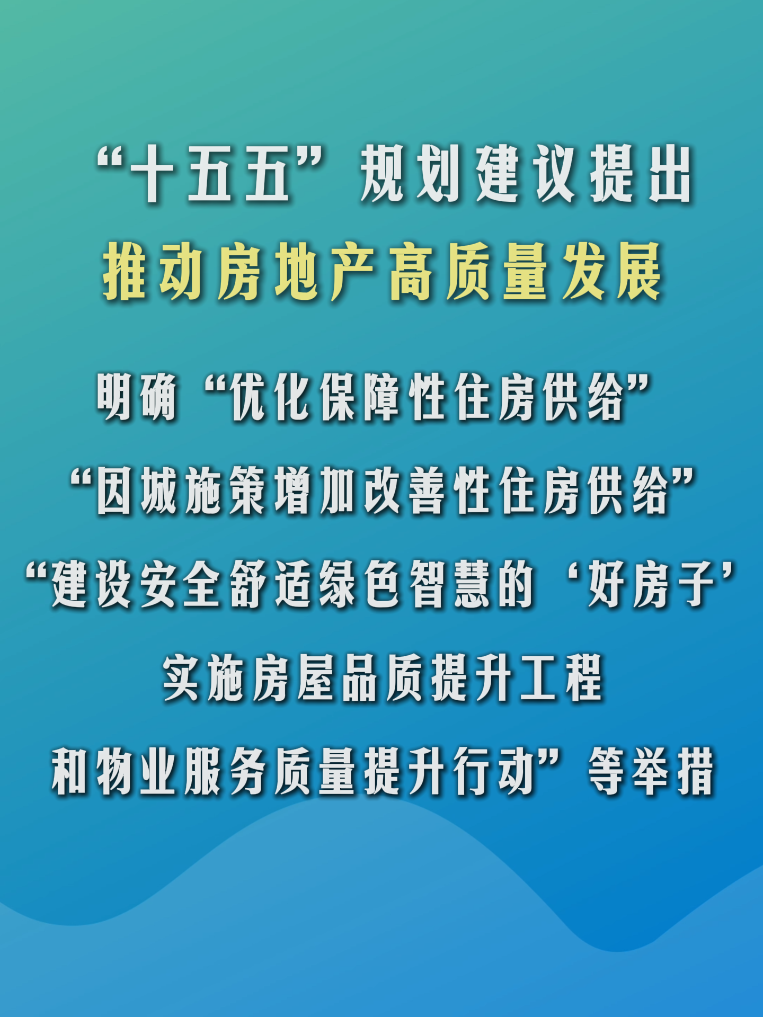
0:00 / 2:24 近年来,围绕安全、舒适、绿色、智慧的好房子建设目标,我国建筑业领域的企业、单位加速推进科技攻关,已经形成一批具备高科技含 量的技术、产品、设备等成果。 "十五五"规划建议提出,推动房地产高质量发展,明确"优化保障性住房供给""因城施策增加改善性住房供给""建设安全舒适绿色智慧的'好 房子',实施房屋品质提升工程和物业服务质量提升行动"等举措。 这是7月21日拍摄的南宁市鸡村城中村改造项目建设现场(无人机照片)。新华社记者 黄孝邦 摄 未来,要牢牢抓住"安居"这个人民群众幸福生活的基点,加快完善住房供应体系,以新供给满足和创造新需求,进一步改善人民群众的住 房条件。 11月6日,讲解员(右)在住博会上向观众介绍展出的节能建筑。新华社记者 潘旭 摄 编导:房宽 记者:邓楠 摄像:石欢、王俊、吕果毅 新华社音视频部制作 10月31日,观众在2025国际(武汉)智能建造产业博览会现场参观。新华社记者 伍志尊 摄 "十五五"规划建议将"房地产高质量发展"置于"加大保障和改善民生力度"框架下,进一步凸显了房地产行业的居住属性和民生定位。 11月6日,参观者在住博会上了解绿色低碳好房子的展出内容。 ...
港股异动 | 部分内房股上扬 碧桂园(02007)涨4% 建发国际集团(01908)涨近3%
智通财经网· 2025-11-21 06:09
Core Viewpoint - The recent rise in certain Chinese real estate stocks is attributed to a favorable industry rumor, although it has not been officially confirmed [1] Group 1: Stock Performance - Country Garden (02007) increased by 4%, reaching HKD 0.52 - Jianfa International Group (01908) rose by 2.88%, reaching HKD 17.04 - Longfor Group (00960) saw a 2.46% increase, reaching HKD 10 - Greentown China (03900) grew by 1.64%, reaching HKD 9.29 [1] Group 2: Market Sentiment - Analysts suggest that the strength in the real estate sector is linked to a positive rumor from foreign media [1] - Vanke's upcoming temporary shareholders' meeting on November 20, 2025, is expected to address market trends [1] Group 3: Industry Outlook - Vanke believes that with the continued implementation of policies, reasonable housing demand will gradually be realized, leading the industry out of its adjustment phase towards stable development [1] - Galaxy Securities indicates that in the later stages of urbanization, the real estate sector is expected to develop new models for high-quality growth, focusing on improving foundational systems and management [1] - The firm anticipates that as the industry achieves high-quality development, overall valuation recovery will occur, allowing leading real estate companies to improve operations and benefit from valuation recovery [1]



万科新任董事长黄力平,公开发声!
Zhong Guo Ji Jin Bao· 2025-11-20 10:46
【导读】10月接任万科董事长的黄力平首次公开发声 管理层坦言:"经营压力尚未有效缓解,将排除万难提升效益" 针对股东关心的公司经营情况、房地产市场趋势、资本运作等问题,万科管理层也在会上进行了回应。 经营方面,万科1—10月销售金额为1152.8亿元,经营服务业务收入同比略有增长。一方面,万科持续 夯实产品与服务能力基本盘,上海理想之地入选住建部首批好社区案例,上海高福云境项目创造公司近 年单日单盘销售纪录;万物云首创"弹性定价"模式获市场认可,整体收入同比增长3%;长租业务出租 率超94%,长租期客户占比显著提升;物流业务战略客户占比持续提升。另一方面,万科借助政策支 持,有序推进资源盘活,前10月新增可售货值228亿元。此外,万科通过组织重建推动公司经营效率改 善,将管控层级从"三级半"压缩至"两级",进一步强化总部管理职能,缩短管理链条。但万科管理层也 坦言,经营压力尚未有效缓解,困难是客观存在的,公司将团结一心、排除万难,继续发挥产品与服务 优势,不断优化管理,提升公司经营效益。 11月20日下午,万科2025年第一次临时股东会在深圳大梅沙万科中心举行。会上,今年10月接任万科董 事长的黄力平亮相。黄 ...
万科新任董事长黄力平,公开发声!
中国基金报· 2025-11-20 10:40
Core Viewpoint - The new chairman of Vanke, Huang Liping, emphasizes the need for collective efforts to systematically resolve risks faced by the company, highlighting the challenges in the transition of the real estate development model and the necessity for patience and confidence in overcoming these difficulties [4][5]. Group 1: Company Strategy and Governance - Vanke will focus on strategic alignment with the "14th Five-Year Plan" to promote high-quality development in real estate, optimizing business layout and structural adjustments while maintaining stability in residential development [4][5]. - The company aims to enhance governance by establishing a transparent management mechanism that combines effective control with organizational vitality, reducing management levels from "three and a half" to "two" to improve operational efficiency [5][7]. - Vanke plans to leverage new technologies and sustainable practices to create competitive products and services, fostering collaboration with partners to enhance operational capabilities [5][6]. Group 2: Financial Performance and Market Outlook - From January to October, Vanke reported sales of 115.28 billion yuan, with a slight increase in revenue from operational services, indicating a solid foundation in product and service capabilities [7]. - The company has added 22.8 billion yuan in marketable assets in the first ten months, supported by policy measures to revitalize resources [7]. - Vanke's management acknowledges ongoing operational pressures but is committed to improving efficiency and enhancing profitability through strategic capital operations and divestment of non-core assets [8][9]. Group 3: Industry Trends and Future Prospects - Vanke's executive vice president, Yu Liang, believes that the real estate industry is poised to gradually emerge from its adjustment phase as policies are implemented, leading to a new stage of stable development [9]. - The "14th Five-Year Plan" underscores the importance of the real estate sector in improving living standards and emphasizes the need for high-quality housing and services, which will be foundational for future competitiveness [9].

万科举行2025年第一次临时股东会,表决通过股东借款框架协议相关议案
Zheng Quan Shi Bao Wang· 2025-11-20 09:15
Core Viewpoint - Vanke is taking steps to address financial challenges and improve operational efficiency through a framework agreement with Shenzhen Metro Group for a loan of up to 22 billion yuan, while also focusing on strategic adjustments and risk management in the current real estate market environment [1][2][3] Group 1: Financial Arrangements - Vanke's shareholders approved a framework agreement allowing Shenzhen Metro Group to provide a loan of up to 22 billion yuan, aimed at repaying public debt and specified interest [1] - As of now, Shenzhen Metro Group has already provided 21.376 billion yuan in unsecured loans, with Vanke required to provide collateral for any future borrowings [1] - The arrangement is in line with previous agreements and reflects a market-oriented approach to financial management [1] Group 2: Operational Strategy - Vanke's chairman emphasized the need for collective effort to navigate the challenges posed by the transition in the real estate sector, indicating a period of adjustment and pressure on operational performance [2] - The company plans to focus on strategic alignment with its "15th Five-Year Plan," optimizing business layout and structure while maintaining stability in residential development [2] - Vanke aims to enhance governance and operational efficiency by streamlining management structures and leveraging technology for competitive product offerings [2] Group 3: Market and Performance Insights - For the first ten months, Vanke reported sales of 115.28 billion yuan, with a slight increase in service revenue, indicating resilience in product and service capabilities [3] - The company has successfully launched initiatives such as the "elastic pricing" model and achieved high occupancy rates in its long-term rental business, contributing to overall revenue growth of 3% [3] - Vanke anticipates a gradual recovery in the real estate market as policy support continues, with plans to improve cash flow and debt structure through strategic divestments [3]