
低空经济

Search documents
低空经济站上风口,融资资金出手加仓5股(名单)
Zheng Quan Shi Bao Wang· 2026-01-05 05:36
Core Insights - The low-altitude economy is maturing with detailed policies and increasing investment value in related industries [1][2] Group 1: Policy and Industry Development - Shanghai aims to establish itself as the "world eVTOL capital" with a target of reaching an industry scale of approximately 80 billion yuan by 2028 [2] - The measures emphasize leveraging Shanghai's manufacturing advantages to create a complete industrial chain for low-altitude new aircraft [2] - The low-altitude economy is characterized by the development of eVTOLs and industrial drones, driving innovation across various sectors [3] Group 2: Market Potential and Growth - The low-altitude economy market in China is projected to become a trillion-yuan blue ocean, with a compound annual growth rate exceeding 10% during the 14th Five-Year Plan [3] - By 2030, the general aviation equipment market is expected to reach a trillion-yuan scale, supported by national strategies and local policies [3] - Key application scenarios include low-altitude logistics and tourism, with major eVTOL manufacturers rapidly expanding their orders and market presence [3] Group 3: Investment and Stock Performance - Nearly 70 A-share stocks are involved in the low-altitude economy sector, with significant institutional interest in companies like Sihua Electronics and Guanglian Aviation [4][5] - Ten low-altitude economy concept stocks are predicted to have net profit growth rates exceeding 20% in 2026 and 2027, with five stocks seeing net purchases exceeding 100 million yuan in December 2025 [7][8] - Aerospace Electronics leads with a net purchase of 1.676 billion yuan in December 2025, indicating strong investor confidence in its future growth [7][8]


上海支持低空经济建设,通用航空ETF基金(561660)涨超3.5%
Xin Lang Cai Jing· 2026-01-05 05:34
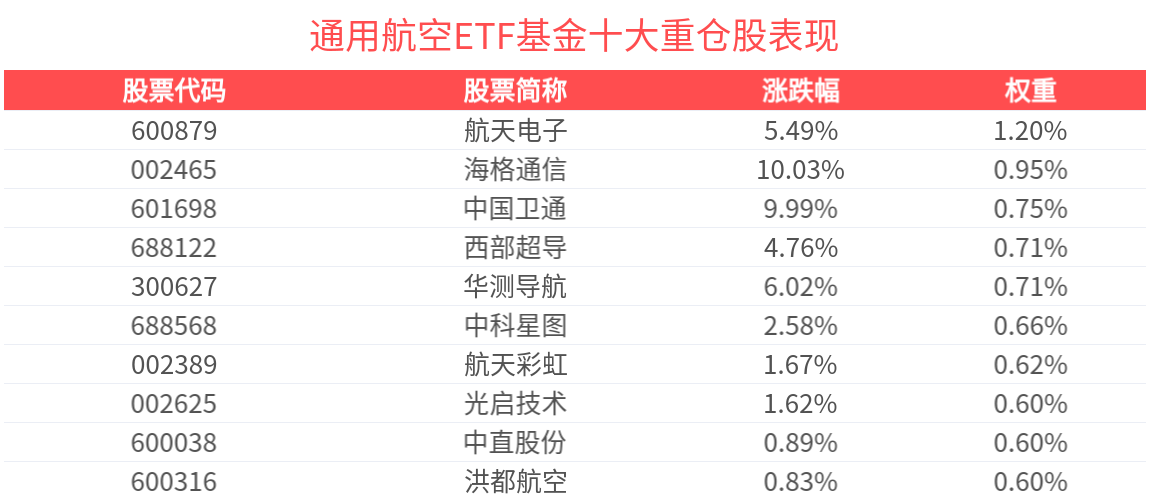
上海:支持新型航空器适航取证,编制发布低空基础设施建设方案。上海市经济和信息化委员会等部门印发《上海市关于链接长三角加快建设低空经济先进 制造业集群的若干措施》。其中提到,到2028年,上海低空经济核心产业规模达到800亿元左右,形成低空新型航空器完整产业链体系,建设低空经济国家 先进制造业集群,加快迈向比较优势凸显的"世界eVTOL之都"。支持新型航空器适航取证。加大对获得型号合格证(TC)和生产许可证(PC)低空经济产 业链企业的支持力度,对eVTOL、工业级无人机等新型航空器以及发动机、螺旋桨等关键核心零部件,市区给予一次性奖励支持。编制发布低空基础设施 建设方案。分级分类支持建设符合新型航空器需求的大型专业化起降场址、低空智能网联系统等综合性基础设施,鼓励社会资本共同参与。 截至2026年1月5日 13:11,中证通用航空主题指数(931855)强势上涨3.48%,成分股雷科防务(002413)上涨10.04%,海格通信(002465)上涨10.03%,北斗星通 (002151)上涨9.99%,中国卫通(601698),盟升电子(688311)等个股跟涨。通用航空ETF基金(561660)上涨3.44 ...
光威复材涨2.00%,成交额21.20亿元,主力资金净流入636.23万元
Xin Lang Zheng Quan· 2026-01-05 05:11
Core Viewpoint - Guangwei Composite Materials Co., Ltd. has shown significant stock performance with a 2.00% increase on January 5, 2025, and notable gains over various time frames, indicating strong market interest and potential growth in the composite materials sector [1]. Financial Performance - For the period from January to September 2025, Guangwei Composite achieved a revenue of 1.986 billion yuan, reflecting a year-on-year growth of 4.40%. However, the net profit attributable to shareholders decreased by 32.55% to 415 million yuan [2]. - The company has distributed a total of 2.261 billion yuan in dividends since its A-share listing, with 1.188 billion yuan distributed over the past three years [2]. Stock and Market Activity - As of January 5, 2025, Guangwei Composite's stock price was 40.25 yuan per share, with a total market capitalization of 33.462 billion yuan. The stock has seen a 25.16% increase over the last five trading days and a 34.12% increase over the last 20 days [1]. - The company experienced a net inflow of 6.3623 million yuan in principal funds, with significant buying and selling activity from large orders [1]. Shareholder Structure - As of December 31, 2025, the number of shareholders increased to 76,600, with an average of 10,716 shares held per shareholder, a slight decrease of 0.91% [2]. - The top ten circulating shareholders include various ETFs, with notable changes in holdings, such as E Fund's ChiNext ETF reducing its stake by 1.9031 million shares [3].

低空经济站上风口,融资资金出手加仓5股
3 6 Ke· 2026-01-05 05:04
近年来,低空经济相关政策逐步细化,行业日渐走向成熟。随着行业规模不断扩大,布局相关产业链的 企业投资价值凸显。据数据宝统计,A股涉及低空经济产业链的概念股接近70只。2025年机构调研最频 繁的是四创电子,年内累计获调研38次。广联航空2025年获得16次机构调研,排在第二。机构调研频次 较多的还有亿嘉和、纵横股份、汇嘉时代、中航西飞、国睿科技等。据数据宝统计,从未来增长潜力来 看,根据5家及以上机构一致预测,2026年、2027年净利润增速均有望超20%的低空经济概念股有10 只。这10股当中,2025年12月融资净买入均逾1亿元的有5股,分别是航天电子、航天电器、海格通信、 航发动力、北方导航。(证券时报) ...
AI赋能低空经济:三大高潜力赛道即将引爆万亿市场
Tai Mei Ti A P P· 2026-01-05 04:05
Core Insights - The article discusses the evolution of China's low-altitude economy, highlighting a shift from traditional real estate to a new digital asset paradigm involving airspace below 1000 meters, which is expected to become a high-frequency trading asset by 2025 [1][2] Group 1: Low-altitude Economy Development - The low-altitude economy has transitioned from policy relaxation to industrial infrastructure development, marking a significant turning point in 2025 where applications are moving from single-point tests to large-scale clusters [2] - The explosion of the low-altitude economy relies on system-level scheduling capabilities rather than individual operators [3] Group 2: Core Drivers of Low-altitude Market - The core driver of the trillion-level low-altitude market is not merely the extension of the aviation manufacturing industry but rather an AI-driven "air operating system" that manages airspace operations [4] - Key technologies supporting this system include digital twins for airspace management, edge intelligence for autonomous decision-making, and swarm intelligence algorithms for coordinated operations [5] Group 3: Market Dynamics and Future Trends - As the industry matures, strict commercial rules will re-emerge in the low-altitude sector, leading to diminishing profits in hardware manufacturing, similar to the early smartphone market [6] - The future competitive landscape is likely to exhibit a "dumbbell structure," with one end focusing on core algorithms and platforms, while the other end specializes in vertical applications, leaving traditional aircraft manufacturers in a precarious position [7] Group 4: Strategic Focus for Businesses - Companies are advised to shift focus from hardware manufacturing to leveraging AI across traditional industries, including the low-altitude economy [8] - Understanding the data and algorithmic frameworks that underpin operations is more critical than merely achieving higher flight altitudes [9][10] Group 5: Infrastructure and Service Opportunities - The low-altitude economy requires invisible infrastructure, emphasizing the need for computational and communication capabilities, including low-altitude sensing networks and high-precision mapping services [12] - High-frequency vertical service providers that offer comprehensive solutions in high-risk and efficiency-demanding sectors will command premium pricing [12] - The post-operation market surrounding drones is expected to explode, with services like maintenance, AI pilot training, and automated positioning becoming vital segments [12]
低空经济共保体风险减量实验室在重庆揭牌
Zheng Quan Ri Bao Wang· 2026-01-05 03:48
Core Viewpoint - The establishment of the risk reduction laboratory in Chongqing marks a significant milestone for the low-altitude economy mutual insurance body, which was founded by 19 local commercial insurance companies in August 2025 [1] Group 1: Laboratory Establishment - The risk reduction laboratory is led by the chairman unit of the low-altitude economy mutual insurance body, focusing on risk governance throughout the entire lifecycle of the low-altitude industry [1] - The laboratory aims to conduct theoretical research, trace risk mechanisms, establish industry standards, explore data value, and innovate intelligent risk reduction services [1] Group 2: Future Development Directions - The laboratory will focus on four development directions: 1. Standard leadership, tracing risk mechanisms to create a "Chongqing standard, nationally applicable" governance model [1] 2. Data integration, developing exclusive risk control models to enhance pricing precision and assist companies in reducing costs and increasing efficiency [1] 3. Technology empowerment, utilizing AI to construct a full-process closed loop for risk management, enhancing proactive risk avoidance [1] 4. Ecological co-construction, building an open platform for government, enterprises, academia, and research to consolidate industry efforts and support the high-quality development of the low-altitude economy [1]
上海再出新政发展低空经济
第一财经· 2026-01-05 03:27
Core Viewpoint - Shanghai aims to become the "world eVTOL capital" by 2028, targeting a core industry scale of approximately 80 billion yuan in the low-altitude economy, supported by new policies to enhance high-end manufacturing capabilities and attract leading eVTOL and drone companies [3][4][5]. Group 1: Policy Measures - The newly released measures propose to cultivate and attract 10 leading companies in eVTOL, industrial drones, and new energy aircraft, aiming for a manufacturing capacity of over 500 new aircraft and an additional investment of over 20 billion yuan in the industry [3]. - The measures emphasize regional collaboration, aiming to establish a national-level testing platform for new low-altitude aircraft and enhance cooperation between urban and regional areas in the Yangtze River Delta [3][4]. Group 2: Industry Development - Shanghai has a strong industrial foundation for low-altitude economy, with over 50% of the country's leading eVTOL companies based in the city, forming a comprehensive ecosystem for low-altitude economic activities [5]. - The city plans to focus on low-altitude economy, commercial aerospace, embodied intelligence, biological manufacturing, and smart terminals as new growth points, targeting an overall industry scale of 1 trillion yuan by the end of the 14th Five-Year Plan [4][5]. Group 3: Infrastructure and Collaboration - The establishment of the East China Drone Base as a national pilot zone for civil unmanned aerial vehicles is highlighted, which integrates R&D, manufacturing, flight services, and training into a low-altitude industry ecosystem [8]. - The Minhang District has formed a low-altitude economic industry alliance with 41 member units, achieving a total order amount of over 15 billion dollars since 2025, while the Yangpu District has over 130 related companies focusing on low-altitude R&D and applications [8].

重药控股涨2.06%,成交额1.93亿元,主力资金净流出97.11万元
Xin Lang Cai Jing· 2026-01-05 03:27
Core Viewpoint - The stock price of Zhongyao Holdings has shown fluctuations, with a recent increase of 2.06% but a decline of 6.90% over the past five trading days, indicating volatility in the market performance of the company [1]. Group 1: Stock Performance - As of January 5, Zhongyao Holdings' stock price reached 5.94 CNY per share, with a total market capitalization of 10.265 billion CNY [1]. - The company has experienced a year-to-date stock price increase of 2.06%, a 6.90% decline over the last five trading days, an 8.59% increase over the last 20 days, and a 15.12% increase over the last 60 days [1]. Group 2: Financial Performance - For the period from January to September 2025, Zhongyao Holdings reported a revenue of 62.211 billion CNY, reflecting a year-on-year growth of 4.22% [2]. - The net profit attributable to shareholders for the same period was 384 million CNY, representing a significant year-on-year increase of 31.41% [2]. Group 3: Shareholder Information - As of September 30, 2025, the number of shareholders for Zhongyao Holdings was 42,000, a decrease of 4.05% from the previous period [2]. - The average number of circulating shares per shareholder increased by 4.22% to 41,112 shares [2]. Group 4: Dividend Distribution - Since its A-share listing, Zhongyao Holdings has distributed a total of 864 million CNY in dividends, with 294 million CNY distributed over the last three years [3]. Group 5: Institutional Holdings - As of September 30, 2025, Hong Kong Central Clearing Limited was the seventh-largest circulating shareholder, holding 10.091 million shares, an increase of 851,000 shares from the previous period [3]. - The Southern CSI 1000 ETF was the ninth-largest circulating shareholder, holding 7.8976 million shares, a decrease of 55,600 shares from the previous period [3].

1小时→12分钟 低空物流加速深山鲜货走向餐桌
Yang Shi Xin Wen Ke Hu Duan· 2026-01-05 02:49
Core Viewpoint - The development of the low-altitude economy in Jiangxi is accelerating, transitioning from conceptual exploration to large-scale implementation, driven by policy support, technological integration, and expanded application scenarios [1][2]. Group 1: Low-altitude Economy Development - Jiangxi's "14th Five-Year Plan" emphasizes the creation of emerging pillar industries, including the low-altitude economy [1]. - The establishment of a "drone + high-speed rail" transport line in Jiangxi facilitates rapid logistics for agricultural products, significantly reducing transportation time and costs [2][3]. - The successful implementation of drone logistics has addressed transportation bottlenecks for mountainous agricultural areas, benefiting local farmers and enhancing product distribution [3][4]. Group 2: Economic Impact and Growth - The innovative logistics model has already benefited 26 family farms and increased income for 106 households, with projected total revenue exceeding 49 million yuan by 2025, representing a nearly threefold increase [3]. - The low-altitude economy industrial park in Jiangxi is expected to attract 34 upstream and downstream enterprises by 2025, generating over 1.5 billion yuan in revenue [7]. Group 3: Infrastructure and Support - The establishment of a low-altitude economy industrial park in Jiangxi integrates research, testing, manufacturing, and talent training, creating a comprehensive industrial ecosystem [5][6]. - A specialized meteorological service platform has been developed to support drone operations, providing real-time weather data to ensure safe flights [3][9]. Group 4: Future Prospects - Plans to expand the existing drone routes from 9 to 18 are underway, aiming to enhance service offerings, including medical deliveries for rural elderly residents [4]. - The low-altitude economy is projected to contribute over 200 billion yuan to economic growth in Jiangxi by 2026, with a national market size forecasted to reach 1.5 trillion yuan by 2025 and 3.5 trillion yuan by 2035 [9][10].
工信部:面向车联网、低空经济等提升互联网赋能水平
Cai Jing Wang· 2026-01-05 02:33
Core Insights - The Ministry of Industry and Information Technology has released guidelines to accelerate the innovation and development of national new-type internet exchange centers [1] Group 1: Industry Development - The guidelines aim to address data exchange needs for low-latency applications in scenarios such as vehicle networking and low-altitude economy [1] - The initiative seeks to enhance the service level of industry empowerment [1] Group 2: Business Support - The exchange centers are encouraged to support enterprises in cloud migration, multi-cloud interconnection, G virtual private networks, industrial internet, and satellite internet [1] - Innovative business offerings are to be provided by the exchange centers to meet the demands of various application scenarios [1]