
智慧交通

Search documents
电子发票落地,铁路数字化升级更好服务群众出行
Xin Lang Cai Jing· 2025-10-01 11:18
Core Insights - The implementation of electronic invoices by the National Railway Group aims to enhance public service efficiency and improve the travel experience for millions of passengers during peak travel periods, particularly during the 2025 National Day and Mid-Autumn Festival holidays [1][2] Group 1: Digital Transformation - The transition to electronic invoices eliminates the need for passengers to return to stations for printing reimbursement documents, saving them over half an hour during peak times [1] - The entire process of invoice issuance can now be completed through the 12306 APP, including refunds and changes, addressing the long-standing issue of lost invoices [1] - The seamless integration of electronic invoices with tax platforms reduces manual calculations for VAT deductions, significantly lowering financial costs for businesses [1] Group 2: Inclusivity and Accessibility - The railway department maintains offline application channels for elderly and non-digital users, allowing others to assist in obtaining invoices through a "scan to issue" feature [2] - The continued availability of printed travel information caters to passengers who prefer physical documents, demonstrating a commitment to service flexibility and inclusivity [2] Group 3: Environmental and Operational Efficiency - The expected daily passenger flow of 219 million during the National Day holiday will benefit from the reduced pressure on paper document printing, enhancing ticket management efficiency through data collaboration [2] - The reduction in paper consumption and printing costs aligns with the initiative for green travel, making each electronic invoice issuance a step towards sustainability [2] Group 4: Service Quality Enhancement - The rollout of electronic invoices represents a shift in railway services from merely meeting basic needs to pursuing a higher quality travel experience [2] - The initiative reflects the core principle of smart transportation: leveraging technology to minimize passenger effort while maximizing service efficiency [2]
北京“七站两场”上新服务保障国庆中秋假期出行
Xin Hua She· 2025-10-01 04:19
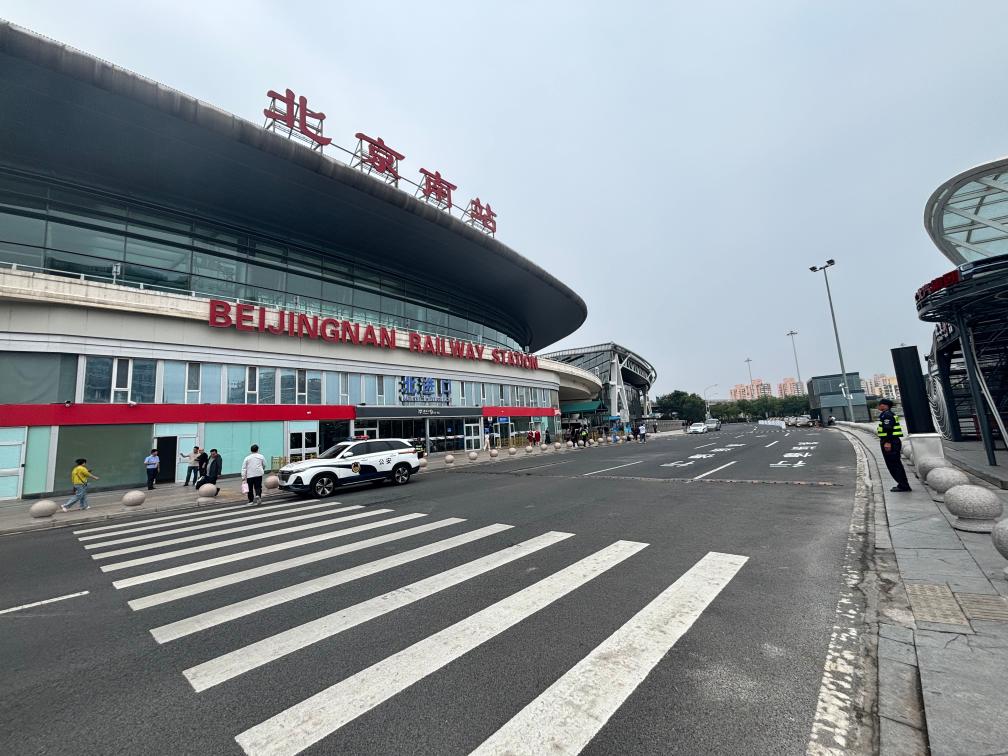
Core Viewpoint - The article highlights the improvements in transportation services at Beijing's major train stations and airports to accommodate the increased passenger flow during the upcoming National Day and Mid-Autumn Festival holidays, with a focus on enhancing efficiency and convenience for travelers [1][6]. Group 1: Transportation Improvements - Beijing South Station has introduced a new "immediate drop-off" lane with four lanes to ease traffic congestion, where taxi drop-off is located on the innermost lane and social vehicle drop-off on the outer lanes [1]. - The North entrance of Beijing South Station has undergone expansion, adding one security check lane and four ticketing lanes, resulting in a 50% overall increase in traffic efficiency [2]. - At Beijing West Station, a new dedicated entrance and passage for taxis has been created, allowing taxis to queue without incurring parking fees, while maintaining the original taxi dispatch station's location [2]. Group 2: Passenger Experience Enhancements - A "short-haul" mechanism has been implemented at Beijing Station, Beijing North Station, and Qinghe Station, allowing short-distance return drivers to prioritize picking up passengers, improving service efficiency [5]. - The "Spark Warm Journey" mini-program has been launched at Chaoyang Station, significantly reducing driver refusal and passenger complaints by 85% and 70%, respectively [5]. - During the National Day and Mid-Autumn Festival, the total number of railway and civil aviation passengers entering and leaving Beijing is expected to reach 13.81 million, a 6.79% increase compared to the same period last year [6].

通达电气(603390.SH):不涉及机器人产品的研发或生产
Ge Long Hui· 2025-09-29 08:24
Core Viewpoint - The company is focusing on developing three main product lines in the smart transportation sector and enhancing its capabilities in mobile healthcare services while planning to increase R&D investment for sustainable growth [1] Group 1: Smart Transportation - The company has established three main product lines in the smart transportation sector: intelligent connected systems, electric vehicle motors and thermal management systems, and vehicle-mounted components [1] - The company also offers specialized vehicle modification design and production services [1] Group 2: Mobile Healthcare - In the mobile healthcare sector, the company provides health screening and wellness services through mobile medical vehicles, integrated with a cloud-based platform for remote diagnosis [1] Group 3: Future Plans - By 2025, the company aims to continue focusing on its core business, increasing R&D investment, enhancing product intelligence, and driving technological innovation [1] - The company plans to continuously improve its industrial chain layout in mobile healthcare, passenger vehicles, and specialized vehicles to promote sustainable development of its main business [1]

工信部等六部门:加快发展智能制造、智慧交通、智慧农业、智慧医疗等应用场景
Xin Lang Cai Jing· 2025-09-29 07:23
Core Viewpoint - The document outlines a plan for the mechanical industry to stabilize growth from 2025 to 2026, emphasizing the importance of digital transformation and intelligent upgrades in various sectors [1] Group 1: Digital Transformation and Intelligent Upgrades - The plan aims to promote the digital transformation and intelligent upgrades of the industry, aligning with the overall layout of digital China construction [1] - It encourages the development of smart manufacturing, smart transportation, smart agriculture, and smart healthcare applications [1] - The initiative includes expanding the demand for industrial mother machines, agricultural machinery, robots, rail transit equipment, medical equipment, engineering machinery, and intelligent detection equipment [1] Group 2: Implementation Actions - A series of "smart transformation and digital upgrade" projects will be implemented to promote the renovation of outdated equipment and the transformation of "silent" equipment [1] - A special action for empowering small and medium-sized enterprises (SMEs) in digitalization will be launched, supporting them in implementing low-investment, quick-effect digital "micro-transformations" based on their needs [1] Group 3: Smart Manufacturing Development - The plan includes continuous optimization of typical scenarios and reference guidelines for smart manufacturing [1] - It proposes a gradient cultivation action for smart factories, supporting the construction of basic, advanced, excellent, and leading smart factories [1] - The integration of new-generation information technologies, such as artificial intelligence, into production and manufacturing processes will be promoted, focusing on optimizing the entire production process, product lifecycle, and supply chain [1]

聚焦客运出行、货运物流等,智能运输系统标准体系将完善
Di Yi Cai Jing· 2025-09-27 04:40
Core Viewpoint - The article emphasizes the strengthening of advanced information technology applications, such as big data and artificial intelligence, in the transportation sector to support the construction of a strong transportation nation in China [1][4]. Group 1: Standardization in Intelligent Transportation - The Ministry of Transport has released a draft for the "Intelligent Transportation System Standard System (2025)" for public consultation, aiming to establish a comprehensive standardization framework for intelligent transportation systems [1][2]. - The standardization efforts will focus on various areas including passenger travel, freight logistics, electronic toll collection, vehicle-road collaboration, autonomous driving, traffic operation monitoring, and smart water transport [1][2][4]. - The standard system will address key issues in the intelligent transportation sector, such as providing information services for safe and convenient travel and monitoring traffic operation status for government management [2][5]. Group 2: Integration of Advanced Technologies - The integration of technologies like big data, the internet, artificial intelligence, and blockchain is accelerating within the transportation industry, becoming a crucial driver for high-quality development [4][5]. - The standardization organizations are developing standards related to automated driving, information services for travelers, electronic toll collection, and traffic data management, among others [4][5]. - The urgency for standardization in the intelligent transportation field is highlighted due to the rapid technological advancements and the need for timely updates to standards [5]. Group 3: Future Focus Areas - Future efforts will prioritize the standardization of smart travel, smart logistics, digitalization of infrastructure, vehicle-road collaboration, and information security [5]. - The article notes that the average technology iteration cycle in this field is less than 3 to 5 years, indicating a pressing need for updated standards to keep pace with technological advancements [5].
Space42联合微软等推出阿联酋首个“主权出行云”
Shang Wu Bu Wang Zhan· 2025-09-26 16:20
Core Point - Space42, in collaboration with Core42 and Microsoft, has launched the UAE's first "Sovereign Mobility Cloud" to enhance data security and compliance for mobility and autonomous driving within the UAE [1] Group 1: Project Overview - The Sovereign Mobility Cloud aims to ensure safe and compliant management of mobility and autonomous driving data in the UAE [1] - Microsoft and Core42 will provide the cloud infrastructure, AI platform, and training support for the initiative [1] Group 2: Operational Achievements - Space42 operates the TXAI autonomous driving system in Abu Dhabi, achieving nearly 600,000 kilometers of accident-free driving [1] Group 3: Industry Impact - This project represents a significant breakthrough for the UAE in the fields of autonomous driving data sovereignty and smart transportation [1] - It sets a global benchmark for safety and innovation in the region [1]

世纪恒通(301428.SZ):拟收购黔通智联13%股权
Ge Long Hui A P P· 2025-09-26 12:52
Core Viewpoint - Century Hengtong plans to acquire a 13% stake in Guizhou Qiantong Zhiliang Technology Co., Ltd. for approximately RMB 112.99 million, enhancing its strategic positioning in the smart transportation sector [1][2]. Group 1: Company Overview - Guizhou Qiantong Zhiliang Technology Co., Ltd. is a comprehensive service provider in smart transportation, primarily focusing on the ETC (Electronic Toll Collection) industry chain services and smart transportation information technology services [2]. - The company has a leading position in the ETC business across the country, with a significant scale of issuance and a 30-year exclusive operating right for highway network communication systems [2]. - Qiantong Zhiliang has been recognized as a high-tech enterprise and has received various accolades, including being named a "small giant" by Guizhou Province and a benchmark enterprise by the State-owned Assets Supervision and Administration Commission [2]. Group 2: Business Operations - The company's services encompass ETC issuance and customer service, derivative businesses related to ETC, network transmission and security, digital transformation of traffic infrastructure, and smart highway construction [2]. - Qiantong Zhiliang has established an OTN (Optical Transport Network) full optical transmission network and is involved in multiple pilot projects for cloud tolling and smart highways, demonstrating its capability for nationwide service output [2].

世纪恒通拟1.13亿元收购智慧交通综合服务商黔通智联13%股权
Zhi Tong Cai Jing· 2025-09-26 12:08
Core Viewpoint - The company plans to acquire a 13% stake in Guizhou Qiantong Zhiliang Technology Co., Ltd. for 113 million yuan, enhancing its capabilities in the transportation big data sector [1] Group 1: Investment Details - The company intends to use its own or raised funds amounting to 113 million yuan for the acquisition [1] - The target company, Guizhou Qiantong Zhiliang Technology, is a comprehensive service provider in smart transportation, primarily focusing on the ETC industry chain and smart transportation information technology services [1] Group 2: Business Operations - Guizhou Qiantong Zhiliang Technology's main business areas include ETC issuance and customer service, derivative businesses related to ETC, network transmission and security, digital transformation of transportation infrastructure, and smart highway construction [1] - The company possesses a large-scale ETC user resource base and traffic scene data, along with mature system integration capabilities for smart highways [1] Group 3: Strategic Implications - The investment is expected to enhance the company's service capabilities in the transportation big data field, facilitating resource integration and business collaboration between the two entities [1] - This move aims to improve the competitiveness of overall solutions offered by the company [1]
“人工智能+交通运输”实施意见印发
Di Yi Cai Jing Zi Xun· 2025-09-26 08:10
Core Insights - The implementation opinions on "Artificial Intelligence + Transportation" were jointly released by several government agencies, aiming for widespread application of AI in the transportation sector by 2027 and deep integration by 2030 [1][2] Group 1: AI Integration Goals - By 2027, AI will be widely applied in typical scenarios within the transportation industry, with a comprehensive transportation model system deployed [1] - By 2030, AI will be deeply integrated into the transportation sector, promoting a smart and comprehensive transportation network [1] Group 2: Innovation in Smart Products - The initiative emphasizes accelerating the innovation of smart products, including the development of intelligent driving systems and remote driving cockpits [2] - It encourages the research and application of new technologies and equipment, such as high-performance night vision monitoring and structural detection [2] - The plan includes upgrading railway equipment with smart train systems, new generation communication signals, and intelligent scheduling systems [2]
交通运输部等部门:到2030年人工智能深度融入交通运输行业,智能综合立体交通网全面推进
Zheng Quan Shi Bao Wang· 2025-09-26 07:44
人民财讯9月26日电,交通运输部、国家发展改革委、工业和信息化部、国家数据局、国家铁路局、中 国民用航空局、国家邮政局发布关于"人工智能+交通运输"的实施意见,其中提出,到2027年,人工智 能在交通运输行业典型场景广泛应用,综合交通运输大模型体系落地部署,普及应用一批智能体,建成 一批"人工智能+交通运输"标志性创新工程,人工智能成为引领交通运输创新发展的重要动力。到2030 年,人工智能深度融入交通运输行业,智能综合立体交通网全面推进。智慧交通与智慧物流领域关键核 心技术实现自主可控,总体水平位于世界前列,培育一批新产业(300832)、新业态,形成较为完备的 交通领域人工智能治理体系,引领交通运输高质量发展和高水平安全迈上新台阶。 ...