
量化策略

Search documents
百亿级私募,持续扩容
Shang Hai Zheng Quan Bao· 2025-09-12 00:39
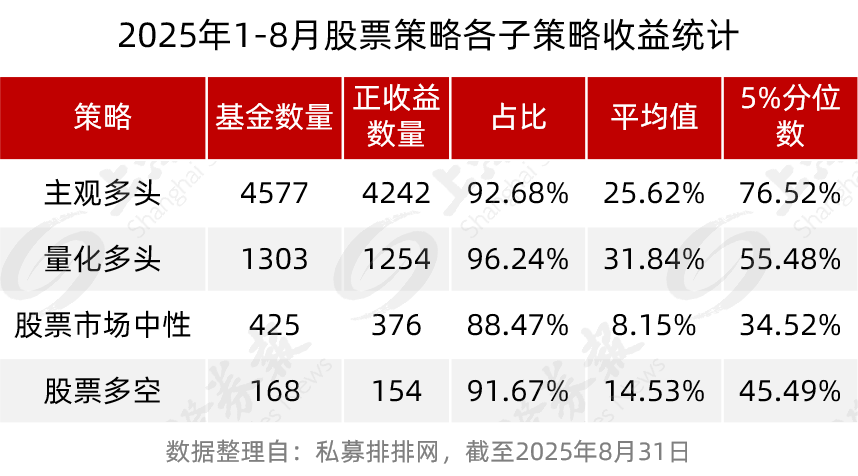
Group 1 - The number of billion-level private equity firms has reached 91 as of September 11, showing an increase of 10 firms since the end of July, with the new addition being Nianjue Private Equity based in Shanghai [1][3] - The growth of billion-level private equity firms contrasts with last year's contraction, indicating a recovery in the private equity issuance market [3][5] - The average return of private equity securities investment funds with performance records has exceeded 20% this year, with stock strategy products averaging over 25% [5][6] Group 2 - The number of new registered private equity securities investment funds has reached 7,907 this year, marking an 82.19% increase compared to the same period last year [6] - Despite recent market fluctuations, there has been no significant redemption from investors, indicating a stable sentiment towards the market [8] - Quantitative managers are continuously optimizing their strategy models to adapt to market changes, enhancing their investment portfolios' resilience [9]

铸帝控股(01413)股东将股票由昌利证券转入富途证券国际香港 转仓市值606.05万港元
Zhi Tong Cai Jing· 2025-09-11 01:14
Core Viewpoint - The shareholders of Zhu Di Holdings (01413) have transferred their stocks from Changli Securities to Futu Securities International Hong Kong, with a transfer value of HKD 6.0605 million, accounting for 5.05% of the total shares [1] Group 1: Shareholder Activity - On September 10, shareholders transferred stocks valued at HKD 6.0605 million from Changli Securities to Futu Securities International Hong Kong [1] - The transfer represents 5.05% of Zhu Di Holdings' total shares [1] Group 2: Strategic Investment Plan - Zhu Di Holdings announced plans to establish a joint venture to diversify its investment portfolio and capture emerging opportunities in the digital asset sector [1] - The board has approved a strategic investment framework, allowing the group to invest up to HKD 4.5 million of its own capital in cryptocurrency [1] - The investment strategy will utilize a mature, delta-neutral quantitative approach, focusing on capital preservation and robust risk-adjusted returns [1] Group 3: Management and Expertise - The core objective is to achieve uncorrelated alpha returns and diversify the company's investments, leveraging the expertise of a professional team and a solid multi-layer risk management framework [1] - The strategic investment will only involve the group's own funds and will not constitute regulated third-party asset management services, thus avoiding licensing costs and regulatory complexities [1] - The investment initiative will be led by Mr. Wang Junjie, a seasoned professional with over 12 years of experience in the blockchain and Web3 sectors [1]
百亿私募年内平均收益接近25% 量化跑赢主观与混合产品
Di Yi Cai Jing· 2025-09-10 13:35
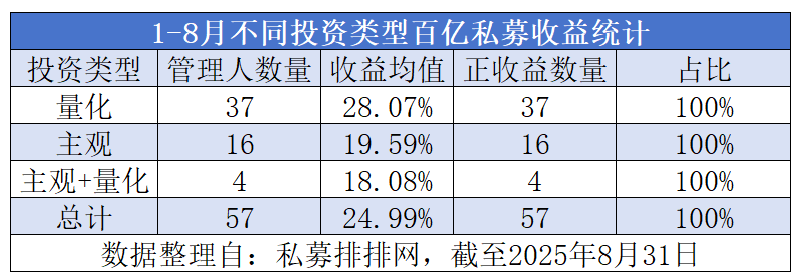
Core Insights - The private equity market has seen a significant increase in product registrations this year, with a year-on-year growth of over 80% in private securities products [1][2] - The number of billion-yuan private equity firms has reached 91, with an average annual return of nearly 25% for those with performance data [1][2] - Quantitative private equity strategies have outperformed subjective and mixed strategies, with an average return of 28.07% for 37 billion-yuan quantitative firms [3][4] Private Equity Market Overview - As of August 2023, a total of 7,907 private securities products have been registered, a year-on-year increase of 82.19% [2] - The proportion of quantitative private equity products has risen to 45.33%, with 3,584 products registered, marking a 100.34% increase [2] - The number of billion-yuan quantitative private equity firms has increased to 45, accounting for 49.45% of the total [2] Performance Analysis - All 57 billion-yuan private equity firms with performance data have achieved positive returns this year, with an average return of 24.99% [2][4] - Among different investment types, quantitative strategies have shown the highest average return of 28.07%, followed by subjective strategies at 19.59% and mixed strategies at 18.08% [4] Market Dynamics - The changing market environment and style preferences have created abundant trading opportunities for quantitative strategies, leading to significant excess returns [5][6] - The rapid rotation of market styles has increased the difficulty of stock selection for subjective strategies, resulting in noticeable performance differentiation [7] Strategic Recommendations - For subjective private equity firms, focusing on in-depth research and flexible adjustments is crucial to navigate the complex market environment [8] - Quantitative firms should optimize their models to adapt to potential style shifts and enhance the application of AI and big data technologies [8][9] Emerging Trends - The "subjective + quantitative" model is gaining traction as a strategy for some firms to explore new growth avenues, combining active management with quantitative investment approaches [9]
百亿私募年内平均收益接近25%,量化跑赢主观与混合产品
Di Yi Cai Jing· 2025-09-10 13:04
Core Insights - The changing market environment and style preferences have created abundant trading opportunities and excess return potential for quantitative strategies, while increasing the difficulty of stock selection for subjective strategies, leading to greater performance divergence [1][5][7] Group 1: Market Performance - As of August 2023, the number of registered private equity securities products has increased by over 80% year-on-year, with a total of 7,907 products registered [2] - The number of quantitative private equity products has also surged, with 3,584 products registered, accounting for 45.33% of total registered products, representing a year-on-year growth of 100.34% [2] - The average return for 57 billion private equity firms this year is approximately 24.99%, with over 70% of these firms achieving returns exceeding 20% [2][4] Group 2: Quantitative vs. Subjective Strategies - The average return for 37 billion quantitative private equity firms is 28.07%, with all firms showing positive returns [3][4] - Despite a significant rebound in the A-share market in August, quantitative strategies continue to outperform subjective strategies [2][3] - Subjective strategies are facing challenges due to rapid market rotations and increased stock selection difficulty, resulting in noticeable performance divergence [7] Group 3: Factors Driving Quantitative Success - The performance of billion quantitative private equity firms is attributed to the wide fluctuations in the A-share market, accelerated industry rotations, and the dominance of small-cap styles, which provide rich trading opportunities [5][6] - The rapid development of artificial intelligence and big data technologies has significantly enhanced the performance of quantitative strategies, allowing for more precise capture of excess returns [6] - The liquidity in the A-share market, with trading volumes consistently above 1 trillion, has created favorable conditions for the implementation of quantitative strategies [6][8] Group 4: Strategic Recommendations - For subjective private equity firms, focusing on in-depth research and flexible adjustments is recommended to navigate the complex market environment [8] - Quantitative strategies should optimize models to adapt to potential style shifts and enhance the application of AI and big data technologies in stock selection and trading execution [8][9] - The "subjective + quantitative" model is emerging as a new growth avenue, combining active management with quantitative investment to achieve absolute return goals [9]
长城基金汪立:市场情绪仍偏强,关注科技成长核心方向
Xin Lang Ji Jin· 2025-09-10 08:38
Group 1 - The A-share market is currently experiencing volatility, with expectations of limited downside in the near term, but potential for significant fluctuations as the market digests recent gains [1] - Two possible market scenarios are identified: continued thematic speculation with a need for adjustment in the TMT sector, or increasing selling pressure leading to a prolonged downtrend [1] - The current market sentiment remains strong, suggesting a likelihood of sector rotation within growth industries, while relatively cheap consumer and low-position sectors may lack short-term momentum [1] Group 2 - Liquidity support remains, but significant selling pressure from the previous week indicates a need for market consolidation before seeking new upward opportunities [2] - A potential rebalancing between large and small caps is anticipated, with growth styles expected to outperform value styles in the near term [2] - Key investment themes to focus on include technology rotation (e.g., new energy, innovative pharmaceuticals, robotics), interest rate cut trades (e.g., non-bank financials), and sectors benefiting from inflation stabilization (e.g., materials, chemicals) [2]
港股异动 | 铸帝控股(01413)一度涨超30% 拟斥资不超450万港元投资加密货币
智通财经网· 2025-09-08 03:02
Group 1 - The core viewpoint of the article highlights that Zhudi Holdings (01413) experienced a significant stock price increase, rising over 30% at one point and closing up 26.58% at HKD 0.1, with a trading volume of HKD 6.5205 million [1] - On September 8, Zhudi Holdings announced plans to establish joint ventures on November 22, 2024, and December 13, 2024, to diversify its investment portfolio and capture emerging opportunities in the digital asset sector [1] - The company's board has approved a strategic investment framework, allowing the group to invest up to HKD 4.5 million of its own capital in cryptocurrency through its indirect non-wholly owned subsidiary, Tiankun Digital Limited [1] Group 2 - The investment strategy will employ a mature, Delta-neutral quantitative approach, focusing on capital preservation and robust risk-adjusted returns [1] - The primary objective is to achieve uncorrelated alpha returns and diversify the company's investments, leveraging the expertise of a professional team and a solid multi-layer risk management framework [1] - This strategic investment will solely involve the group's self-funded investments and will not constitute regulated third-party asset management services, thereby avoiding licensing costs and regulatory complexities [1]
铸帝控股:拟斥资不超450万港元投资加密货币-港股-金融界
Jin Rong Jie· 2025-09-08 01:16
Group 1 - The company announced plans to establish joint ventures on November 22, 2024, and December 13, 2024, to diversify its investment portfolio and capture emerging opportunities in the digital asset sector [1] - The board has approved a strategic investment framework, allowing the company to invest up to HKD 4.5 million through its indirect non-wholly owned subsidiary, Tiankun Digital Limited, in cryptocurrency investments [1] - The strategy will employ a mature, delta-neutral quantitative approach focused on capital preservation and robust risk-adjusted returns [1] Group 2 - The core objective is to achieve uncorrelated alpha returns and diversify the company's investments, leveraging the expertise of a professional team and a solid multi-layer risk management framework [1] - This strategic investment will only involve the company's own capital and will not constitute regulated third-party asset management services, thereby avoiding licensing costs and regulatory complexities [1]
铸帝控股股东将股票由昌利证券转入海通国际证券 转仓市值521.12万港元
Zhi Tong Cai Jing· 2025-09-08 00:34
Group 1 - The core point of the article highlights that Chudi Holdings (01413) is diversifying its investment portfolio by establishing a joint venture focused on digital assets [1] - On September 5, shareholders transferred shares from Changli Securities to Haitong International Securities, with a market value of 5.21 million HKD, representing 5.57% of the total [1] - The company plans to invest up to 4.5 million HKD of its own capital in cryptocurrency through its indirect non-wholly owned subsidiary, Tiankun Digital Limited, utilizing a Delta-neutral quantitative strategy [1] Group 2 - The board of directors has approved a strategic investment framework to capture emerging opportunities in the digital asset sector [1] - The strategy emphasizes capital preservation and robust risk-adjusted returns [1]
太平基金韩聪、张子权:建立“股债对冲+动态再平衡”机制
Zhong Guo Zheng Quan Bao· 2025-09-08 00:04
Core Insights - The recent market sentiment has improved, leading to increased investor interest in A-shares and "fixed income +" products due to declining bank deposit rates [1] - Taiping Fund launched a new "fixed income +" product, Taiping Jiayu Bond, managed by fund managers Han Cong and Zhang Ziquan, who have previously collaborated on public fund products [1][2] Investment Strategy - The equity portion of Taiping Jiayu Bond will focus on a quantitative enhancement strategy centered around the CSI A500 index, which offers better stock selection breadth and industry representation compared to the CSI 300 [2] - The fund aims for absolute returns, with Han Cong managing the fixed income part, emphasizing credit safety and liquidity management while maintaining a high credit quality bond portfolio [3] Performance Metrics - As of August 21, the jointly managed Taiping Jiayu Bond has shown strong performance, with returns exceeding 11% since inception and another product managed by Zhang Ziquan achieving over 25% returns this year [2][4] - The collaboration between Han Cong and Zhang Ziquan has resulted in consistent top-tier performance in their previous products, with a focus on shared goals in asset allocation [4] Market Outlook - Both fund managers maintain an optimistic outlook on the A-share market, citing healthy market conditions and increasing retail investor participation [5] - Despite challenges in the bond market, Han Cong believes there are significant capital gain opportunities, especially with potential interest rate declines driven by external factors [5][6] Product Design - The Taiping Jiayu Bond emphasizes "sharpness" and "flexibility," utilizing an open-ended structure with a core focus on quantitative enhancement for equities and enhanced yield flexibility for fixed income [6]
铸帝控股:拟斥资不超450万港元投资加密货币
Zhi Tong Cai Jing· 2025-09-07 23:26
Core Viewpoint - The company plans to establish a joint venture to diversify its investment portfolio and capture emerging opportunities in the digital asset sector, with a strategic investment framework approved by its board [1] Investment Strategy - The company will invest up to 4.5 million HKD of its own capital in cryptocurrency through its indirect non-wholly owned subsidiary, Tiankun Digital Limited [1] - The investment strategy will employ a mature, Delta-neutral quantitative approach, focusing on capital preservation and robust risk-adjusted returns [1] Objectives - The core objective is to achieve uncorrelated alpha returns and diversify the company's investments, leveraging the expertise of its professional team and a solid multi-layer risk management framework [1] - This strategic investment will solely involve the company's own funds and will not constitute regulated third-party asset management services, thereby avoiding licensing costs and regulatory complexities [1]