临时拨款法案

Search documents
美国参议院两党达成临时拨款协议 政府停摆危机有望终结
Xin Hua Cai Jing· 2025-11-10 00:56
Core Points - The U.S. Senate has reached a preliminary agreement on a temporary funding bill to extend federal government operations until January 30, 2026, marking the end of a record-long partial government shutdown [1][2] - The temporary funding proposal includes three key provisions: the reversal of the Trump administration's decision to lay off federal employees, ensuring continued funding for the Supplemental Nutrition Assistance Program (SNAP) through the 2026 fiscal year, and full annual funding for military construction, the Department of Veterans Affairs, legislative bodies, and the Department of Agriculture [1] - Although the Democrats aimed to include an extension of premium subsidies from the Affordable Care Act in the funding agreement, this temporary proposal does not include that provision, but guarantees Democrats the right to a separate vote on the issue in December [1] Legislative Process - The Senate will first conduct a procedural vote on the temporary funding measure already passed by the House of Representatives, requiring at least eight Democratic votes to advance the bill [2] - After the Senate approves the revised bill, it will return to the House for a final vote before being sent to the President for signature into law [2] - President Trump indicated that the government shutdown is nearing an end [2]
36天,美国联邦政府“停摆”创纪录!航空濒临关闭,军饷发放困难,债务增超6000亿美元......
Sou Hu Cai Jing· 2025-11-05 05:17
Core Points - The U.S. federal government shutdown has reached its 36th day, marking the longest shutdown in history, primarily due to partisan disagreements over key issues like healthcare subsidies [2][4] - The economic impact of the shutdown is becoming increasingly severe, with the Congressional Budget Office (CBO) projecting a potential decline in the annualized GDP growth rate by 1 to 2 percentage points in Q4 [2][11] - Key pressure points driving negotiations include disruptions in air traffic, the suspension of food stamp benefits for 42 million people, and impending military pay issues [2][18] Economic Impact - The CBO warns that if the shutdown lasts six weeks, the GDP growth rate could drop by 1.5 percentage points, and if it extends to eight weeks, the decline could reach 2 percentage points [11] - The economic losses from the shutdown are projected to be permanent, with estimates of $11 billion in lost output after six weeks and $14 billion after eight weeks [11] - Financial markets are reacting negatively, with a significant drop in stock prices and a decrease in expectations for Federal Reserve interest rate cuts due to the uncertainty created by the shutdown [17][15] Political Dynamics - The shutdown is a result of failed negotiations between Democrats and Republicans, with Democrats insisting on including healthcare subsidy extensions in any funding bill [6][10] - The Senate has seen 14 failed votes during the shutdown, highlighting the procedural challenges and the use of filibuster tactics by Democrats to leverage their demands [8][10] - Political analysts suggest that the pressure from the economic and social consequences of the shutdown may force both parties to reach a compromise soon [18][24] Potential Resolutions - Analysts predict that a compromise may involve a "clean" continuing resolution in exchange for future negotiations on healthcare subsidies, allowing both parties to save face [24][25] - The earliest potential date for the end of the shutdown is suggested to be November 16, as various pressures mount [21][23] - Observational signals for a nearing agreement include the reconvening of the House, positive developments in Senate negotiations, or a shift in President Trump's stance [25]

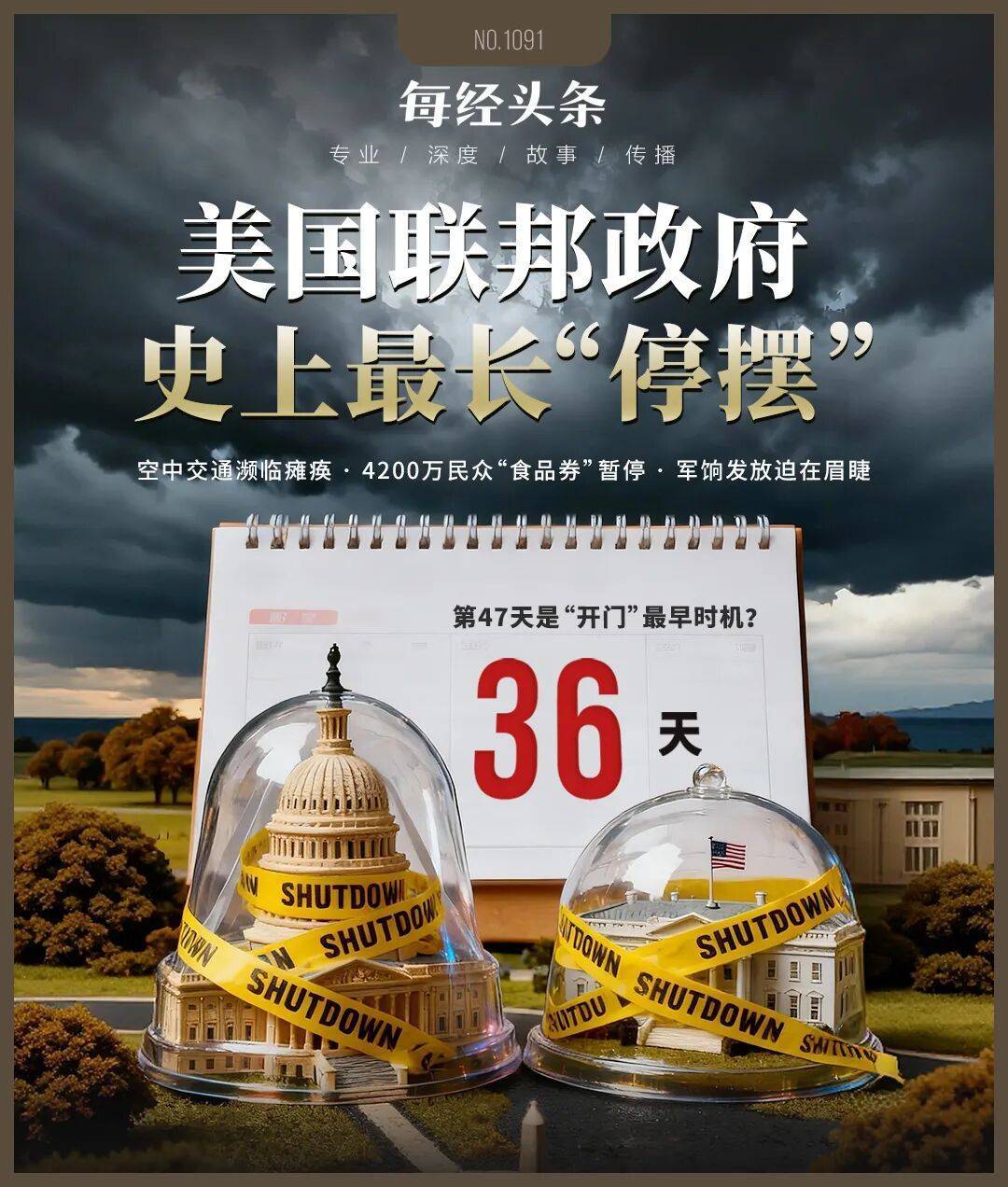
36天,美国联邦政府“停摆”创纪录!航空濒临关闭,债务增超6000亿美元……
Mei Ri Jing Ji Xin Wen· 2025-11-05 04:59
Core Points - The U.S. federal government shutdown has reached its 36th day, marking the longest shutdown in history, primarily due to partisan disagreements over key issues like healthcare subsidies [1] - The Congressional Budget Office (CBO) warns that the shutdown could reduce the annual GDP growth rate by 1 to 2 percentage points in the fourth quarter [1][12] - Key pressure points driving negotiations include disruptions in air traffic, the suspension of food stamp benefits for 42 million people, and impending military pay issues [1][21] Group 1: Government Shutdown Dynamics - The shutdown began on September 30 after Congress failed to pass any temporary funding bills, leading to 14 failed votes in the Senate over the past month [1][5] - The inability to reach a compromise stems from deepening partisan divides, particularly regarding the extension of enhanced subsidies under the Affordable Care Act (ACA) [4][11] - The current political stalemate is exacerbated by the procedural tool of "filibuster," which allows unlimited debate unless a supermajority is reached [10][11] Group 2: Economic Impact - The CBO estimates that a six-week shutdown could result in a permanent loss of approximately $11 billion in economic output, with losses increasing to $14 billion if the shutdown lasts eight weeks [12][13] - The economic costs are compounded by the absence of critical economic data releases due to the shutdown, creating uncertainty for the Federal Reserve's decision-making [16][19] - The market's confidence in potential interest rate cuts by the Federal Reserve has diminished, with expectations dropping from 90.5% to 69% for a December rate cut [17][19] Group 3: Pressure Points for Resolution - The aviation sector is facing significant disruptions, with a high absenteeism rate among air traffic controllers leading to flight delays and cancellations [21][23] - The suspension of the Supplemental Nutrition Assistance Program (SNAP) has created a direct political pressure on Republican lawmakers, as many beneficiaries reside in Republican-controlled states [21][24] - Military pay issues are also looming, with uncertainty surrounding the next scheduled payment on November 15, which could further compel action from Congress [24][27] Group 4: Potential Outcomes - Analysts suggest that a compromise may involve a "clean" continuing resolution in exchange for future negotiations on healthcare subsidies, allowing both parties to save face [27] - Observing the reconvening of the House and positive developments in Senate negotiations could signal that an agreement is nearing [27]
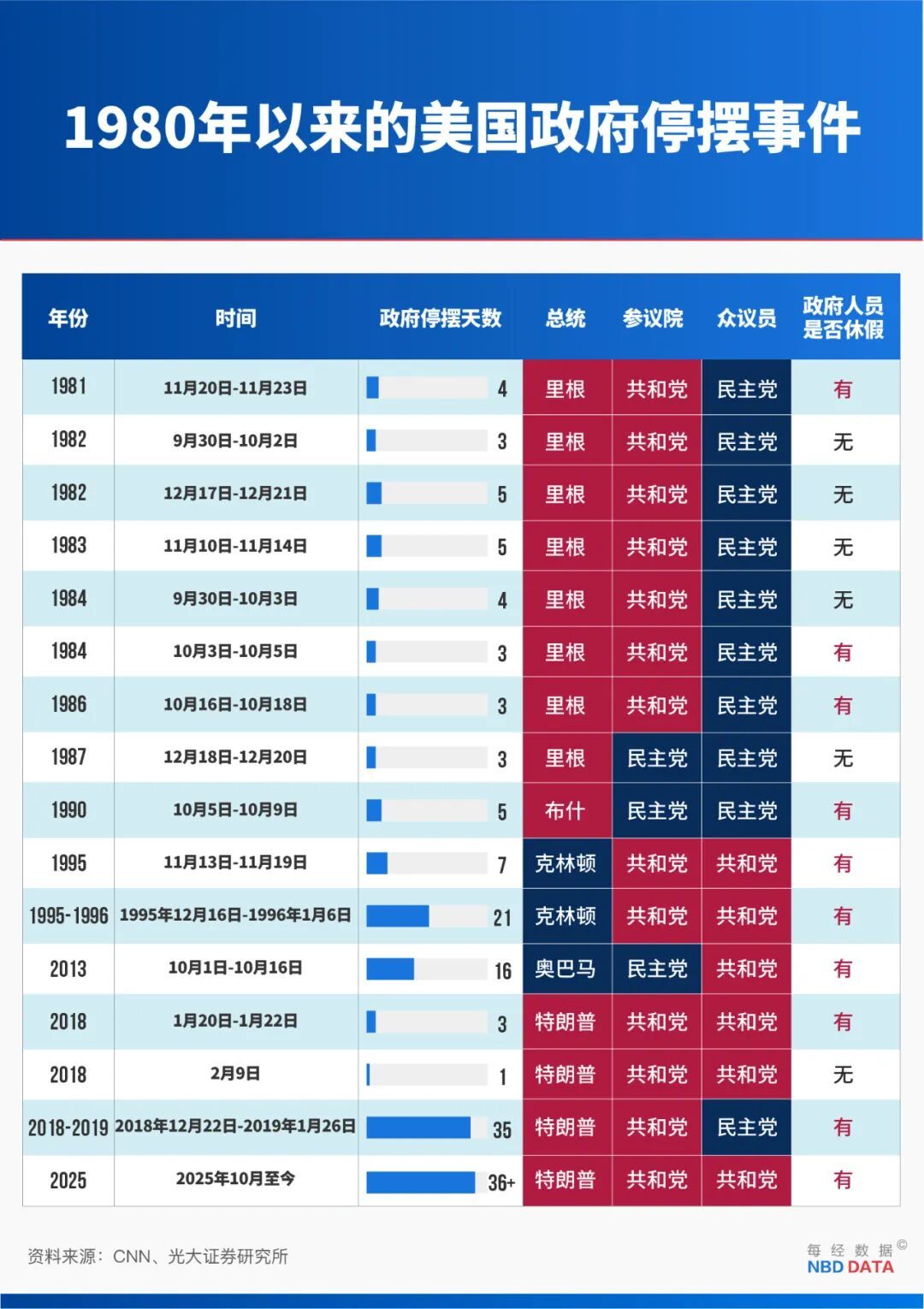
美国参议院又谈崩了,“停摆”即将创纪录!
券商中国· 2025-11-04 23:47
Core Viewpoint - The U.S. Senate failed to pass a temporary funding bill for the federal government, leading to a potential government shutdown that could become the longest in U.S. history, surpassing the 35-day shutdown from late 2018 to early 2019 [1] Group 1: Government Shutdown - The Senate's 14th attempt to advance a temporary funding bill, already passed by the House, did not receive the necessary 60 votes, resulting in an ongoing fiscal deadlock [1] - The record for the duration of the shutdown will be reset at midnight on November 5, 2023 [1] Group 2: Political Disputes - The primary contention between the Democratic and Republican parties regarding the temporary funding bill centers on healthcare spending, particularly related to the Affordable Care Act [1] - Senate Democratic Leader Chuck Schumer stated that Republicans are responsible for the anticipated rise in healthcare costs, which could leave 4 million Americans without health insurance [1] Group 3: Emergency Funding and Public Assistance - President Trump attributed the shutdown to the Democrats, emphasizing that emergency funds for food assistance would only be released once the government reopens [2] - The U.S. Department of Agriculture announced the use of $4.65 billion in emergency funds for food relief in November, highlighting the urgency of the situation for low-income individuals [2] Group 4: Legislative Challenges - The inability of Congress to pass a new annual budget before the start of the fiscal year on October 1 has led to reliance on temporary funding measures [2] - Senate Republican Leader Mitch McConnell expressed hope for breaking the fiscal deadlock soon, acknowledging the prolonged suffering it has caused for the American people [2]

“为了孩子吃上饭,自己靠喝水撑着”! 约4200万美国人吃饭成问题
Mei Ri Jing Ji Xin Wen· 2025-11-01 13:39
Core Points - The U.S. federal government shutdown has led to the impending depletion of funds for the Supplemental Nutrition Assistance Program (SNAP), affecting approximately 42 million Americans, primarily low-income individuals, the disabled, and the elderly [1][3][4] - The shutdown has resulted in significant operational challenges for the aviation sector, with air traffic control personnel shortages leading to increased flight delays and cancellations [7][8][10] SNAP Program Impact - SNAP is set to run out of funds by October 31, with benefits ceasing on November 1, which will severely impact the livelihoods of 42 million Americans [3][4] - A federal judge has ordered the USDA to release emergency funds to ensure SNAP benefits can be distributed, criticizing the decision not to utilize $6 billion in emergency funds as "arbitrary" [3][5] - The USDA had previously announced that it would not provide funding for SNAP if the government shutdown continued, leading to legal actions from Democratic-led states seeking to access emergency funds [5][4] Aviation Sector Challenges - The FAA reported staffing issues at over 35 locations, particularly in the Northeast, due to the government shutdown, resulting in significant flight delays and cancellations [7][8] - On October 30, over 6,000 flights were delayed and more than 1,000 were canceled, with the situation expected to worsen as the shutdown continues [7][8][10] - The ongoing shutdown has raised concerns about the potential impact on air travel during the Thanksgiving holiday season, with warnings from officials about a possible "disaster" for the aviation industry [7][10] Economic Consequences - The Congressional Budget Office warned that the shutdown could reduce the annualized GDP growth rate by 1 to 2 percentage points in Q4, leading to an estimated loss of $7 billion to $14 billion in economic output [21] - The U.S. Chamber of Commerce reported that federal contractors have already incurred losses of approximately $12 billion during the first four weeks of the shutdown, with many small businesses facing cash flow crises [21]

临时拨款法案第13次被否决 美政府继续“停摆”
Zhong Guo Xin Wen Wang· 2025-10-29 00:35
Core Points - The U.S. Senate failed to advance a temporary funding bill with a vote of 54 to 45, indicating that the government shutdown will continue [1] - The federal government shutdown has entered its 28th day with no signs of resolution [1] - Senate Democrats have blocked a Republican-backed funding bill for the 13th time, which aimed to keep federal agencies funded until November 21 [1] - The funding bill did not include funding for healthcare programs demanded by Democrats and did not impose restrictions on President Trump's cuts to previously approved congressional funding, leading to a lack of necessary support from Democrats [1]
参议院第13次否决临时拨款法案,美政府“停摆”继续
Zhong Guo Xin Wen Wang· 2025-10-28 23:33
Core Points - The U.S. Senate has failed for the 13th time to advance a temporary funding bill, resulting in the continuation of the government shutdown [1] - The government shutdown has now entered its 28th day, with no signs of resolution [1] - The Senate is experiencing a deadlock over spending bills, while a critical food assistance program is nearing depletion of funds [1] Group 1 - The Senate voted 54 to 45 against the temporary funding bill, which aimed to keep federal agencies operational until November 21 [1] - The bill did not include funding for healthcare programs demanded by Democrats, nor did it impose restrictions on President Trump's cuts to previously approved congressional funding, leading to a lack of necessary support from Democrats [1]
白宫:10月通胀数据可能无法发布
Sou Hu Cai Jing· 2025-10-25 00:55
Group 1 - The White House announced that due to Congress's failure to pass a temporary funding bill, critical data collection has been hindered, potentially leading to "devastating" economic consequences [1] - The government shutdown has entered its fourth week, marking the second-longest shutdown in U.S. history, with approximately 700,000 federal employees either furloughed or working without pay [1] - The core issue of the government shutdown stems from a stalemate between the two parties over healthcare benefits, preventing the passage of the temporary funding bill [1] Group 2 - The Consumer Price Index (CPI) report for September was released to allow the Social Security Administration to calculate cost-of-living adjustments for millions of retirees and other beneficiaries, despite the ongoing government shutdown [1] - The CPI report is a crucial reference for the Federal Reserve in determining interest rate policies, with traders increasing bets on two more rate cuts by the end of the year following the September CPI data release [2]
美政府“停摆”已19天,两党何时放下私心缓和分歧?
Xin Jing Bao· 2025-10-20 05:15
Core Points - The U.S. federal government has been in a shutdown for 19 days as of October 19, due to significant disagreements between the Republican and Democratic parties over healthcare-related spending and other core issues, preventing the passage of a new temporary funding bill [1] - Both parties are firmly sticking to their positions and blaming each other for the impasse regarding the temporary funding bill [2] Group 1: Political Dynamics - Republican House Speaker Mike Johnson stated he does not plan to recall House members until the government reopens, accusing Democrats of "playing politics" [4] - Democratic House Leader Hakeem Jeffries expressed willingness to negotiate but noted a lack of communication from Republicans since a meeting at the White House before the shutdown [4] Group 2: Implications of the Shutdown - Analysts believe the core reason for the prolonged shutdown is the deadlock over healthcare benefits, with both parties using the situation to advance their political agendas without a pressing desire to resolve the shutdown [5] - The Trump administration is reportedly using the shutdown as an opportunity to "streamline government," with expectations that over 10,000 federal positions may be cut [5] - The Democratic party is leveraging the shutdown to strengthen internal unity, as they previously faced a decline in support after compromising on a funding bill earlier this year [5] Group 3: Future Outlook - The shutdown may continue as the Trump administration has found temporary measures to alleviate some pressures, such as reallocating funds to pay military personnel, which diminishes the urgency for bipartisan negotiations [6]

美国防部证实!用80亿美元研发经费给军人发工资
证券时报· 2025-10-16 04:08
Group 1 - The U.S. Department of Defense confirmed that approximately $8 billion from research and development funds has been used to pay military personnel to avoid salary disruptions due to government shutdown [1] - The Department of Defense sourced this $8 billion from leftover appropriations from the previous fiscal year, indicating potential legal risks for the Trump administration by reallocating congressionally approved funds for other purposes [1] - The Senate is expected to vote on a "clean" temporary funding bill for the tenth time, which requires 60 votes to advance but is anticipated to be rejected [3] Group 2 - The Senate will also vote on a procedural motion regarding the defense appropriations bill, which, if passed, could lead to comprehensive military funding legislation in the coming weeks [3] - Even if the government remains shut down, the resolution of military salary payments could be temporarily secured if the defense appropriations bill progresses [3] - If the temporary funding bill does not advance, the government shutdown may continue until October 20 [4]