二手车保值率

Search documents
蓄力二十年,官方认证二手车欲反客为主
Zhong Guo Qi Che Bao Wang· 2025-07-21 01:05
Core Insights - The official certified used car market in China has only a 3.1% market share despite over 2 billion yuan investment by SAIC Volkswagen over 22 years, indicating a struggle to transition from the periphery to the center of the used car market [1] - The Chinese automotive market has entered a phase where used cars are central to its development, emphasizing the need for manufacturers to elevate used car business to a strategic level equal to new car sales [3][4] - The used car business is becoming a crucial profit source for dealerships, with over 5% contribution to overall revenue, contrasting with negative profit contributions from new car sales [4] Industry Trends - The used car market is approaching a transaction volume of 20 million units annually, with a significant growth rate of 47.9% for new energy used cars [15] - The industry is experiencing a shift from quantity accumulation to quality enhancement, with a focus on improving the integrity and transparency of transactions [15][16] - The introduction of new policies is accelerating the transformation of the used car market, with a growing emphasis on professional and branded operators [17] Company Strategies - SAIC Volkswagen is restructuring its used car business by integrating various sales channels and enhancing its certification system to improve efficiency and market presence [7] - Lexus has established a comprehensive used car certification and training system, emphasizing direct engagement in the used car market to better understand challenges and support dealers [5] - BMW is encouraging authorized dealers to develop robust used car teams and has invested resources to support long-term planning in the used car sector [6] Financial Insights - The profitability of used car operations is becoming increasingly important, with dealers facing declining margins in new car sales [4][8] - The implementation of financial tools to create high-quality used cars is suggested to alleviate sourcing issues and stabilize market prices [4] - The introduction of vehicle age premium strategies by companies like FAW Toyota aims to enhance brand loyalty and improve trade-in values for customers [8][9] Market Challenges - The used car industry faces challenges such as declining profit margins and a lack of trust due to issues like concealed vehicle conditions and false advertising [16] - The need for improved financial and insurance services is critical to meet the evolving demands of consumers in the used car market [16] - The industry is urged to embrace transformation and focus on building a transparent and trustworthy environment to stimulate consumer confidence in purchasing used cars [16][17]


自主品牌保值率反超合资车
Guang Zhou Ri Bao· 2025-05-21 20:15
Core Insights - The article highlights the increasing market share and value retention of Chinese domestic brands in the automotive sector, particularly in the context of the ongoing vehicle replacement policy in China [1][5]. Group 1: Market Trends - The latest data from the China Automobile Circulation Association indicates that the three-year depreciation rate for leading domestic brands has reached 57%, surpassing luxury brands like BBA (53%) and joint venture brands from the US, France, and South Korea (40%) [1]. - The trading volume of used new energy vehicles has exceeded 10%, becoming a core driver of market growth [1][4]. - The demand for used cars is shifting, with consumers increasingly prioritizing vehicle quality and diverse service experiences over mere pricing [5]. Group 2: Brand Performance - GAC Trumpchi leads the domestic brand retention rate, with top models like the Trumpchi, Tank, and Lynk & Co showing three-year depreciation rates of 57.5%, 56.8%, and 54.3% respectively, outperforming joint venture brands like Volkswagen (52.8%) [2][3]. - In the electric vehicle segment, models such as Xiaomi SU7 and AITO M9 have achieved a one-year retention rate of up to 88.7%, significantly higher than luxury models like Porsche Taycan and Tesla Model 3 [3]. - The used car market is witnessing a "younger" trend, with a notable increase in transactions for vehicles less than two years old, particularly among domestic brands [4]. Group 3: Market Dynamics - The number of used cars available for sale reached over 780,000 units in April, marking a record high for a single month [5]. - The competitive landscape in the used car market is stabilizing after initial price adjustments, with brands finding new market positions [5]. - The article anticipates a moderate increase in used car transaction volumes in May compared to April [5].
二手小米SU7,“高保值”难再续
虎嗅APP· 2025-05-16 14:09
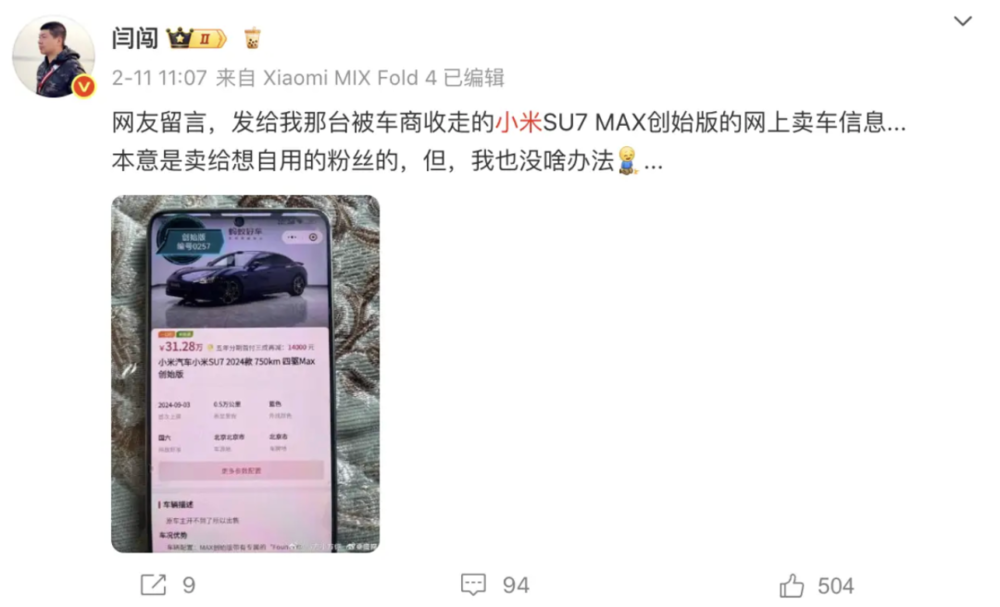
Core Viewpoint - The article discusses the high resale value of the Xiaomi SU7 electric vehicle, highlighting its impressive initial depreciation rates and the factors contributing to its market performance, while cautioning that the sustainability of this high resale value remains uncertain [1][2]. Group 1: High Resale Value and Market Dynamics - The Xiaomi SU7 has achieved a resale value of approximately 96% after one year, with a notable case where a vehicle sold for 28.88 million yuan, only slightly below its original price of 29.98 million yuan [1]. - The high resale value is attributed to successful marketing, high brand recognition, and a long delivery cycle for new vehicles, which has created a perception of value among consumers [4][8]. - The average inventory cycle for second-hand Xiaomi SU7 vehicles is around 60 days, which is longer than the industry average, indicating potential challenges for dealers in maintaining profitability [6][10]. Group 2: Delivery Challenges and Market Saturation - The delivery cycle for new Xiaomi SU7 models is currently estimated at 37 to 45 weeks, leading to a backlog that affects the availability of vehicles in the market [4][12]. - Despite the high initial demand, there are signs that the sales growth for Xiaomi vehicles is slowing down, with recent data showing a decline in weekly sales figures [13]. Group 3: Industry Context and Future Outlook - The second-hand car market in China saw a total transaction volume of approximately 19.61 million vehicles in 2024, reflecting a year-on-year growth of 6.52% [9]. - The transition towards electric vehicles is prompting second-hand car dealers to adapt their strategies, with many betting on the future value of models like the Xiaomi SU7 as they shift focus from traditional fuel vehicles [10].

二手小米SU7,“高保值”难再续
Hu Xiu· 2025-05-16 11:18
Core Viewpoint - The Xiaomi SU7 has demonstrated a high resale value, with reports indicating a 96% retention rate after one year, leading to its recognition as a "top performer" in the electric vehicle market [2][3][5]. Group 1: Resale Value and Market Perception - The resale price of the Xiaomi SU7, originally priced at 299,800 yuan, was sold for 288,800 yuan after nearly a year of use, indicating a strong market demand [1]. - The high resale value has led to social media buzz, with users claiming that owning a Xiaomi SU7 is akin to paying for insurance without depreciation [2]. - However, industry experts caution that the conclusion regarding the high resale value may be premature, as the high purchase prices by dealers could lead to low profit margins and high inventory cycles [3][15]. Group 2: Sales Performance and Production Capacity - Xiaomi's automotive division has seen a significant increase in delivery volumes, exceeding targets by 37% last year, with monthly deliveries surpassing 20,000 units for seven consecutive months [6][7]. - The company has set an ambitious sales target of 350,000 units for the current year, primarily relying on the SU7 and its variants [7]. - The delivery timelines for the SU7 and its variants are currently extended, with the shortest delivery period being 37 weeks, indicating that production capacity is nearly exhausted [19][20]. Group 3: Market Dynamics and Inventory Challenges - The average inventory cycle for the Xiaomi SU7 in the second-hand market is around 60 days, which is longer than the industry average, suggesting potential challenges in maintaining high resale prices [13][14]. - The second-hand market for electric vehicles is evolving, with a growing number of transactions and a shift in consumer preferences towards more established models like the Xiaomi SU7 [15][16]. - Despite the current high resale prices, dealers express concerns about the sustainability of these prices, especially as the market adjusts to new models and changing consumer demands [17][18].