京津冀协同创新

Search documents
五个维度测定!京津冀协同创新指数年均增速达13.1%
Xin Lang Cai Jing· 2026-01-10 14:22
Core Insights - The Beijing-Tianjin-Hebei (Jing-Jin-Ji) collaborative innovation index has significantly increased from 100 in 2013 to 388.0 in 2024, with an average annual growth rate of 13.1% [1] - The number of academic papers in the region has surged from 64,000 in 2013 to 230,000 in 2024, reflecting an annual growth rate of 12.3% [3] - Beijing has maintained its position as the top city globally for high-level scientific publications, with 11,915 papers published in leading journals in 2024, accounting for 17.1% of the national total [3][4] Innovation Capacity - The region boasts one of the densest clusters of major scientific infrastructure globally, with 37 technology facilities established in the Huairou Comprehensive National Science Center, of which 29 are operational [4] - Beijing has 145 national key laboratories, representing nearly 30% of the national total, and ranks third globally in the number of unicorn companies, with over 70% in cutting-edge fields like AI and commercial aerospace [4] Industrial Collaboration - The "Six Chains and Five Clusters" industrial collaboration framework has been developed, with Beijing leading in hydrogen energy and biomedicine, while Tianjin focuses on high-end industrial mother machines and cybersecurity [6] - The region has established several national advanced manufacturing clusters, including those in information technology and smart connected vehicles, with a total of seven such clusters in Jing-Jin-Ji [6] Strategic Recommendations - The report suggests that Jing-Jin-Ji should focus on building an international technology innovation center, enhancing collaborative innovation, and increasing R&D funding, particularly in Hebei [9] - It emphasizes the need for strategic planning in future industries, with Beijing targeting sectors like future information and health, while Tianjin should focus on next-generation information technology and life sciences [9]

廊坊倾力推动京津科技成果落地生金
Xin Lang Cai Jing· 2025-12-22 23:27
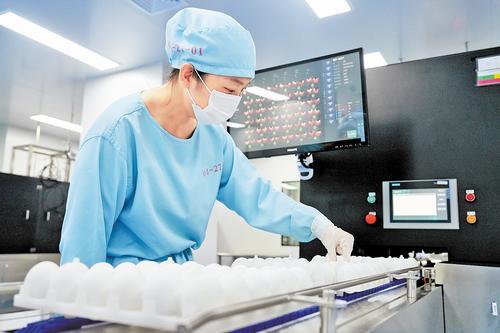
Core Viewpoint - Langfang is leveraging its geographical advantages to transform technological achievements from Beijing and Tianjin into industrialization through a collaborative model of "Beijing-Tianjin R&D, Langfang incubation and transformation" [6][10]. Group 1: Technological Achievements and Collaborations - The Jinowei Innovation Vaccine Production Base in Langfang has completed its first phase and is set to begin mass production of a quadrivalent influenza vaccine [5][6]. - In the first 11 months of this year, Langfang's technical contract transaction volume reached 629.37 billion yuan, a year-on-year increase of 17.09% [6]. - Langfang has established 126 collaborative R&D platforms with universities and research institutes from Beijing and Tianjin, transferring over 370 technological achievements [8][9]. Group 2: Industry Development and Ecosystem - The city is focusing on key industries such as modern commerce, electronic information, new energy, and new materials, actively engaging with top universities and research institutions [7][8]. - Langfang has introduced over 60 enterprises from Beijing and Tianjin in the biopharmaceutical sector, enhancing collaboration in technology research and development [10][12]. - The establishment of a comprehensive technology financial service system aims to address the financing challenges faced by technology-based SMEs, with a loan balance of 484.21 billion yuan, up 30.02% year-on-year [14][15]. Group 3: Policy and Infrastructure Support - Langfang has implemented various policies to facilitate the transfer and transformation of technological achievements, including guidelines for technology transfer and the establishment of pilot bases [8][12]. - The city has built 10 pilot bases for technology maturation, providing essential support for the engineering and reliability verification of laboratory results [8][9]. - A total of 41 new municipal-level R&D platforms have been established this year, covering multiple key areas such as high-end equipment manufacturing and biomedicine [7][8].
京津冀将打造更加紧密的协同创新共同体
Zhong Guo Xin Wen Wang· 2025-12-18 01:51
Group 1 - Beijing-Tianjin-Hebei region aims to create a more closely integrated collaborative innovation community, focusing on building an international technology innovation center [1] - The region will leverage national laboratories, research institutes, and universities in Beijing to enhance the output and transformation capabilities of major original achievements [1] - The Xiong'an New Area is experiencing rapid development, with over 1,000 students enrolled in schools supported by Beijing and a cumulative outpatient volume of over 510,000 at Xiong'an Xuanwu Hospital [1] Group 2 - The Beijing-Tianjin-Hebei intelligent connected new energy vehicle technology ecological port has reached 42 projects, with over 300 key component enterprises from Tianjin and Hebei entering the supply chains of leading companies like Beijing Benz and Xiaomi [2] - The region plans to build a more competitive industrial chain cluster, attracting leading component enterprises to settle in the ecological port [2] - There is an emphasis on accelerating the humanoid robot industry chain project and enhancing cooperation with key parks in Tianjin and Hebei to improve industrial collaboration efficiency [2]
多个京津冀协同创新项目签约
Bei Jing Ri Bao Ke Hu Duan· 2025-11-25 01:23
Group 1 - The "Towards New Action" series event facilitated the signing of multiple collaborative innovation projects in the Beijing-Tianjin-Hebei region, focusing on connecting new technologies with market applications [1][2] - Key technology demands were presented, including smart road testing, satellite internet applications, and biodegradable materials development, highlighting the emphasis on cutting-edge and critical technologies [1] - The event aimed to create an efficient platform for supply-demand matching in the three regions, promoting the application of technological achievements in real-world scenarios [2] Group 2 - Seven organizations, including Amos (Tianjin) Technology Co., Ltd. and Hebei Science and Technology Achievements Display and Trading Center, signed cooperation agreements to develop core components for medical devices and clinical diagnostics for surgical robots [2] - The event is part of the 2025 Zhongguancun Forum series, focusing on the validation and iterative innovation of new technologies and products [2] - Future activities will continue to optimize the technological innovation ecosystem in the city, driving high-quality development of technology enterprises through scenario-driven models [2]
中国区域科技创新报告出炉:上海、北京、江苏等6地领先
Di Yi Cai Jing· 2025-09-21 04:27
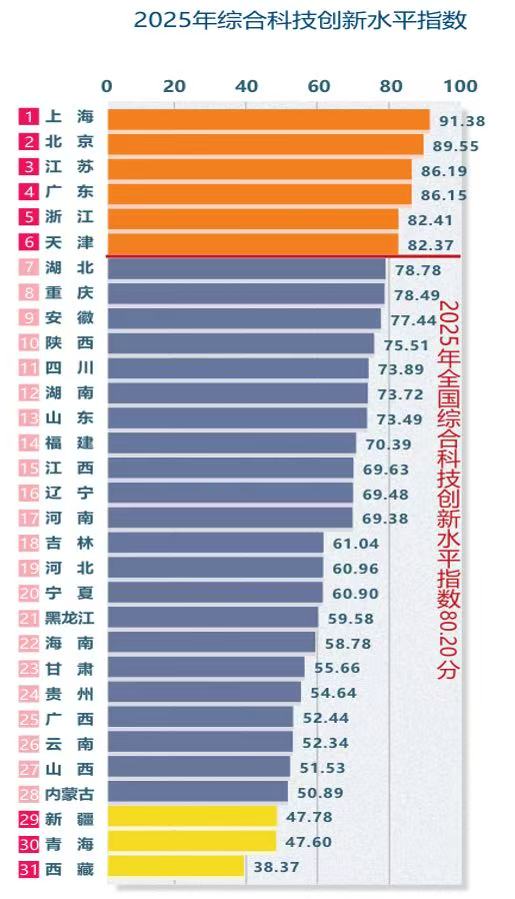
Core Insights - The report indicates that China's overall technological innovation level has improved, scoring 80.20, an increase of 1.77 from the previous year, with growth in innovation input, output, and high-tech industries [1][4] Group 1: Regional Innovation Levels - The report categorizes 31 regions into three tiers based on their innovation scores: - First tier includes Shanghai, Beijing, Jiangsu, Guangdong, Zhejiang, and Tianjin, all above the national average [5] - Second tier includes regions like Hubei, Chongqing, and Anhui, scoring above 50 but below the national average [6] - Third tier includes Xinjiang, Qinghai, and Tibet, scoring below 50 [6] Group 2: Key City Clusters - The Beijing-Tianjin-Hebei region shows significant collaborative innovation, with Beijing ranking second nationally in innovation level and first in innovation environment [7] - The Yangtze River Delta is strengthening its innovation community, with Shanghai ranking first nationally and Jiangsu third, both showing improvements in R&D investment [8] - The Guangdong-Hong Kong-Macau Greater Bay Area maintains strong innovation momentum, with Guangdong ranking fourth nationally and leading in innovation promotion [8] Group 3: Regional Development and Performance - The Yangtze River Economic Belt has seen continuous improvement in innovation capabilities, with Hubei rising to seventh and Chongqing to eighth in innovation rankings [9]
京津冀协同创新共同体建设如何?市人大常委会听取这份报告
Xin Jing Bao· 2025-07-25 08:53
Group 1 - The report highlights the progress made in promoting the collaborative innovation community in the Beijing-Tianjin-Hebei region since the implementation of the decision, while also identifying existing issues [1] - The establishment of a "one core, two wings" spatial layout supports the innovative development of Xiong'an New Area, with significant advancements in collaboration between Beijing and Tianjin, and the integration of industrial chains [2] - The report suggests enhancing cross-regional benefit sharing mechanisms and improving the modernization level of industrial chains to strengthen the innovation ecosystem [4] Group 2 - The report indicates the formation of a collaborative framework in the Beijing-Tianjin-Hebei region, with 199 companies in Xiong'an New Area projected to generate over 5 billion yuan in revenue by 2024 [2] - The establishment of 25 university alliances and the implementation of 1,743 cooperative projects demonstrate the strengthening of the innovation ecosystem [3] - Recommendations include the implementation of a talent green card system and the creation of a one-stop talent service platform to facilitate talent mobility [5]
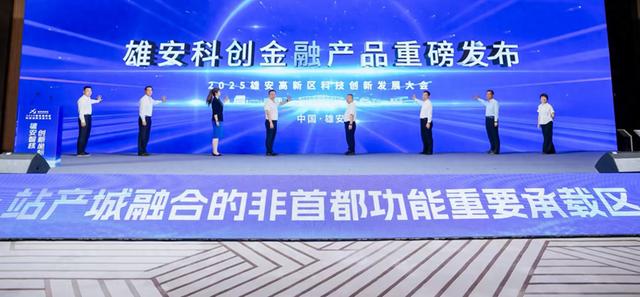
雄安高新区新增7个前沿科创项目
Bei Jing Ri Bao Ke Hu Duan· 2025-07-18 10:13
Core Insights - The "Xiong'an Smart Core Innovation Coordinates - 2025 Xiong'an High-tech Zone Technology Innovation Development Conference" has led to the signing of seven high-quality technology companies in fields such as low-altitude economy, new generation information technology, and robotics, indicating further improvement of the related industrial chain and accelerated gathering of innovation entities [1][3] Group 1 - The conference showcased the spatial layout of Xiong'an High-tech Zone, characterized by "one core, two wings, and three supports," outlining a progressive development path of "gathering innovative elements - forming industrial ecology - improving urban functions" [3] - Companies like Yushi Technology and Bingo Intelligence shared innovative achievements and practical experiences in areas such as autonomous driving and AI education during the event [3] - Seven banks introduced specialized financial products such as "Innovation Points Loan" and "Sci-tech Loan," which rely on enterprises' intellectual property and innovation indicators for convenient credit granting, marking the acceleration of a comprehensive service system in Xiong'an High-tech Zone [3][5] Group 2 - Experts in a high-end roundtable discussion emphasized the need for Xiong'an High-tech Zone to build an open innovation ecosystem supported by a modern industrial system and policy capital ecology to achieve sustainable development with global influence [5] - The conference deepened regional collaborative innovation ties, promoting extensive connections among government, industry, academia, research, and finance, laying a solid foundation for gathering high-end innovative elements and constructing a competitive full-chain innovation system [5]