
人类命运共同体理念

Search documents
南京师范大学教授郦波:阳明心学必将持续引发全球共鸣
Zhong Guo Xin Wen Wang· 2026-01-10 12:05
Core Viewpoint - Wang Yangming's philosophy, known as "Yangming Xinxue," is gaining global resonance and is a key topic in overseas speeches by Professor Li Bo from Nanjing Normal University [1][3]. Group 1: Yangming Xinxue's Global Influence - Yangming Xinxue has received enthusiastic responses in overseas speeches, particularly among overseas Chinese, highlighting their deep sense of belonging to their homeland [3]. - The philosophy, originating from Wang Yangming's enlightenment over 500 years ago, emphasizes the core idea of "unity of knowledge and action," which has been widely respected both domestically and internationally [3]. - Li Bo connects Yangming Xinxue with China's concept of a community with a shared future for mankind, suggesting that ancient wisdom can provide insights for contemporary global governance [3][4]. Group 2: Historical and Cultural Significance - Li Bo's book "Five Hundred Years of Wang Yangming" argues that Japan's modern rise is fundamentally based on Yangming Xinxue, indicating its significant impact on East Asian thought and culture [3]. - The philosophy has provided guidance and value to certain ethnic groups during its transmission in East Asia, showcasing its practical relevance [3]. - The assertion by Harvard Professor Tu Weiming that the 21st century will be the century of Wang Yangming underscores the enduring importance of Yangming Xinxue in addressing contemporary human civilization challenges [4].

“中国已成为国际关注中心和焦点”——中外学者热议《2025年中国国际形象全球调查报告》
Huan Qiu Shi Bao· 2025-12-30 01:08
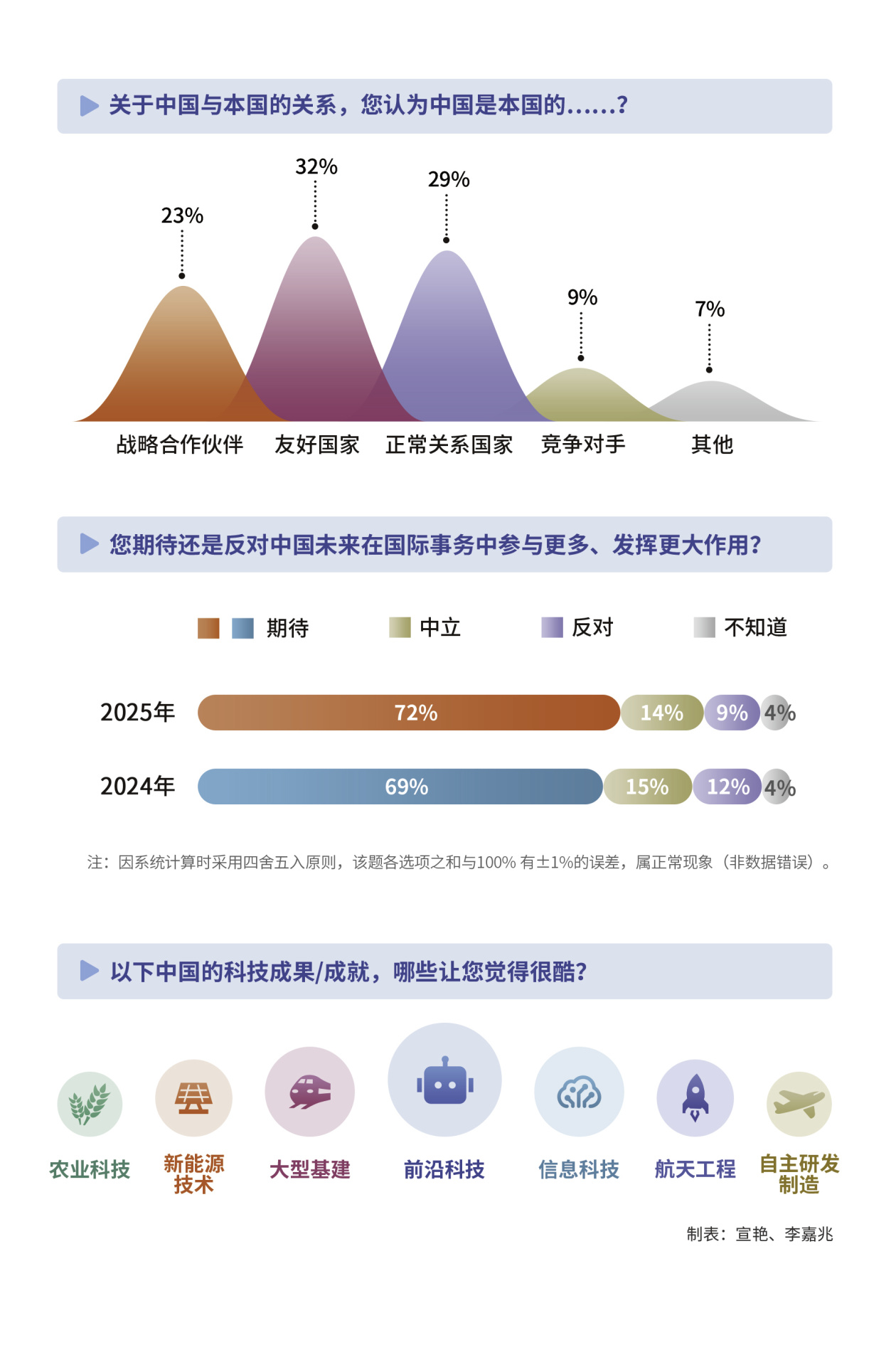
Core Insights - The 2025 Global Survey on China's International Image indicates a growing recognition of Xi Jinping's Thought on Socialism with Chinese Characteristics, with significant international support for key concepts such as "building a community with a shared future for mankind" and "green development" [3][4][5]. Group 1: International Perception of China - Approximately 78% of foreign respondents acknowledge China's increasing comprehensive national strength, an 8 percentage point increase from 2024 [11]. - Nearly 69% of foreign respondents express a favorable view of China, up 6 percentage points from the previous year [11]. - Over 90% of respondents show interest in China, with cultural aspects being the primary interest for developed countries and technology for developing nations [11]. Group 2: Recognition of Governance and Development Models - About 70% of foreign respondents positively view the Chinese Communist Party's strict governance practices and the implementation of five-year plans, recognizing them as important experiences for economic and social development [7][9]. - The international community appreciates China's long-term planning and strong execution capabilities, which are seen as key factors in its development success [8][9]. Group 3: China's Global Initiatives - The survey highlights that over 70% of respondents recognize China's global initiatives, such as the Global Development Initiative and the Global Security Initiative, reflecting a growing awareness and acceptance of these concepts [3][4]. - China's emphasis on mutual respect, common development, and collective security resonates with many countries, particularly in the context of rising global uncertainties [5][6]. Group 4: Expectations for China's Role in Global Affairs - More than 70% of respondents expect China to play a larger role in international affairs, particularly in promoting a fairer global order and addressing regional issues [16][17]. - Over 80% of foreign respondents believe their countries maintain normal, friendly, or strategic cooperative relations with China, indicating a positive perception of bilateral relations [19].
国际社会一致认可中国斡旋柬泰,并非偶然
Huan Qiu Shi Bao· 2025-12-29 08:13
Core Viewpoint - The recent ceasefire agreement between Cambodia and Thailand, facilitated by China, highlights China's role as a mediator in regional conflicts and its commitment to promoting peace and stability in Southeast Asia [1][2][3]. Group 1: Ceasefire Agreement - Cambodia and Thailand signed a joint ceasefire statement during a special meeting of the border committee on December 27, following weeks of conflict that resulted in significant casualties and displacement of civilians [1]. - The ceasefire is seen as a critical step in addressing the long-standing border disputes between the two nations, with China aiming to use this opportunity to establish a long-term dialogue mechanism [3]. Group 2: China's Mediation Role - China has been praised by both parties for its objective and fair stance, emphasizing support for ASEAN's mediation efforts without imposing political conditions [2][3]. - The Chinese approach to mediation is characterized by a non-confrontational and pragmatic strategy, focusing on dialogue and cooperation rather than traditional Western methods that often exacerbate conflicts [2][3]. Group 3: Broader Implications - China's involvement in the Cambodia-Thailand conflict is part of its broader strategy to engage in global conflict resolution, reflecting its commitment to the concept of a shared future for humanity [4]. - The successful mediation in this conflict reinforces China's diplomatic credibility and showcases its unique approach to international relations, contrasting with Western-centric mediation practices [3][4].
社评:国际社会一致认可中国斡旋柬泰,并非偶然
Xin Lang Cai Jing· 2025-12-28 16:22
Core Viewpoint - The recent ceasefire agreement between Cambodia and Thailand, facilitated by China, highlights China's growing role in regional conflict resolution and its commitment to maintaining peace and stability in Southeast Asia [1][2][3]. Group 1: Ceasefire Agreement - Cambodia and Thailand signed a joint ceasefire statement during a special meeting of the border committee on December 27, following weeks of conflict that resulted in significant casualties and displacement of civilians [1]. - The ceasefire is seen as a critical step in addressing the long-standing border disputes between the two nations, with China aiming to use this opportunity to establish a long-term dialogue mechanism [3]. Group 2: China's Role in Mediation - China has been praised by both parties for its neutral and constructive approach, emphasizing support for ASEAN's mediation efforts without imposing political conditions [2][3]. - The Chinese government has provided humanitarian aid to Cambodia, demonstrating its commitment to a cooperative and supportive role in the region [2]. Group 3: Broader Implications - The successful mediation reflects a shift from traditional Western-led conflict resolution methods, which often involve political conditions and can exacerbate tensions, to a more inclusive and respectful approach by China [3][4]. - China's involvement in this conflict, along with its participation in other global issues, underscores its advocacy for a community of shared destiny and its commitment to regional security through dialogue and cooperation [4].
环球时报社评:国际社会一致认可中国斡旋柬泰,并非偶然
Xin Lang Cai Jing· 2025-12-28 16:22
Core Viewpoint - The recent ceasefire agreement between Cambodia and Thailand, facilitated by China, highlights China's constructive role in regional conflict resolution and its commitment to maintaining peace and stability in Southeast Asia [1][2][3]. Group 1: Ceasefire Agreement - Cambodia and Thailand signed a ceasefire joint statement during a special meeting of the border committee on December 27, following weeks of conflict that resulted in significant casualties and displacement of civilians [1]. - The ceasefire is seen as a critical step in addressing long-standing border disputes and restoring political trust between the two nations [3]. Group 2: China's Role in Mediation - China has been recognized for its objective and fair stance in mediating the conflict, avoiding the pitfalls of traditional Western mediation approaches that often exacerbate tensions [2][3]. - The Chinese government emphasized support for ASEAN's mediation efforts and refrained from imposing political conditions, which has fostered a comfortable environment for dialogue [2]. Group 3: Long-term Goals - China's objectives extend beyond a temporary ceasefire; it aims to establish a long-term dialogue mechanism to help Cambodia and Thailand resolve historical issues and achieve lasting peace [3]. - The successful mediation reflects China's unique approach to global conflict management, characterized by respect for national sovereignty and a commitment to mutual benefit [3][4]. Group 4: Broader Implications - China's involvement in the Cambodia-Thailand conflict is part of its broader strategy to promote a community with a shared future, demonstrating its commitment to regional stability and cooperation [4]. - The situation illustrates China's capability to provide constructive solutions in a world filled with uncertainties, reinforcing its role as a stabilizing force in international relations [4].
我国推动气候适应型社会建设有哪些经验?对破解全球气候治理困境带来哪些启示?
Zhong Guo Huan Jing Bao· 2025-12-18 00:29
Core Viewpoint - The article emphasizes the urgent need for enhancing climate resilience as global warming approaches critical thresholds, highlighting the necessity for a strategic shift towards a climate-adaptive society while balancing mitigation efforts [1] Group 1: Global Climate Adaptation Challenges - Climate adaptation is increasingly included in national policies, yet faces systemic inadequacies, slow implementation, and fairness issues, indicating the need for comprehensive reform in development concepts and governance mechanisms [2] - Adaptation actions are fragmented despite international consensus, with developing countries facing structural shortcomings in funding, technology, and capacity building, which hinders their adaptation capabilities [2] - The governance system struggles to balance global public goods supply with national interests, necessitating a fair and cooperative global climate governance framework to address adaptation coordination challenges [2] Group 2: Urban Resilience and Infrastructure - Cities are critical for adaptation, yet many still rely on traditional engineering approaches, failing to recognize the long-term and complex nature of climate risks, leading to insufficient resilience against compound climate shocks [3] - A shift from a focus on "hard engineering" to a systems-thinking approach is essential for effective climate risk management, integrating adaptation into urban development and ecological civilization [3] Group 3: Equity and Technology Gaps - The distribution of climate adaptation technologies is highly imbalanced, with vulnerable countries remaining on the periphery of technological supply, exacerbating the "adaptation gap" and "technology gap" [4] - The current global governance system has institutional barriers in resource allocation, reinforcing the concentration of capital and technology in advantaged regions, which limits the overall global adaptation capacity [4] Group 4: China's Path to a Climate-Resilient Society - China is guided by Xi Jinping's ecological civilization thought, promoting profound changes in development concepts, governance models, and cooperation paradigms to address climate crises and global governance deficits [5] - The "National Strategy for Climate Change Adaptation 2035" marks a new phase of systematic and institutional adaptation efforts, emphasizing the integration of adaptation into long-term national development planning [6] - China adopts a systematic approach to adaptation, recognizing the interconnectedness of ecosystems and promoting ecological protection, disaster risk management, and green space development [6] Group 5: Pilot Projects and International Cooperation - China implements a strategy of classified guidance and pilot projects for climate-resilient urban development, creating a network of demonstration cities that integrate adaptation goals into urban planning and management [7] - Through initiatives like the Belt and Road and South-South cooperation, China shares adaptation knowledge and technology with developing countries, enhancing their capacity to respond to climate risks [7] Group 6: Global Insights from China's Practices - China's approach to building a climate-adaptive society reflects a deep transformation in development paradigms, enhancing national climate resilience and providing insights for addressing structural and mechanistic challenges in global climate governance [8] - The fundamental shift in development logic towards ecological harmony is essential for overcoming the inadequacies in global public goods supply [8] - A comprehensive governance system that integrates planning, spatial security, engineering support, and institutional collaboration is crucial for effective climate adaptation [9] - Fair and cooperative global climate governance must address the urgent needs of developing countries in terms of funding, technology, and capacity building [9]
国际观察:汤加国王的暖冬之旅
人民网-国际频道 原创稿· 2025-12-09 07:09
11月21日至27日,应国家主席习近平邀请,汤加国王图普六世时隔七年再次对中国进行国事访问。 11月25日上午,天安门广场21响礼炮轰鸣,礼兵列队致敬。图普六世在习近平主席陪同下检阅中国人民 解放军仪仗队,并观看分列式。 合作之旅:共绘蓝图的务实笃行 中汤27年来的务实合作,已结出累累硕果。中国援建的提升基础设施水平的瓦伊普阿大桥项目,保 护汤加文化遗产的王陵外围区域改造项目,助力能源绿色转型的风力发电项目等,实实在在增进了汤加 民生福祉。 国王此次访问更是为中汤合作之路按下"加速键"。两国元首在会见后见证签署了《提升经济伙伴关 系框架协定》,该协定有利于提升贸易和投资便利化水平。两国领导人还见签多项合作谅解备忘录,为 两国拓展合作提供坚实支撑。此外,双方同意扩大教育、医疗、旅游、体育、青年、媒体、地方等领域 交往合作,持续增进民心相通。 此前,中国援汤农业专家组已在汤加扎根15年,传授种植技巧、引进优良品种,让中国技术结出汤 加硕果。中国援汤医疗队已派遣六批次,惠及上万名汤加民众,带去的不仅是高超的医术,更是天下一 家的温度。中方表示,将继续为汤加实现自主可持续发展提供力所能及的帮助,会继续向汤加派遣医疗 ...
中国企业品牌向南非青少年足球项目捐赠助力青训
Zhong Guo Xin Wen Wang· 2025-12-07 01:43
中新网比勒陀利亚12月6日电 (记者 孙翔)海信南非公司5日向南非皮托·莫西马尼青少年足球项目(Pitso Mosimane Youth Football,简称 PMYF)捐赠100部海信移动设备,通过数字化科技助力南非青训体系发 展。南非豪登省省长勒苏非,南非体育、艺术和文化部部长麦肯齐,中国驻南非大使吴鹏等出席捐赠仪 式并致辞。 勒苏非表示,此次捐赠不仅是企业支持体育事业的善举,更是对南非青少年未来的投资。"这样的合作 让南非孩子能够勇敢追梦。" 麦肯齐在讲话中感谢中国企业对青训事业的长期投入。他说:"我们欢迎海信这样的合作伙伴加入南非 青训体系。他们提供的不只是设备,而是机会、信心和未来。" 海信南非自1996年进入南非市场以来,已成为本地就业、制造业和社会发展中的重要一员,建立本地化 制造体系和供应链,为社会创造数千就业机会,持续投资教育、体育与社区公益。(完) 中国驻南非大使吴鹏致辞称,"中国和南非都是是体育大国,双方体育合作潜力巨大。"中国企业积极参 与提升当地社区和民众福祉,很好体现了中国倡导的人类命运共同体理念和非洲"我为人人,人人为 我"的"乌班图"精神。使馆将继续鼓励中资企业积极承担社会责 ...

中俄总理第三十次定期会晤联合公报(全文)
国家能源局· 2025-11-05 02:04
Core Viewpoint - The joint statement from the 30th regular meeting of the Chinese and Russian Prime Ministers emphasizes the historical high level of the comprehensive strategic partnership between China and Russia, guided by the strategic leadership of their respective presidents [2][3]. Bilateral Cooperation - Both parties reaffirm their commitment to mutual support on core interests and major concerns, including adherence to the one-China principle and opposition to any form of Taiwan independence [4]. - The two countries plan to enhance practical cooperation in various fields, including trade, investment, and technology, while addressing external challenges [4][5]. Economic and Trade Cooperation - In 2024, China and Russia aim to overcome external adverse factors and achieve a record high in bilateral trade, with a focus on improving trade structure and exploring growth points in e-commerce and agricultural products [4][5]. - Both sides will continue to enhance cooperation in service trade, including tourism and information technology, and support the establishment of a joint agricultural investment cooperation memorandum [5][6]. Energy Cooperation - The two countries will deepen cooperation in energy sectors, including oil, gas, and renewable energy, while ensuring the safety and stability of cross-border energy channels [18][19]. - They will also collaborate on nuclear energy projects, including the Tianwan and Xudabao nuclear power plants, and explore further cooperation in nuclear fuel cycle projects [18][19]. Financial Cooperation - China and Russia will continue to enhance cooperation in the financial sector, including currency settlement and banking collaboration, to support economic stability [16][17]. - They will also work together in international financial institutions to promote a fair global financial system [17]. Cultural and Human Exchange - The two countries will expand bilateral educational exchanges and support high-quality inter-university cooperation, including the establishment of a Sino-Russian vocational education alliance [20][21]. - They will also enhance cooperation in health, sports, and cultural fields, including joint medical research and sports events [20][21]. Environmental and Technological Cooperation - Both parties will strengthen cooperation in environmental protection, biodiversity, and climate change, emphasizing the importance of sustainable development [30][31]. - They will also enhance collaboration in technology innovation, particularly in artificial intelligence and information technology [12][13]. Regional Cooperation - The two countries will promote cooperation in border regions and local areas, enhancing trade and investment opportunities [24][25]. - They will also support the development of the China-Mongolia-Russia Economic Corridor and strengthen ties with ASEAN [30].

全文丨中俄总理第三十次定期会晤联合公报
Bei Jing Ri Bao Ke Hu Duan· 2025-11-04 10:33
Core Points - The meeting between Chinese and Russian Prime Ministers marks the 30th regular meeting, emphasizing the historical high level of the comprehensive strategic partnership between the two countries [1][2] - Both parties reaffirm their commitment to mutual support on core interests and major concerns, resisting attempts to alter the outcomes of World War II and promoting a multipolar world [2][3] - The meeting resulted in several agreements aimed at enhancing cooperation in various sectors, including trade, energy, technology, and cultural exchanges [4][5] Trade and Economic Cooperation - The bilateral trade volume is expected to reach new highs in 2024, with both sides agreeing to improve trade structure and explore growth points in e-commerce and agricultural products [4][5] - Both parties plan to enhance service trade cooperation, including tourism and information technology, and support the establishment of a joint agricultural investment cooperation memorandum [6][7] - The two countries will work on optimizing customs procedures and enhancing logistics efficiency to facilitate trade [9][10] Energy Cooperation - The meeting highlighted the importance of deepening energy cooperation, particularly in oil, gas, and renewable energy sectors, to ensure energy security [27][28] - Both sides agreed to continue the construction of nuclear power plants and explore collaboration in nuclear energy [28][29] Technological and Scientific Collaboration - The two countries will develop a roadmap for scientific and technological innovation cooperation from 2026 to 2030, focusing on joint research and knowledge sharing [21][22] - There will be an emphasis on artificial intelligence cooperation, including the establishment of a specialized committee for ethical governance and standardization [22][23] Cultural and Human Exchange - The meeting underscored the significance of cultural exchanges, with plans to expand student exchanges and enhance cooperation in education and healthcare [30][31] - Both parties will continue to promote tourism and improve infrastructure to facilitate travel between the two nations [34][35] Multilateral Cooperation - The two countries reaffirmed their commitment to multilateral frameworks such as the Shanghai Cooperation Organization and BRICS, aiming to enhance regional stability and economic cooperation [42][44] - Both sides will coordinate efforts to address global challenges, including climate change and security threats, through collaborative initiatives [47][48]