价值陷阱

Search documents
白酒股集体创新低,抄底警惕“价值陷阱”
第一财经网· 2025-06-16 11:43
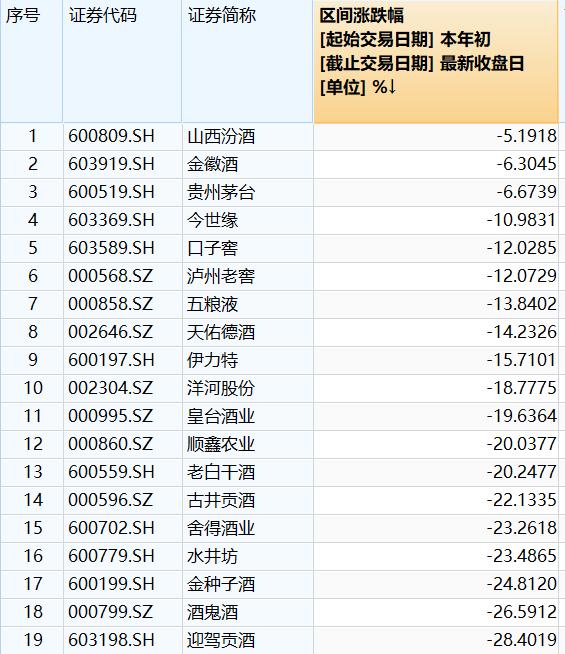
Core Viewpoint - The decline of Feitian Moutai below 2000 yuan has triggered a downward trend in the liquor stocks, indicating a significant downturn in the high-end liquor market [1][3][4] Group 1: Market Performance - On June 16, the liquor index hit a new low, with Wuliangye's stock price down nearly 14% year-to-date, and Guizhou Moutai showing signs of fatigue [3][4] - The liquor sector has seen a complete downturn this year, with 19 stocks recording losses, 8 of which exceeded 20%, and the largest drop being 28.4% for Yingjia Gongjiu [3][4] - The liquor index has dropped 10.73% year-to-date, with a cumulative decline of 13.25% since mid-May, reflecting a nearly 44% retracement from the historical peak in 2021 [4][6] Group 2: Price Dynamics - Feitian Moutai's wholesale price has fallen below the psychological barrier of 2000 yuan, indicating a weakening investment appeal and prompting speculative sell-offs [5][6] - The recent price drop of Feitian Moutai from 2100 yuan in mid-May to below 2000 yuan has raised concerns about the industry's overall health [5][6] - The current price trend suggests a shift in the supply-demand dynamics, with high-end liquor sales being adversely affected by new regulations and seasonal factors [6][7] Group 3: Regulatory Impact - New regulations on government alcohol consumption have further suppressed high-end liquor sales, as recent policies prohibit serving alcohol at official receptions [6][7] - The combination of seasonal demand fluctuations and regulatory changes has led to a significant impact on high-end liquor sales, particularly in the second quarter [6][7] Group 4: Valuation Concerns - The valuation levels of liquor stocks are nearing historical lows, with the Shenyin Wanguo liquor index's P/E ratio at 17.81, the second-lowest since June 2020 [8] - Guizhou Moutai's current P/E ratio is 20.14, while other leading liquor stocks are below 15, indicating a potential value trap for investors [8][9] - The market is advised to wait for stabilization in prices, channels, and inventory before reassessing investment opportunities in the liquor sector [8][9]






你不必在跌倒的地方爬起来
Hu Xiu· 2025-06-02 07:35
Group 1 - The article discusses the common behaviors of investors in the stock market, particularly "bottom fishing" and "chasing highs" [1][2] - A real case is presented where an investor bought shares of Jiakai City at a price of 0.49 yuan after a significant drop of 96.5% from its peak of 12.99 yuan [3][4] - The investor aimed to benefit from a potential rebound after the stock was delisted, but the stock price further declined to 0.10 yuan, resulting in a substantial loss [7][8] Group 2 - The article highlights the common mistake of blindly "bottom fishing," referencing the 2008 financial crisis where many investors lost money by buying stocks they believed were undervalued [10][11] - It emphasizes the concept of "value traps," where stocks appear cheap but their fundamentals continue to deteriorate, leading to further declines [14] - The narrative suggests that trying to recover losses in the same failing investment can lead to deeper losses, illustrating the importance of recognizing when to stop investing in a losing position [15][30] Group 3 - The article introduces the concept of "recouping thinking," which is a cognitive trap that can lead investors to make poor decisions based on past losses [17][18] - It explains the gambler's fallacy, where individuals mistakenly believe that past independent events will influence future outcomes, leading to irrational investment decisions [19][20] - The article discusses the anchoring effect, where investors fixate on previous high prices as reference points, ignoring the deteriorating fundamentals that may prevent a return to those levels [24] Group 4 - The article advocates for a more rational approach to resource allocation, suggesting that investors should focus on opportunities with higher marginal returns rather than being tied to past losses [33][36] - It emphasizes the importance of recognizing opportunity costs, where continued investment in a failing asset can prevent capital from being allocated to more promising opportunities [43] - The article concludes that in a rapidly changing environment, the ability to adapt and reallocate resources is more valuable than stubbornly trying to recover losses in a failing investment [68][72]
30年日债这么跌,会把30年美债一起拖下水?
华尔街见闻· 2025-05-23 09:20
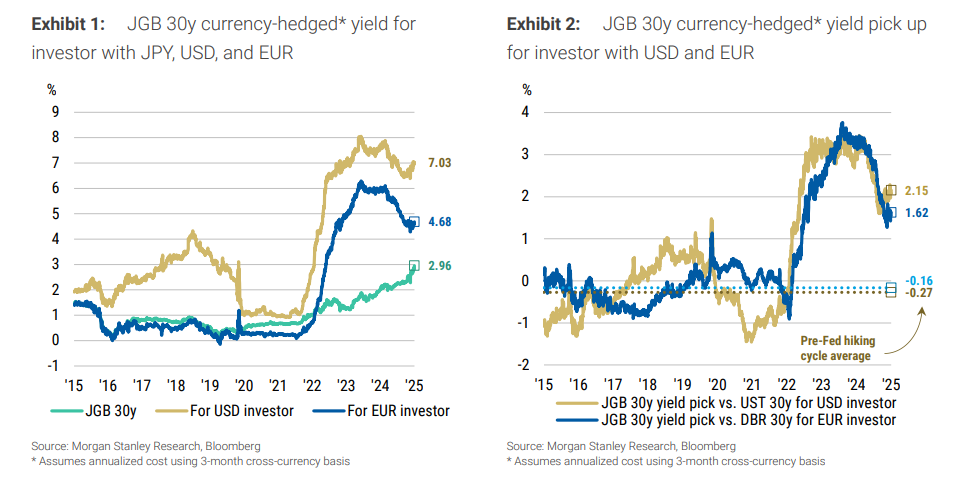
Core Viewpoint - The recent surge in 30-year Japanese government bond yields to historical highs has raised concerns about the global bond market, indicating potential structural issues within the market [1][2][3]. Group 1: Japanese Bond Market Dynamics - The rise in 30-year Japanese bond yields began in mid-April and has led to fears of a "value trap," where bonds appear cheap but may continue to decline in value due to structural supply-demand imbalances [2][3][6]. - Since early April, the 30-year Japanese bond yield has increased by 85 basis points, while the 30-year U.S. bond yield rose by 60 basis points during the same period [3]. - For dollar investors, the 30-year Japanese bond yield, after currency hedging, stands at 7.03%, significantly higher than the 4.96% yield of the 30-year U.S. bond [4]. Group 2: Global Bond Market Implications - The issues in the Japanese bond market may serve as a warning signal for the global bond market, reflecting three major trends affecting bond markets worldwide: persistent inflation pressures, declining demand from asset-liability management (ALM) investors, and high government financing needs [8]. - Japan's core inflation rate has exceeded the Bank of Japan's 2% target for two consecutive years, contributing to rising equilibrium yields [8]. - The demand for long-term bonds is decreasing as market interest rates rise, with domestic holdings of long-term bonds stabilizing [8]. Group 3: Potential Responses from the Bank of Japan - The Bank of Japan's future policy direction is a focal point for market observers, with potential measures including reducing the maturity of issued debt, fiscal constraints, adjusting the quantitative tightening path, and possibly restarting a rate hike cycle [13][14][18]. - The expectation is that the Bank of Japan will maintain a steady pace of reducing its bond purchases, with a target of 2 trillion yen per month starting in April 2026 [17].



30年日债这么跌,会把30年美债一起拖下水?
Hua Er Jie Jian Wen· 2025-05-22 11:12
Core Viewpoint - The sharp rise in Japan's 30-year government bond yields signals potential structural issues in the global bond market, with Japan's situation possibly serving as a "canary in the coal mine" for broader market concerns [1][8]. Group 1: Japan's Bond Market Dynamics - Japan's 30-year government bond yields have surged to historical highs, now comparable to Germany's, raising alarms about the global bond market [1]. - Morgan Stanley warns of a "value trap" in Japanese bonds, where seemingly cheap bonds may continue to depreciate due to structural supply-demand imbalances [3][7]. - Since early April, the 30-year Japanese bond yield has increased by 85 basis points, outpacing the 60 basis point rise in U.S. bonds during the same period [3]. Group 2: Global Bond Market Implications - High inflation pressures, declining demand from asset-liability management (ALM) investors, and high government financing needs are identified as three global trends affecting bond markets [9]. - Japan's core inflation rate has exceeded the Bank of Japan's 2% target for two consecutive years, contributing to rising equilibrium yields [9]. - The ongoing high fiscal deficits in developed markets are expected to keep debt issuance levels elevated, further pressuring long-term bonds [9]. Group 3: U.S. Bond Market Concerns - The rise in Japanese bond yields is expected to influence U.S. Treasury yields, potentially steepening the yield curve [2][11]. - Morgan Stanley indicates that the risk-reward ratio for long-term U.S. bonds is less favorable compared to short-term bonds, with a significant disparity in risk-adjusted returns [11]. - The attractiveness of hedged Japanese bonds may lead to a reallocation of investment portfolios, putting additional downward pressure on the U.S. long-term bond market [11]. Group 4: Potential Responses from the Bank of Japan - The Bank of Japan's future policy direction is under scrutiny, with potential measures including adjusting the duration of issued debt and maintaining a steady pace of quantitative tightening [13]. - A gradual return to interest rate hikes is anticipated, with expectations for the next rate increase in January 2026, which could flatten the yield curve and manage long-end risk premiums [13].
Is PayPal a Deep Value Stock or a Value Trap to Avoid?
The Motley Fool· 2025-05-09 10:15
Core Viewpoint - PayPal Holdings has seen significant stock price fluctuations, currently trading near its lowest valuation since going public, reflecting a decline in investor sentiment towards the fintech company [1] Group 1: Company Performance and Strategy - Under CEO Alex Chriss, who took over in 2023, PayPal is focused on improving profit margins and reigniting growth [2][8] - The company is implementing initiatives like PayPal Complete Payments to enhance user engagement and profit margins [9] - PayPal's stock has become more affordable, trading at one of its cheapest valuations since its spin-off from eBay in 2015 [6] Group 2: Market Challenges - PayPal has experienced a slowdown in growth, with competition from major players like Apple Pay, Google Pay, and others impacting its market position [3] - The company's take rate, which is the percentage of transaction value retained as revenue, has been declining due to increased competition [4] - Concerns arose after PayPal's 2024 full-year results, particularly regarding slow growth in unbranded transactions and conservative earnings guidance [5] Group 3: Growth Opportunities - PayPal is leveraging its first-mover advantage in the payment space, with 85% of survey respondents using its services, compared to 54% for its closest competitor, Block's Cash App [11] - The company is expanding its ad business, PayPal Ads, to sell programmatic ads, aiming to enhance its platform and grow ad revenue [10] - A $15 billion stock buyback authorization has been approved to reduce outstanding shares and boost earnings per share, indicating the company's belief in its undervalued stock [12]