信贷开门红

Search documents
信贷开门红表现亮眼 杭州银行密集接待机构调研
Quan Jing Wang· 2026-01-21 07:17
Group 1 - The core viewpoint of the news is that Hangzhou Bank is demonstrating confidence in its operational stability and growth potential, as evidenced by recent institutional research and responses to key questions regarding credit lending and asset quality [1][2][3] - Hangzhou Bank has achieved steady growth in corporate credit lending at the beginning of 2026, with a notable increase in lending scale compared to the same period in previous years, ensuring stable profitability [1] - The bank's retail mortgage loan demand is expected to stabilize and recover in 2026, supported by ongoing policy efforts and a gradual market adjustment, with a focus on high-quality projects and differentiated strategies [2] Group 2 - For the first three quarters of 2025, Hangzhou Bank reported a steady performance with operating income of 28.88 billion yuan, a year-on-year increase of 1.35%, and a net profit attributable to shareholders of 15.88 billion yuan, a significant year-on-year growth of 14.53% [3] - The bank announced a mid-term dividend, distributing 3.80 yuan per 10 shares to ordinary shareholders, totaling approximately 2.76 billion yuan, which reflects its strong profitability and commitment to returning value to investors [3] - Hangzhou Bank has established a clear strategic plan for the next five years, aiming to become a "value-leading bank in China" and aligning with national and regional development strategies [3][4] Group 3 - The bank's strategic framework for 2026-2030 focuses on three core objectives: customer, scale, and efficiency, while emphasizing digitalization, internationalization, and enhancing key capabilities in talent, risk control, and technology [4] - The bank aims to concentrate its efforts on six core business segments, including corporate finance, small and micro finance, and retail finance, to drive high-quality growth [4]

复盘10年走势,春节银行绝对、超额收益胜率最高!银行掉头向上,顶流银行ETF(512800)逆市上探逾1%
Xin Lang Cai Jing· 2026-01-20 11:27
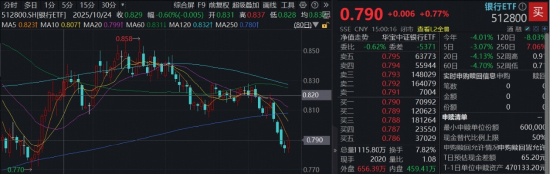
Group 1 - The banking sector showed resilience amid market fluctuations, with 42 bank stocks rising, except for Shanghai Pudong Development Bank, and notable gains from Chengdu Bank, Chongqing Bank, Changsha Bank, and others [1][9] - The top bank ETF (512800) experienced a price increase of over 1% at one point, closing up by 0.77% [1][9] - The absolute and excess returns of banks before the Spring Festival are driven by multiple factors, including balanced market styles, insurance fund allocations, and favorable credit data [3][11] Group 2 - Looking ahead to 2026, factors supporting the banking sector's performance include continued growth policies, ongoing asset shortages in insurance, and increased market volatility [3][11] - The People's Bank of China has lowered various structural monetary policy tool rates by 0.25 percentage points, indicating a focus on maintaining moderate monetary easing and structural adjustments [3][11] - As of January 20, the latest dividend yield of the China Securities Banking Index reached 4.78%, significantly exceeding the 10-year government bond yield of 1.84% [3][11] Group 3 - Historical data shows that the banking sector has an 80% success rate for absolute and excess returns before the Spring Festival over the past decade, with an average return of 4.4% from 2017 to 2025 [4][9] - The banking ETF (512800) is the largest and most liquid among A-share bank ETFs, with a recent scale of 11.18 billion yuan and an average daily trading volume exceeding 800 million yuan since 2025 [12]

结构性降息落地,短久期优质品种领涨
Hua Lian Qi Huo· 2026-01-18 13:20
Report Title - The report is titled "Hualian Futures Treasury Bond Weekly Report: Structural Interest Rate Cut Implemented, Short - Duration High - Quality Bonds Lead the Rise" [1] Report Industry Investment Rating - No information about the industry investment rating is provided in the report Core Viewpoints - This week, the total issuance scale of China's bond market was 1405.62 billion yuan, with the supply rhythm significantly advanced at the beginning of the year. Government bonds and credit bonds jointly pushed up the weekly issuance volume. Market institutions predict that the net financing of government bonds in Q1 2026 may reach 830 - 880 billion yuan [7] - This week, the central bank's open - market operations had a net injection of 171.28 billion yuan to supplement short - and medium - term liquidity, hedge against capital gaps, and support the "good start" of credit and the stable operation of the bond market [7] - This week, the performance of credit bonds with different ratings and maturities was significantly differentiated. There was a strong preference for short - duration high - coupon assets, and the market was cautious about the credit risk of industrial bonds. 1 - 3 - year credit bonds were the core of allocation [7] - This week, the long - end yield continued to decline. It is recommended to appropriately allocate 1 - 3 - year treasury bonds and local bonds on dips [7] - In December 2025, new social financing decreased year - on - year, and the stock growth rate declined. The central bank's targeted easing policies will improve the inefficiency of capital activation and reduce the financing cost of key areas [9] Summary by Relevant Catalogs 1. Bond Market Issuance - This week, the total issuance scale of China's bond market was 1405.62 billion yuan. Government bonds (treasury bonds + local bonds) issued over 1.2 trillion yuan, and the combined issuance of medium - term notes, commercial paper, and financial bonds was 314.781 billion yuan. Market institutions predict that the net financing of government bonds in Q1 2026 may reach 830 - 880 billion yuan, with a monthly average of over 130 billion yuan, much higher than in 2025 [7] 2. Central Bank Operations - This week, the central bank's open - market operations had a net injection of 171.28 billion yuan. On January 15, a 90 - billion - yuan 6 - month repurchase was carried out, with a net injection of 30 billion yuan. Considering the large tax revenue in January, the central bank used daily repurchases and term repurchases to avoid a sharp tightening of liquidity [7] 3. Credit Bond Performance - This week, the performance of credit bonds with different ratings and maturities was significantly differentiated. The yield of AA - rated 1 - year urban investment bonds dropped from 2.39% on January 12 to 1.08% on January 16, a decrease of over 130 BP. Some high - rated varieties entered the "negative spread" range. The average yield of AAA - rated industrial bonds was 7.31%, significantly higher than that of urban investment bonds. 1 - 3 - year credit bonds were the core of allocation, and funds preferred 3 - year - and - below varieties [7] 4. Yield and Liquidity - This week, the long - end yield continued to decline, with the 30 - year treasury bond yield falling to 2.3010% and the 10 - year yield falling to 1.8430%. DR007 fluctuated around the 1.40% policy rate, and the overnight Shibor was stable in the 1.2% - 1.3% range. Short - end liquidity remained loose, and it was recommended to appropriately allocate 1 - 3 - year treasury bonds and local bonds on dips [7] 5. Social Financing and Monetary Data in December 2025 - New social financing in December 2025 was 221 billion yuan, a year - on - year decrease of 64.62 billion yuan. The stock growth rate dropped 0.2 percentage points to 8.3%. The net financing of government bonds decreased significantly year - on - year, dragging down the overall social financing growth rate [9] - In terms of credit structure, corporate loans increased by 107 billion yuan year - on - year, with short - term loans and bill financing accounting for a relatively high proportion. Resident loans decreased, and the "scissors gap" between M1 and M2 widened [9] - The central bank cut the interest rates of various structural monetary policy tools by 0.25 percentage points and added 400 billion yuan in re - loan quotas for scientific and technological innovation and technological transformation. The minimum down - payment ratio for commercial real estate loans was reduced from 50% to 30% [9] - In December 2025, the weighted average interest rate of newly issued corporate loans and personal housing loans both dropped to a historical low of 3.1%. The targeted easing policy will improve capital activation and reduce the financing cost of key areas [9] 6. Charts and Data - The report includes multiple charts on treasury bond futures prices, basis, implied interest rates, yield curves, various bond yields, inter - bank repurchase rates, lending rates, money market liquidity, bond market liquidity, foreign bond markets, etc., providing data support for the analysis of the bond market situation [10][13][15]
华泰证券:基建与地产相关融资走势分化
Sou Hu Cai Jing· 2026-01-16 00:23
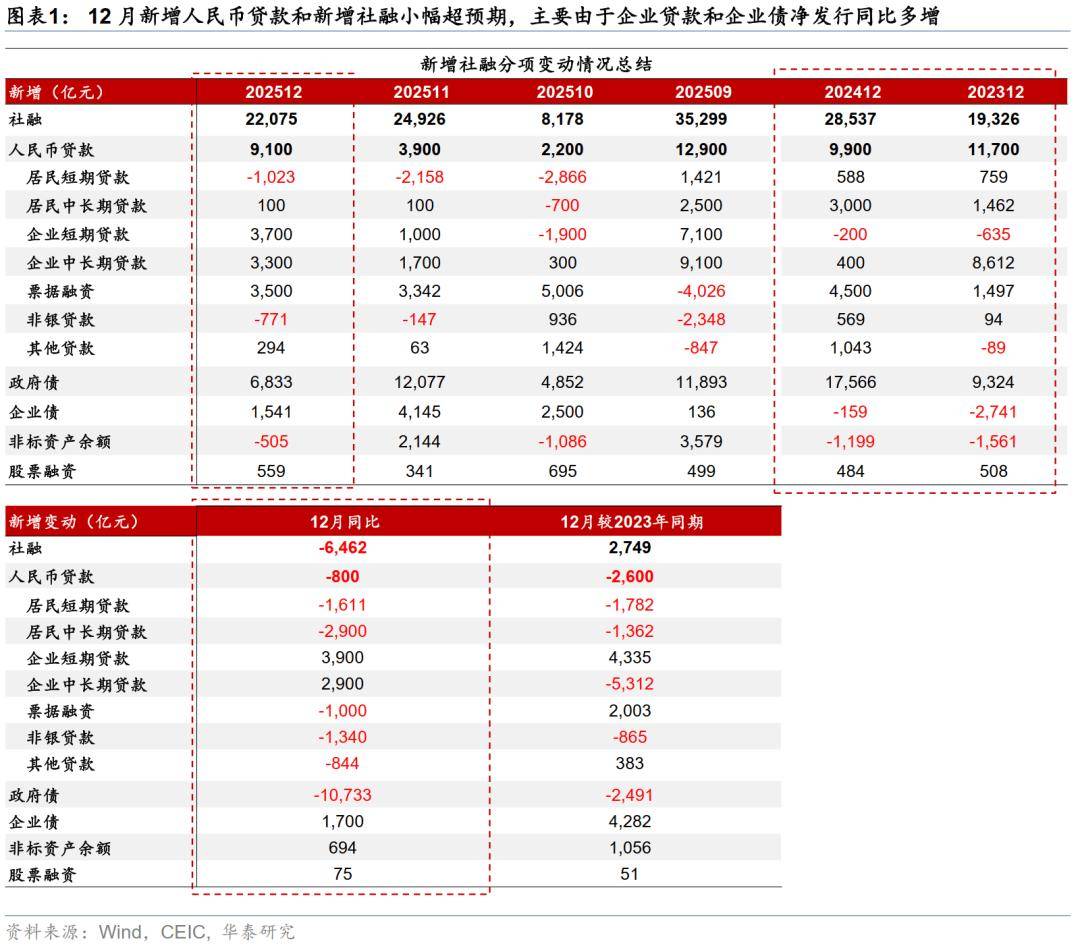
Core Viewpoint - In December, new RMB loans and new social financing slightly exceeded market expectations but showed a year-on-year decrease, indicating a continued divergence in financing demand between enterprises and households, primarily reflecting accelerated financing related to infrastructure while household loan demand remains under pressure due to real estate market challenges [1] Summary by Relevant Sections New RMB Loans and Social Financing - December new RMB loans amounted to 910 billion yuan, exceeding Bloomberg's consensus estimate of 800 billion yuan, but showing a year-on-year decrease of 800 billion yuan, keeping the loan balance year-on-year growth rate stable at 6.4% [3] - New social financing in December was 2.21 trillion yuan, surpassing the consensus estimate of 1.9 trillion yuan, but down 6.457 billion yuan year-on-year, with a year-on-year growth rate slowing from 8.5% in November to 8.3% [5] Corporate and Household Loan Dynamics - Corporate loan financing accelerated in December, likely due to the implementation of new policy financial tools and local government debt limits, with corporate loans increasing by 580 billion yuan year-on-year, and the year-on-year growth rate rising from 8.8% in November to 9.1% [1][4] - In contrast, household loan demand remained weak, with a year-on-year decrease of 4.511 billion yuan in December, and the year-on-year growth rate of household loans slowing from 1.1% in November to 0.5% [1][4] Government Debt and Fiscal Deposits - The net issuance of government bonds in December decreased significantly by 1.07 trillion yuan year-on-year due to a high base effect, while fiscal deposit growth accelerated, indicating that the government may be reserving funds for economic stimulus in the first quarter of 2026 [2] Monetary Indicators - The year-on-year growth rate of M1 decreased from 4.9% in November to 3.8% in December, while M2 growth increased from 8.0% to 8.5%, indicating a mixed picture of liquidity in the economy [6] Future Outlook - The focus will be on the strength of credit growth in early 2026, the impact of the central bank's expansion of relending quotas, and the pace of fiscal fund disbursement, as well as the potential recovery of household purchasing intentions in the real estate market [3]

流动性与同业存单跟踪:同业存单利率或仍将“上下两难”
ZHESHANG SECURITIES· 2026-01-12 05:13
1. Report Industry Investment Rating No relevant information provided. 2. Core Viewpoints - The report maintains the view in the December 7, 2025, report "Interbank Certificates of Deposit in a Dilemma" that interbank certificate of deposit (CD) rates may remain "caught between a rock and a hard place." The rates face difficulties in rising due to the cost comparison between central bank's medium - term liquidity tools like outright reverse repurchase and MLF and the current issuance rate of interbank CDs, as well as the increasing demand for CD allocation driven by the growth of current - period wealth management products. They also face difficulties in falling because, under the policy of narrowing the short - term interest rate corridor, DR001 and R001 are unlikely to deviate significantly from the central bank's 7 - day OMO rate [1][9]. - The report focuses on answering two key questions: how the RMB exchange - rate appreciation affects the inter - bank liquidity and the scale of the "good start" in credit in January 2026. 3. Summary by Directory 3.1 Interbank CD Rates May Remain "Caught Between a Rock and a Hard Place" - The view that interbank CD rates are in a difficult situation of neither rising nor falling is maintained. The reasons for the difficulty of rising and falling are the same as those in the previous report [1][9]. - Investors are concerned about the impact of RMB exchange - rate appreciation on inter - bank liquidity and the scale of the "good start" in credit in January 2026 [2][9]. 3.2 Narrow - Sense Liquidity 3.2.1 Central Bank Operations - Short - term liquidity: At the beginning of the month, there was a net withdrawal. In the past week (January 4 - 9), the central bank's open - market repurchase agreements matured intensively, with a net withdrawal of 1.655 trillion yuan through pledged reverse repurchases. As of January 9, the central bank's reverse - repurchase balance was 138.7 billion yuan, remaining at a low level [15]. - Medium - term liquidity: The 3 - month outright reverse repurchase was renewed at the same amount. In January, the total maturity amount of outright reverse repurchases was 1.7 trillion yuan (1.1 trillion yuan for the 3 - month and 600 billion yuan for the 6 - month), and the MLF maturity was 200 billion yuan. On January 8, the central bank renewed 1.1 trillion yuan of 3 - month outright reverse repurchases, achieving the third consecutive monthly equivalent renewal [16]. - Long - term liquidity: In December 2025, the central bank's net purchase of treasury bonds was 50 billion yuan, falling short of market expectations [18]. 3.2.2 Institutions' Borrowing and Lending Situations - Fund supply (lending side): On January 9, large - scale banks' net lending (flow concept, excluding same - day maturities) was about 5 trillion yuan, an increase of about 2.8492 trillion yuan compared to December 31, at a relatively high level in the same period of previous years. Their net lending balance was 5.9 trillion yuan, an increase of about 1.2712 trillion yuan compared to December 31. The net lending balance of money - market funds was 0.8 trillion yuan, a decrease of about 412.2 billion yuan compared to December 31, at an extremely low level in the same period of previous years. Small - and medium - sized banks' net lending was - 637.3 billion yuan, a decrease of about 256.6 billion yuan compared to December 31, at a relatively low level in the same period of previous years [19]. - Fund demand (borrowing side): On January 9, the balance of bonds to be repurchased in the inter - bank pledged repurchase market was about 13.1 trillion yuan, an increase of 1.2491 trillion yuan compared to December 31. By institution, public funds (excluding money - market funds), securities companies, bank wealth - management products, and insurance companies increased by 5.4 billion yuan, 30 billion yuan, 34.6 billion yuan, and decreased by 207.5 billion yuan respectively. The market - wide leverage ratio was 107.6%, an increase of 0.72 percentage points compared to December 31, at the 42% percentile since 2020. The leverage ratio of non - legal - person products was 114.2%, an increase of 0.19 percentage points compared to December 31, at about the 53% percentile since 2020 [25]. 3.2.3 Repurchase Market Transaction Situations - Fund quantity and price: In the past week, the inter - bank pledged repurchase market had a large volume and stable prices. The median daily trading volume of inter - bank pledged repurchases was about 8.7 trillion yuan, an increase of 2.3934 trillion yuan compared to December 29 - 31. The median R001 was 1.33%, a decrease of about 4 basis points compared to the previous week, remaining at a low level. In terms of liquidity stratification, the median spread between R001 and DR001 was 6.8 basis points, a decrease of 5.6 basis points compared to the previous week; the median spread between GC001 and R001 was 10.6 basis points, a decrease of 42.9 basis points compared to the previous week [31]. - Fund sentiment index: The overall inter - bank liquidity was loose, and the financing difficulty was low. The sentiment index was mostly below 50 [33]. 3.2.4 Interest - Rate Swaps - The 1 - year FR007 IRS rate was basically flat compared to the previous week. This week, the median 1 - year FR007 IRS rate was 1.51%, at the 4% percentile since 2020 [35]. 3.3 Government Bonds - In the past week, the net payment for government bonds was 432.7 billion yuan, with a large net - payment pressure, including 315 billion yuan for treasury bonds and 117.7 billion yuan for local bonds. In the coming week, government bonds are expected to have a net repayment of 93.1 billion yuan, including a net repayment of 159.2 billion yuan for treasury bonds and a net payment of 66.1 billion yuan for local bonds [37]. 3.4 Interbank CDs 3.4.1 Absolute Yield - On January 9, the SHIBOR overnight, 7 - day, 1 - month, 3 - month, 6 - month, 9 - month, and 1 - year quotes were 1.27%, 1.46%, 1.56%, 1.6%, 1.62%, 1.64%, and 1.65% respectively. The yields to maturity of ChinaBond's commercial - bank AAA - rated 1 - month, 3 - month, 6 - month, 9 - month, and 1 - year interbank CDs were 1.53%, 1.6%, 1.63%, 1.63%, and 1.63% respectively. Except for the 9 - month term with no change in the quote, the other terms increased by 4 basis points, 5 basis points, 2 basis points, and 1 basis point respectively compared to December 31 [38]. 3.4.2 Issuance and Outstanding Situations - In the past week (January 4 - 9), the total primary issuance of interbank CDs was 176.36 billion yuan (excluding those with undisclosed actual raised amounts as of January 9), an increase of 35.69 billion yuan compared to December 29 - 31. In terms of issuance terms, the proportions of 1 - month, 3 - month, 6 - month, 9 - month, and 1 - year were 26%, 6%, 15%, 15%, and 44% respectively. Among them, the proportions of 1 - month, 6 - month, 9 - month, and 1 - year increased by 6.4 percentage points, 11.9 percentage points, 6.0 percentage points, and 43.6 percentage points respectively, while the 3 - month proportion decreased by 42.6 percentage points [41]. 3.4.3 Relative Valuation - On January 9, the spread between the 1 - year AAA - rated interbank CD yield to maturity and R007 was 12 basis points, at the 29% percentile since 2020; the spread between the 10 - year treasury - bond yield to maturity and the 1 - year AAA - rated interbank CD was 25 basis points, at the 66% percentile since 2020 [44].
银行今十条:数字人民币App上线新服务;辽宁农商银行董事长杨济时拟提名为市长;陕国投拟增持长安银行...
Jin Rong Jie· 2026-01-08 10:58
Group 1: Central Bank Operations - The People's Bank of China conducted a 1.1 trillion yuan reverse repurchase operation to offset the same amount maturing this month, ensuring liquidity in the market [1] Group 2: Digital Currency Innovations - The digital yuan app launched a "carbon inclusive" service in Shanghai, allowing users to earn carbon credits for eco-friendly behaviors, which can be exchanged for digital yuan [2] Group 3: HSBC and Hang Seng Bank Privatization - HSBC announced the results of Hang Seng Bank's privatization, emphasizing the goal of enhancing complementary advantages rather than erasing differences between the two entities [3] Group 4: Banking Security Measures - Several regional small banks, including Anping Huimin Village Bank, suspended overseas transactions to mitigate cross-border fraud risks, following similar actions by larger banks [4] Group 5: Credit Market Developments - A competitive lending environment has emerged, with personal loan rates dropping to the "2s" as banks simplify approval processes and enhance loan disbursement efficiency [5] Group 6: Leadership Changes in Financial Leasing - The Shanghai Financial Regulatory Bureau approved the appointment of a new chairman for China Everbright Financial Leasing, amidst a wave of leadership changes in the financial leasing sector [6] Group 7: Agricultural Bank Personnel Adjustments - Agricultural Development Bank is undergoing personnel adjustments, with new appointments in its northeastern branches aimed at optimizing regional business management [7] Group 8: Capital Increase at Chang'an Bank - Shaanxi Guotou plans to increase its stake in Chang'an Bank through a capital increase of up to 800 million yuan, raising its shareholding to 6.23% post-transaction [8][9] Group 9: Political Aspirations of Banking Executives - The chairman of Liaoning Rural Commercial Bank, Yang Jishi, is nominated as a candidate for a city mayor position, indicating a significant career transition [10] Group 10: Anti-Corruption Efforts in Banking - The deputy secretary of Hunan Rural Credit Cooperative, Jiang Junwen, is under investigation for serious violations, highlighting ongoing anti-corruption efforts within the financial system [11]




票据利率开年跳升高开,信贷开门红稳了?
Di Yi Cai Jing· 2026-01-07 12:32
Group 1 - The core viewpoint of the article highlights the significant fluctuations in the bill discount rates at the beginning of 2026, with a notable increase in rates following a sharp decline at the end of 2025 [2][3] - As of January 6, 2026, the 6-month and 3-month national bank bill discount rates rose to 1.29% and 1.47%, respectively, marking an increase of 69 basis points (BP) and 117 BP from the low points at the end of December 2025 [3] - The volatility in bill rates is attributed to the imbalance in supply and demand, particularly influenced by the pressure of bank credit expansion at year-end [2][3] Group 2 - Historical data indicates that the beginning of the year often sees a pattern of rising bill rates, with the first half of January typically experiencing a consistent upward trend [3] - The demand for bills is expected to remain cautious due to the anticipated credit "opening red" effect, which may lead to a decrease in the supply of lower-yielding bill assets as institutions focus on higher-yield loans [4] - Market participants are closely monitoring the upcoming financial data for December 2025, with conservative expectations for credit demand recovery and bill financing increments [5][6] Group 3 - The forecast for December indicates a bill financing increment of 0.35 trillion yuan, a year-on-year decrease of 0.1 trillion yuan, while the increment for real entity loans is expected to be 0.44 trillion yuan, showing a year-on-year increase of 0.05 trillion yuan [6] - The relationship between credit indicators and bill rates may shift, as the significance of credit metrics compared to overall social financing data diminishes, potentially altering the dynamics of bill demand and pricing [6] - Analysts suggest that if social financing data meets expectations, the necessity for banks to increase bill allocations may decrease, limiting the downward pressure on bill rates [6]
债券月度策略思考:1月:重视全年票息布局-20260105
Huachuang Securities· 2026-01-05 05:43
Group 1 - The report emphasizes the importance of annual coupon layout, indicating that January may serve as a key window for economic activity due to the late timing of the Spring Festival in February [2][6] - The central bank's stance is described as cautious, with a focus on quantity operations and a relatively stable liquidity environment, suggesting limited conditions for significant liquidity withdrawal [3][6] - The supply-demand structure in the bond market is expected to be relatively balanced, with government bond net financing projected at approximately 3.6 trillion yuan in the first quarter, peaking in January and March [3][6] Group 2 - The report highlights the impact of new fund rate regulations, which are expected to ease market sentiment and favor coupon strategies, with a potential slight decline in yields anticipated [6][7] - The 10-year government bond yield is projected to return to the central bank's focus range of 1.75%-1.85%, while the 30-10 year yield spread is expected to maintain around 40 basis points [7][8] - The report suggests that institutional behavior may create structural opportunities, particularly in the context of the "opening red" effect from banks and insurance companies [4][6]
光大期货:1月5日金融日报
Sou Hu Cai Jing· 2026-01-05 01:49
Group 1: Market Trends and Expectations - The likelihood of a "cross-year market" in January is low, with indices expected to continue oscillating within a central range due to insufficient conditions for a breakout [1][2] - Historical data shows that January indices have often recorded negative growth, with significant declines in 2022 and 2024 due to tightening liquidity [2] - The adjustment of index constituents in December has increased the weight of growth sectors, particularly in the tech and AI industries, indicating a market expectation aligned with current trends [3] Group 2: Bond Market Dynamics - The bond market has shown a continued oscillating pattern, with a steepening yield curve influenced by a combination of loose funding and rising risk appetite [4] - The People's Bank of China conducted significant reverse repo operations to maintain liquidity, with a net injection of 653 billion yuan in December [5] - Government bond issuance in December totaled 21,048 billion yuan, with a net issuance of 5,002 billion yuan, indicating a robust supply in the bond market [6] Group 3: Manufacturing and Economic Indicators - The official manufacturing PMI for December was reported at 50.1, indicating a return to expansion territory, with notable improvements in production and new orders [7] - The service sector also showed slight recovery, with the business activity index rising to 49.7, driven by favorable weather and increased construction activity [7][8] Group 4: Precious Metals Market - Gold and silver prices experienced significant increases in December, with gold reaching a monthly high of 4,550.52 USD/oz and silver rising by 26.92% [9][10] - The market for precious metals is influenced by factors such as the Federal Reserve's monetary policy shifts and ongoing geopolitical tensions, which have heightened demand for safe-haven assets [10][11] - The outlook for January suggests a high volatility environment for platinum and palladium, with potential buying opportunities following price corrections [11]
票据月评(12月):票据利率震荡上行,月末跳水回弹
Xin Lang Cai Jing· 2026-01-04 11:30
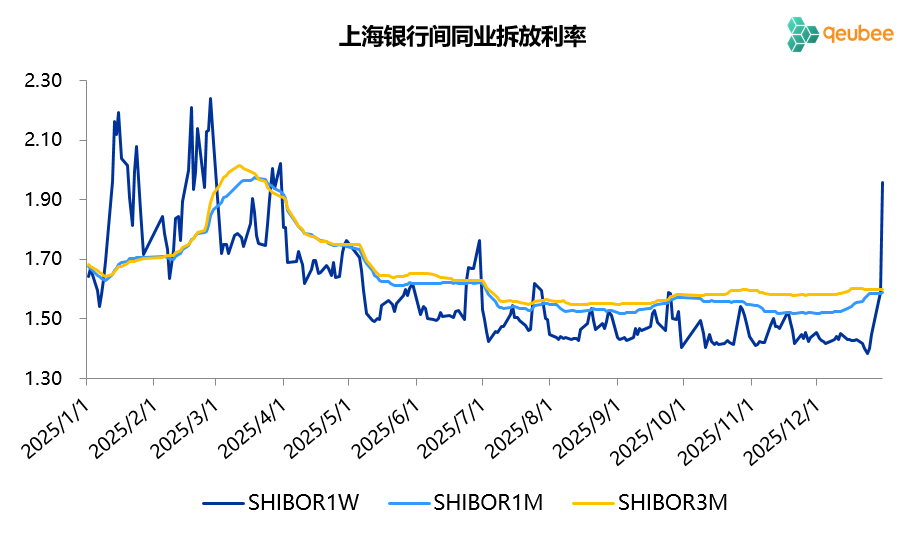
Group 1: Funding Situation - In December 2025, the central bank conducted reverse repurchase operations amounting to 37,361 billion yuan, with a buyout reverse repurchase of 16,000 billion yuan, MLF injection of 4,000 billion yuan, and issuance of treasury cash deposits of 1,500 billion yuan [1][13] - The total funds returned included 34,542 billion yuan from reverse repurchase maturity, 14,000 billion yuan from buyout reverse repurchase maturity, 3,000 billion yuan from MLF maturity, and 1,200 billion yuan from treasury cash deposits maturity, resulting in a net injection of 6,119 billion yuan [1][13] - The funding environment remained loose throughout the year, but was tight during the year-end period, with the 7-day SHIBOR rate mostly around 1.40%, surging to 1.96% at year-end [1][13] Group 2: Bill Market Conditions - In December 2025, the bill market acceptance amount was 4.28 trillion yuan, a year-on-year decrease of 1.7%, while the discount amount was 3.25 trillion yuan, down 5.0% year-on-year [3][16] - The acceptance growth rate was higher than the discount growth rate, with a discount acceptance ratio of 76%, down 2 percentage points from November and lower than the 79% of the previous year, indicating an overall supply-demand imbalance in the bill market [3][16] Group 3: Bill Interest Rates - Bill interest rates showed a volatile upward trend in December 2025, with the 6-month national stock bank bill discount rate starting at around 0.75%, rising to 0.93% mid-month, then dropping to a low of 0.85%, and finally rebounding to 0.95% at the end of the month [6][19] - The month-end saw significant fluctuations in bill rates due to short-term demand shocks and limited direct bill sources [6][19] Group 4: Yield Comparisons of Related Assets - In December 2025, the yield on 6-month government bonds decreased by 10 basis points, while the yield on interbank certificates of deposit remained stable, and the yield on bill discounts increased by 22 basis points [8][21] - The bill interest rates continued to run below government bond yields, with the month-end yield spread between bills and government bonds at -38 basis points, and between bills and interbank certificates of deposit at -66 basis points [8][21] Group 5: Macroeconomic and Policy Analysis - Economic conditions improved in December 2025, with the manufacturing PMI at 50.1%, up 0.9 percentage points from the previous month, and the non-manufacturing PMI at 50.2%, up 0.7 percentage points, both returning to the expansion zone [11][23] - The Central Economic Work Conference held on December 10-11 outlined the economic work for 2026, emphasizing a stable yet progressive policy approach, with a focus on maintaining liquidity and supporting key sectors such as domestic demand and technological innovation [11][23] Group 6: Bill Market Outlook - The bill market in December 2025 saw a strong supply of primary market bills, despite rising bill interest rates, with acceptance volumes remaining high [24] - Looking ahead to January 2026, social financing and bill supply are expected to be key factors influencing future bill interest rate movements, with anticipated pressures on bill rates due to expected credit tightening [24][25]