
制造业采购经理人指数(PMI)

Search documents
2026年首个交易日英镑走势缺乏方向
Xin Lang Cai Jing· 2026-01-02 11:28
Core Viewpoint - The British pound remains stable against the US dollar and euro as the market lacks significant news to drive exchange rate movements at the start of 2026 [1][3]. Group 1: Market Activity - Trading activity in the UK market is expected to remain subdued around the Christmas and New Year holidays, with a full recovery in market activity anticipated next week [2][4]. - Recent weeks have seen a reduction in concerns regarding the UK fiscal budget and Bank of England policies, which have significantly influenced the recent exchange rate of the pound [2][4]. Group 2: Monetary Policy - The Bank of England passed a rate cut decision last month with a narrow vote of 5 to 4, indicating a potential slowdown in its already gradual easing pace in 2026 [2][4]. - Market traders expect the next rate cut from the Bank of England to occur in June, with current pricing suggesting a total reduction of only 40 basis points for 2026, implying a 60% probability of a further 25 basis point cut by year-end [2][4]. Group 3: Economic Indicators - A recent survey indicated that UK manufacturing activity expanded at its fastest pace in 15 months in December, although the growth rate was below previous expectations [2][4]. - The S&P Global Manufacturing Purchasing Managers' Index (PMI) rose from 50.2 in November to 50.6 in December, but was lower than the preliminary reading of 51.2 [2][4]. - An economist from Pantheon Macroeconomics stated that the PMI reflects a stable state for UK manufacturing at present [2][4].
韩国12月工厂活动恢复扩张 制造商乐观情绪为三年半最高
Xin Lang Cai Jing· 2026-01-02 00:58
Core Insights - South Korea's factory activity expanded in December, ending two months of contraction, driven by a rebound in export demand and the most optimistic sentiment among manufacturers in three and a half years [1][2] Economic Indicators - The Manufacturing Purchasing Managers' Index (PMI) for South Korea in December was 50.1, slightly above the neutral line of 50, compared to 49.4 in the previous two months [1][2] - The economy grew at its fastest pace in nearly four years in Q3, supported by strong exports and a rebound in consumption [1][2] Orders and Production - December saw the first increase in new orders in three months, marking the largest increase since November 2024, with export orders also recovering [1][2] - Production continued to decline for the third consecutive month, but the rate of decline narrowed compared to the previous month [1][2] Short-term Indicators - Other short-term indicators showed improvement in demand, with the increase in input purchases being the largest since August 2024, and the decline in finished goods inventory being the largest since May 2025 [1][2] Business Sentiment - Companies' optimism for the coming year reached its highest level since May 2022, driven by expectations of business expansion and new product launches, particularly in the automotive and semiconductor sectors [1][2] Inflation and Costs - Input prices rose at the fastest rate since July 2022 due to a weakening currency, leading to a rebound in output inflation to a nine-month high after a decline in the previous month [1][2]
制造业PMI时隔8个月重返扩张区间,供需两端均明显改善
Sou Hu Cai Jing· 2025-12-31 02:24
Core Viewpoint - In December, China's manufacturing Purchasing Managers' Index (PMI) rose by 0.9 percentage points to 50.1%, marking a return to the expansion zone after eight months [1] Manufacturing Sector Summary - The manufacturing production index in November was 51.7%, an increase of 1.7 percentage points from the previous month [1] - The new orders index rose to 50.8%, up by 1.6 percentage points [1] - The new export orders index increased by 1.4 percentage points to 49.0% [1] - Large enterprises had a PMI of 50.8%, up by 1.5 percentage points, while medium-sized enterprises had a PMI of 49.8%, up by 0.9 percentage points, and small enterprises had a PMI of 48.6%, down by 0.5 percentage points [1] Future Outlook - Economic factors such as fiscal and credit policies aiming for a "good start" in the new year and resilient exports are expected to keep the PMI at a high level in the first quarter [1] - The manufacturing sector is transitioning from "making the cake" to "cutting the cake," emphasizing the need for technological advancements to enhance competitiveness [3] - Four key factors will influence the PMI trend towards 2026: domestic growth policies, strong market demand in high-tech manufacturing, the impact of high tariffs on global trade, and ongoing adjustments in the real estate market [3][4] - The macroeconomic environment is expected to maintain a "strong supply, weak demand" scenario, with the PMI likely remaining below 50% for most of the time [3] Non-Manufacturing Sector Summary - In December, the non-manufacturing PMI recorded 50.2%, an increase of 0.7 percentage points from the previous month [5] - The construction business activity index was 52.8%, up by 3.2 percentage points, while the services business activity index was 49.7%, up by 0.2 percentage points [6] - Certain service sectors, such as telecommunications and financial services, showed strong activity indices above 60.0%, while retail and catering sectors remained below the critical point [6]

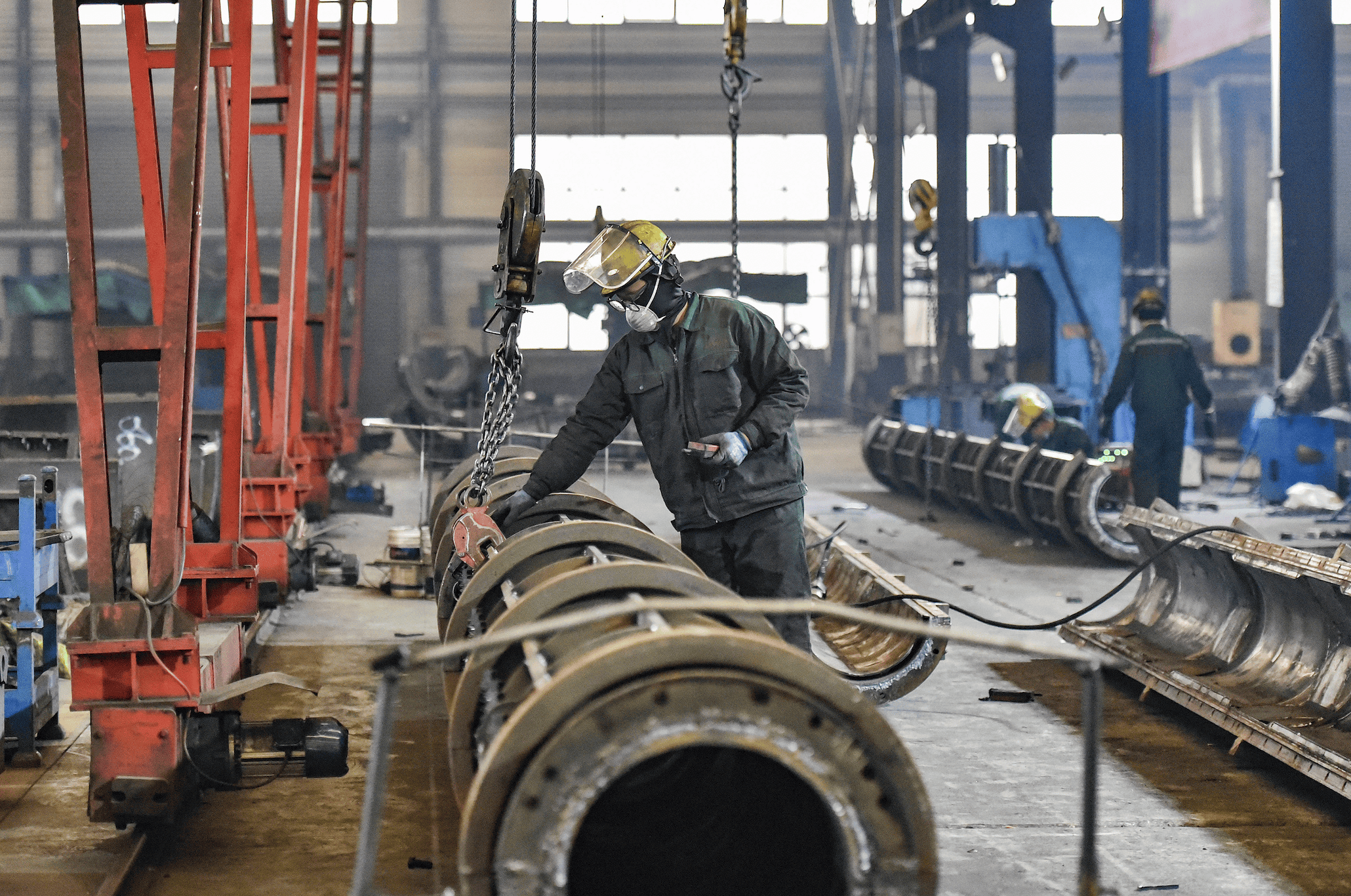
美国11月制造业PMI指数降至48.2
Yang Shi Xin Wen Ke Hu Duan· 2025-12-02 02:28
Core Viewpoint - The ISM reported that the US manufacturing PMI decreased from 48.7 in October to 48.2 in November, indicating that manufacturing activity has contracted for the ninth consecutive month, falling below market consensus expectations of 49 [1] Group 1 - The manufacturing PMI decline signifies ongoing contraction in the US manufacturing sector [1] - The PMI value of 48.2 reflects a continued downturn in manufacturing activity, which is a critical indicator of economic health [1] - The data suggests that the manufacturing sector is facing persistent challenges, impacting overall economic performance [1]
美国制造业活动连续9个月萎缩
Xin Hua She· 2025-12-02 00:38
Core Viewpoint - The US manufacturing sector continues to experience contraction, with the Purchasing Managers' Index (PMI) declining for the ninth consecutive month, indicating ongoing challenges in the industry due to tariffs and government shutdowns [1] Group 1: Manufacturing Sector Performance - The PMI for US manufacturing fell from 48.7 in October to 48.2 in November, which is below the market consensus expectation of 49 [1] - This decline signifies that manufacturing activity has been in a state of contraction for nine months in a row [1]
【环球财经】美国制造业活动连续第九个月萎缩
Xin Hua Cai Jing· 2025-12-02 00:02
Group 1 - The core point of the article is that U.S. manufacturing activity has contracted for the ninth consecutive month in November, influenced by tariff policies and fiscal uncertainty [1] - The Manufacturing Purchasing Managers' Index (PMI) decreased from 48.7 in October to 48.2 in November, falling below the market consensus expectation of 49 [1] - Among the five main components of the PMI, new orders, employment, inventory, and supplier deliveries are all in contraction territory, while only the production index returned to expansion [1] Group 2 - In the survey of 18 manufacturing sectors, 4 reported expansion, 11 reported contraction, and 3 remained stable or showed no significant change [1] - The chair of the Manufacturing Business Survey Committee noted that the acceleration of contraction in manufacturing activity is due to weak new orders and employment, along with further delays in supplier deliveries [1] - The PMI is a key indicator of U.S. manufacturing health, with a reading above 50 indicating expansion and below 50 indicating contraction [1] Group 3 - Historical data indicates that when the manufacturing PMI is above 42.3, it typically signals overall economic expansion [2] - Based on the November PMI reading, the model from the Supply Management Association estimates the current quarter's annualized GDP growth rate for the U.S. to be approximately 1.7% [2]
10月亚洲制造业PMI为50.7% 继续平稳扩张态势
Zhong Guo Xin Wen Wang· 2025-11-06 09:07
Group 1 - The Asian manufacturing Purchasing Managers' Index (PMI) for October 2025 is reported at 50.7%, a slight decrease of 0.2 percentage points from the previous month, marking six consecutive months above 50% [1] - China's manufacturing PMI has decreased compared to the previous month, while India's manufacturing PMI has increased to over 59% [1] - Among ASEAN countries, Thailand, Indonesia, the Philippines, and Vietnam have all seen varying degrees of PMI increases, remaining above 50%, whereas Malaysia's PMI has decreased and is below 50% [1] Group 2 - Japan and South Korea's manufacturing PMIs have both declined compared to the previous month and are below 50% [1] - Overall, the Asian manufacturing sector continues to show stable expansion and resilience [1] - The International Monetary Fund (IMF) projects a 4.5% economic growth rate for the Asia-Pacific region in 2025, an increase of 0.6 percentage points from the April forecast, contributing approximately 60% to global economic growth [1]
美国10月制造业活动继续萎缩
Xin Hua Wang· 2025-11-04 07:59
Core Insights - The report from the Institute for Supply Management indicates that U.S. manufacturing activity continued to decline in October, marking the eighth consecutive month of contraction [1] - The Purchasing Managers' Index (PMI) for October fell to 48.7 from 49.1 in the previous month, with a reading below 50 indicating a contraction in the manufacturing sector [1] Manufacturing Sector Performance - Only 2 out of the surveyed industries reported expansion in October, while 12 industries experienced contraction [1] - The chemical products sector reported that uncertainty in the global economic environment and fluctuating tariff policies led to order cancellations or reductions, putting continued pressure on business [1] - The machinery manufacturing sector indicated that ongoing tariff impacts and a lack of domestic alternatives for imported products hindered plans for reshoring manufacturing [1] Economic Outlook - The chair of the manufacturing survey committee, Susan Spence, noted that the pace of contraction in U.S. manufacturing activity accelerated in October, particularly in production and inventory metrics [1] - Despite some improvements in August and September, short-term growth has not translated into sustained growth in manufacturing, reflecting ongoing economic uncertainty [1]
【环球财经】俄罗斯10月制造业采购经理人指数降至48点
Xin Hua Cai Jing· 2025-11-03 22:34
Group 1 - The core point of the article indicates that the Russian manufacturing sector is experiencing a significant decline, with the Purchasing Managers' Index (PMI) dropping to 48 in October, down from 48.2 in September, marking the largest decline since July [1] - The data shows that manufacturing activity has been decreasing for five consecutive months, with employment levels and procurement of inputs also declining further in October [1] - The speed of decline in manufacturing procurement activities has accelerated, reaching the fastest level in three months, indicating a worsening economic situation [1] Group 2 - The report highlights a reduction in new orders, which has alleviated some capacity pressure for manufacturers, leading to a faster decrease in backlogged orders and inventory levels [1] - Additionally, companies noted that in October, due to shortened supplier delivery times, there is an occurrence of overcapacity in the industry [2]
荷兰制造业PMI回落至四个月低点 出口支撑增长但就业与成本压力显现
Xin Hua Cai Jing· 2025-11-03 13:55
Core Insights - The Netherlands' manufacturing Purchasing Managers' Index (PMI) fell to 51.8 in October, down from 53.7 in September, marking the lowest level since June 2024 [1] - Despite remaining above the neutral 50 mark, the manufacturing sector is experiencing a significant slowdown in expansion [1] Manufacturing Activity - New orders continue to be the main driver of manufacturing activity, with increased demand from European and Asia-Pacific customers leading to a rise in export demand [1] - Manufacturing output has maintained a continuous growth trend since March 2024 [1] Employment Trends - The number of manufacturing jobs decreased for the first time since May 2024, influenced by voluntary resignations, corporate restructuring, and a reduction in temporary staff [1] Cost Pressures - Input costs have slightly increased due to rising prices of food, energy, and raw materials [1] - However, factory gate price inflation has further slowed, reaching the lowest level in a year, indicating limited ability for companies to pass on costs to downstream customers [1] Future Outlook - Despite the weakening expansion momentum, Dutch manufacturers remain optimistic about their business outlook for the next twelve months, although overall confidence is still below the historical average for the PMI series [1]