券商财富管理转型

Search documents
上市券商上半年经纪业务收入同比增超43%
Zheng Quan Ri Bao· 2025-08-31 17:42
Core Viewpoint - The brokerage business is a fundamental aspect of securities firms' operations and a crucial starting point for their wealth management transformation, showing significant growth in net income and performance in the first half of 2025 [1][2]. Group 1: Market Performance - The brokerage business net income for listed securities firms exceeded 63 billion yuan, marking a year-on-year increase of over 43% due to a notable recovery in market trading activity [1][2]. - The average daily trading volume for stock funds reached 1.61 trillion yuan, a year-on-year increase of 63.87%, with new account openings totaling 12.6 million [2]. - The overall net income from securities trading for 150 firms in the industry was 688.42 billion yuan, reflecting a substantial year-on-year growth of 48.22% [2]. Group 2: Brokerage Income Growth - All 42 listed securities firms reported a year-on-year increase in brokerage fee net income, with a total of 634.54 billion yuan, representing a growth of 43.98% [2][3]. - Major firms like CITIC Securities, Guotai Junan, and GF Securities achieved significant brokerage income, with CITIC Securities leading at 64.02 billion yuan, a 31.2% increase [3]. Group 3: Structural Changes and Growth Drivers - The top-tier firms maintained their leading positions, while smaller firms achieved rapid growth through differentiated advantages [3]. - Mergers and acquisitions contributed to the growth of brokerage income, with firms like Guolian Minsheng seeing a staggering 223.77% year-on-year increase [3]. Group 4: Wealth Management Transformation - The wealth management transformation of securities firms is progressing from quantitative to qualitative changes, driven by regulatory guidance and a focus on customer-centric services [4]. - CITIC Securities reported over 16.5 million wealth management clients and a total managed asset scale exceeding 12 trillion yuan, with significant growth in various financial products [4]. - CICC innovated its product service model, achieving record highs in wealth management business, with managed assets totaling approximately 3.4 trillion yuan [5]. Group 5: Future Growth Potential - The brokerage business has solidified its foundational role, while the wealth management transformation is expected to become a core growth engine for the industry in the next phase [6].





香港证券ETF(513090)交投活跃,全天成交额超217亿元,多家头部券商晒半年报“成绩单”,亮眼表现受关注
Xin Lang Cai Jing· 2025-08-29 07:43
Group 1 - The Hong Kong Securities ETF (513090) has shown a strong performance, with a 53.22% increase over the past three months and a trading volume of 21.725 billion yuan on August 29, 2025 [1][2] - Major securities firms, including CITIC Securities, reported significant growth in their half-year results for 2025, with CITIC Securities achieving a revenue of 33.039 billion yuan, a year-on-year increase of 20.44%, and a net profit of 13.719 billion yuan, up 29.80% [1] - The brokerage business revenue has seen high growth due to active market trading, with firms like China Galaxy Securities and招商证券 reporting substantial increases in their respective revenues and client bases [2] Group 2 - 招商证券 reported a brokerage business revenue of 3.73 billion yuan for the first half of 2025, reflecting a year-on-year growth of 44.9%, alongside a 27% increase in managed client assets [2] - China Galaxy Securities achieved a trading volume of 185.5 billion yuan in agency securities transactions, marking a 12% increase since the beginning of the year, with a retail client base exceeding 18 million [2] - The Hong Kong Securities ETF (513090) tracks the performance of the China Securities Hong Kong Securities Investment Theme Index, with an annual management fee of 0.15% and a custody fee of 0.05% [2]
“瘦身”进行时!多家券商分公司、营业网点组团告别市场
Bei Jing Shang Bao· 2025-08-14 14:16
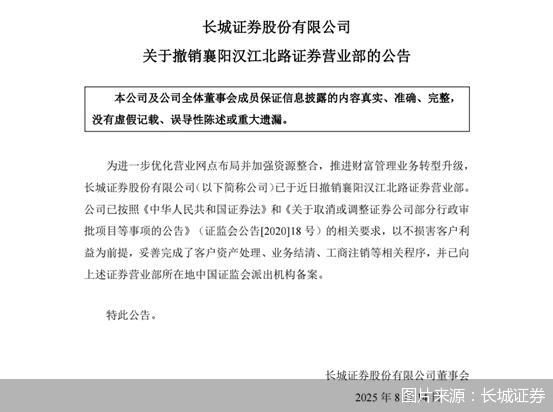
Group 1 - The trend of securities firms closing or merging their branches is increasing, driven by cost reduction and resource optimization [1][3][6] - Changcheng Securities announced the closure of its Xiangyang Hanjiang North Road branch to enhance resource integration and promote wealth management transformation [3][4] - Guosen Securities has also announced the closure of 12 branches, with plans to further optimize its network [4][5] Group 2 - Several securities firms, including Fangzheng Securities and Debang Securities, have also announced branch closures to improve operational efficiency and support high-quality business development [5][6] - The closures are part of a broader industry trend towards digital transformation and a focus on online services, reflecting changing investor habits [6][7] - The number of branches among securities firms varies significantly, with some firms having over 100 branches while others have fewer than 5 [7][8]




年内裁撤网点超百家!券商加速“瘦身”
Guo Ji Jin Rong Bao· 2025-08-14 11:06
Group 1 - The core viewpoint of the article is that the wave of brokerage branch closures signifies a shift in the industry from "extensive expansion" to "refined operations" [2][4][7] - Changcheng Securities announced the closure of its Xiangyang Hanjiang North Road branch as part of its strategy to optimize branch layout and enhance resource integration [1][3] - Over 20 brokerage firms have announced branch closures this year, with a total of more than 100 branches shut down, led by Guosen Securities, which closed 21 branches [1][3] Group 2 - The trend of branch closures is seen as a natural market correction, driven by the rise of internet finance and declining trading commissions, making traditional high-cost, low-efficiency models unsustainable [4][5] - The closures are not just about reducing numbers but represent a revolutionary change in business models, shifting from a transaction-centered approach to a client asset allocation-centered approach [4][6] - The increasing focus on digital transformation and cost pressures is forcing brokerages to upgrade their services, as traditional branches struggle to meet evolving client needs [4][5] Group 3 - The "Matthew effect" is expected to intensify, with leading brokerages like CITIC and Huatai expanding their advantages, while smaller firms face increased operational pressures [6][7] - The closure of branches may weaken the offline service connection for traditional client groups, but brokerages can mitigate client loss by implementing "digital twin branch" solutions [6][7] - The future may see a continued reduction in branch numbers as brokerages shift focus to digital capabilities and wealth management services, creating a new multi-faceted service model [7]
券商系公募再添一子 两大信号折射行业新趋势
Xin Hua Wang· 2025-08-12 05:47
Core Insights - The establishment of Peng'an Fund Management Co., Ltd. has been approved, marking a significant move in the brokerage's public fund layout strategy [1][2][3] - The approval reflects two key trends: the ongoing development of the brokerage's public fund strategy and the shift of new public funds to lower-tier cities, particularly Hainan, due to tax incentives [1][4] Company Developments - Peng'an Fund is fully owned by Kaiyuan Securities, with a registered capital of 100 million yuan, and is required to complete its establishment within six months of approval [2][3] - The fund's registration in Hainan allows it to benefit from a 550,000 yuan incentive and a reduced corporate income tax rate of 15% [5][6] Industry Trends - The approval of Peng'an Fund indicates a growing trend of brokerages establishing public funds, with over 40% of public fund institutions being brokerage-affiliated [7][8] - The recent trend shows brokerages favoring the application for public fund licenses through asset management subsidiaries, enhancing internal collaboration and product offerings [8][9] Regulatory Environment - The China Securities Regulatory Commission (CSRC) emphasizes the importance of risk isolation and compliance in the operations of newly established public funds [2][3] - The regulatory framework supports the establishment of public funds in Hainan, aligning with the broader financial reform initiatives in the region [4][6]

“牛市旗手”成色几何?
经济观察报· 2025-07-18 12:44
Core Viewpoint - The significant growth in the securities industry in the first half of the year is driven by three main factors: a strong rebound in proprietary trading, a surge in market trading activity, and the gradual release of policy dividends [1][5][9]. Group 1: Performance Growth - A total of 33 securities firms in the A-share market have disclosed their performance forecasts for the first half of 2025, with 32 firms expecting profit increases, and nearly 40% (12 firms) anticipating growth exceeding 100% [5][7]. - Jianghai Securities reported a net profit of 288 million yuan for the first half of the year, a substantial increase of 1189.53% compared to 22 million yuan in the same period last year [3]. - Among the 30 firms with profit increases, 27 firms reported growth exceeding 50%, 12 firms reported growth exceeding 100%, and 3 firms (Jianghai Securities, Huaxi Securities, and Guolian Ming Sheng) reported growth exceeding 1000% [8]. Group 2: Driving Factors - The three driving factors for the significant performance growth in the securities industry are: 1. A strong rebound in proprietary trading, with a notable increase in equity investment returns due to the recovery of the A-share market since the beginning of the year [9]. 2. A surge in trading activity, with an average daily trading volume exceeding 1.6 trillion yuan and margin financing balances rising to over 1.8 trillion yuan, boosting brokerage and credit business revenues [9]. 3. The gradual release of policy dividends, including the resumption of cross-border investment banking business and the expansion of the STAR Market, which has led to a recovery in investment banking revenues [9]. Group 3: Policy Impact - Since 2025, the securities industry has seen several significant policies aimed at promoting high-quality development, including guidelines for financial instrument valuation and management measures for financial institutions [12]. - The introduction of new regulations is expected to enhance the importance of insurance and bank wealth management products for securities firms, providing new revenue sources and opportunities for wealth management transformation [14][15]. - The policies are expected to create a dual effect of guidance and constraints, requiring firms to enhance specialized services while raising the bar for market entry [14]. Group 4: Market Performance - Despite the widespread positive performance forecasts in the securities industry, the market performance of securities stocks has been relatively subdued, with the securities index only rising by 0.75% as of July 17, compared to a 4.92% increase in the Shanghai Composite Index [17]. - The historical role of securities firms as "bull market leaders" has diminished, with changes in their business models leading to a more stable but less elastic income structure [20].





多家头部券商业绩高增长,深市规模最大证券ETF(159841)昨日净流入超1700万,机构:券商财富管理转型迎来新机遇
2 1 Shi Ji Jing Ji Bao Dao· 2025-07-15 02:38
Group 1 - The securities sector experienced a volatile trading session on July 15, with the Securities ETF (159841) showing a slight increase of 0.19% and a trading volume exceeding 65 million yuan [1] - The Securities ETF (159841) saw a net inflow of over 17 million yuan yesterday, with a total circulation of 5.187 billion shares and a market size of 5.495 billion yuan, making it the largest in its category in the Shenzhen market [2] - The Securities ETF (159841) closely tracks the CSI All Share Securities Company Index, which includes both traditional securities leaders and financial technology firms, indicating a diversified investment approach [2] Group 2 - The performance of the brokerage sector has been strong in the first half of the year, with 31 out of 32 brokerages reporting positive year-on-year net profit growth, highlighting a robust industry outlook [2] - The introduction of new licenses for insurance and bank wealth management sales is expected to enhance the service offerings of brokerages, allowing them to provide comprehensive financial services and diversify their revenue sources [3] - The China Securities Association's initiative to promote compliance and risk management among brokerages is anticipated to create new opportunities for wealth management transformation within the sector [3]
券业重大利好?券商可拿银行理财、保险产品销售牌照,究竟该如何理解?
凤凰网财经· 2025-07-12 11:16
Core Viewpoint - The article discusses the recent developments in the securities industry regarding the ability of brokerages to sell insurance and bank wealth management products, highlighting regulatory changes and potential impacts on the industry [2][4][10]. Summary by Sections Regulatory Changes - On July 11, the China Securities Association (中证协) released the "28 Measures for High-Quality Development of the Securities Industry," which emphasizes enhancing communication with relevant departments to allow more compliant brokerages to obtain licenses for selling bank wealth management and insurance products [2][4]. - The Financial Regulatory Bureau also issued the "Financial Institutions Product Appropriateness Management Measures," which will take effect on February 1, 2026, establishing a regulatory foundation for brokerages to expand into these new sales areas [2][3]. Historical Context - The ability for brokerages to sell financial products, including insurance, was first established in the "Regulations on the Management of Securities Companies' Agency Sales of Financial Products" issued by the CSRC in November 2012 [5]. - Despite the long-standing regulations, the actual scale of insurance agency business has been limited, leading to a lack of focus on this area within the industry [7]. Industry Impact and Future Prospects - The renewed focus on brokerage sales of diverse products is seen as a potential shift from "single securities services" to "comprehensive wealth management," indicating a systemic adjustment in business models [8][10]. - The article suggests that the new regulatory environment could lead to more brokerages entering the insurance and bank wealth management product sales market, although this will require careful observation and compliance with regulatory standards [9][10]. Challenges and Opportunities - Brokerages face challenges in adapting to the different sales models and regulatory requirements associated with bank wealth management and insurance products, necessitating enhanced training for sales personnel and improvements in compliance systems [9][10]. - The potential for brokerages to tap into the growing demand for personal and commercial pension products is highlighted, as these products are becoming key components of a multi-tiered pension system [11]. - The article also notes that the integration of investment advisory and insurance advisory services could create new opportunities for wealth management, particularly in addressing the needs of high-net-worth clients [12]. Conclusion - The push for brokerages to obtain licenses for selling bank wealth management and insurance products represents a significant opportunity for the industry to evolve and meet diverse investor needs, with regulatory support aimed at fostering this transition [10][16].

券业重大利好?券商可拿银行理财、保险产品销售牌照,究竟该如何理解?
财联社· 2025-07-12 03:23
Core Viewpoint - The recent regulatory changes indicate that securities firms may expand their product offerings to include insurance and bank wealth management products, reflecting a shift towards comprehensive wealth management services in the industry [1][5][12]. Group 1: Regulatory Developments - The China Securities Association (中证协) has released the "28 Measures for High-Quality Development of the Securities Industry," which aims to facilitate securities firms in obtaining licenses for selling bank wealth management and insurance products [1][5]. - The Financial Regulatory Bureau has introduced the "Financial Institutions Product Appropriateness Management Measures," which will take effect on February 1, 2026, establishing a regulatory framework for the sale of financial products [1][2]. Group 2: Historical Context - The ability for securities firms to sell insurance products is not new; regulations allowing this were established as early as November 2012 [2][4]. - Currently, at least eight securities firms, including CITIC Securities and Ping An Securities, have obtained the necessary qualifications to sell insurance products [3][4]. Group 3: Industry Implications - The potential expansion into selling insurance and bank wealth management products is seen as a significant opportunity for securities firms to transition from traditional securities services to comprehensive wealth management [5][8]. - The industry is expected to shift from homogeneous competition to differentiated strategies, as firms seek to enhance their service offerings and meet diverse client needs [5][9]. Group 4: Challenges and Considerations - Securities firms face challenges in adapting to the sales models and regulatory requirements of bank wealth management and insurance products, necessitating enhanced training and compliance measures [6][7]. - The acceptance of insurance products by clients and the suitability of these products for sale through securities channels are critical factors that need to be addressed [7][8]. Group 5: Future Opportunities - The introduction of new sales licenses could significantly enrich the product offerings of securities firms, catering to the growing demand for diversified investment options [8][9]. - The focus on pension-related financial products presents a substantial growth opportunity for securities firms, aligning with national initiatives to develop personal and commercial pension schemes [8][10].

券商ETF最新“战报”!
中国基金报· 2025-06-23 14:42
Core Viewpoint - The article highlights the competitive landscape of ETF business among securities firms, emphasizing the leading positions of China Galaxy and Shenwan Hongyuan in ETF holdings, while Huatai Securities leads in trading volume [2][4]. ETF Holdings Ranking - As of the end of May, the total number of ETF products in the Shanghai market is 691, with a total market value of 30,018.81 billion yuan, reflecting a 1.33% increase from the previous period [4]. - China Galaxy Securities holds the largest market share in ETF holdings at 24.63%, followed by Shenwan Hongyuan at 18.05%, and CITIC Securities and China Merchants Securities at 6.06% and 4.78%, respectively [4][6]. ETF Trading Volume Ranking - In May, Huatai Securities led the ETF trading volume with an 11.3% market share, significantly ahead of the second place, CITIC Securities, which had a 9.35% share [7][8]. - The trading volume for ETFs in May reached 30,097.61 billion yuan, with an average daily trading volume of 1,584.08 billion yuan [4]. Brokerage Business Performance - The top brokerage for ETF trading volume in May was Huabai Securities' Shanghai Dongdaming Road branch, capturing 3.59% of the market share [9][10]. - The competitive landscape among brokerage branches is intense, with several smaller firms showing strong performance [9]. ETF Trading Account Numbers - In terms of ETF trading accounts, Huatai Securities and Oriental Fortune each hold over 10% of the market share, at 11.59% and 11.18%, respectively [12]. - The dominance of leading brokerages in trading accounts is attributed to their strong brand influence and comprehensive customer service [12][13]. Strategic Developments - Leading brokerages are enhancing their ETF business strategies, with Guotai Junan focusing on optimizing the ETF ecosystem and Huatai Securities leveraging advanced technology for trading services [12][13]. - Smaller brokerages are also seeking differentiated development paths, with firms like Caitong Asset Management investing in passive equity products [13].