国际储备结构优化

Search documents
央行连续增持,黄金超越美债成全球最大储备资产
Hua Xia Shi Bao· 2026-01-11 15:37
Core Viewpoint - The People's Bank of China (PBOC) has reported an increase in gold reserves, reaching 74.15 million ounces by the end of December 2025, marking the 14th consecutive month of growth, although the monthly increase of 30,000 ounces is at a low level for the past 10 months [1][3]. Group 1: Gold Reserves and Market Trends - As of December 2025, China's gold reserves stand at 74.15 million ounces, up from 74.12 million ounces the previous month, indicating a modest increase [3]. - The increase in gold reserves aligns with market expectations, driven by geopolitical changes and rising international gold prices, which have seen a significant increase of approximately 65% in 2025 [3][4]. - The World Gold Council (WGC) reported that global central banks net purchased 45 tons of gold as of November 2025, maintaining a high level of demand despite a slight decrease from October [6]. Group 2: Global Gold Reserve Dynamics - The total value of global official gold reserves has surpassed that of U.S. Treasury securities for the first time in 30 years, with U.S. gold reserves exceeding 900 million troy ounces valued at $3.93 trillion [7]. - This shift indicates a fundamental change in global reserve holdings, as countries reduce their exposure to the U.S. financial system amid concerns over dollar depreciation and geopolitical risks [8]. - Analysts predict a bullish outlook for gold prices, with UBS raising its price target to $5,000 for the first three quarters of 2026, reflecting increased market demand for safe-haven assets [8].
我国外汇储备规模 连续五个月站上3.3万亿美元
Xin Lang Cai Jing· 2026-01-07 21:21
Group 1 - As of December 2025, China's foreign exchange reserves reached $33,579 billion, an increase of $115 billion from the end of November, marking a rise of 0.34% and the highest level since December 2015 [1] - The increase in foreign exchange reserves is attributed to factors such as the decline in the US dollar index and fluctuations in global financial asset prices, with the dollar index falling by 1.1% to 98.3 in December 2025 [1] - China's trade surplus in goods exceeded $1 trillion for the first time in the first eleven months of 2025, indicating strong performance in the foreign trade sector [1] Group 2 - As of the end of 2025, China's gold reserves amounted to 7.415 million ounces, an increase of 30,000 ounces from the end of November, marking the 14th consecutive month of gold accumulation [2] - The proportion of gold reserves in China's official international reserves is approximately 9.5%, significantly lower than the global average of around 15% [2] - The central bank's strategy to increase gold reserves is seen as a move to enhance the credibility of the sovereign currency and support the gradual internationalization of the renminbi [2]
连续14个月增持,央行黄金配置仍具长期趋势
Jin Rong Jie· 2026-01-07 12:17
Core Insights - In 2025, China's gold reserves increased by 860,000 ounces, reaching a total of 74.15 million ounces by the end of the year, with a month-on-month increase of 30,000 ounces from November 2025 [1] - The People's Bank of China (PBOC) maintained a continuous gold accumulation strategy throughout 2025, marking 14 consecutive months of increases since resuming purchases in November 2024 [1] - The monthly gold accumulation by the PBOC in 2025 varied, with the highest being 160,000 ounces in January and the lowest at 30,000 ounces in December [1] Group 1 - The PBOC's gold accumulation is driven by the changing global political and economic landscape following the new U.S. government taking office, leading to a likely prolonged period of rising international gold prices [2] - The urgency to optimize the international reserve structure has increased, as the gold reserve proportion in China's official international reserves is approximately 9.5%, significantly lower than the global average of around 15% [2] - The PBOC's strategy includes a gradual increase in gold reserves while potentially reducing U.S. Treasury holdings to enhance asset allocation [2]
央行连续13个月增持黄金,专家:未来需持续增持,并适度减持美债
Sou Hu Cai Jing· 2025-12-07 04:29
Group 1 - As of November 2025, China's foreign exchange reserves reached $33,464 billion, an increase of $30 billion from the end of October, reflecting a growth rate of 0.09% [1] - The increase in foreign exchange reserves is attributed to the stable economic performance of China, which supports the overall stability of the reserves [1][2] - The dollar index fell by 0.29% in November due to expectations of interest rate cuts by the Federal Reserve and rising interest rates in Japan, contributing to the appreciation of non-dollar assets in China's reserves [1][2] Group 2 - China's foreign exchange reserves have remained above $3.3 trillion for four consecutive months, the highest level since December 2015, with a significant increase of $144 billion compared to the end of the previous year [2] - The central bank's limited increase in gold reserves in November suggests a potential for foreign exchange net selling to maintain reserves at a moderate level [2] - The current foreign exchange reserves are considered to be in a moderately sufficient state, providing important support for maintaining the RMB exchange rate and mitigating external shocks [2] Group 3 - The official gold reserves increased to 7.412 million ounces by the end of November 2025, marking the thirteenth consecutive month of increase, although the increment has been low for nine months [2][3] - The central bank's small increase in gold reserves amidst rising international gold prices signals an intention to optimize international reserves [3] - The proportion of gold reserves in China's official international reserves is 8.0%, significantly below the global average of around 15%, indicating a need for continued accumulation of gold reserves [3]
中国外储连续三月超3.3万亿美元,央行买金节奏有变
凤凰网财经· 2025-11-08 12:18
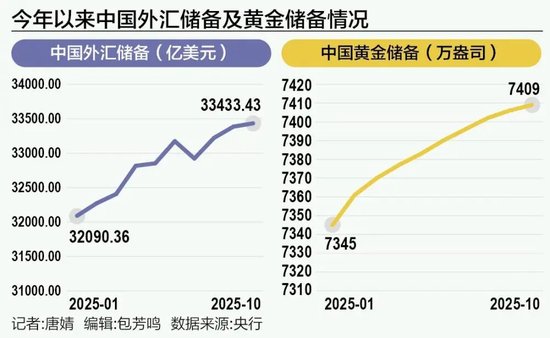
Core Viewpoint - As of October 2025, China's foreign exchange reserves reached $33,433 billion, marking a $47 billion increase from September, the highest level since December 2015, while gold reserves also saw a continuous increase for the 12th month in a row [2][3]. Foreign Exchange Reserves - China's foreign exchange reserves stood at $33,433 billion at the end of October 2025, up by $47 billion or 0.14% from the end of September [2][3]. - The increase in reserves is attributed to the rise in the dollar index and the overall increase in global financial asset prices, which counterbalanced the depreciation of non-dollar assets [4][5]. - The dollar index rose by 1.9% in October, but significant increases in global stock indices, such as a 16.6% rise in the Nikkei 225, contributed to the valuation effect that supported the foreign reserves [4][5]. Gold Reserves - As of the end of October 2025, China's gold reserves increased to 7,409 million ounces (approximately 2304.457 tons), with a month-on-month increase of 3,000 ounces [2][9]. - The value of gold reserves rose to $297.2 billion, accounting for 8.89% of total foreign exchange reserves, marking a historical high [9][10]. - The pace of gold accumulation by the central bank has slowed down this year, with a total increase of 139,000 ounces from January to October 2025, reflecting a strategy of buying on dips rather than chasing high prices [9][10]. Economic Outlook - The recent "14th Five-Year Plan" emphasizes the importance of high-level opening-up, which is expected to stabilize cross-border capital flows and support the foreign exchange reserves [8]. - The strong economic fundamentals of China, including its resilience and potential, are seen as key factors for maintaining stable foreign exchange reserves [8][11]. - The central bank's strategy of increasing gold reserves is viewed as a response to global uncertainties and a means to optimize the international reserve structure, with a focus on enhancing the credibility of the yuan [11].


中国外储连续三月超3.3万亿美元 央行买金节奏有变
2 1 Shi Ji Jing Ji Bao Dao· 2025-11-08 05:46
Core Insights - As of the end of October 2025, China's foreign exchange reserves reached $33,433 billion, marking an increase of $4.7 billion from the end of September, the highest level since December 2015 [1] - The People's Bank of China (PBOC) has increased its gold reserves for the 12th consecutive month, with gold reserves reported at 7.409 million ounces (approximately 2304.457 tons) as of the end of October, an increase of 30,000 ounces [1][5] - The rise in foreign exchange reserves is attributed to the combined effects of currency exchange rate fluctuations and asset price changes, with a notable increase in global financial asset prices [2][3] Foreign Exchange Reserves - The increase in foreign exchange reserves is primarily driven by the valuation effects from changes in exchange rates and asset prices, with the dollar index rising by 1.9% in October [2][3] - Despite the dollar's strength, global stock indices, particularly the Nikkei 225, saw significant gains, which helped offset the potential decline in reserves due to non-dollar asset depreciation [2][3] - The PBOC's statement emphasizes the stability of China's economic fundamentals, which supports the maintenance of foreign exchange reserves [1][4] Gold Reserves - China's gold reserves increased by $13.9 billion to $297.2 billion, with the proportion of gold reserves to total foreign exchange reserves rising to 8.89%, a historical high [6] - The pace of gold accumulation by the PBOC has slowed this year, with monthly increases decreasing from 160,000 ounces in January to 30,000 ounces in October [6] - The global trend of central banks increasing gold holdings is noted, with a total net purchase of 220 tons in Q3 2025, reflecting a 28% increase from Q2 [7] Future Outlook - Analysts suggest that the PBOC will continue to increase gold reserves to optimize the international reserve structure and support the internationalization of the renminbi [8] - The current gold holdings in China's international reserves are significantly below the global average of around 15%, indicating room for further accumulation [8] - The strategy of gradual gold purchases is seen as a way to mitigate market volatility and manage costs effectively [7][8]
中国外储连续三月超3.3万亿美元,央行买金节奏有变
2 1 Shi Ji Jing Ji Bao Dao· 2025-11-08 01:18
Core Insights - As of October 2025, China's foreign exchange reserves reached $33,433 billion, marking an increase of $47 billion from September, the highest level since December 2015 [1][3] - The People's Bank of China (PBOC) has increased its gold reserves for the 12th consecutive month, with gold reserves reported at 7,409 million ounces (approximately 2,304.457 tons) as of the end of October, reflecting a month-on-month increase of 30,000 ounces (approximately 0.93 tons) [1][6] Foreign Exchange Reserves - The rise in foreign exchange reserves in October was influenced by the strengthening of the US dollar index, which increased by 1.9%, and significant gains in global financial asset prices, particularly in stock indices [3][4] - The valuation effect from rising asset prices countered the depreciation of non-dollar assets, leading to a slight increase in reserves despite the dollar's strength [4][5] - Major stock indices, including the Nikkei 225, saw substantial increases, with the Nikkei rising by 16.6%, contributing to the positive valuation effect on China's foreign reserves [3][4] Gold Reserves - China's gold reserves increased by $139 billion to $297.2 billion, with the proportion of gold reserves to total foreign exchange reserves rising to 8.89%, a new historical high [6][7] - The pace of gold accumulation by the PBOC has slowed this year, with monthly increases decreasing from 160,000 ounces in January to 30,000 ounces in October [6][7] - The PBOC's strategy of gradual accumulation aims to mitigate market volatility and optimize the international reserve structure amid global uncertainties [7][8] Future Outlook - Analysts suggest that the PBOC will continue to increase gold reserves to enhance the credibility of the yuan and support its internationalization, as the current gold proportion remains below the global average of around 15% [8][9] - The emphasis on expanding high-level openness in the "14th Five-Year Plan" indicates a commitment to fostering trade and investment, which will support the stability of foreign exchange reserves [5][8]
10月我国外储增至33433亿美元近十年最高 央行连续12个月增持黄金
Zheng Quan Shi Bao· 2025-11-07 22:45
Core Insights - As of October 2025, China's foreign exchange reserves reached $3.3433 trillion, marking a $4.7 billion increase from September, the highest level since December 2015 [1] - The increase in reserves is attributed to the rise in the US dollar index and overall global financial asset prices, influenced by major economies' monetary policies and macroeconomic data [1] - The US dollar index rose approximately 1.95% in the past month, while major non-USD currencies depreciated against the dollar [1] Group 1: Foreign Exchange Reserves - China's foreign exchange reserves have remained stable above $3.3 trillion for three consecutive months [1] - The increase in reserves is a result of combined effects from exchange rate adjustments and asset price changes [1] - The US Federal Reserve's interest rate decisions and the easing of US-China trade tensions have contributed to the strengthening of the dollar [1] Group 2: Asset Prices and Market Trends - Global stock and bond markets showed overall strength in October, supporting China's foreign exchange reserves [2] - The 10-year US Treasury yield fell by about 5 basis points due to the Fed's rate cuts and increased demand for safe-haven assets [2] - Major stock indices, including the S&P 500 and Nikkei, experienced gains, reflecting high market sentiment [2] Group 3: Gold Reserves - As of October, China's official gold reserves increased to 7.409 million ounces, with a monthly rise of 30,000 ounces, the lowest increase since November 2024 [2] - The People's Bank of China has been gradually increasing gold reserves since March, with monthly additions below 100,000 ounces [2] - The recent trend indicates a potential slowdown in gold purchases by central banks, including China, amid fluctuating gold prices [3] Group 4: Future Outlook - The foreign exchange authority emphasizes the stability of China's economic fundamentals, which are expected to support the stability of foreign exchange reserves [2] - The central bank's strategy to optimize international reserves and promote the internationalization of the renminbi suggests continued interest in gold accumulation [3] - The dual nature of gold as both a financial and commodity asset positions it as a key component in diversifying international reserves [3]
10月末我国外汇储备规模超33433亿美元 黄金储备“十二连增”
Zheng Quan Ri Bao· 2025-11-07 16:27
Group 1 - As of the end of October 2025, China's foreign exchange reserves reached $33,433.43 billion, an increase of $4.7 billion from the end of September, representing a growth rate of 0.14% [1] - The rise in foreign exchange reserves is attributed to the impact of major economies' monetary policies, macroeconomic data, and the overall increase in global financial asset prices, influenced by the appreciation of the US dollar index [1] - The People's Bank of China has been continuously increasing its gold reserves for 12 consecutive months, with a total of 7.409 million ounces as of the end of October, up from 7.406 million ounces at the end of September [2] Group 2 - The recent emphasis on "expanding high-level opening-up" in the 15th Five-Year Plan highlights the commitment to reform and development through openness, which is expected to stabilize cross-border capital flows [2] - The demand for gold as a reserve asset is increasing globally, with gold surpassing the euro to become the second-largest reserve asset for central banks, driven by geopolitical risks and the depreciation of dollar assets [3] - The continuous increase in gold reserves by the central bank signals a strategic move to optimize the international reserve structure and mitigate risks associated with a high proportion of dollar assets [3]
10月外汇储备继续环比上升!央行连续12个月增持黄金
证券时报· 2025-11-07 09:50
Core Viewpoint - As of the end of October 2025, China's foreign exchange reserves reached $33,433 billion, marking a $47 billion increase from the end of September, the highest level since December 2015, with reserves remaining above $3.3 trillion for three consecutive months [1][4][5]. Group 1: Foreign Exchange Reserves - The increase in foreign exchange reserves in October was influenced by the monetary policies and expectations of major economies, as well as macroeconomic data, leading to a rise in the US dollar index and overall global financial asset prices [1][5]. - The US dollar index rose approximately 1.95% in the past month, while the euro, yen, and pound depreciated against the dollar by 1.7%, 4%, and 2.2% respectively [5][6]. - Despite the Federal Reserve's interest rate cut in October, the dollar strengthened due to market expectations regarding future rate cuts and geopolitical uncertainties [5][6]. Group 2: Gold Reserves - As of the end of October, China's official gold reserves stood at 7,409 million ounces, with a monthly increase of 3,000 ounces, the lowest growth rate since the resumption of gold purchases in November 2024 [1][9]. - The People's Bank of China has been incrementally increasing its gold reserves for 12 consecutive months, signaling a strategy to optimize international reserves [8][10]. - Recent fluctuations in the gold market saw prices briefly exceed $4,000 per ounce before retreating, with expectations of a slowdown in gold purchases by central banks due to various market factors [11].