
地区经济发展

Search documents
拉萨地区生产总值首破千亿元
Xin Hua Wang· 2026-01-14 13:27
Core Insights - In 2025, Lhasa's GDP is projected to exceed 100 billion yuan for the first time [1] - The city is expected to see steady growth in investment and consumption, with fixed asset investment increasing by over 5% year-on-year [1] - The retail sales of consumer goods are anticipated to reach 55.3 billion yuan, reflecting a year-on-year growth of 5% [1] Economic Development - All 60 key projects in Lhasa are set to commence construction, contributing to the overall economic expansion [1] - The number of new high-tech enterprises is expected to increase by 61, along with 11 new industrial enterprises above designated size, enhancing innovation and industrial capacity [1] - The total import and export volume is projected to reach 5.5 billion yuan, indicating a further release of vitality in the open economy [1] Tourism and Cultural Integration - The integration of culture and tourism is expected to continue to rise, supporting high-quality economic and social development [1] - Lhasa is projected to receive 50.51 million tourists, marking a year-on-year increase of 16.8% [1] - Total tourism expenditure is expected to reach 60.6 billion yuan, with a year-on-year growth of 14.5% [1]
前三季度十大经济强省“门槛”跃上4万亿元台阶 地区经济发展韧性进一步彰显
Jing Ji Ri Bao· 2025-11-04 00:05
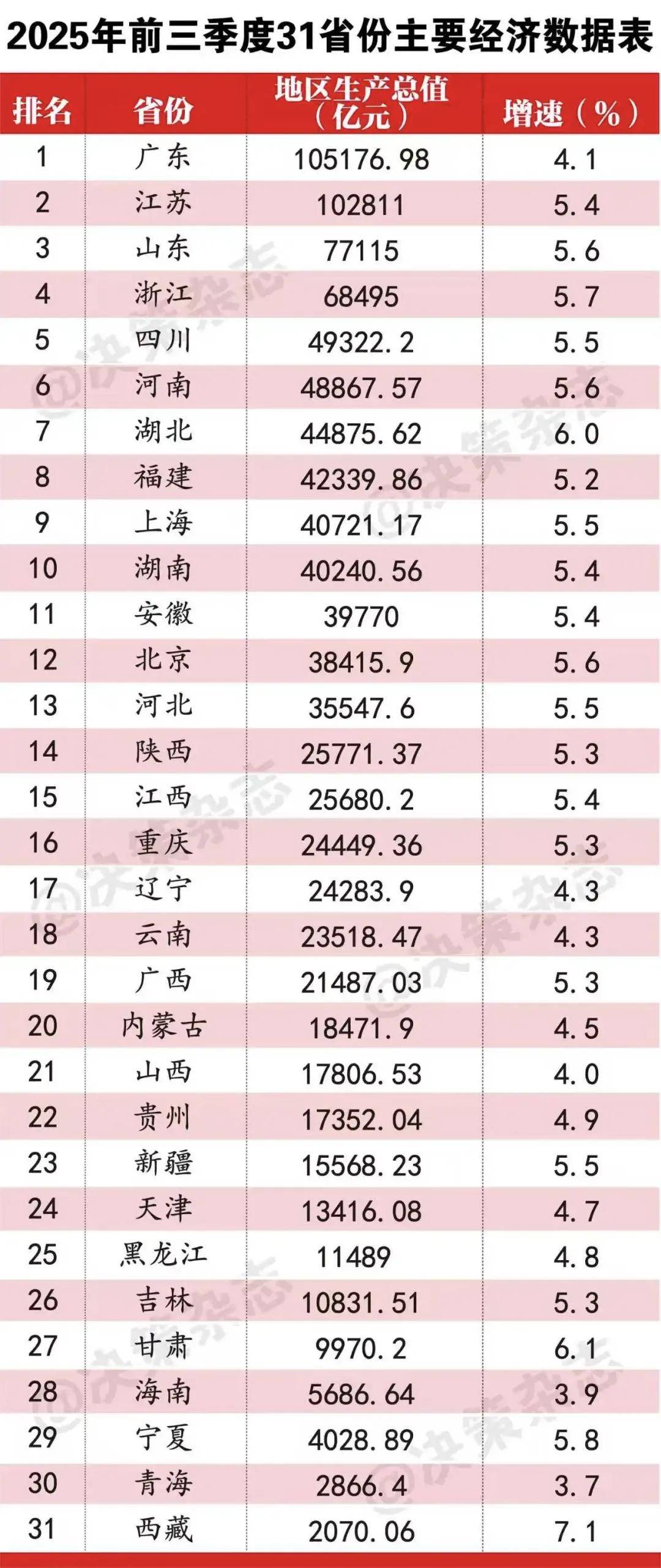
Core Insights - China's economy has shown resilience and progress despite external pressures and internal challenges, with 21 provinces achieving growth rates that either surpassed or matched the national average of 5.2% [1][3] Economic Performance - The top ten provinces by economic output are Guangdong, Jiangsu, Shandong, Zhejiang, Sichuan, Henan, Hubei, Fujian, Shanghai, and Hunan, with Guangdong and Jiangsu both exceeding 10 trillion yuan in GDP [2] - The economic threshold for the top ten provinces has increased from 3.7 trillion yuan to 4 trillion yuan compared to the previous year [2] Growth Rates - 21 provinces have growth rates that either exceed or match the national average, with Tibet leading at 7.1% growth [3] - Gansu has maintained a growth rate above the national average for 15 consecutive quarters, while Hubei's growth rate is 6% [3] Trade Performance - External trade data reflects resilience, with Guangdong, Jiangsu, Zhejiang, Shanghai, and Shandong contributing over 80% to national import and export growth, with Zhejiang achieving historical highs in trade values [4] Demand and Consumption - The implementation of proactive macro policies has effectively stabilized economic operations, with notable growth in retail sales in provinces like Hainan and Henan [5] - Hainan's retail sales grew by 8.6%, while Henan's retail sales increased by 6.2% [5] Innovation and New Growth Drivers - There is a significant focus on technological innovation, with high-tech manufacturing in regions like Shanghai and Jiangsu showing substantial growth [7] - In the central and western regions, industries such as strategic emerging industries in Henan and high-tech manufacturing in Hubei have also seen impressive growth rates [7] Future Outlook - Various provinces are actively planning for the fourth quarter to ensure the achievement of annual economic goals, with Guangdong and Shanghai emphasizing the need for effective policy implementation and economic management [8]
“三季报”确认了!南京守擂十强,江苏加速逼近广东,年度冠军有悬念
Sou Hu Cai Jing· 2025-11-03 12:45
Core Insights - The economic reports for the first three quarters of 2025 from 31 provinces show that Guangdong and Jiangsu have entered the 10 trillion yuan club, with Guangdong's GDP at 10,517.698 billion yuan and a growth rate of 4.1%, while Jiangsu's GDP is at 10,281.1 billion yuan with a growth rate of 5.4% [1][2] Economic Performance by Province - Guangdong ranks first with a GDP of 10,517.698 billion yuan and a growth rate of 4.1% [2] - Jiangsu follows closely with a GDP of 10,281.1 billion yuan and a growth rate of 5.4% [2] - Shandong, Zhejiang, and Sichuan also show strong performance with GDPs of 77,115 billion yuan (5.6%), 68,495 billion yuan (5.7%), and 49,322.2 billion yuan (5.5%) respectively [2] - The overall economic performance indicates a competitive landscape among the provinces, with Jiangsu's industrial economy contributing significantly to its growth [3][4] Industrial Contributions - Jiangsu's industrial added value grew by 6.3%, contributing 2.3 percentage points to GDP growth, indicating a solid manufacturing base [3] - The second industry's growth rate in Jiangsu at 5.2% significantly outpaces Guangdong's 2.7%, highlighting a divergence in economic performance between the two provinces [3][4] Economic Gap and Projections - The GDP gap between Jiangsu and Guangdong has narrowed, with the difference expected to decrease from approximately 7,451 billion yuan in 2023 to about 2,366 billion yuan in the first three quarters of this year [4] - The competition between Jiangsu and Guangdong for economic supremacy will hinge on the performance in the fourth quarter of 2025 [4] City-Level Insights - Among the top ten cities by GDP in the first three quarters of 2025, Jiangsu has two cities: Suzhou with 1,993.021 billion yuan (5.5% growth) and Nanjing with 1,405.949 billion yuan (5.2% growth) [4] - Suzhou's economic strength is attributed to its advanced manufacturing sector, while Nanjing benefits from both advanced manufacturing and modern service industries [4][5] Competitive Dynamics - Ningbo has shown rapid economic growth, surpassing several cities and positioning itself as a strong competitor to Nanjing, with a projected GDP of 1,814.77 billion yuan in 2024 [5] - Nanjing's GDP growth in the first three quarters was 935.06 billion yuan, which is higher than Ningbo's 848.61 billion yuan, reducing the likelihood of Nanjing being overtaken this year [5]

乌兹别克斯坦总统听取塔什干州发展报告
Shang Wu Bu Wang Zhan· 2025-09-23 02:53
Core Insights - The meeting held by President Mirziyoyev evaluated the economic reforms in Tashkent region and outlined the next phase of development [1] Economic Growth - Tashkent region has seen steady economic growth, attracting a total of $18 billion in investments from 2017 to 2024 [1] - The number of enterprises with annual revenues exceeding 100 billion soums (approximately $809,700) increased from 137 to 193 [1] - The number of enterprises with annual revenues over 100 million soums (approximately $80,900) grew by 80%, reaching 1,700 [1] Government Initiatives - The government plans to allocate over 40 trillion soums (approximately $32.3 billion) to reduce unemployment and poverty, with an expected decrease in unemployment and poverty rates to 4.5% by the end of this year [1] - A dedicated reform coordination body has been established to develop further economic indicators and planning [1] Key Projects - Major projects include the construction of two industrial substations in Nurafshan, Almalyk, and Chirchik with foreign investor participation [1] - Plans to organize automotive parts production in Bekabad and establish food and textile industries in Akkurghan district [1] - Development of tourism and shopping centers along the Karasu River in the regions of Akhangaran, Angren, and Urtachirchik [1] - These projects are expected to attract approximately $2.5 billion in investments, providing jobs for 11,000 people and creating an export potential of $434 million [1]
西藏自治区成立60年来 经济发展水平不断提升
Yang Shi Xin Wen· 2025-08-05 02:12
Economic Development Achievements - The GDP of Tibet Autonomous Region is projected to reach 276.5 billion yuan in 2024, which is 155 times that of 1965, with an average annual growth rate of 8.9% [1] - Local fiscal revenue is expected to reach 27.7 billion yuan, which is 1,258 times that of 1965, with an average annual growth rate of 12.9% [1] - It took 50 years for Tibet to reach its first trillion yuan in GDP, while the second trillion was achieved in just 6 years [1]
九州“新硅岛”成形中:半导体园区投资盘点
日经中文网· 2025-07-02 02:51
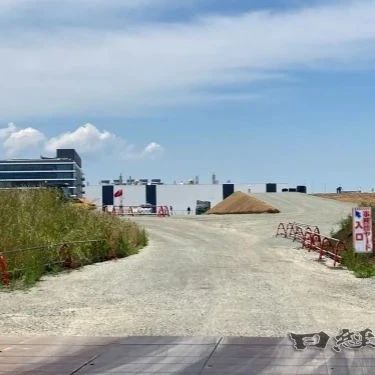
Group 1 - TSMC's second factory in Kumamoto is expected to begin construction in the second half of 2025, with local municipalities actively promoting industrial park development [1][3] - The total area of industrial parks planned around TSMC's factories is approximately 2 million square meters, which is nine times the size of TSMC's first factory [1][5] - The local government anticipates significant tax revenue increases, potentially allowing Kumamoto to become a "non-delivery group" that does not require national subsidies [3] Group 2 - The new industrial park in Kikuyō Town will cover about 240,000 square meters and is set to start selling plots in 2031, with around 30 supply chain companies expected to gather in the area [3][4] - The construction of industrial parks is seen as a crucial step for regional economic development, with local leaders emphasizing the need for proactive administration to boost tax revenues [4] - Challenges such as balancing agricultural needs and addressing traffic congestion and groundwater protection issues have been highlighted amid the rapid industrial park development [5]

辽阳:锚定全年地区生产总值破千亿目标
Liao Ning Ri Bao· 2025-06-13 01:06
Group 1 - The core objective of Liao City is to achieve a regional GDP exceeding 100 billion yuan, with a growth rate of 5.2% in the first quarter, maintaining synchronization with the provincial growth rate for four consecutive quarters [1] - The city aims to enhance effective investment through actions such as attracting investment, promoting projects, and facilitating implementation, targeting a 10% increase in actual funds in place [1][2] - Liao City will focus on industrial economic operation, promoting the coordinated development of primary, secondary, and tertiary industries, and will accelerate the construction of five key industrial clusters [2] Group 2 - The city plans to support Liao Petrochemical as a leading state-owned enterprise, implementing strategies to reduce oil dependency while increasing chemical production and innovation [2] - Liao City will enhance the business environment by addressing issues such as slow processing, approval bottlenecks, and high costs, aiming to make business operations more convenient and profitable [2] - The city will prioritize safety and stability, implementing measures to maintain social harmony and security while promoting financial reform [3]