
GDP排名

Search documents
31省2025年GDP排名:上海5.6万亿仅第9,北京破5万亿仍无缘前十
Sou Hu Cai Jing· 2026-02-11 16:27
Core Insights - The economic ranking reveals that Shanghai, with a GDP of 5.6 trillion, ranks only 9th nationally, while Beijing surpasses the 5 trillion mark but remains outside the top ten [1][3] - The leading province, Guangdong, has a significant economic advantage, with a GDP of 14 trillion, driven by diverse industries and population growth [9][11] Economic Rankings - The rankings reflect provincial capacity rather than city strength, indicating that cities like Shanghai and Beijing are limited by their geographical boundaries [5][7] - The rankings are not suitable for assessing city strength, as they primarily show who can maximize provincial capacity rather than who leads in economic performance [7][25] Guangdong's Economic Structure - Guangdong's economic strength is attributed to a balanced development across population, industry, and trade, making it resilient to fluctuations in any single sector [9][11] - The province has been addressing internal imbalances, leading to rapid income growth in rural areas and a steady influx of labor into cities [9][11] Mid-tier Provinces - Mid-tier provinces like Shandong, Zhejiang, and Sichuan are showing significant growth, supported by diverse industries that provide stability against external pressures [13][15] - These provinces are transitioning to high-tech manufacturing and digital industries, indicating a structural shift that may not immediately reflect in rankings but will influence future growth [17][19] Growth Dynamics - Some provinces with lower total GDP are experiencing faster growth, indicating a shift in economic dynamics where growth is becoming more distributed across regions [19][23] - The gap between the top and bottom provinces is widening, with some regions still struggling to reach the trillion mark while others are advancing rapidly [21][25] Conclusion - The GDP rankings serve to highlight regional disparities and the different paths taken by provinces, with Guangdong's robust structure and the strategic shifts of Beijing and Shanghai illustrating varied economic strategies [25][27]

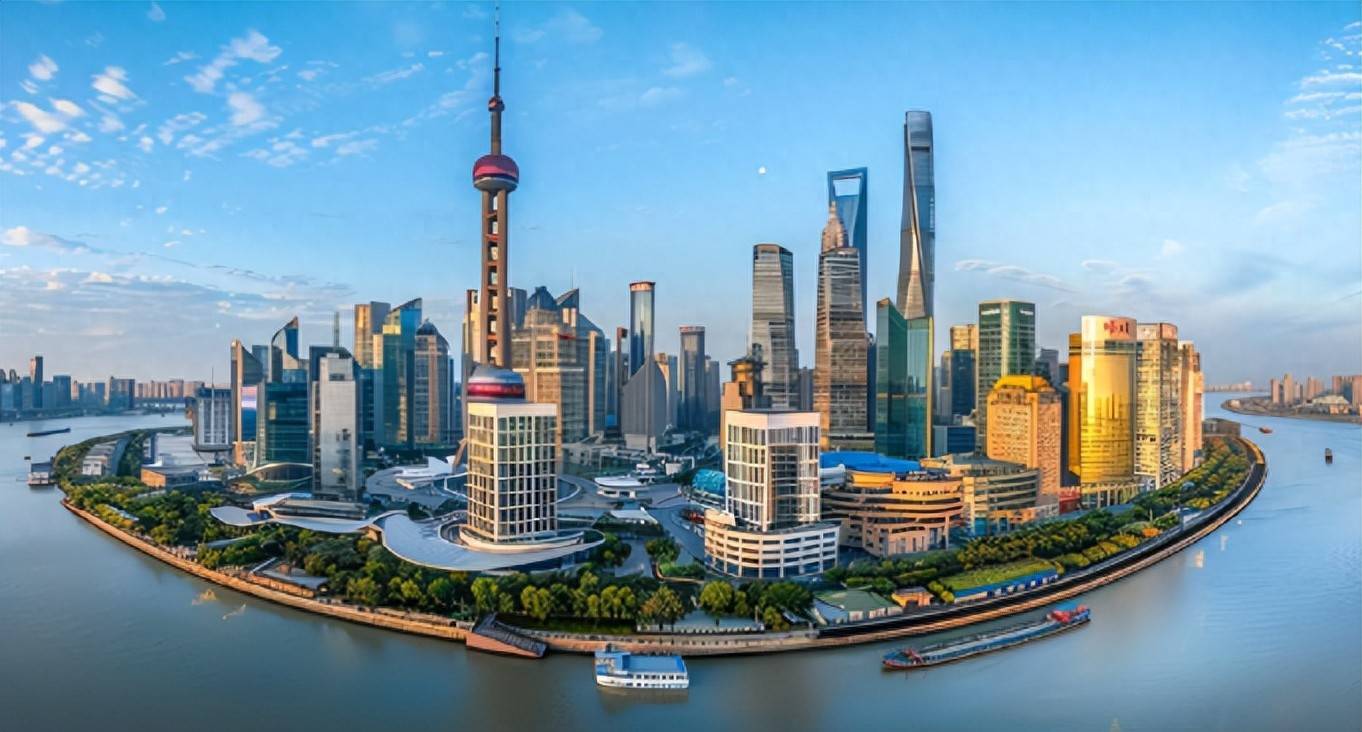
最新公布!31省份2025年GDP排名,来了
3 6 Ke· 2026-01-29 02:39
Core Insights - The economic performance of 31 provinces in China for 2025 has been released, highlighting which regions excelled and which lagged behind in growth rates [1] Group 1: Economic Growth Rates - In 2025, 20 provinces achieved GDP growth rates at or above the national average of 5%, with Tibet leading at 7%, marking it as the only province to reach this growth rate [1][2] - Nine provinces, including Shandong, Zhejiang, and Gansu, recorded growth rates of 5.5% or higher, with Gansu achieving a notable 5.8% [4][7] - Conversely, 11 provinces fell below the national average, with Guangdong's growth at 3.9% and Liaoning at 3.7%, the lowest among all provinces [7][8] Group 2: Investment and Economic Drivers - Tibet's fixed asset investment surged by 17.2%, significantly contributing to its GDP growth, with major projects like the Sichuan-Tibet Railway driving investment momentum [4] - Gansu's industrial sector showed resilience, with a 9.5% increase in industrial output, particularly in gold and copper production [4] - Provinces like Yunnan and Guizhou, previously high-growth areas, are now facing challenges as their growth rates dip below the national average, indicating a need for new economic drivers [15] Group 3: Total GDP and Rankings - Shandong's GDP surpassed 10 trillion yuan, making it the third province to reach this milestone, while Beijing's GDP exceeded 5 trillion yuan for the first time [11][12] - The only significant ranking change was Chongqing surpassing Liaoning to become the 16th largest economy [12] - The gap between Jiangsu and Guangdong's GDP has narrowed to 340 billion yuan, raising questions about future rankings [14] Group 4: Economic Characteristics and Future Outlook - The top ten provinces are increasingly contributing to national economic growth, with half of them achieving growth rates of 5.5% or higher [15] - Regions heavily reliant on investment, such as Guizhou and Yunnan, are under scrutiny for their ability to sustain growth without new economic drivers [15] - The need for energy provinces and northeastern regions to accelerate their transformation and enhance resilience is emphasized, particularly in the context of consumption's growing contribution to economic growth [16][17]

官宣!2025年GDP15强省名单落定,3大趋势关乎养老和理财!
Sou Hu Cai Jing· 2026-01-27 11:43
Core Insights - The 2025 GDP rankings reveal a stable yet evolving landscape among the top 15 provinces, indicating regional development trends and implications for investment strategies [1][3] Group 1: Key Rankings and Data - The top 15 provinces by GDP include Guangdong, Jiangsu, Shandong, and Zhejiang, with notable growth rates and nominal GDP figures [4][5] - Guangdong and Jiangsu both exceed 13 trillion in GDP, collectively accounting for over 20% of the national economy, while Shandong and Zhejiang show significant growth rates of 4.87% and 5.04% respectively [6][8] Group 2: Emerging Trends - The traditional dominance of coastal provinces is shifting, with inland provinces like Hubei and Jiangxi showing strong growth driven by technology and innovation [8][9] - Shandong stands out as the only northern province in the top three, demonstrating resilience through industrial transformation and innovation in sectors like offshore wind and biomedicine [9] Group 3: Practical Insights for Investment - High GDP does not equate to safe investment opportunities; provinces with high growth rates may still carry significant risks due to reliance on single industries [11] - Investment strategies should focus on stable industries such as Hubei's optoelectronics and Zhejiang's digital economy, while avoiding high-risk, unsupported high-yield products [11] - For retirement planning, second-tier cities in economically strong provinces offer a balance of quality resources and lower living costs compared to first-tier cities [11]
2025年GDP10强省大洗牌:山东首超10万亿,四川险胜河南,上海第9
Sou Hu Cai Jing· 2026-01-27 05:35
Core Insights - The economic landscape of China's provinces is undergoing significant changes, with a notable reshuffling among the top ten provinces by GDP for 2025, highlighting the competitive dynamics within the region [1][9] Group 1: Economic Milestones - Shandong has achieved a historic milestone by surpassing the 10 trillion yuan mark in GDP, reaching 10,319.7 billion yuan, making it the third province to join the "10 trillion club" [1][8] - Guangdong and Jiangsu are expected to maintain their leading positions with substantial GDP figures of 141,633.81 billion yuan and 137,008.03 billion yuan respectively [8] Group 2: Competitive Dynamics - The competition for the fifth and sixth positions is intense, with Sichuan narrowly defeating Henan by a mere 33.55 billion yuan, achieving a GDP of 67,665.34 billion yuan compared to Henan's 66,632.79 billion yuan [3][8] - The growth rates for Sichuan and Henan are closely matched at 4.85% and 4.84% respectively, indicating a highly competitive economic environment [3][8] Group 3: Growth Performance - Shanghai recorded the highest nominal growth rate among the top ten provinces at 5.49%, increasing its GDP from 53,759.53 billion yuan to 56,708.71 billion yuan, solidifying its position above Hunan [5][8] - Hunan's GDP stands at 55,308.65 billion yuan with a growth of 2,223.95 billion yuan and a nominal growth rate of 4.19%, maintaining a stable position despite being surpassed by Shanghai [7][8] Group 4: Overall Economic Trends - The overall scale of the top ten provinces continues to expand, with Hunan also crossing the 5.5 trillion yuan threshold, reflecting the robust growth of China's regional economies [8][9]

英国有望超日本,重回前五大经济体?专家发出警告
Guo Ji Jin Rong Bao· 2025-12-27 00:28
Group 1 - The core viewpoint of the article is that the global economic landscape is shifting, with the UK expected to surpass Japan and reclaim its position as the fifth-largest economy by the end of the next decade [1][6]. - The UK's GDP is projected to grow from under $4 trillion in 2025 to approximately $6.8 trillion by 2040, driven by productivity improvements and a service-led economy [2][3]. - Key sectors contributing to the UK's GDP growth include financial services, legal and professional services, healthcare, education, and technology [2][3]. Group 2 - Analysts emphasize that future growth will depend on effective policy execution, particularly in infrastructure, skills development, and innovation [3]. - Despite the positive outlook, structural challenges such as high public debt and slow population growth may hinder the UK's long-term GDP predictions [3][4]. - The report indicates that while the UK may improve its global ranking, this does not necessarily translate to higher living standards or reduced inequality [3][4]. Group 3 - The report highlights that Japan may drop to sixth place due to slowing economic growth, while France and Germany are expected to have relatively weak growth prospects [6]. - The US and China will maintain their positions as the first and second largest economies, with China's GDP projected to approach $48 trillion and the US around $53 trillion by 2040 [6]. - Emerging economies like India are predicted to rise, with India potentially becoming the third-largest economy by 2040 [6]. Group 4 - The article stresses the importance of focusing on quality growth rather than just GDP rankings, as economic performance should reflect stable jobs, reliable income, and affordable living costs for citizens [8]. - The global economic environment is becoming more complex due to high debt levels, aging populations, and geopolitical tensions, which may impact overall economic stability [7][8]. - The article concludes that the real significance of economic ranking changes lies in whether they lead to improved living conditions for the general populace [8].
“三季报”确认了!南京守擂十强,江苏加速逼近广东,年度冠军有悬念
Sou Hu Cai Jing· 2025-11-03 12:45
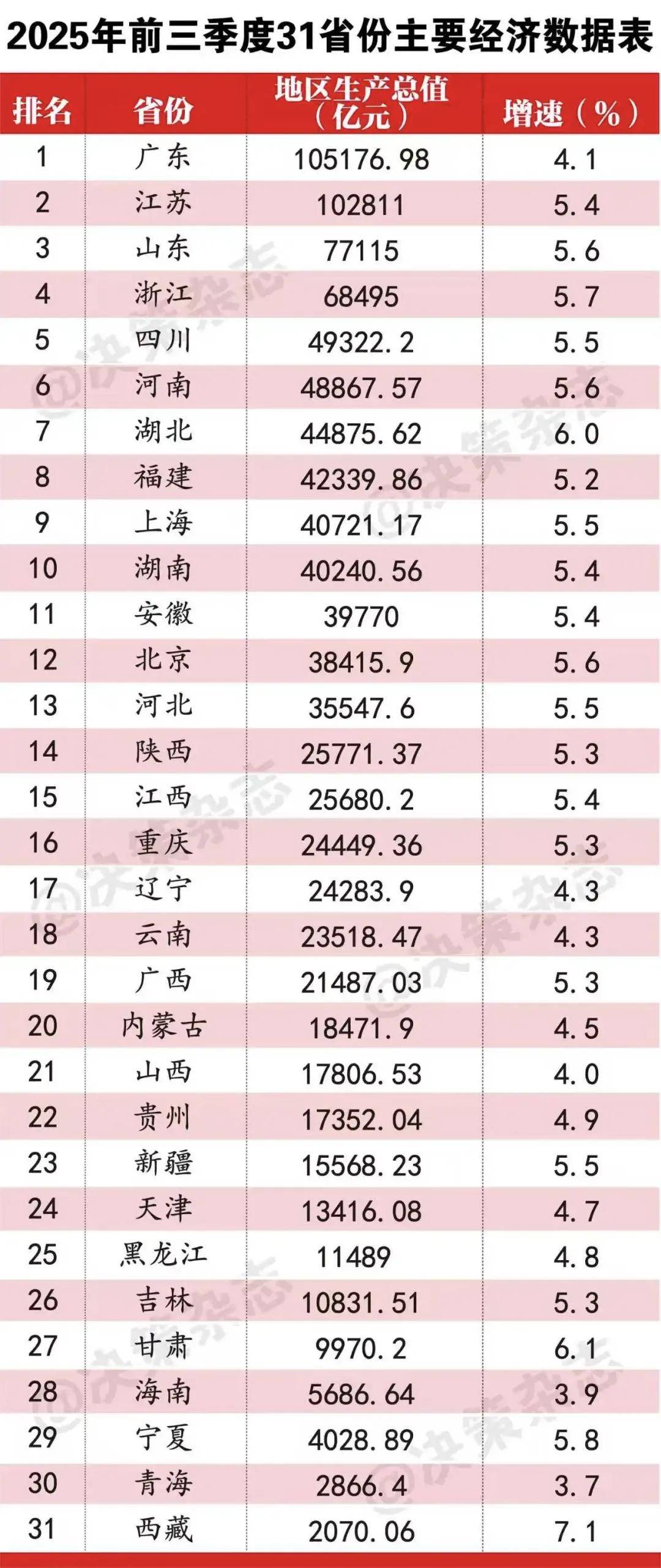
Core Insights - The economic reports for the first three quarters of 2025 from 31 provinces show that Guangdong and Jiangsu have entered the 10 trillion yuan club, with Guangdong's GDP at 10,517.698 billion yuan and a growth rate of 4.1%, while Jiangsu's GDP is at 10,281.1 billion yuan with a growth rate of 5.4% [1][2] Economic Performance by Province - Guangdong ranks first with a GDP of 10,517.698 billion yuan and a growth rate of 4.1% [2] - Jiangsu follows closely with a GDP of 10,281.1 billion yuan and a growth rate of 5.4% [2] - Shandong, Zhejiang, and Sichuan also show strong performance with GDPs of 77,115 billion yuan (5.6%), 68,495 billion yuan (5.7%), and 49,322.2 billion yuan (5.5%) respectively [2] - The overall economic performance indicates a competitive landscape among the provinces, with Jiangsu's industrial economy contributing significantly to its growth [3][4] Industrial Contributions - Jiangsu's industrial added value grew by 6.3%, contributing 2.3 percentage points to GDP growth, indicating a solid manufacturing base [3] - The second industry's growth rate in Jiangsu at 5.2% significantly outpaces Guangdong's 2.7%, highlighting a divergence in economic performance between the two provinces [3][4] Economic Gap and Projections - The GDP gap between Jiangsu and Guangdong has narrowed, with the difference expected to decrease from approximately 7,451 billion yuan in 2023 to about 2,366 billion yuan in the first three quarters of this year [4] - The competition between Jiangsu and Guangdong for economic supremacy will hinge on the performance in the fourth quarter of 2025 [4] City-Level Insights - Among the top ten cities by GDP in the first three quarters of 2025, Jiangsu has two cities: Suzhou with 1,993.021 billion yuan (5.5% growth) and Nanjing with 1,405.949 billion yuan (5.2% growth) [4] - Suzhou's economic strength is attributed to its advanced manufacturing sector, while Nanjing benefits from both advanced manufacturing and modern service industries [4][5] Competitive Dynamics - Ningbo has shown rapid economic growth, surpassing several cities and positioning itself as a strong competitor to Nanjing, with a projected GDP of 1,814.77 billion yuan in 2024 [5] - Nanjing's GDP growth in the first three quarters was 935.06 billion yuan, which is higher than Ningbo's 848.61 billion yuan, reducing the likelihood of Nanjing being overtaken this year [5]
9市突破万亿,大连赶超唐山,襄阳55,上半年GDP60强城市洗牌
Sou Hu Cai Jing· 2025-09-22 07:18
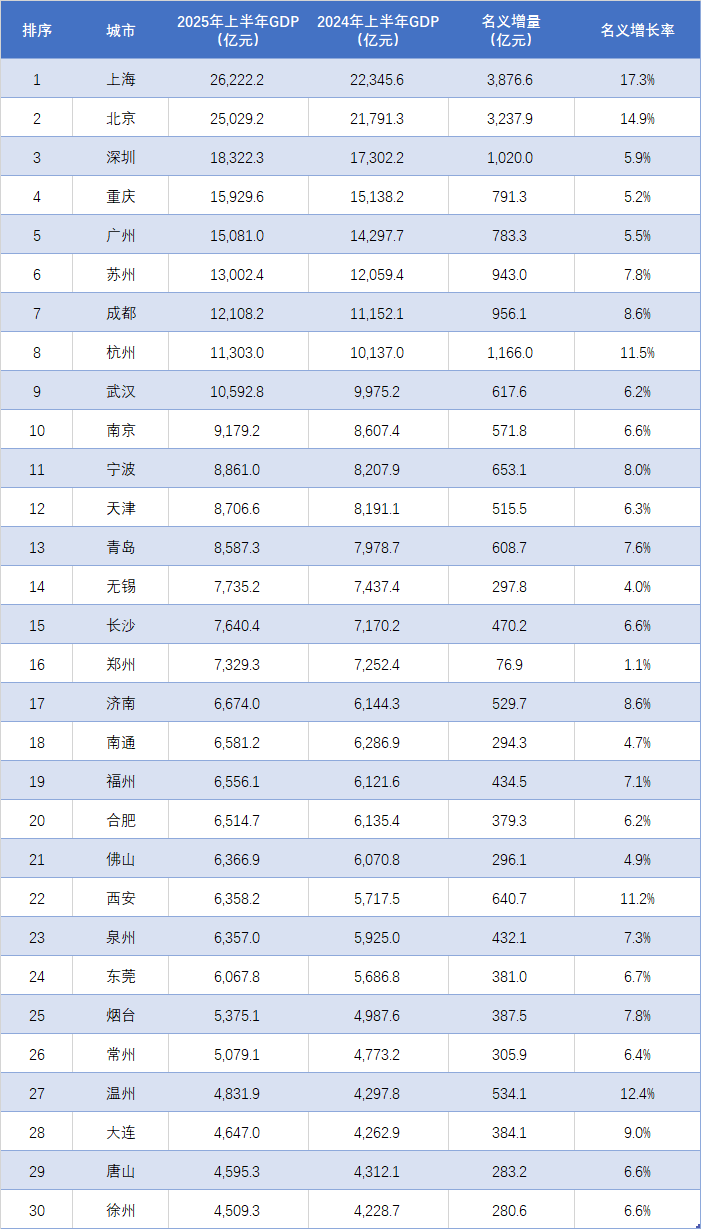
Core Insights - The "trillion-dollar club" in China's urban economy has expanded, with nine cities now part of this elite group, indicating a new historical height in economic development [1] - Beijing and Shanghai remain the top two cities, both surpassing 2.5 trillion yuan in GDP, showcasing their strong economic power as national central cities [2] - Emerging cities like Suzhou, Hangzhou, and Wuhan are making significant strides, with notable growth rates and contributions to the economy [4][5] Group 1: Economic Performance of Major Cities - Beijing's GDP reached 25,029 billion yuan, marking a 5.5% increase from the previous year [10] - Shanghai's GDP was 26,222 billion yuan, with a growth rate of 4.61% [10] - Shenzhen's GDP stood at 18,322 billion yuan, reflecting a 5.9% growth [11] Group 2: Emerging Cities and Growth Rates - Suzhou achieved a remarkable growth rate of 7.82%, surpassing 13,000 billion yuan in GDP [4] - Wuhan's GDP reached 10,593 billion yuan, with a significant contribution of 617 billion yuan from its optoelectronics industry [4] - Hangzhou joined the trillion-dollar club with a GDP of 11,302.72 billion yuan, showing an impressive growth rate of 11.5% [4] Group 3: Regional Economic Competitiveness - Dalian's GDP reached 4,647 billion yuan, surpassing Tangshan, driven by major projects from Intel and Hengli Petrochemical [5] - Tangshan's growth rate slowed to 6.57%, but it made progress in industrial transformation, with over 65% of its steel production being high-quality products [7] - The cities of Yichang and Xiangyang in Hubei province are competing closely, with Yichang's GDP at 2,866.57 billion yuan and a growth rate of 8.56% [7][14] Group 4: Overall Economic Resilience - The overall performance of China's cities reflects strong resilience and continuous innovation, with various regions showcasing unique economic strengths [15] - The competition among cities is expected to intensify, driven by macroeconomic policy benefits and regional economic characteristics [15]
杭州紧追成都,泉州不敌西安!2025年上半年GDP城市30强排行出炉
Sou Hu Cai Jing· 2025-08-07 09:05
Core Insights - The threshold for entering the top 30 cities by GDP has increased to 450 billion yuan, indicating that all cities in this group are expected to surpass the trillion yuan mark for the year [1][2] - Shanghai and Beijing remain the only two cities with a GDP exceeding 20 trillion yuan in the first half of 2025, with respective totals of 26,222.15 billion yuan and 25,029.2 billion yuan, showing significant year-on-year growth rates of 17.3% and 14.9% [1] - Other major cities like Shenzhen, Chongqing, and Guangzhou have GDPs between 15 trillion and 20 trillion yuan, but their growth rates are considerably lower than those of Shanghai and Beijing, indicating potential areas for improvement [1] Summary by Categories Top Cities - Shanghai: 26,222.15 billion yuan, up from 22,345.6 billion yuan, with a growth rate of 17.3% [1] - Beijing: 25,029.2 billion yuan, up from 21,791.3 billion yuan, with a growth rate of 14.9% [1] - Shenzhen: 18,322.26 billion yuan, up from 17,302.2 billion yuan, with a growth rate of 5.9% [1] - Chongqing: 15,929.58 billion yuan, up from 15,138.2 billion yuan, with a growth rate of 5.2% [1] - Guangzhou: 15,080.99 billion yuan, up from 14,297.7 billion yuan, with a growth rate of 5.5% [1] Cities Exceeding 1 Trillion Yuan - Suzhou: 13,002.35 billion yuan, up from 12,059.4 billion yuan, with a growth rate of 7.8% [2] - Chengdu: 12,108.2 billion yuan, up from 11,152.1 billion yuan, with a growth rate of 8.6% [2] - Hangzhou: 11,303 billion yuan, up from 10,137 billion yuan, with a growth rate of 11.5% [2] - Wuhan: 10,592.8 billion yuan, up from 9,975.2 billion yuan, with a growth rate of 6.2% [2] Cities Approaching 1 Trillion Yuan - Nanjing: 9,179.18 billion yuan, up from 8,607.4 billion yuan, with a growth rate of 6.6% [2] - Ningbo: 8,861 billion yuan, up from 8,207.9 billion yuan, with a growth rate of 8.0% [3] - Tianjin: 8,706.6 billion yuan, up from 8,191.1 billion yuan, with a growth rate of 6.3% [3] Cities with GDP Between 6,000 and 7,000 Billion Yuan - Jinan: 6,674 billion yuan, up from 6,144.3 billion yuan, with a growth rate of 8.6% [3] - Xian: 6,358.2 billion yuan, up from 5,717.5 billion yuan, with a growth rate of 11.2% [3] Cities Below 6,000 Billion Yuan - Yantai: 5,375.1 billion yuan, up from 4,987.6 billion yuan, with a growth rate of 7.8% [3] - Changzhou: 5,079.1 billion yuan, up from 4,773.2 billion yuan, with a growth rate of 6.4% [3] - Wenzhou: 4,831.9 billion yuan, up from 4,297.8 billion yuan, with a growth rate of 12.4% [3]
全国各省2024年GDP排名
数说者· 2025-03-02 13:25
2024 年全国 GDP 达到 134.91 万亿元,约 18.94 万亿美元。而美国 2024 年 GDP 为 29.2 万亿美 元,我国 GDP 总量已经达到美国近 65% 。 31 个省份中,广东依然以 14.16 万亿元 GDP 总量排在全国首位,江苏以 13.70 万亿元排在第二。 广东和江苏也是全国 31 个省份中唯二 GDP 总量超过 10 万亿元的省份。 山东以 9.86 万亿元 GDP 总量排在全国第三,浙江以 9.01 万亿元排在全国第四。 另有四川( 6.47 万亿)、河南( 6.36 万亿)和湖北( 6.00 万亿)三省 GDP 总量超过 6 万亿元; 福建( 5.78 万亿)、上海( 5.39 万亿)、湖南( 5.32 万亿)和安徽( 5.06 万亿)四省 GDP 总量超过 5 万亿元。 全国 31 个省份中排名前十的省份 2024 年 GDP 总量均超过 5 万亿元。 四个直辖市中上海 GDP 总量超过 5 万亿元,北京为 4.98 万亿元,重庆为 3.22 万亿元,天津为 1.80 万亿元。 海南( 0.79 万亿)、宁夏( 0.55 万亿)、青海( 0.40 万亿)和西藏( 0 ...