家族财富传承

Search documents
月内两单亿元级保险金信托相继落地
Zheng Quan Ri Bao· 2025-11-26 16:53
Core Insights - The insurance trust sector is witnessing significant transactions, indicating a growing acceptance among high-net-worth individuals for insurance trust services [1][3] - The future of insurance trusts appears promising, with potential for further growth despite some risk factors [2] Group 1: Recent Developments - Sunshine Life and Zhongcheng Trust successfully established a large-scale insurance trust for a family business, showcasing the integration of insurance and family trust structures for wealth management [3] - On November 11, a high-net-worth client signed a 180 million yuan insurance trust service agreement with China United Insurance, marking a substantial advancement in comprehensive wealth planning solutions [3] Group 2: Industry Growth - The insurance trust business has experienced rapid growth, with the scale increasing from 5 billion yuan in 2017 to approximately 747.93 billion yuan by 2021, marking a pivotal point in its development [4] - By the end of 2024, the wealth management service trust scale is projected to exceed 1 trillion yuan, with insurance trusts accounting for about 270.3 billion yuan, representing over 26% of the total [4] - As of early 2025, more than 60 insurance companies are involved in the insurance trust business, indicating a growing market participation [4] Group 3: Market Drivers - The rapid expansion of insurance trusts is driven by increasing demand for wealth transfer and asset isolation among high-net-worth individuals, along with the effective combination of insurance and trust management features [5] - The decline in fixed-income product yields has made whole life insurance a preferred choice for wealth management, further boosting the insurance trust market [5] - The competitive landscape among financial institutions has led to a focus on middle-net-worth and mass affluent clients, enhancing the accessibility of insurance trusts [6] Group 4: Future Trends - The threshold for entering the insurance trust market is decreasing, with a trend towards inclusivity and broader market appeal [6] - The upcoming generational wealth transfer and enhanced client understanding of wealth management are expected to sustain strong demand for insurance trusts [6] - The insurance trust sector is anticipated to evolve from a niche market to a mainstream wealth management tool, supported by product innovation and regulatory improvements [6]
走进受托人 | 中诚信托为蓉城家庭解码财富传承之道
Mei Ri Jing Ji Xin Wen· 2025-11-24 08:11
Core Insights - The event organized by Zhong Cheng Trust in Beijing aimed to educate high-net-worth clients from Chengdu about the unique functions of insurance trust in family wealth management and inheritance [1][4] - The current economic environment is complex, but Chengdu is positioned as a core economic engine in the West, with a focus on family wealth accumulation and intergenerational transfer [1][2] Group 1: Event Overview - Zhong Cheng Trust hosted a specialized sharing event on "Insurance Trust" for high-net-worth clients from Chengdu, highlighting the importance of understanding trust mechanisms in wealth management [1][4] - The event featured a detailed analysis of macroeconomic trends and local wealth characteristics, addressing the specific concerns of Chengdu's affluent families [1][2] Group 2: Product Features - The integration of insurance and trust services provides a robust risk protection framework while ensuring precise wealth distribution for key life events such as education and retirement [2][3] - Insurance trust serves as a critical tool for high-net-worth families in Chengdu, allowing for effective asset isolation and equitable wealth distribution among heirs [3] Group 3: Client Engagement - The event included practical case studies relevant to local entrepreneurs and high-net-worth families, demonstrating the application of insurance trust in real-life scenarios [3] - One-on-one consultations were provided, allowing clients to receive tailored advice on debt isolation, retirement planning, and wealth preservation strategies [3][4] Group 4: Future Commitment - Zhong Cheng Trust aims to continue its commitment to serving Chengdu clients by integrating local needs into its financial services, ensuring a high level of professionalism and local understanding [2][4] - The company emphasizes its mission of protecting local wealth and supporting families in achieving their aspirations for wealth preservation and happiness [4]
香港家族办公室协会郭兴业:企一代要给企二代更多容错空间
2 1 Shi Ji Jing Ji Bao Dao· 2025-11-21 08:59
Group 1 - The 2025 Bay Area Wealth Conference was held in Shenzhen, focusing on global asset allocation, cross-border wealth management, and wealth management and inheritance [1] - Discussions highlighted the changing investment behaviors of high-net-worth clients, with insights from family office founders and trust business leaders [1] - The need for systematic and institutionalized approaches to family wealth succession was emphasized, particularly in the context of generational differences between the first and second generations of business leaders [1][2] Group 2 - The first generation tends to be conservative and seeks stability, while the second generation, influenced by web 3.0, is more innovative and exposed to diverse information sources [2] - Family wealth succession is described as a long-term, systematic process that requires careful planning and consideration of the next generation's capabilities and institutional frameworks [2] - The importance of providing the next generation with opportunities for error and growth, rather than a one-time training approach, was highlighted as essential for successful succession [2]
云南“药王”阮鸿献分给女儿2%股份 万店一心堂转型中途二代走上台前
Chang Jiang Shang Bao· 2025-11-09 23:46
Core Viewpoint - Yunnan's "Medicine King" Ruan Hongxian is in the spotlight following Yixin Hall's announcement of a share transfer to his daughters, amidst the company's ongoing performance decline and strategic transformation efforts [1][10]. Company Overview - Yixin Hall, founded by Ruan Hongxian, has grown to operate 11,372 pharmacies, establishing itself as a leading player in the southwestern Chinese pharmaceutical retail market [1][9]. - The company reported a revenue decline of 4.33% year-on-year to 13 billion yuan and a net profit drop of 8.17% to 269 million yuan for the first three quarters of 2025 [1]. Historical Background - Ruan Hongxian began his career in the pharmaceutical industry at the age of 14, eventually founding Yixin Hall in 2006 after years of building a reputation for quality [3][4]. - The company went public in 2014, marking a significant milestone in its expansion journey, with revenues reaching 17.43 billion yuan and net profits hitting 1.01 billion yuan by 2022 [4]. Strategic Challenges and Responses - The company has faced challenges such as declining gross margins due to policy changes and market competition, prompting Ruan to initiate a strategic transformation [7][8]. - A dual-track transformation strategy has been proposed, with plans to convert 70% of stores to multi-category health stores and 30% to professional pharmacies, enhancing the medical attributes of nearly one-third of the stores [8][9]. Family Succession and Future Outlook - Ruan Hongxian is transferring shares to his daughters as part of a family wealth succession plan, with the total value of the shares amounting to approximately 157 million yuan [1][10]. - The involvement of the next generation, particularly Ruan Aixiang as vice president, is seen as crucial for the company's innovative development amid ongoing transformation efforts [2][11].

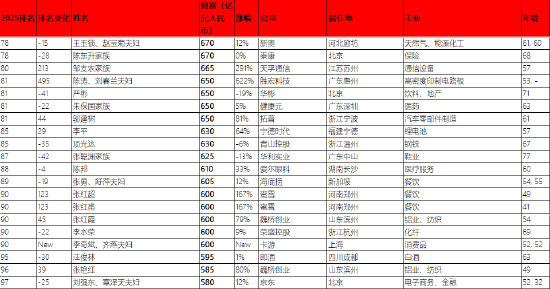
陈东升家族最新财富670亿元,较去年实现零增长,排名下滑28位降至第七十八
Xin Lang Zheng Quan· 2025-10-28 10:31
Core Insights - The Chen Dongsheng family, founder of Taikang Insurance Group, has a wealth value of 67 billion yuan in the 2025 Hurun Rich List, showing no growth compared to 2024, and their ranking dropped from 50th to 78th [1][3] Group 1: Company Performance - Taikang Group's total assets reached 1.67 trillion yuan by the end of 2023, with managed assets exceeding 2.7 trillion yuan, indicating a solid financial foundation [3] - The core businesses, including insurance and Taikang's medical and nursing communities, continue to contribute stable revenues [3] - The family governance structure is evolving, with Chen Dongsheng's eldest son, Chen Yilun, taking a key role as CEO of Taikang Asset Management (Hong Kong), supporting both business growth and family legacy [3] Group 2: Market Position and Trends - The wealth trajectory of the Chen Dongsheng family reflects the "growth temperature difference" between traditional finance and emerging industries, with traditional sectors like insurance providing stable returns but not rapid growth [3] - The "insurance + medical care" model pioneered by Chen Dongsheng aligns well with the aging population trend, providing a unique value proposition and long-term support through physical assets like Tongji Rehabilitation Hospital [3] - Despite a significant drop in short-term rankings due to market cycles, Taikang Group's large asset scale and mature business model create a solid wealth foundation, with potential for long-term value release as the medical and nursing industry develops further [3]

家族财产纠纷刺痛高净值人群,传承大考下,香港家办或为优选
Di Yi Cai Jing· 2025-10-27 02:04
Core Insights - Offshore family trusts have become a topic of discussion, with many older entrepreneurs and founders being unaware or only partially aware of the implications for their estate planning [1][2] - Recent cases of wealthy individuals facing legal and tax disputes due to poorly structured offshore family trusts highlight the risks of relying solely on trusts for asset protection [1][2] - The importance of comprehensive family wealth management planning is emphasized, as many wealthy families have lost significant assets due to lack of planning and oversight [3][4] Group 1: Offshore Family Trusts - Offshore family trusts are commonly used by high-net-worth individuals for wealth planning, but many have encountered issues due to key pitfalls such as retaining control, neglecting tax compliance, and unclear asset sources [2][3] - Successful execution of trust arrangements is critical, as the design of the trust structure is only a small part of the overall process [2] Group 2: Wealth Management and Family Offices - The lack of a structured wealth management mechanism has led to rapid wealth loss among families, particularly in industries like coal where founders did not establish proper governance [3][4] - Family offices are increasingly seen as essential for high-net-worth families to protect assets, ensure business continuity, and manage family affairs effectively [4][6] Group 3: Hong Kong as a Family Office Hub - Hong Kong is positioned as a leading international financial center, offering a comprehensive range of services for family offices, including asset allocation, trust structuring, and tax planning [6][7] - The city boasts a robust financial infrastructure, with active capital markets and a variety of investment vehicles, making it an attractive location for family offices [7] Group 4: Education and Next-Generation Leadership - Education is becoming a critical factor in wealth transfer, with many families prioritizing the cultivation of financial responsibility and leadership skills in their children [10][11] - Hong Kong's educational resources and international school systems provide a conducive environment for the next generation to develop skills necessary for managing family wealth [11][12] Group 5: Multi-Dimensional Legacy - The concept of family offices in Hong Kong encompasses not just financial management but also the transmission of family values and cultural heritage, integrating investment philosophy with cultural continuity [12][13] - Family offices serve as neutral entities to mediate family disputes regarding wealth distribution and management, thereby fostering harmony within the family [13]

家族财产纠纷刺痛高净值人群!传承大考下,香港家办或为优选
第一财经· 2025-10-26 23:39
Core Viewpoint - The article emphasizes the importance of early and reasonable planning for family wealth management, particularly in the context of offshore family trusts, which have seen numerous failures due to poor design and execution [1][2][3]. Group 1: Offshore Family Trusts - Offshore family trusts are commonly used by high-net-worth individuals for wealth planning, but many have encountered significant issues due to factors such as retaining actual control, neglecting tax compliance, unclear asset sources, incorrect timing, and unprofessional trust terms [2][3]. - The execution of trust arrangements is critical, as it involves strict adherence to the trust's design and compliance management, rather than just the initial setup [2]. Group 2: Overall Wealth Management - Poor wealth management has led to significant losses for families, particularly among early coal industry entrepreneurs who failed to establish a family wealth management mechanism, resulting in rapid wealth depletion due to lack of long-term planning and institutional management [3][4]. - Family businesses often face wealth loss due to marriage disputes, especially when ownership is concentrated in one individual's name without proper arrangements [4]. Group 3: Importance of Family Offices - Family offices are increasingly seen as essential for high-net-worth families, serving to protect assets, ensure business succession, and manage family affairs effectively [4]. - The establishment of family offices is crucial for systematic planning and avoiding fragmented decision-making, especially as significant wealth transfer is expected in the Asia-Pacific region [4]. Group 4: Advantages of Hong Kong for Family Offices - Hong Kong is highlighted as a leading international financial center with a comprehensive range of services for family offices, including asset allocation, trust structuring, and tax arrangements [6][7]. - The presence of top-tier law firms and accounting firms in Hong Kong provides essential support for complex family structures and cross-border compliance [7][8]. Group 5: Education and Next Generation - Education for the next generation is becoming a critical consideration, with many families now opting for education in Hong Kong due to its rich educational resources and international school systems [11][12]. - Family offices can facilitate financial and non-financial education for heirs, preparing them for future management of family affairs and fostering a sense of social responsibility [12]. Group 6: Multidimensional Inheritance - Hong Kong's family wealth management has a long history, integrating cultural values with international wealth governance and philanthropy [13][14]. - Family offices in Hong Kong serve as a vehicle for transmitting family values, ensuring a comprehensive inheritance of wealth, family business, and values [14].

许家印23亿美元家族信托可能被击穿
Di Yi Cai Jing· 2025-10-21 12:46
Core Insights - Family trusts are not an infallible wealth "safe haven" and can become "wealth traps" if misused or misunderstood [2][13] - The case of Xu Jiayin's family trust illustrates the potential pitfalls and legal vulnerabilities associated with family trusts [3][13] Group 1: Family Trust Functions - Family trusts serve three main functions: wealth transfer and planning, risk isolation and asset protection, and tax planning and privacy protection [1] - They are designed to clarify asset distribution rules, protect family wealth from disputes, and optimize cross-border tax costs [1] Group 2: Xu Jiayin's Family Trust Case - Xu Jiayin established a $2.3 billion family trust before the Evergrande debt crisis, which was seen as a key strategy for wealth preservation [3] - The trust was funded by over 50 billion RMB in dividends from Evergrande between 2009 and 2022, with the intention of ensuring long-term family wealth stability [3] Group 3: Legal Vulnerabilities - The Hong Kong High Court ruled that the family trust was invalid due to fraudulent asset transfer aimed at evading creditors [4] - The court found that the trust was established under suspicious motives, particularly to avoid debt obligations, which led to its legal nullification [4] Group 4: Key Legal Principles - The legitimacy of a family trust relies on the lawful source of its assets; if the funds are deemed illegitimate, the trust can be invalidated [5][8] - The independence of the trust is crucial; if the grantor retains control over the assets, the trust's protective function is compromised [6][7] Group 5: Risks Associated with Family Trusts - Five major risks associated with family trusts include: 1. Legitimacy of fund sources [8] 2. Lack of independence [9] 3. Illegitimate motives for establishment [10] 4. Cross-jurisdictional legal conflicts [11] 5. Risks from third-party management [12] Group 6: Conclusion and Recommendations - The Xu Jiayin case highlights that the protective functions of family trusts are relative and can be undermined by flaws in motivation, funding sources, or independence [13] - Effective family wealth management should focus on legal compliance and sound institutional frameworks rather than solely relying on trust structures [13]
告别房地产周期后,理财怎么理?
和讯· 2025-10-17 09:22
Group 1 - The total number of A-share investors in China has surpassed 240 million as of June 2025, indicating that one in six Chinese individuals is now a stock market participant [2] - By the end of 2024, individual investors accounted for over 99.76% of the total investor base, with 99.63% of new accounts in the first half of 2025 being individual investors [2] - The influx of personal investors reflects strong confidence in the A-share market and a growing demand for wealth management amid economic transitions and structural adjustments in China [2] Group 2 - The family trust market in China is projected to exceed 900 billion yuan by the end of 2024, with expectations to enter the "trillion era" in 2025 [2] - An estimated 20 trillion yuan of wealth is expected to be passed down to the next generation over the next decade, highlighting the urgency of addressing family wealth inheritance issues [3][18] Group 3 - The investment landscape is shifting as individuals seek effective asset allocation strategies beyond traditional real estate investments, particularly in the context of a changing economic cycle [3] - Young investors exhibit diverse attitudes towards wealth management, with some being overly conservative and others seeking high-risk, high-reward opportunities [7][9] Group 4 - Quantitative investment strategies are gaining traction among retail investors, offering a systematic approach to decision-making that can mitigate emotional biases in trading [11][12] - Basic quantitative methods focus on fundamental analysis, allowing investors to make informed decisions based on company performance rather than market trends [12] Group 5 - Effective wealth management requires a clear understanding of individual financial goals and risk tolerance, which can significantly influence investment strategies [13][14] - A layered approach to wealth management, separating funds for daily living expenses from those intended for long-term growth, can alleviate anxiety related to investment losses [17] Group 6 - The concept of wealth management should evolve from viewing oneself as the "owner" of wealth to acting as a "steward," emphasizing responsible management and long-term value creation [20][21] - Wealth should be viewed through a moral lens, ensuring that its use benefits society and enhances overall well-being rather than merely serving personal interests [22]
高盛观点 | 私人财富管理:家族传承与赋能
高盛GoldmanSachs· 2025-10-15 09:06
Core Insights - The accumulation of wealth in Asia is leading to a critical period for family wealth succession planning over the next 20 to 30 years, with families increasingly prioritizing wealth management and legacy planning [1] - Family succession is not just about preserving assets but also about ensuring the growth of the family business and maintaining family unity, which requires strategic planning and rigor [4] Group 1: Importance of Planning - Succession planning is an ongoing process rather than a one-time event, and initiating plans early helps avoid rushed decisions and ensures a smooth transition [5] - Effective communication is essential for strong family succession, with regular family meetings and the establishment of a "family charter" playing a significant role in aligning family members' opinions [5] Group 2: Guidance and Philanthropy - Effective succession planning involves guidance rather than control, fostering a high-performance family culture that encourages communication, trust, and resilience among family members [6] - Engaging in philanthropy is a powerful way to instill values and unite generations within a family, with many new wealth creators in Asia considering charitable endeavors early in their wealth accumulation [6] Group 3: Empowering the Next Generation - Supporting the next generation is a top priority, with Goldman Sachs being recognized as Asia's Best for Next-Gen services by Euromoney for its commitment to tailored education and innovative digital tools [6][7] - Goldman Sachs offers unique opportunities such as the "Next Gen Summer Series" and events like "Rising Leaders" to foster financial literacy and engagement among young clients, ensuring they are integrated into the firm's ecosystem for lasting legacy [7]