
居民储蓄入市

Search documents
国庆持股还是持币?周末科技主线这个大消息,很关键
Mei Ri Jing Ji Xin Wen· 2025-09-28 06:40
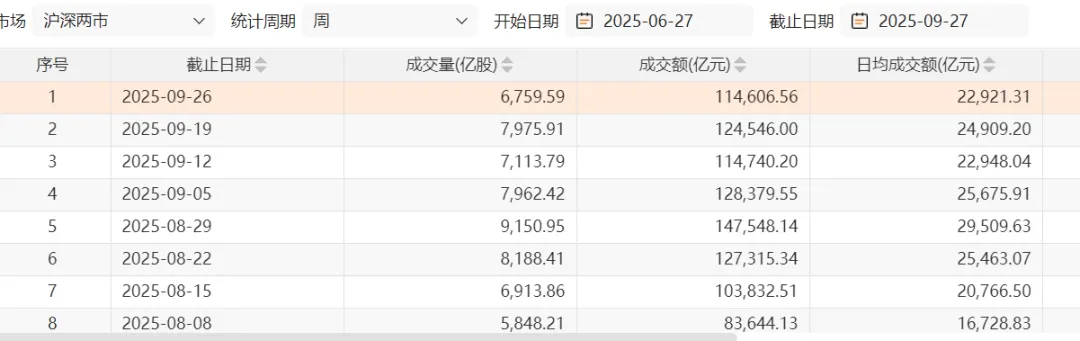
Market Overview - The three major indices experienced slight increases during the week from September 22 to September 26, with the Shanghai Composite Index closing at 3828.11 points, a weekly increase of 0.21% [1] - The Shenzhen Component Index closed at 13209.00 points, with a weekly increase of 1.06% [1] - The ChiNext Index closed at 3151.53 points, reflecting a weekly increase of 1.96% [1] Trading Volume and Value - The total trading volume for the week in the Shanghai and Shenzhen markets was 6759.59 billion shares, a decrease of approximately 15.25% from the previous week [1] - The total trading value was 114606.56 billion yuan, with an average daily trading amount of 22921.41 billion yuan, down about 7.98% from the previous week [1] Individual Stock Performance - A total of 1649 stocks rose, while 3729 stocks fell, and 57 stocks remained flat during the week [3] - The top ten stocks with the largest gains included Jianfa Zhixin, Xinhua New Materials, and Haocreative Technology, among others [3][4] - The top ten stocks with the largest declines included Borui Pharmaceutical, Xiangjiang Holdings, and Haotaitai, among others [5] Market Sentiment and Future Outlook - The market is experiencing a clear differentiation between large-cap and small-cap stocks, with large-cap stocks frequently reaching new highs [6] - The upcoming National Day holiday and the end of the quarter may lead to a decrease in market activity, with investors considering whether to hold stocks or cash during the holiday [6][7] - Institutions suggest that the market may see a decline in risk appetite as funds seek to avoid uncertainty before the holiday [7] - The recent approval of the IPO application for Moer Thread Technology, a company known for its GPU products, reflects strong policy support for key sectors like semiconductors and AI [9] Upcoming Events - The National Day holiday transportation period will begin on September 29 and last until October 10 [10] - The National Bureau of Statistics will release the official manufacturing PMI on September 30, which is crucial for assessing economic conditions [10]

【机构策略】A股市场大概率延续震荡格局
Zheng Quan Shi Bao Wang· 2025-09-24 01:20
Group 1 - The A-share market experienced a rebound after hitting a low, with significant fluctuations observed. Key sectors such as banking, precious metals, engineering construction, and shipping performed well, while tourism, small metals, real estate, and software development lagged behind [1] - The monetary policy is expected to maintain a "moderately loose" stance, with a focus on structural policies. In August, foreign capital showed a net inflow into domestic stocks and bonds, indicating continued confidence in Chinese assets [1] - The trading volume in the Shanghai and Shenzhen markets has consistently exceeded 2 trillion yuan, with a gradual shift of household savings towards the capital market, creating a sustained source of incremental funds [1] Group 2 - The A-share market is showing signs of stabilization, with the ChiNext index turning positive towards the end of the trading day. However, the Shanghai Composite Index has broken below the 5-day moving average, indicating a weakening short-term trend [2] - Despite the current market consolidation, structural opportunities remain significant, particularly in the semiconductor industry, banking, and port shipping sectors, which have shown resilience [2] - The upcoming National Day holiday is prompting some funds to take precautionary measures, especially leveraged funds that are actively closing positions, which is considered a seasonal norm [2]
【机构策略】本轮慢牛行情的根基并未动摇
Zheng Quan Shi Bao Wang· 2025-09-23 01:09
Market Overview - The A-share market experienced narrow fluctuations on Monday, with the Shanghai Composite Index showing slight movements while the Shenzhen Component and ChiNext Index saw initial gains followed by a decline and a late recovery [1][2] - The overall market sentiment remains optimistic, supported by the Federal Reserve's interest rate cuts and a strengthening yuan, which is expected to improve risk appetite [2][3] Sector Performance - Key sectors such as consumer electronics, semiconductors, computer equipment, and automotive parts performed well, while tourism, energy metals, automotive services, and fertilizers lagged behind [1] - The technology sector, particularly the Sci-Tech 50 Index, led the major indices, with strong performances in the consumer electronics and semiconductor chip sectors [3] Investment Trends - Foreign capital showed confidence in Chinese assets, with net purchases of domestic stocks and bonds in August, indicating a positive outlook for the market [1] - There is a gradual shift of household savings towards the capital market, creating a sustained source of incremental funds [1][2] Market Dynamics - The market is expected to maintain a steady upward trend amidst fluctuations, with a focus on structural optimization to seize investment opportunities [1] - The current market liquidity remains active, with daily trading volumes exceeding 2 trillion yuan, reflecting a robust market environment [2] Future Outlook - The market is anticipated to experience a slow bull trend, with the foundation for continued strength remaining intact despite short-term fluctuations [3] - The upcoming long holiday may lead to a stabilization in trading activity, but the overall sentiment remains positive with expectations of further market improvements [3]
光控资本:本轮慢牛行情的基础仍然存在
Sou Hu Cai Jing· 2025-09-18 04:21
Group 1 - The A-share market showed resilience amidst a generally subdued Asia-Pacific market, with three major indices rising, although the number of stocks rising was slightly less than those falling, indicating market differentiation and style rotation [3] - The A-share market is expected to maintain a steady upward trend in the short term, supported by the influx of household savings into the capital market, which is crucial for the market index's strength [3] - The sectors performing well included optical electronics, photovoltaic equipment, and batteries, while sectors like precious metals, retail, and travel showed weaker performance [1][3] Group 2 - The recent net inflow of global funds into the A-share market is attributed to the acceleration of household savings transitioning to the capital market, creating a continuous source of incremental funds [1] - The market is anticipated to experience new investment opportunities amidst structural optimization, with close attention needed on policy changes, funding conditions, and external market developments [1] - The current valuation of A-shares remains attractive in the medium to long term, with future "anti-involution" policies and demand-side policies being critical factors for determining the market's height [3]

【机构策略】预计A股市场维持震荡偏强走势
Sou Hu Cai Jing· 2025-09-17 01:13
Group 1 - The A-share market showed a rebound after a dip, with the Shanghai Composite Index and Shenzhen Component Index experiencing fluctuations, while sectors like automotive, internet services, robotics, and computer equipment performed well [1] - Global capital is flowing into the A-share market, with an acceleration of household savings moving towards capital markets, creating a continuous source of incremental funds [1] - The expectation of a dovish signal from the Federal Reserve and a weaker dollar is likely to facilitate foreign capital returning to the A-share market [1] Group 2 - The A-share market continued its volatile trend, but individual stocks were active, and trading volume slightly increased ahead of the Federal Reserve's meeting [2] - The current valuation of A-shares remains attractive in the medium to long term, with policies aimed at reducing internal competition and demand-side policies being crucial for the market's future performance [2] - The influx of household savings into the market is expected to support the strengthening of market indices, indicating that the foundation for a slow bull market still exists [2]
居民储蓄入市、外资加仓,A 股港股行情火了!慢牛到底能撑多久?
Sou Hu Cai Jing· 2025-09-15 13:50
Core Viewpoint - The current market conditions in A-shares and Hong Kong stocks are characterized by increased participation from retail investors and foreign capital, with concerns about the sustainability of this "slow bull" market compared to past experiences like in 2015 [1] Group 1: Market Dynamics - Retail savings are gradually entering the market through funds, and foreign capital is flowing into A-shares and Hong Kong stocks, driven by the expectation of interest rate cuts by the Federal Reserve [1][8] - The Hong Kong stock market has surpassed 26,000 points, while A-shares are experiencing upward movement despite some volatility [1] - The current market is different from 2015 due to stricter regulations on margin trading, with the margin financing balance being significantly lower than in 2015 [3][4] Group 2: Investor Behavior - Investors have learned from past mistakes and are less likely to use excessive leverage, which reduces overall risk in the market [4] - The inflow of retail savings is gradual, akin to watering a plant slowly to avoid root rot, suggesting a more sustainable market growth compared to previous surges [4][6] Group 3: Fundraising and Investment Opportunities - Fundraising limits for most funds are between 1 billion to 5 billion yuan, indicating that the influx of retail savings is still in its early stages [6] - A-shares and Hong Kong stocks are currently undervalued, with many quality stocks offering dividend yields higher than bonds, presenting attractive investment opportunities [8] Group 4: Foreign Capital Inflow - Since the second half of last year, foreign capital has consistently flowed into Hong Kong stocks, with over 10 billion USD entering A-shares in the first half of this year, indicating a sustained interest rather than a fleeting trend [10] - The attractiveness of A-shares and Hong Kong stocks is enhanced by their relative undervaluation compared to the high valuations in the US market [10] Group 5: Economic Context and Investment Strategy - The anticipated interest rate cuts by the Federal Reserve may lead to lower borrowing costs, encouraging both corporate investment and individual investors to seek higher returns in the stock market [11] - A diversified investment strategy, including a 20% allocation to gold, is recommended to mitigate risks associated with market volatility while maintaining exposure to potential growth in equities [11][13]
