
港股慢牛

Search documents
瑞士隆奥:料恒指今年仍有望挑战3万点 维持对黄金高配
Zhi Tong Cai Jing· 2026-02-02 07:37
Group 1 - The nomination of Kevin Warsh as the next Federal Reserve Chairman by President Trump has reduced market expectations for interest rate cuts, leading to a reversal in the dollar's decline and impacting Hong Kong stocks [1] - The head of Asian portfolio management at Swiss Longo, Shao Zhiming, anticipates that Hong Kong stocks could reach approximately 30,000 points this year, indicating a potential high single-digit percentage increase from current levels [1] - Investor confidence in the independence of the Federal Reserve has wavered recently, with expectations that the dollar will depreciate overall, but at a slower pace [1] Group 2 - There has been a slowdown in capital inflows into Hong Kong stocks compared to last year, with a slight decrease in net inflows from the north, suggesting a slow bull market pattern [1] - The inflow situation in emerging markets has also shown fluctuations, but the overall trend remains positive, indicating ongoing volatility [1] - The recent volatility in gold prices has led both central banks and institutional investors to increase their gold allocations to hedge against geopolitical risks, significantly boosting demand for gold [1]
5万亿后可能还有10万亿,南向资金点燃港股慢牛引擎
第一财经· 2025-11-19 14:35
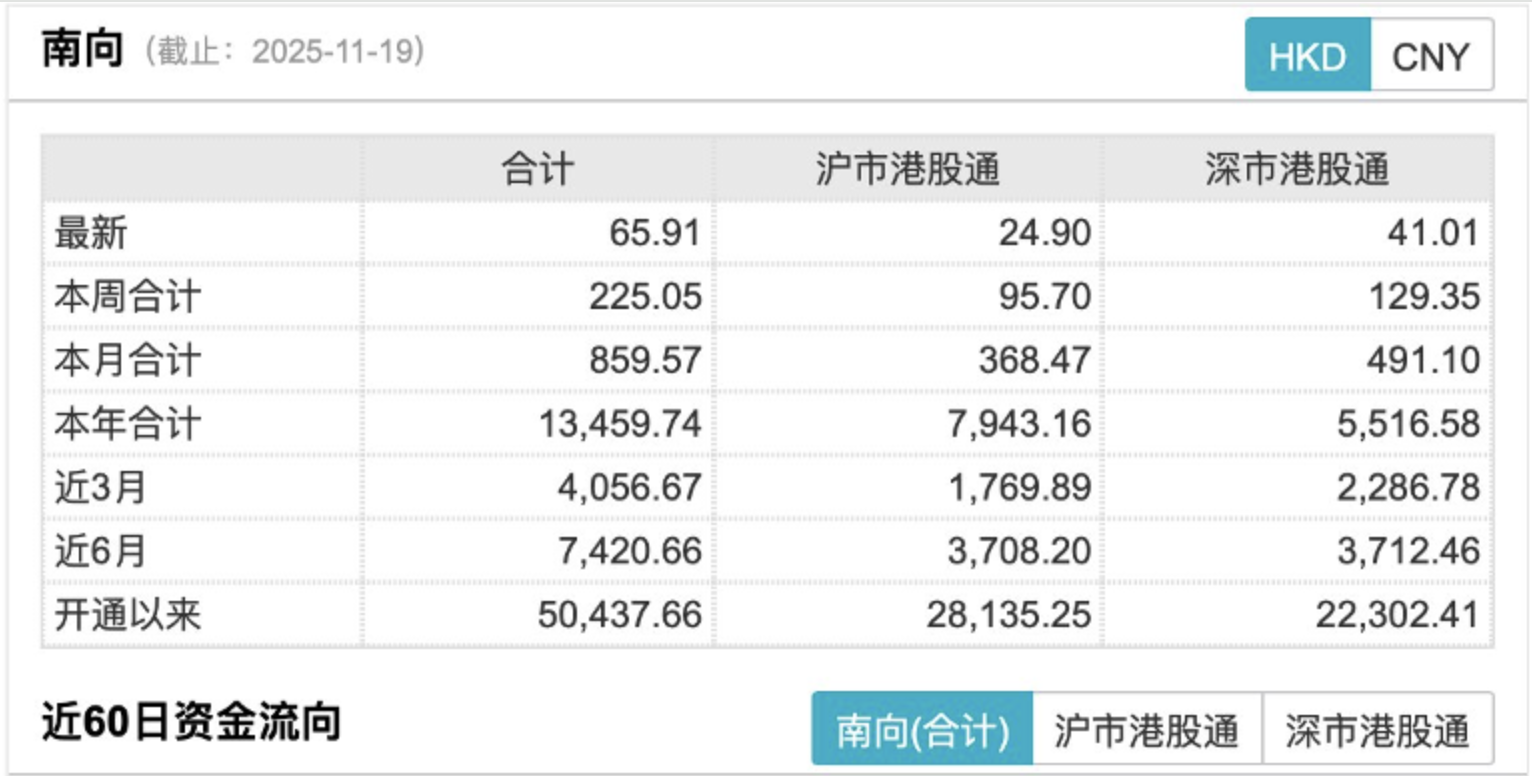
Core Viewpoint - The article highlights the significant inflow of southbound capital into the Hong Kong stock market, driven by the increasing presence of high-quality Chinese companies and the attractiveness of valuations, which is expected to support a long-term "slow bull" market trend in Hong Kong stocks [3][10][16]. Group 1: Southbound Capital Inflow - As of November 10, southbound capital's cumulative net purchase of Hong Kong stocks exceeded 5 trillion HKD, continuing to grow [3]. - By November 19, southbound capital net inflow through the Stock Connect reached 65.91 million HKD, bringing the total net purchase for the year to over 1.34 trillion HKD, a 66% increase compared to the total inflow of 807.8 billion HKD in 2024 [5][6]. - The proportion of southbound capital in the total trading volume of the Hong Kong market has steadily increased from 15.6% at the beginning of 2024 to 23.6% in the third quarter of 2025 [6]. Group 2: Investment Trends and Sector Focus - The composition of southbound capital has shifted significantly, with technology and dividend-paying stocks becoming the primary focus, moving away from the banking sector, which previously dominated [7][8]. - The top ten holdings of southbound capital are now split between technology and high-dividend stocks, with Tencent Holdings and Alibaba being major players [8]. - Insurance funds and public funds are the main contributors to southbound capital, with insurance holdings surpassing 1 trillion RMB by the end of the third quarter [9]. Group 3: Future Growth Potential - Analysts predict that the southbound capital inflow could increase by 1.4 trillion RMB (approximately 1.54 trillion HKD) by the end of next year, with a potential growth of 10 trillion RMB (about 11 trillion HKD) over the next five years [11][13]. - The continuous inflow of long-term capital is expected to enhance market liquidity and optimize the capital market structure, supporting a sustainable "slow bull" market [13][14]. Group 4: Quality of Listed Companies - The article notes that more high-quality Chinese companies are choosing to list in Hong Kong, which enhances the market's attractiveness to both domestic and foreign investors [15][17]. - As of November 19, 2025, 88 companies have gone public in Hong Kong, raising a total of 250.5 billion HKD, a 172.44% increase from the previous year [17]. - The increasing number of globally competitive companies listed in Hong Kong is expected to attract more capital inflow, creating a positive feedback loop [18].



5万亿后可能还有10万亿,南向资金点燃港股慢牛引擎
Di Yi Cai Jing· 2025-11-19 13:15
Core Insights - The Hong Kong stock market is becoming a crucial platform for global investors to share in the growth dividends of China's core assets, with significant inflows of southbound capital [1][12] - As of November 10, southbound capital's cumulative net purchases of Hong Kong stocks exceeded 5 trillion HKD, continuing to grow [1] - The influx of long-term mainland funds, primarily from insurance and public offerings, is expected to support a "slow bull" market in Hong Kong [1][8] Southbound Capital Inflows - As of November 19, southbound capital net inflows through the Stock Connect reached 65.91 million HKD, bringing the total for the year to over 1.34 trillion HKD, a 66% increase compared to the total inflow of 807.8 billion HKD in 2024 [2] - Cumulative net inflows since the launch of the Stock Connect have surpassed 5 trillion HKD [2][3] Market Dynamics - Southbound capital has become a core driver of liquidity in the Hong Kong stock market, with its share of total market turnover rising from 15.6% at the beginning of 2024 to 23.6% by the third quarter of 2025 [3] - The total market value of southbound capital holdings exceeded 6.3 trillion HKD by the end of the third quarter, representing a year-on-year increase of over 90% [3] Sector and Stock Preferences - The allocation of southbound capital has shifted significantly, with the banking sector previously dominating but now more evenly distributed across industries, including media, pharmaceuticals, and technology [3][4] - The top ten holdings of southbound capital are now characterized by a "technology + dividend" strategy, with Tencent Holdings and Alibaba being major beneficiaries [4] Fund Composition - Insurance funds and public funds constitute the majority of southbound capital, with insurance holdings surpassing 1 trillion RMB (approximately 1.4 trillion HKD) by the end of the third quarter [7] - Public fund holdings reached 1.01 trillion RMB, accounting for about 18% of total southbound capital [7] Future Projections - Predictions indicate that southbound capital could see an additional inflow of 1.4 trillion RMB (approximately 1.54 trillion HKD) by the end of next year, with a potential total increase of 10 trillion RMB (approximately 11 trillion HKD) over the next five years [8] - The continuous inflow of long-term capital is expected to enhance market fundamentals and support a "slow bull" market [8][9] Market Valuation and Asset Supply - The Hong Kong stock market is viewed as having significant allocation value, with lower valuation levels compared to other major global markets [11] - The influx of quality companies listing in Hong Kong is creating a virtuous cycle, enhancing market liquidity and attracting more capital [12][13] Historical Context - Historical analysis indicates that periods of outperformance in the Hong Kong stock market have been driven by the scarcity of assets, with current trends reflecting similar dynamics as seen in previous advantageous periods [14]


交银国际:港股“慢牛”行情有望持续演绎 延续“高弹性”+“高股息”哑铃型策略
Zhi Tong Cai Jing· 2025-10-07 11:24
Group 1 - The Hong Kong stock market continued its upward trend in September, driven by the resumption of US-China trade negotiations and expectations of overseas interest rate cuts, along with a rotation in the technology sector [1][2] - The external environment is showing marginal improvement, with increased market risk appetite supported by ongoing US-China trade talks and stable macro policies in mainland China [2][3] Group 2 - Liquidity pressure in Hong Kong has eased with the resumption of overseas interest rate cuts, leading to accelerated inflows of southbound capital, with a net inflow exceeding 1.1 trillion HKD this year, setting a new historical high [3] - The market is expected to enter a "quiet season" due to the National Day and Mid-Autumn Festival holidays, alongside uncertainties related to the US government's short-term financing plan, which may amplify overseas disturbances [4] Group 3 - The investment strategy continues to focus on a "high elasticity" and "high dividend" approach, with adjustments based on policy catalysts [5] - In the technology growth sector, the valuation recovery logic for tech stocks is further strengthened under the interest rate cut environment, with strong demand from southbound capital for high-growth sectors like AI [5] - The biopharmaceutical sector is expected to see valuation recovery, with Chinese innovative drug companies accelerating their global expansion [5] - High dividend yielding sectors such as banks, insurance, and utilities are highlighted as stable components in investment portfolios, providing consistent dividend income amid market volatility [5]
居民储蓄入市、外资加仓,A 股港股行情火了!慢牛到底能撑多久?
Sou Hu Cai Jing· 2025-09-15 13:50
Core Viewpoint - The current market conditions in A-shares and Hong Kong stocks are characterized by increased participation from retail investors and foreign capital, with concerns about the sustainability of this "slow bull" market compared to past experiences like in 2015 [1] Group 1: Market Dynamics - Retail savings are gradually entering the market through funds, and foreign capital is flowing into A-shares and Hong Kong stocks, driven by the expectation of interest rate cuts by the Federal Reserve [1][8] - The Hong Kong stock market has surpassed 26,000 points, while A-shares are experiencing upward movement despite some volatility [1] - The current market is different from 2015 due to stricter regulations on margin trading, with the margin financing balance being significantly lower than in 2015 [3][4] Group 2: Investor Behavior - Investors have learned from past mistakes and are less likely to use excessive leverage, which reduces overall risk in the market [4] - The inflow of retail savings is gradual, akin to watering a plant slowly to avoid root rot, suggesting a more sustainable market growth compared to previous surges [4][6] Group 3: Fundraising and Investment Opportunities - Fundraising limits for most funds are between 1 billion to 5 billion yuan, indicating that the influx of retail savings is still in its early stages [6] - A-shares and Hong Kong stocks are currently undervalued, with many quality stocks offering dividend yields higher than bonds, presenting attractive investment opportunities [8] Group 4: Foreign Capital Inflow - Since the second half of last year, foreign capital has consistently flowed into Hong Kong stocks, with over 10 billion USD entering A-shares in the first half of this year, indicating a sustained interest rather than a fleeting trend [10] - The attractiveness of A-shares and Hong Kong stocks is enhanced by their relative undervaluation compared to the high valuations in the US market [10] Group 5: Economic Context and Investment Strategy - The anticipated interest rate cuts by the Federal Reserve may lead to lower borrowing costs, encouraging both corporate investment and individual investors to seek higher returns in the stock market [11] - A diversified investment strategy, including a 20% allocation to gold, is recommended to mitigate risks associated with market volatility while maintaining exposure to potential growth in equities [11][13]
