
工伤认定

Search documents
工伤中的“三工”要素,你了解吗?
蓝色柳林财税室· 2026-01-22 07:55
Core Viewpoint - The article discusses the regulations and considerations regarding work-related injury insurance, emphasizing the definitions of "working time," "working place," and "work-related reasons" as per the Work Injury Insurance Regulations [2][4][5]. Working Time - The recognition of "working time" includes legally mandated hours, contractual hours, employer-specified hours, time spent on temporary assignments, and overtime [4]. Working Place - The definition of "working place" pertains to areas related to the employee's job responsibilities and reasonable areas necessary for fulfilling those responsibilities [5]. Work-Related Reasons - "Work-related reasons" are defined by the causal relationship between the employee's job duties and the injuries sustained, including injuries from regular job activities or tasks assigned by the employer [5]. Commuting Considerations - Commuting to and from work is considered work-related if it occurs within a reasonable time and route, including travel between the workplace and home or other relevant locations [7][10]. Injury During Work Hours - Injuries sustained during reasonable breaks for basic physiological needs within the workplace are covered, excluding injuries caused solely by personal reasons [8]. Non-Responsibility in Accidents - The determination of "non-primary responsibility" in traffic accidents requires legal documentation from traffic management or court decisions; if not provided, the injury may not be recognized as work-related [12]. Home Office Injury Recognition - Injuries occurring while working from home, if proven to be work-related, should not be affected by the home working arrangement; however, casual communication via modern tools does not qualify as work-related [14][15]. Application for Injury Recognition - Employers must apply for work injury recognition within 30 days of the incident; if they fail to do so, employees or their relatives can apply within one year [17].


女子上班先送娃路上被撞,因送娃与上班路线为反方向,人社局称不算工伤,法院:送娃上学是生活必需,需重新认定
Xin Lang Cai Jing· 2026-01-18 07:07
Core Viewpoint - The case revolves around the determination of whether an injury sustained by an employee while taking their child to school can be classified as a work-related injury under the Workers' Compensation Insurance Regulations, despite the route being in the opposite direction of the employee's workplace [1][2]. Group 1: Incident Details - On October 8, 2024, an employee named Chen was involved in a traffic accident while riding an electric bicycle to drop off their child at school, resulting in serious injuries [1]. - The accident was determined to be the fault of another driver, Yang, who was found to be fully responsible for the incident [1]. Group 2: Initial Decision and Legal Proceedings - On November 29, 2024, the local human resources bureau denied Chen's application for work injury recognition, stating that the route taken was not aligned with the employee's commute to work [1]. - Chen contested this decision in court, leading to a first-instance ruling that overturned the bureau's decision and mandated a reevaluation [2]. Group 3: Court's Reasoning - The court emphasized three key factors for determining the legitimacy of a route taken during a commute: the purpose of the trip (to work), the reasonableness of the time taken, and the rationality of the route [2]. - The court concluded that Chen's actions of dropping off their child were necessary for daily life and did not deviate from the primary purpose of commuting to work, thus supporting the claim for work injury recognition [2][3]. Group 4: Final Ruling - The second-instance ruling upheld the original decision, confirming that the injury should be recognized as a work-related injury based on the criteria established in the Workers' Compensation Insurance Regulations [3].
女子上班先送娃被撞认定为工伤
Xin Lang Cai Jing· 2026-01-15 14:19
Core Viewpoint - The case highlights the legal recognition of commuting routes that include personal responsibilities, such as dropping off children, as part of work-related activities, leading to a ruling in favor of the employee's claim for work-related injury compensation [1] Group 1: Incident Details - The incident occurred on October 8, 2024, at approximately 6:38 AM, when an employee, Chen, was injured while riding an electric bike to drop off her child at school [1] - The accident involved a collision with another individual, Yang, who was deemed fully responsible by the traffic police [1] Group 2: Legal Proceedings - Chen applied for work injury recognition on October 29, 2024, but her request was initially denied by the local human resources department, citing that the route taken was not aligned with her work route [1] - Following the denial, Chen appealed to the court, which ruled in her favor, stating that dropping off her child was a reasonable part of her commuting route [1] - The company contested the ruling, arguing that the route taken was not direct and posed additional risks, but the higher court upheld the initial ruling, confirming Chen's status as a work-related injury [1]
员工上班期间外出身亡被认定“擅自离岗”?检察官发现疑点
Xin Lang Cai Jing· 2026-01-03 13:06
Core Viewpoint - The case highlights the complexities of work-related injury recognition, particularly in situations where the circumstances of the incident are ambiguous and the employer's responsibilities in providing evidence are critical [1][7]. Group 1: Incident Overview - The incident involved a 58-year-old employee, referred to as Lao Sun, who died in a traffic accident just 30 meters from his workplace after taking leave [2][3]. - The accident occurred on August 20, 2020, when Lao Sun was struck by a speeding car shortly after leaving his post [2]. Group 2: Initial Responses and Legal Proceedings - Following the incident, Lao Sun's family applied for work injury recognition, but the employer claimed he had left his post without permission, leading to a denial of the claim by the human resources department [3][4]. - The initial court rulings supported the human resources department's decision, stating that the family could not prove the accident occurred on Lao Sun's way home [3][4]. Group 3: Investigative Actions - The East Guangdong Procuratorate intervened, identifying several inconsistencies in the evidence provided by the employer, including the absence of crucial surveillance footage from the incident [5][6]. - The investigation revealed that Lao Sun's actions of leaving for lunch or returning home fell within a "reasonable route" for a work-related journey, as per the regulations [4][5]. Group 4: Legal Reassessment and Outcome - In May 2023, the East Guangdong Procuratorate recommended a retrial, leading to a reassessment of the case by the court, which ultimately ruled in favor of recognizing the incident as a work-related injury [7]. - The human resources department subsequently acknowledged the work injury and initiated compensation procedures, resulting in a total compensation of 1.03 million yuan being awarded to Lao Sun's family [8]. Group 5: Community and Legal Impact - The case underscores the importance of thorough evidence collection and the responsibilities of employers in work injury claims, as well as the role of legal institutions in ensuring justice for affected families [9][10]. - The positive outcome and the family's gratitude reflect the effectiveness of the legal system in addressing work-related injury claims and the commitment of legal professionals to uphold justice [10][11].
一波三折的工伤认定
Xin Lang Cai Jing· 2026-01-02 17:26
员工上班期间请假外出,在离工作地点30米处不幸遭遇车祸身亡。用人单位认为这是"擅自离岗";人社 部门以无法证实事故地点属于员工"回家途中"为由不予认定工伤;法院一审、二审判决均支持上述观 点…… 处理完父亲后事,老孙的女儿孙女士向人社部门申请工伤认定。 工伤认定调查中,保安公司表示:"事故当天虽安排其他同事顶替老孙值班,但该同事还没到岗老孙就 提前离岗,违反了公司相关规定。" 人社部门则依据案发时一同在岗的其余两名保安证言,认定老孙系"擅自离岗",作出不予认定工伤的决 定,理由是顶班同事到岗时,老孙已离开岗位,且家属未能证明事故地点属于老孙"回家途中"。 孙女士向法院提起诉讼。一审、二审法院判决均支持人社部门不予认定工伤的决定。接连败诉后,孙女 士带着最后一丝希望,向检察机关申请监督。 "老孙与同事的交接班记录在哪里?""事发前后岗亭附近是否有监控录像?""事故发生地点是否在老孙 合理的下班路线上?"……东莞市检察院承办检察官黄秀莉与同事反复查阅卷宗后,敏锐捕捉到多处疑 点。 这是一起历时4年的工伤认定纠纷案,经广东省东莞市检察院依法监督,提出再审检察建议,最终法院 予以改判,人社部门重新作出工伤认定,因工伤 ...
哪些情况属于工伤认定中的“因工作原因”?人社部解答
Zhong Guo Xin Wen Wang· 2025-12-31 01:30
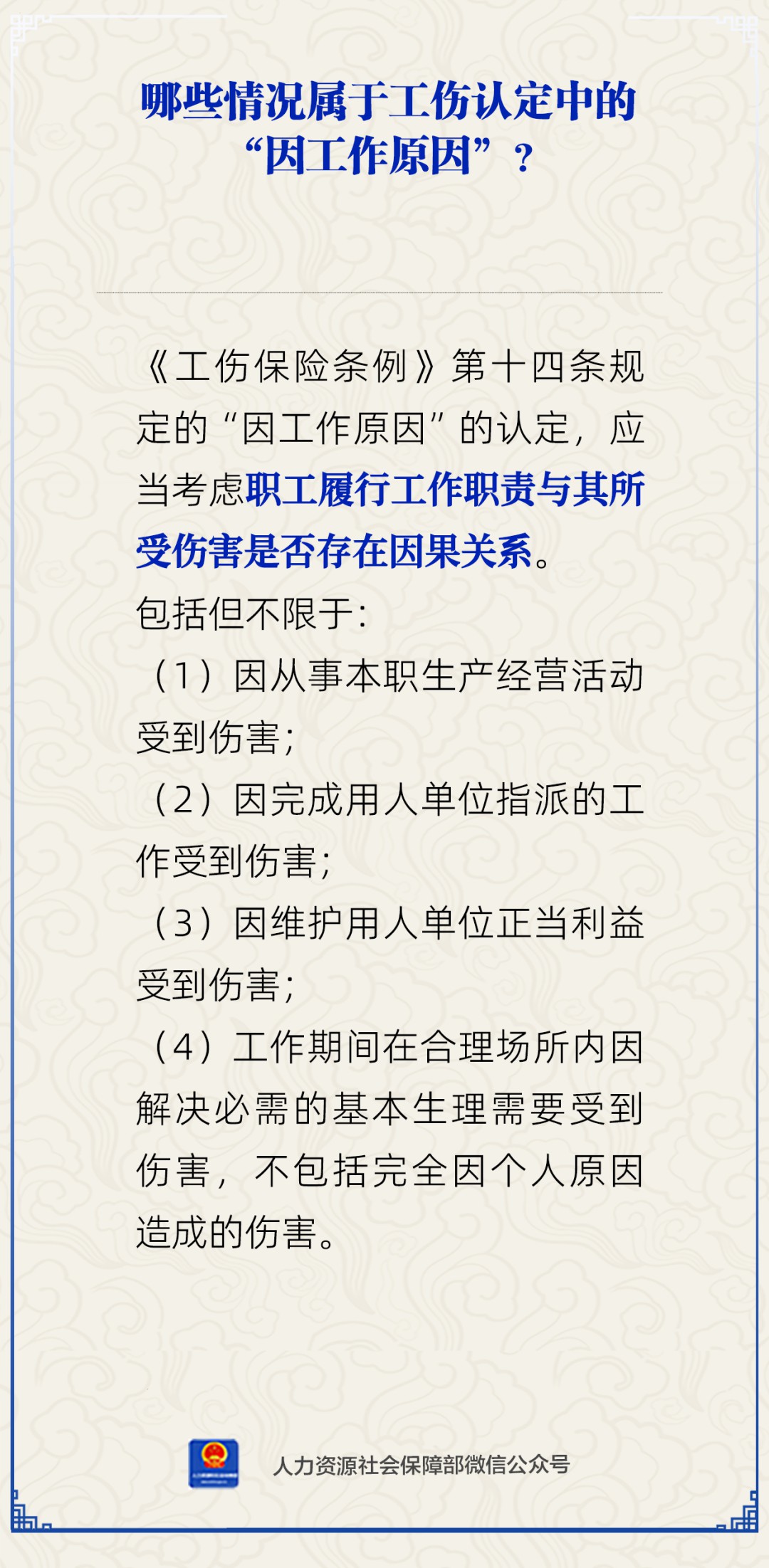
《工伤保险条例》第十四条规定的"因工作原因"的认定,应当考虑职工履行工作职责与其所受伤害是否存在因果关系。包括但不限于: (1)因从事本职生产经营活动受到伤害; (2)因完成用人单位指派的工作受到伤害; (3)因维护用人单位正当利益受到伤害; (4)工作期间在合理场所内因解决必需的基本生理需要受到伤害,不包括完全因个人原因造成的伤害。 中新网12月31日电 哪些情况属于工伤认定中的"因工作原因"?人社部12月31日通过官方微信公众号作出解答。 [ 责编:丁玉冰 ] 图片来源:人力资源和社会保障部微信公众号 ...
违法分包转包和个人挂靠情形能否申请工伤认定?人社部解答
Zhong Guo Xin Wen Wang· 2025-12-24 02:09
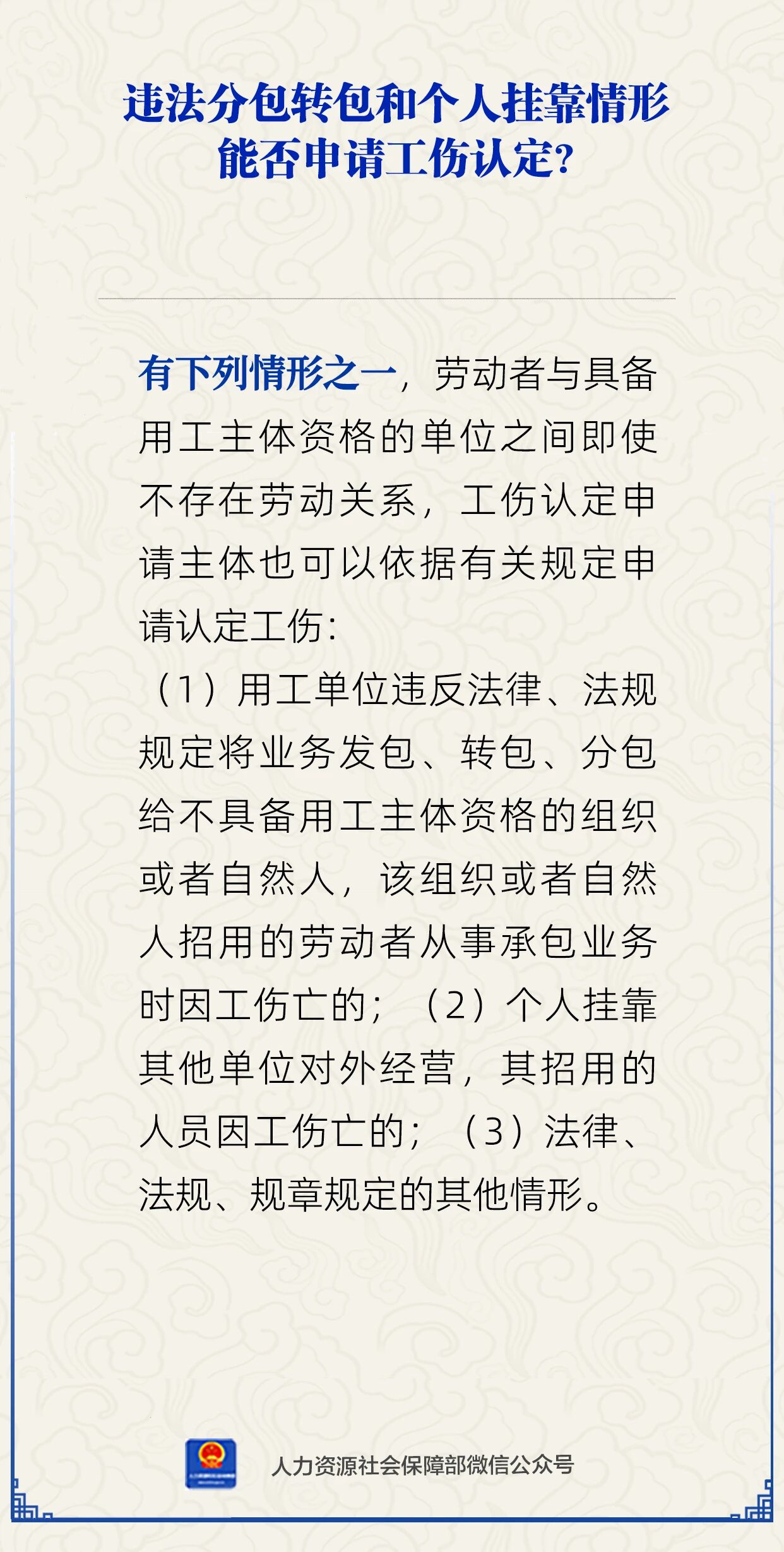
违法分包转包和个人挂靠情形能否申请工伤认定?人社部解答 图片来源:人力资源和社会保障部微信公众号 来源:中国新闻网 中新网12月24日电 违法分包转包和个人挂靠情形能否申请工伤认定?人社部12月24日通过官方微信公众号作出解答。 有下列情形之一,劳动者与具备用工主体资格的单位之间即使不存在劳动关系,工伤认定申请主体也可以依据有关规定申请认定工伤: (1)用工单位违反法律、法规规定将业务发包、转包、分包给不具备用工主体资格的组织或者自然人,该组织或者自然人招用的劳动者从事承包业务时因工 伤亡的;(2)个人挂靠其他单位对外经营,其招用的人员因工伤亡的;(3)法律、法规、规章规定的其他情形。 编辑:陈俊明 广告等商务合作,请点击这里 本文为转载内容,授权事宜请联系原著作权人 中新经纬版权所有,未经书面授权,任何单位及个人不得转载、摘编或以其它方式使用。 关注中新经纬微信公众号(微信搜索"中新经纬"或"jwview"),看更多精彩财经资讯。 ...
前往公司团建集合途中发生事故受伤,能否认定为工伤?
Ren Min Wang· 2025-12-02 00:42
Core Viewpoint - The court ruled that the injury sustained by the employee, Xiao Zheng, while traveling to a company-organized team-building event, does not qualify as a work-related injury under the Workers' Compensation Insurance Regulations [1][4]. Group 1: Incident Details - Xiao Zheng, an employee of Company A, was injured in a traffic accident while riding to a company meeting point for a team-building event [1]. - The accident occurred at approximately 6:45 AM, and the police determined that Xiao Zheng was not at fault for the accident [1]. Group 2: Legal Framework - According to Article 14, Section 6 of the Workers' Compensation Insurance Regulations, injuries sustained during commutes are recognized as work-related if the employee is not primarily responsible for the accident [2]. - The Ministry of Human Resources and Social Security states that reasonable time and route for commuting are essential for determining work-related status [2]. Group 3: Nature of the Activity - The team-building event included leisure activities such as sightseeing and dining, which were not related to Xiao Zheng's job responsibilities as a warehouse worker [3]. - Participation in the team-building event was voluntary, and attendance did not affect salary payments, indicating that the event was not work-related [3]. Group 4: Court's Conclusion - The court found that the decision made by the human resources department to deny the work injury claim was based on clear facts and correct legal application [4]. - Xiao Zheng's argument that the injury occurred while on the way to a work-related event was not supported by sufficient evidence, leading to the dismissal of his claims [4][6]. Group 5: Final Ruling - The court ultimately rejected all of Xiao Zheng's claims, and both parties did not appeal the ruling, making it final [5].
细化工伤认定为劳动者托底
Xin Hua She· 2025-12-01 09:16
Group 1 - The Ministry of Human Resources and Social Security has issued guidelines to clarify the criteria for work-related injury recognition, focusing on "working time, working location, and work-related causes" as well as "commuting" scenarios [1] - The new guidelines address the evolving nature of work in the digital age, including remote work and mobile operations, by incorporating "home office" into the scope of work-related injury recognition [1] - The guidelines emphasize a balance between principles and flexibility, allowing for reasonable commuting routes and times, which helps avoid rigid enforcement while maintaining the original intent of the work injury protection system [1] Group 2 - The clear and precise rule design aims to reduce disputes over work-related injuries by limiting the ability of employers to shift responsibility, thereby encouraging compliance and improving internal management systems [1] - The evolution of these rules reflects a people-centered value orientation, contributing to the modernization of national governance and enhancing the social security network for workers [2]
工伤认定新规明确“模糊地带”判断依据——为参保职工筑牢权益保障网
Jing Ji Ri Bao· 2025-11-24 02:46
Core Viewpoint - The Ministry of Human Resources and Social Security has issued "Opinions (III)" to clarify the ambiguous areas in the recognition of work-related injuries, adapting to changes in employment practices in the digital age and strengthening the protection of insured individuals' rights [1][4]. Group 1: Work Injury Insurance Context - Work injury insurance is one of the earliest established social insurance systems globally, with China implementing its Work Injury Insurance Regulations in 2004. Currently, there are 304 million insured individuals, with over 2 million workers receiving protection annually [1][2]. - Among the insured, over 90 million are migrant workers, a key demographic for preventing work-related injuries and occupational diseases [2]. Group 2: Clarifications on Work Injury Recognition - The new regulations clarify that injuries sustained while working from home, if proven to be work-related and required by the employer, will be recognized as work injuries. However, casual communication through modern means does not qualify [2][3]. - The definition of "commuting" has been refined, allowing for injuries sustained during reasonable travel between home and work to be recognized as work injuries, including specific scenarios such as traveling to a spouse's or child's residence [3][4]. Group 3: Implications for Employers and Employees - The new rules emphasize the need for employers to enhance compliance awareness and manage subcontracting and remote work practices to reduce disputes over work injuries [4]. - Employees are encouraged to maintain records of overtime and work communications to support their claims for work injury recognition [4].