投机泡沫

Search documents
新年伊始,金属市场“暴涨先锋”:锡
财联社· 2026-01-19 07:14
Core Viewpoint - The tin market has experienced explosive growth at the beginning of the year, with prices reaching historical highs, driven by speculative investments despite warnings from industry associations about the unsustainable nature of this surge [1][2][10]. Group 1: Market Performance - Tin prices on the London Metal Exchange (LME) have surged by an astonishing 21% since the beginning of the year, significantly outperforming other metals like nickel and copper [1]. - The trading volume of tin contracts on the Shanghai Futures Exchange exceeded 1 million tons, more than double the global annual physical consumption [2]. Group 2: Supply and Demand Dynamics - Despite the perception of a supply shortage, recent developments indicate an improvement in the supply situation, with key mines in the Democratic Republic of Congo and Myanmar showing signs of increased production [6][8]. - Global refined tin supply is not lacking, as producers and traders have delivered substantial amounts of metal, with combined LME and Shanghai Futures Exchange inventories rising from 11,000 tons to over 19,000 tons [9]. Group 3: Speculative Behavior - The current tin price surge is characterized by speculative behavior, with significant liquidity mismatches in the market, leading to increased volatility [4][11]. - Investment funds have significantly increased their long positions in the tin market, with record levels of 5,753 contracts, equating to 28,765 tons, contributing to the price instability [11]. Group 4: Impact on the Industry - The irrational rise in tin prices has disrupted supply chains, causing challenges for upstream and downstream companies, particularly in sectors like soldering and chemicals, where rising costs have led to operational difficulties [13]. - The influx of funds into the tin market serves as a warning for other metals like copper, indicating potential risks associated with speculative bubbles in industrial metals [14].


金银疯涨,扩大了人性的贪婪!
Sou Hu Cai Jing· 2026-01-15 01:39
人为什么活得这么累? 不是你不够努力,也不是你情绪管理不好,而是作为人而活"这件事,本身就很重。 人一出生,就被扔进一个早已运转的世界。时代、规则、评价体系、成功标准,全都不是你定的。 但你必须参与、必须承担、必须负责。 你没有选择这场游戏,却要为输赢买单。 人还是唯一知道自己会死的生物。 这意味着你无法只活在当下:回看过去反复咀嚼遗憾,承担现在不断比较与焦虑,透支未来提前消耗。 恐惧身体可以休息,但意识几乎从不关机。真正让人疲惫的,是停不下来的头脑。 更残酷的是,现代社会不再允许"只是活着"。 你必须证明:你有价值,你没被淘汰,你配得上尊重。 于是,生活变成了一场长期绩效考核。 你不是在生活,而是在持续交付一个"还算成功的人生版本"。 我们还被告知:你是自由的。但自由的另一面,是没有借口。选错了,只能怪自己,失败了,没人替你负责,尤其金融交易者,面对市场波动必须做过选 择,必须为选择"付费"。 最根本的矛盾在这里:生命是有限的,但社会、他人、甚至你自己,对意义的要求是无限的,尤其当意义被赋予金钱的标题价之后,你被要求有结果,有 价值 ,有留下些什么。而世界,对这些期待保持沉默。 所以,人为什么活得累?因为你 ...
一夜狂泻!金银高台跳水,发生了什么?
Sou Hu Cai Jing· 2025-12-30 03:05
Core Viewpoint - The recent sharp decline in precious metal prices, including gold and silver, has caused significant panic among investors, driven by increased margin requirements and market speculation [1][4][5]. Price Decline Analysis - The primary trigger for the price drop was the CME Group's decision to raise margin requirements for gold and silver contracts, significantly increasing trading costs for investors [4]. - Prior to the decline, precious metals had experienced substantial price increases, with silver rising by 173% and gold by over 71% since 2025, creating a speculative bubble that was unsustainable [5]. - Market rumors regarding a major bank's potential default due to silver futures positions further exacerbated investor panic, leading to increased selling pressure [6]. Impact on Market Participants - Investors faced severe asset losses, particularly those who bought at high prices, with many accounts experiencing significant reductions in value [8]. - The decline in precious metal prices triggered a domino effect in financial markets, leading to sharp declines in mining company stocks and related ETFs, as well as broader impacts on major stock indices like the S&P 500 and Nasdaq [9]. - The volatility in precious metal prices has raised concerns about macroeconomic expectations, with fears of inflation control and potential deflation affecting market confidence [10]. Future Outlook and Investment Recommendations - Experts suggest that precious metal prices may experience further fluctuations, with potential for excess returns in 2026 due to factors such as a weakening dollar and increased demand for industrial silver [11]. - However, there are warnings about the current overbought conditions in silver, which may lead to a rapid correction or prolonged consolidation [11]. - Investors are advised to maintain a diversified asset allocation strategy and to stay informed about macroeconomic indicators and central bank policies that could influence precious metal prices [12].
美股散户惨遭半年最大单日亏损!恐慌为何突然蔓延?
Jin Shi Shu Ju· 2025-11-05 02:55
Core Viewpoint - The recent sell-off in the U.S. stock market, particularly affecting retail investors, is attributed to disappointing earnings from Palantir and concerns over high valuations in the AI sector, exacerbated by a notable decline in Bitcoin prices [2][3][5]. Group 1: Market Performance - The Retail Favorites Index, which tracks stocks heavily held by retail investors, experienced its largest drop since April, falling by 3.6%, significantly more than the S&P 500's decline [2]. - Despite a significant drop in stock prices on Tuesday, retail traders purchased $560 million worth of stocks and ETFs, briefly helping the market recover before it fell again [3]. - Palantir's stock, despite exceeding sales expectations and raising its annual outlook, dropped by 7.9% due to concerns over its high valuation and the sustainability of the AI boom [3][4]. Group 2: Influencing Factors - The sell-off was intensified by a well-known hedge fund manager's disclosure of short positions in Palantir and Nvidia, which raised alarms among investors [4]. - The decline in Bitcoin, which fell below $100,000 for the first time since June, negatively impacted related stocks and added pressure on retail investors [5]. - Market analysts suggest that while corporate earnings have been strong, the high expectations for tech companies could lead to disproportionate negative impacts if performance falls short [4].
黄金又崩了,有人上周刚买10克就亏了,业内人士:还要继续调整
Sou Hu Cai Jing· 2025-10-28 03:08
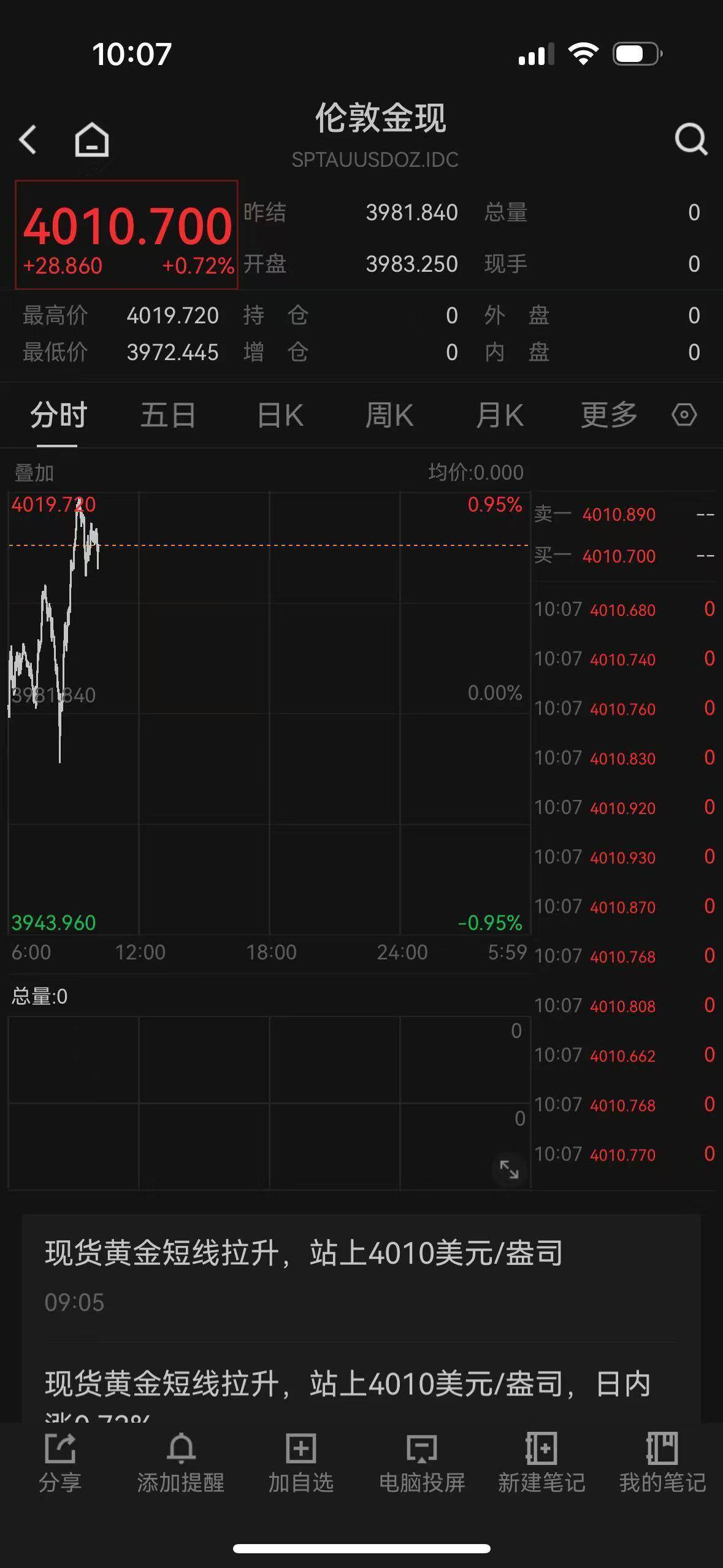
Core Viewpoint - The recent fluctuations in gold and silver prices have raised concerns among investors, particularly following a significant drop after a period of rapid price increases. Price Movements - On October 27, spot gold fell by 3.15%, dropping below $4000 per ounce to close at $3981.84, while spot silver decreased by 3.4% to $46.968 per ounce [1] - As of October 28, spot gold rebounded by 0.7%, surpassing $4010 per ounce, and spot silver increased by 0.5%, temporarily recovering the $47 per ounce mark [4] Market Analysis - Year-to-date, spot gold has risen over 53% due to factors such as geopolitical risks, expectations of loose monetary policy, and central bank purchases. However, after reaching a historical high above $4380 per ounce on October 20, the market has entered a correction phase due to overbought signals and a recovery in market risk appetite [8] - John Reade, a strategist from the World Gold Council, noted that the demand from central banks is not as strong as before, and a deeper correction could be welcomed by professional traders. He suggested that a price level of $3500 per ounce would be healthy for the gold market [8] - Paul Fisher, the outgoing chairman of the London Bullion Market Association, stated that the recent adjustments are a result of "squeezing speculative bubbles," indicating that the rapid price increases were unsustainable [8] - Analysts predict that spot gold may test the $3800 to $3850 per ounce range, while the support level for spot silver is expected around $46 per ounce [8] Investor Sentiment - A senior manager from a state-owned bank expressed that after spot gold fell below $4000 per ounce, the focus should shift to the $3800 level, suggesting that a period of consolidation between $3500 and $3800 would be beneficial for long-term price stability [9]
Are There Any Crypto Treasury Companies Worth Buying Right Now?
The Motley Fool· 2025-10-25 10:20
Core Insights - The investment case for companies solely focused on crypto treasury is becoming increasingly difficult to justify as they are viewed as high-risk and speculative bets on cryptocurrency [1] - Prominent crypto companies are debating the viability of the crypto treasury business model, leading to increased scrutiny from short-sellers [1] Group 1: Types of Crypto Treasury Companies - "Pure-play" crypto treasury companies are those specifically created to invest in cryptocurrencies like Bitcoin, with Strategy (formerly MicroStrategy) being a leading example [2] - Some companies have transitioned from other industries to focus on crypto, such as SharpLink Gaming, which shifted from affiliate marketing to becoming a top Ethereum treasury company [3] - Companies like Trump Media & Technology Group have also entered the crypto space, holding significant Bitcoin assets, indicating a trend of traditional businesses pivoting to crypto [5] Group 2: Valuation and Market Trends - Many crypto treasury companies are trading at or below the value of their crypto holdings, raising concerns about their market valuations [7] - Strategy, for instance, holds $71 billion in Bitcoin but is valued at $86 billion, trading at a multiple of 1.2 times its core Bitcoin holdings [8] - A significant portion of Bitcoin treasury companies, approximately 25%, now trade below their net asset value (NAV), making it challenging to identify viable investment opportunities [9] Group 3: Risks and Investment Strategies - The crypto market's volatility, exemplified by recent flash crashes, underscores the risks associated with investing in crypto treasury companies [10] - Many of these companies are financing their crypto purchases through external capital, often involving debt, which could lead to a speculative bubble [11] - The focus for prudent investors should be on best-in-class companies that prioritize Bitcoin purchases with minimal leverage, or alternatively, consider investing in a Bitcoin exchange-traded fund (ETF) for exposure [12]


AI 并非存在一个泡沫,而是三个
3 6 Ke· 2025-10-19 00:03
Core Viewpoint - The article discusses the existence of multiple bubbles in the AI sector, highlighting the potential risks and opportunities for companies involved in AI investments and implementations [3][4][5]. Group 1: Types of Bubbles - The first bubble identified is an asset or speculative bubble, where AI-related companies like Nvidia and Tesla have inflated valuations, with Nvidia's P/E ratio at 50 and Tesla's at 200 despite revenue declines [3][4]. - The second bubble is an infrastructure bubble, characterized by massive investments in AI infrastructure without guaranteed future demand, reminiscent of historical overbuilding in the railroad and internet sectors [4]. - The third bubble is a hype bubble, where the promises of AI technology exceed its current capabilities, with a study indicating that 95% of AI pilot projects fail to deliver returns [4][7]. Group 2: Implications for Companies - Companies are advised not to panic in response to the bubble discussions, as the speculative and infrastructure bubbles may not directly impact most organizations [6]. - The hype bubble, however, presents a critical insight: the failure of many AI projects is often due to incorrect application rather than a lack of value in AI itself [7][8]. - Historical parallels are drawn to the internet bubble, where despite the collapse, companies that focused on building value through technology thrived [8]. Group 3: Value Creation Strategies - Successful companies should adopt a problem-oriented approach to identify friction points within their operations that AI can address [9]. - A balanced portfolio of AI initiatives should be developed, considering short-term and long-term investments, with a focus on integrating AI solutions across business functions [9][10]. - The key to thriving in the AI landscape is a systematic approach to value extraction, emphasizing clear objectives and immediate action [10]. Group 4: Opportunities Amidst the Bubble - The AI bubble may present unique opportunities for pragmatic practitioners, such as access to abundant venture capital and talent, as well as lower costs due to overcapacity in infrastructure [11]. - Companies can strategically leverage the bubble to acquire tools and technologies at reduced prices, while others bear the capital risks [11][12]. - The distraction caused by bubble discussions can provide a competitive advantage for companies that continue to focus on systematic AI implementation [12].







Can Gold Keep Rising? Depends If You Think This Time Is Different
WSJ· 2025-10-18 03:00
Core Viewpoint - Gold is currently experiencing speculative excess, which poses a risk of creating bubbles similar to those seen in other areas of the financial system [1] Group 1 - The speculative nature of gold investment is highlighted as a significant concern [1]

市场综述:美股股指期货缺乏方向黄金从历史高位回落
Xin Lang Cai Jing· 2025-10-07 09:49
Market Overview - European stock markets and US futures are lacking direction as investors await political developments on both sides of the Atlantic [1] - Gold prices retreated after approaching $4000 per ounce, following a historical high of $3977 [1] - The S&P 500 index futures slightly declined after reaching a record high on Monday, driven by a surge in technology stocks due to AI spending [1] - The Stoxx 600 index remained largely flat, while the French CAC40 index reversed early losses amid political turmoil in France [1] Political and Economic Factors - Concerns over a US government shutdown and a political crisis in France have led investors to seek alternative assets like gold and Bitcoin, both of which reached new highs [1] - The resignation of French Prime Minister Sebastien Lecornu has prompted President Emmanuel Macron to make last-ditch efforts to stabilize the government [1] Sector-Specific Developments - Truck manufacturers such as Volvo AB and Daimler Truck Holding AG saw stock price declines due to President Trump's announcement of a 25% tariff on medium and heavy trucks next month [1] - A series of AI-related transactions among chip manufacturers have driven stock prices up, raising concerns about a potential "speculative bubble" reminiscent of the late 1990s internet bubble [1] Investment Insights - Michael Brown, a senior research strategist at Pepperstone Group Ltd., believes concerns about a tech bubble are "overblown," citing that the valuations of the "Magnificent Seven" tech giants are in line with their five-year averages [1] - The overall market's "path of least resistance" appears to be upward, supported by strong corporate earnings growth, robust economic resilience, and an increasingly accommodative monetary policy environment [1] - Recent significant deals in the data center sector, including a major transaction by Advanced Micro Devices, highlight the ongoing demand for computing power driven by tools like ChatGPT [1]
美联储降息预期催生投机泡沫 高风险反弹席卷未盈利科技股
智通财经网· 2025-09-24 12:50
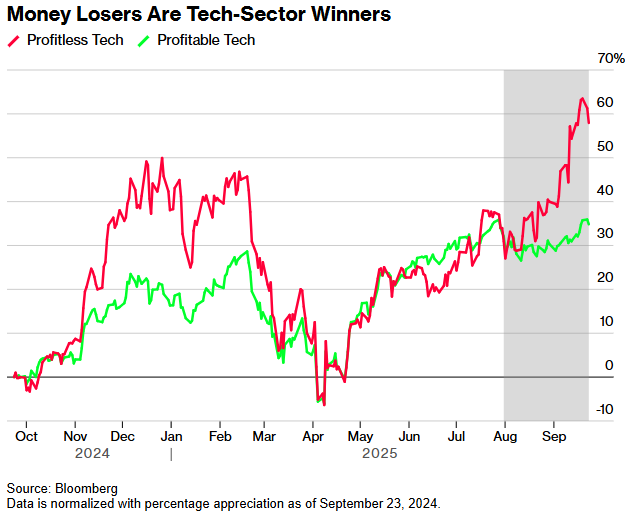
Group 1 - The core viewpoint of the articles highlights a significant rise in high-risk tech stocks due to market expectations of continued interest rate cuts by the Federal Reserve, raising concerns about potential rapid declines if these expectations change [1][4][8] - A basket of unprofitable tech stocks tracked by UBS has surged 21% since the end of July, while profitable tech stocks only increased by 2.1%, and the Nasdaq 100 index rose by 5.9% during the same period [1] - The recent rally in unprofitable tech stocks is characterized as a "junk rebound," driven by speculative excess and the revival of "animal spirits," with warnings about the high risks involved [4][8] Group 2 - Goldman Sachs reports that a similar unprofitable investment portfolio has nearly doubled since its low in April, reaching its highest level since February 2022, with notable stock price increases for companies like OpenDoor Technologies Inc. and IonQ Inc. [5] - Despite the recent rebound, the current performance of unprofitable tech stocks remains about 50% lower than their peak in 2021, indicating a significant decline from previous highs [5] - Some investors view the recent surge as justified, citing higher earnings transparency in the tech sector and favorable macroeconomic conditions, although they caution that unprofitable tech stocks are vulnerable to reversals in the event of a broader economic downturn [8]