
智慧养老

Search documents
群众工作札记丨为老有颐养绘就幸福底色
Zhong Yang Ji Wei Guo Jia Jian Wei Wang Zhan· 2026-02-09 23:59
寒冬时节,走进江苏省宿迁市宿豫区豫新街道顺河集社区日间照料中心,暖意扑面而来。"桌椅板凳都 是新的,能打牌、做理疗。""到了饭点还有热乎的饭菜,我们都爱来。"几位老人对服务升级连连称 赞。 针对查摆出的问题,区纪委监委先后查处养老用房违规占用、设备侵占挪用等案件5件7人,制发交办单 4份。督促投入财政资金500余万元,维修更换、追回复用设施设备139件,清退挤占养老用房12处,推 动撤并优化乡镇敬老院8所,新建区域性养老服务中心3所,以科学规划布局,提升服务质效。 整治过程中,我们还推动解决了一系列关联问题:针对部分养老助餐点运营资金困难问题,推动民政、 财政、属地共同研究制定扶持政策,筹措发放补贴150余万元;针对社会养老服务机构护理员岗位补贴 发放不规范问题,推动民政部门将资金直拨到人,补发补贴57人10.2万元。针对特困老人商业保险理赔 难问题,推动相关部门完善服务机制,优化理赔流程,帮助200余名老人领取理赔款24.7万元。针对独 生子女伤残、死亡家庭扶助不精准不到位问题,推动应纳尽纳、应退尽退,帮助11户家庭纳入扶助范 围。 坚持"查改治"一体推进。我们既聚力"当下改",又注重"长久立",推动智慧养 ...
适老化改造 科技感满满(在现场)
Ren Min Ri Bao· 2026-02-08 23:00
Core Insights - The article highlights the advancements in smart elderly care solutions in Jiangsu, particularly in Nanjing, showcasing how technology is enhancing the quality of life for senior citizens [1][2]. Group 1: Smart Elderly Care Solutions - The company Aipuleide Electronic Technology Co., Ltd. provided a comprehensive elderly-friendly home modification solution for a 90-year-old resident, Mr. Lian [2]. - Smart devices such as anti-slip flooring, a smart medication dispenser, and an adjustable nursing bed are being utilized to improve safety and health monitoring for elderly individuals [3][4]. Group 2: Government Support and Subsidies - Jiangsu province initiated a "Renewal" action for home modifications, offering subsidies for 68 categories of elderly care products, with a maximum subsidy of 15,000 yuan per household [4]. - Over 64,000 households in Jiangsu completed elderly-friendly home modifications last year, with the government disbursing over 50 million yuan in subsidies [4].
深圳龙岗区民政局与远洋椿萱茂签约 共建智慧养老示范项目
Zheng Quan Ri Bao· 2026-02-06 13:18
Core Insights - The cooperation agreement between Longgang District Civil Affairs Bureau and Chuanxuanmao, a subsidiary of Ocean Group, aims to establish a public-private partnership for an elderly care facility in Longgang District, Shenzhen, which will serve as a model for smart elderly care in Guangdong Province and nationwide [2][3] Group 1: Project Overview - The elderly care facility will be located at Xin Nan Road, Pinghu Street, covering a total area of approximately 26,000 square meters, with a planned capacity of 350 beds [2] - The project is backed by government investment and selected through public bidding, with Chuanxuanmao winning the bid due to its extensive operational experience in the Greater Bay Area [2] Group 2: Technological Innovations - The project will utilize the "Hongmeng Health Care Intelligent Base" to create a smart system that includes safety measures such as 4D imaging radar and millimeter-wave life sign monitoring, achieving a 98% accuracy rate for fall alerts and non-contact sleep monitoring [2] - Health management will be supported by the proprietary "WeCaring" platform, which synchronizes health data and incorporates rehabilitation and emotional support robots, along with a telemedicine system [2] Group 3: Service Offerings - Chuanxuanmao plans to introduce international advanced elderly care concepts, providing a comprehensive range of services including daily care, medical treatment, rehabilitation, and emotional support [3] - The facility will establish a dual-layer medical network that integrates basic medical services within the facility and external green channels, connecting with high-quality resources such as the South China Hospital affiliated with Shenzhen University [3] Group 4: Strategic Importance - This public-private partnership is a significant step in Shenzhen's initiative to create a benchmark for elderly care, promoting a model of "government-led + professional enterprise operation" [3] - The Longgang District elderly care facility is expected to become a "warm home" for the elderly and develop standardized experiences that can be replicated, contributing to the sustainable development of the elderly care industry in the Greater Bay Area and nationwide [3]

智慧养老、自动驾驶、跨境支付……互联网赋能千行百业激活“新”动能
Yang Shi Wang· 2026-02-06 04:03
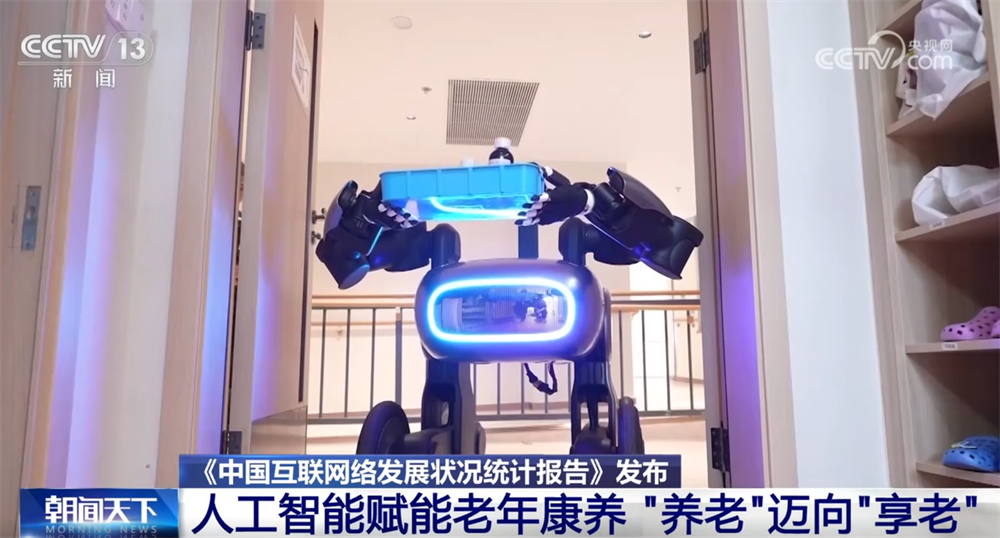
Group 1: Internet Development and User Growth - As of December 2025, China's internet user base is projected to reach 1.125 billion, with an internet penetration rate exceeding 80% [1] - The user base for generative artificial intelligence is expected to reach 602 million, representing a growth of 141.7% compared to the end of 2024 [1] Group 2: AI in Elderly Care - The report highlights that during the 14th Five-Year Plan period, the accelerated application of digital technologies, particularly AI, is enhancing public services in healthcare, elderly care, and education [2] - By December 2025, approximately 30.9 million internet users aged 60 and above are expected to have used AI, with a half-year increase of 9.44 million [2] Group 3: Smart Elderly Care Initiatives - In Hangzhou, a dedicated space for elderly services features various AI robots designed for social interaction, emotional companionship, and health management [5] - The implementation of smart elderly care initiatives is transitioning from concept to daily practice, with cities like Hangzhou and Shanghai enhancing services through smart technology [7] Group 4: Autonomous Driving Developments - The report indicates that 2025 will mark the commercial launch of high-level autonomous driving, with the first L3 conditional autonomous vehicles receiving approval for trial operations in designated areas [10] - L4 level autonomous buses are already in operation in Shenzhen, showcasing advancements in driverless technology [16] Group 5: Cross-Border Payment Innovations - By 2025, China's online payment transaction volume is expected to remain high, with breakthroughs in cross-border payment interoperability enhancing the consumer experience for foreign visitors [19] - The "Nihao China" app, launched by China UnionPay, will serve as a core hub for international card payments, supporting over 160 currencies and facilitating seamless transactions for millions of merchants [21]
省两会代表委员热议政府工作报告中的“南京元素” 不断增强人民群众的获得感幸福感安全感
Nan Jing Ri Bao· 2026-02-06 03:01
Group 1: Core Perspectives - The government work report reflects a people-centered development approach, focusing on enhancing public welfare through employment, education, healthcare, and elderly care [1] - The emphasis is on implementing effective policies to address the urgent needs of the populace, thereby increasing their sense of happiness and security [1] Group 2: Talent Development - The report advocates for a dual approach of "attracting and retaining" talent, aiming to build a skilled workforce that is application-oriented, composite, and innovative [2] - Initiatives include a plan for urban and rural residents' income growth, job stability, and vocational skills enhancement, particularly targeting key employment groups like college graduates and migrant workers [2] Group 3: Local Implementation - Nanjing has introduced a 2.0 version of its talent policy, establishing 10 national and provincial excellence engineering colleges and 7 talent joint task forces, with a focus on creating a talent aggregation area [3] - The city has successfully created over 2,000 units of affordable rental housing, benefiting 116,000 talents [3] Group 4: Education Equity and Quality - The report outlines plans to adjust the distribution of educational resources, promote free preschool education, and enhance the quality of basic education [5] - Nanjing has been selected as a national pilot for comprehensive education reform, with initiatives like a three-year action plan for integrated preschool education benefiting 76,000 children [7] Group 5: Healthcare Services - The report emphasizes the construction of high-level hospitals and the establishment of national medical centers, alongside strengthening community healthcare systems [9] - Nanjing is advancing health initiatives by forming tight-knit medical groups and has been recognized as a model for public hospital reform [10] Group 6: Elderly and Child Services - The report highlights the need for improved support policies for child-rearing and the development of a comprehensive elderly care service network [13] - Nanjing has initiated pilot programs for elderly care vouchers and has provided child-rearing subsidies to over 158,000 individuals [14]
【西安】试点开展智能应急处置呼叫系统平台建设
Shan Xi Ri Bao· 2026-02-06 00:19
"曾经,信息的滞后让黄金救援时间悄然流逝。如今好了,这套智能应急处置呼叫系统已覆盖西安 城六区的试点区域,听说未来还将逐步扩展至全市。这张网以'智能终端+云呼平台+三级联动'为核心: 老人佩戴的智能胸牌兼具定位、呼救、亲情通话功能,背面还能装公交卡;家中的红外感应监测仪能捕 捉'久居未出'的异常情况,卫生间的呼叫器支持拉绳、按键双重触发。"长安区韦曲街道长乐社区工作 人员小马说,"前几天,社区雷大爷在卫生间滑倒,第一时间拉绳报警,我们快速拨打120,老人第一时 间得到了紧急救治。这种'一人呼救、多方响应'的云呼机制,让曾经'遥不可及'的帮助,一下变得近在 咫尺。对老人而言,这些设备真的太方便了!" 如今在西安市,随着试点范围逐渐扩大,智能应急处置呼叫系统正深刻改变着每一个被守护的家 庭。对众多高龄独居老人来说,最真切的感受是"不再孤单"——外出唱秦腔时迷路,按一下胸牌上的 SOS键,社区工作人员循着定位很快就能找到;在家测量血压发现异常,数据通过智能设备同步到社区 医院,社区医生半小时内就上门问诊…… "我以前遇到跌倒、突发疾病等紧急情况,孩子们都在外地,根本没法及时回来。现在好了,有了 这几个设备,就算我一 ...
让养老更普惠,让“打工人”权益更有保障|解码议案提案
Chang Sha Wan Bao· 2026-02-05 23:57
Core Viewpoint - The discussion at the Hunan Two Sessions focuses on promoting high-quality and sustainable development of social security, addressing the needs of special groups, enhancing pension services, and protecting the rights of new employment forms [1] Group 1: Special Group Insurance - There is a proposal to prioritize special groups such as security guards, sanitation workers, and cleaners for participation in work injury insurance due to their significant role in community services and the challenges they face in claiming rights after occupational injuries [2] - Over 60% of older workers in the security and cleaning industries in Hunan are excluded from work injury insurance due to age and insurance payment duration issues, leading to difficulties in rights protection and legal risks for employers [2] - A suggestion has been made to establish a "special group work injury insurance plan" that allows employers to pay separately without bundling with other insurance types, with payment bases determined by minimum wage or actual income [2] Group 2: Flexible Employment Rights - New employment groups, such as delivery riders and couriers, are essential for urban operations, with approximately 127,800 delivery workers projected in Hunan by December 2025, facing long working hours and insufficient rights protection [4] - There is a call for a collaborative approach to enhance the rights of new employment groups, including optimizing insurance services, improving policy transparency, and creating a social insurance mechanism that accommodates flexible employment characteristics [4][5] - Establishing a combined online and offline consultation service platform is recommended to better protect the rights of new employment form workers, with a focus on creating normative documents for labor rights protection [4] Group 3: Pension Services - The emphasis is on making pension services more inclusive and intelligent, with a vision for improved social security coverage for the elderly and flexible employment groups by 2025 [6][7] - Recommendations include enhancing the quality of pension services at the grassroots level, increasing investment in elderly care facilities, and improving the training of elderly care personnel to elevate service quality [7] - A proposal to create a unified smart elderly care data center and business collaboration platform aims to address the practical difficulties faced by the elderly, such as complex application processes and access to services, while incorporating user-friendly technology [7]
深圳龙岗区民政局与远洋椿萱茂签署龙岗区养老护理院“公建民营”合作协议
Xin Lang Cai Jing· 2026-02-05 03:55
Core Viewpoint - The cooperation agreement between the Longgang District Civil Affairs Bureau and Chuanxuanmao, a subsidiary of the Ocean Group, aims to establish a "public-private partnership" nursing home in Longgang District, serving as a model for smart elderly care in Guangdong Province and nationwide [1][10]. Group 1: Project Overview - The Longgang District nursing home is located at Xin Nan Road, Pinghu Street, covering a total area of approximately 26,000 square meters, with a planned capacity of 350 beds [3][13]. - The project is government-funded and will be operated by a professional social entity selected through public bidding, highlighting the rigorous selection process for professional capabilities [3][13]. Group 2: Technological Integration - The project will utilize the "Hongmeng Health Care Intelligent Base" to create a smart care system that transitions from "elderly care" to "enjoying old age," addressing the demand for smart elderly care in Guangdong Province [4][10]. - Key features include a safety guarantee system with 98% accuracy for fall alerts, non-contact sleep monitoring, and lost person prevention [4][16]. Group 3: Comprehensive Care Services - The nursing home will provide a full range of services, including daily care, medical treatment, rehabilitation, and emotional support, leveraging Chuanxuanmao's professional expertise [6][15]. - The project will introduce international advanced elderly care concepts and establish a dual medical care network, ensuring quick access to quality resources like the South China Hospital affiliated with Shenzhen University [6][15]. Group 4: Strategic Importance - This public-private partnership is seen as a significant practice in building a benchmark for elderly care in Shenzhen, aiming to create a replicable and scalable model for high-quality and sustainable development in the elderly care industry across the Greater Bay Area and nationwide [10][20].

从“老有所养”到“老有颐养”
Xin Lang Cai Jing· 2026-02-03 20:49
Core Viewpoint - The articles highlight the ongoing improvements in the elderly care system in various regions, focusing on enhancing the quality and accessibility of services while expanding the coverage of social security for the elderly [4][5][11]. Group 1: Policy and System Improvements - By 2025, the region aims to enhance the pension security system and elderly care services, ensuring basic guarantees while expanding service supply [4]. - The focus is on building a comprehensive elderly care service system based on home care, community support, and institutional care, integrating medical and nursing services [4][5]. - The introduction of policies and projects has improved the accessibility of elderly services, transitioning from "old-age support" to "enjoyable old age" [4][5]. Group 2: Social Security Expansion - The region is actively expanding basic pension insurance coverage, including more flexible employment and new economy workers into the social security system [5][6]. - The proportion of flexible employment and new economy workers among newly insured individuals is expected to increase significantly by 2026 [8]. - Efforts are being made to streamline the transfer and continuity of pension insurance between urban and rural residents, enhancing the stability and resilience of the coverage [8]. Group 3: Medical and Nursing Integration - The integration of medical and nursing services is being explored, with healthcare institutions collaborating with elderly care facilities to provide comprehensive services [9][10]. - Facilities are being equipped with medical resources, allowing elderly residents to receive medical care without leaving their homes [9][10]. - The establishment of health archives for seniors and regular home visits by medical staff are part of the ongoing efforts to enhance service quality [10]. Group 4: Infrastructure and Service Quality - Significant investments are being made in infrastructure for elderly care, with projects like the comprehensive elderly care center in Keke Dala City, which has a total investment of 6.06 billion yuan [11][12]. - The region has established a network of operational elderly care institutions and community service centers, enhancing the overall service framework [12]. - The introduction of smart elderly care platforms aims to provide integrated services, including meal assistance and medical support, to vulnerable elderly populations [12][13].
家门口的幸福养老——金昌市金川区三级养老服务网络建设纪实
Xin Lang Cai Jing· 2026-01-31 01:55
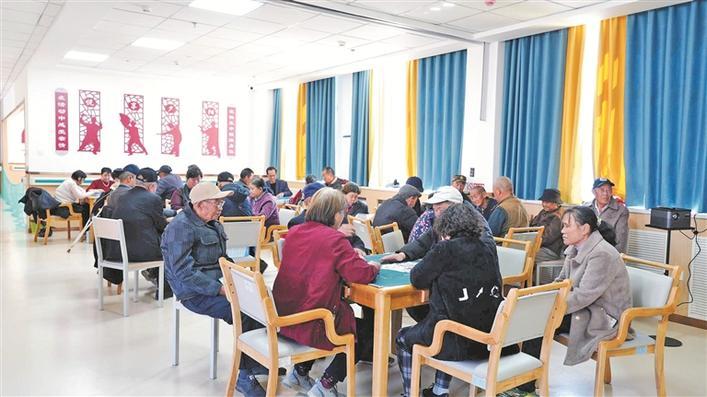
Core Viewpoint - The article highlights the comprehensive development of a three-tiered elderly care service network in Jinchuan District, emphasizing the integration of medical and nursing services, community support, and smart technology to enhance the quality of life for the elderly [1][7]. Group 1: Medical and Nursing Integration - The Baoye Medical and Nursing Apartment is the first "medical care" elderly institution in the province, housing 180 residents with an average age of 86, and 80% of the 60 staff members are professional nurses providing 24-hour care [2][3]. - Residents experience a high level of comfort and care, with services available on-site for various health issues, allowing them to engage in daily activities like playing cards and exercising [2]. Group 2: Community Embedded Services - The community service center in Jinchuan District offers a range of elderly-friendly facilities and a 24-hour monitoring system, ensuring regular check-ins and emergency training for staff [3]. - The introduction of 30 "elderly care consultants" in the community provides a one-stop service for consultation, assessment, and feedback, facilitating seamless transitions in care as health conditions change [3]. Group 3: Smart Elderly Care - The Jinchuan District has implemented a smart elderly care service platform that integrates various service points, allowing for real-time monitoring and management of elderly care services [4][5]. - The platform supports multiple payment methods and provides dietary recommendations based on health status, enhancing the convenience and personalization of services [4]. Group 4: Rural Support Initiatives - The mutual happiness homes in rural areas provide meal delivery services, ensuring that elderly residents receive nutritious meals at low costs, supported by a collaborative funding model involving government and community contributions [6]. - Each mutual happiness home receives an annual subsidy of 30,000 yuan for operational costs, and local associations engage in service management to better meet the needs of elderly residents [6]. Group 5: Overall Coverage and Future Goals - Jinchuan District has established 8 comprehensive elderly service centers, 25 community day care centers, and 27 rural mutual happiness homes, achieving 100% coverage of elderly care facilities [7]. - The district aims to ensure that both urban and rural elderly populations can enjoy a fulfilling and secure retirement through a multi-faceted approach that combines medical care, smart technology, and community support [7].