消费场景

Search documents
消费困局的“盲点”?
2025-06-26 15:51
Summary of Conference Call Records Industry Overview - The records focus on the **Chinese service consumption industry**, highlighting its potential and current challenges. The annual service consumption gap is estimated to be between **2 to 3 trillion yuan** due to factors such as increased working hours and insufficient consumption scenarios, rather than solely income decline [1][2]. Key Points and Arguments 1. **Impact of Working Hours on Consumption** - Chinese residents' average daily consumption time has decreased from **80 minutes in 2018 to 40 minutes** currently, contrasting with countries like Japan and South Korea [1][4]. - Increased working hours in manufacturing and productive services have led to a mismatch between wages and available consumption time, suppressing overall consumption [1][4]. 2. **Holiday and Vacation Dynamics** - China has a total of **18 days** of holidays per year, significantly lower than Japan and South Korea, which have around **30 days** of annual leave [5]. - The reluctance of Chinese employees to take vacations further limits their leisure and holiday spending, negatively impacting the economy [5]. 3. **Future Consumer Behavior Changes** - From **2025 to 2026**, changes such as pilot programs for flexible holidays and the entry of the **post-2000 generation** into the workforce are expected to improve consumer behavior and alleviate internal competition [6]. - The adjustment of employment from manufacturing to service sectors is anticipated to meet labor demands in areas like culture, sports, entertainment, education, and healthcare, which are experiencing high wage growth [7]. 4. **Long-term Trends in Service Consumption** - There is a macro trend indicating a shift in consumer preference from goods to services, particularly as urbanization approaches **70%** [8]. - The primary service consumption demographic will be individuals aged **30-44 and over 55**, with a projected increase in service consumption despite an overall population decline [8]. 5. **Investment Landscape in Service Industry** - There is a significant investment gap in the life service industry, estimated at around **1 trillion yuan** in GDP proportion [9]. - Policy optimizations in **2025** are expected to boost service industry investments, with fixed asset investment in the accommodation sector projected to grow by **20%** [9][10]. 6. **Supply and Demand Dynamics** - The current supply of life services is insufficient compared to demand, indicating that increasing supply can lead to profitability [11][12]. - The government is focusing on service-related infrastructure investments to enhance consumer experiences and overall satisfaction [13]. 7. **Challenges in Cultural and Sports Industries** - The cultural industry faces a **95% reduction** in weekly film releases due to the pandemic, leading to a supply shortage that dampens consumer interest [17]. - The sports sector is also underdeveloped, with only **3 square meters** of sports venue space per person in China compared to **20 square meters** in Japan, indicating a need for increased facilities [16]. 8. **Importance of Service Industry Investment** - Increasing service industry supply can address current deficiencies and unlock potential consumer demand, contributing to both short-term recovery and long-term benefits [18]. - Social factors, alongside income, are crucial in influencing consumption patterns, suggesting that future consumption may outperform income recovery [18]. Additional Important Insights - The records emphasize the need for structural adjustments in employment to alleviate internal competition and meet the growing demand in the service sector [7]. - The shift in investment focus towards service industries is a significant policy direction, aiming to enhance overall economic performance and consumer satisfaction [10]. - The potential for service scene adaptations for the aging population is highlighted, indicating a growing market for age-friendly services and infrastructure [15].
食品饮料周报(25年第23周):白酒淡季需求延续压力,啤酒、饮料进入需求旺季
Guoxin Securities· 2025-06-10 00:45
Investment Rating - The report maintains an "Outperform" rating for the food and beverage sector [5][4]. Core Views - The report highlights that the demand for high-end liquor continues to face pressure during the off-season, while beer and beverages are entering a demand peak [11][1]. - The liquor index has decreased by 0.9%, indicating ongoing short-term fundamental pressures [13]. - The report suggests three investment themes in the liquor sector: 1) Leading companies with proven risk resilience such as Kweichow Moutai, Shanxi Fenjiu, and Wuliangye; 2) Companies like Luzhou Laojiao that are showing positive feedback from digital initiatives and are undervalued; 3) Brands like Jinsiyuan and Yingjia Gongjiu that still have market share growth potential [12][13]. Summary by Sections 1. Liquor - The report notes that high-end liquor prices have slightly declined, with Kweichow Moutai's stock buyback and international product launches indicating a strategic shift [2][11]. - Luzhou Laojiao plans to focus on expanding its market presence and enhancing brand image [2][11]. - The report emphasizes the importance of consumer engagement and market health for liquor companies moving forward [12]. 2. Consumer Goods - The beer industry is expected to enter a peak sales phase, with potential for good performance due to low comparative bases from the previous year [14]. - The snack food sector is experiencing a trend of differentiation, with leading companies driving efficiency across the supply chain [15]. - The report recommends focusing on companies with new product launches and channel breakthroughs, such as Wei Long and Yihai International [15]. 3. Key Company Earnings Forecasts - Kweichow Moutai is projected to have an EPS of 75.28 in 2025, with a PE ratio of 20.0 [4]. - Wuliangye is expected to have an EPS of 8.44 in 2025, with a PE ratio of 14.8 [4]. - Luzhou Laojiao's forecasted EPS is 9.64 for 2025, with a PE ratio of 12.1 [4]. 4. Market Trends - The food and beverage sector saw a decline of 0.65% this week, underperforming the Shanghai Composite Index by 1.78 percentage points [20]. - The report indicates that the beverage sector is entering a peak season, with expectations for continued growth in segments like sugar-free tea and energy drinks [19].





靠“场景”杀到品类第一,伊藤园、多力多滋、龟甲万如何找到增长突破口?
Sou Hu Cai Jing· 2025-05-15 00:35
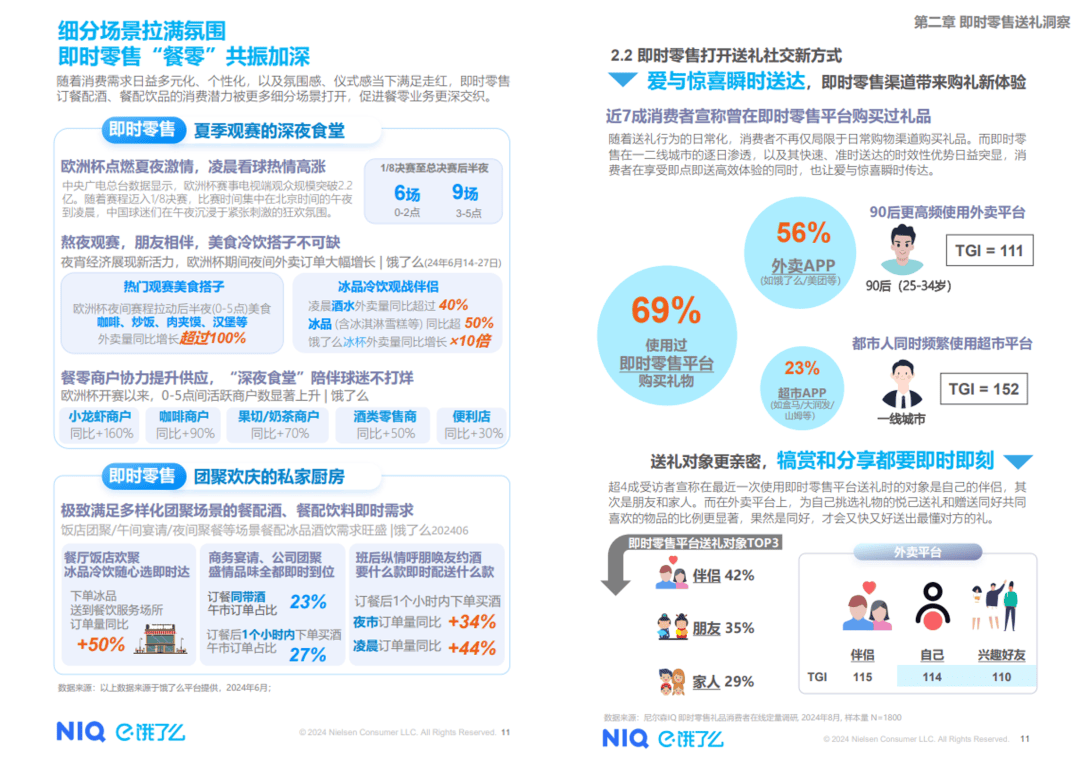
Group 1 - The core competition among major players like JD, Meituan, and Taobao is centered around capturing consumer attention within a 30-minute radius, focusing on instant retail [1][3] - Instant retail is evolving into a lifestyle trend, emphasizing the importance of "consumption scenarios" for food brands to address [2][4] - The demand for local supply and high delivery efficiency is growing, with instant retail expanding to all categories, enhancing consumer convenience [4][28] Group 2 - Instant retail alters consumer demand triggers from traditional bulk purchasing to scenario-based consumption, driven by immediate needs [7][28] - Food brands must innovate products and build trust around specific consumption scenarios to remain competitive [7][28] - The 2025 Foodaily report identifies key consumption scenarios across various dimensions, highlighting opportunities for brand growth [9][28] Group 3 - Case studies illustrate how brands like Kikkoman, Itoen, and Doritos are leveraging specific consumption scenarios to drive growth [11][28] - Kikkoman's microwave seasoning products cater to busy consumers seeking efficiency without sacrificing quality [12][14] - Itoen's barley tea targets health-conscious consumers across all age groups, expanding its market presence through diverse packaging [18][20] - Doritos addresses the gaming community's need for quiet snacking options, showcasing the importance of user experience in consumption scenarios [22][26]