煤炭价格上涨

Search documents
——煤炭开采行业周报:供需边际改善,煤价具备支撑-20260125
Guohai Securities· 2026-01-25 08:05
Investment Rating - The report maintains a "Buy" rating for the coal mining industry, indicating a positive outlook for investment opportunities in this sector [1]. Core Insights - The coal mining industry is experiencing marginal improvements in supply and demand, with coal prices showing support. The report highlights that the recent cold wave has increased electricity consumption, leading to a rise in daily coal usage by major power plants [1][13]. - The report emphasizes the long-term upward trend in coal prices driven by factors such as rising labor costs, increased safety and environmental investments, and government taxation policies. It suggests that the coal price will continue to have upward pressure despite potential fluctuations [6][70]. Summary by Sections 1. Thermal Coal - As of January 23, the price of thermal coal at northern ports is 685 RMB/ton, a decrease of 10 RMB/ton week-on-week. The production capacity utilization rate in the western regions has decreased by 0.86 percentage points due to maintenance and early holidays [13][14]. - The report notes a decline in coal shipments and an increase in electricity consumption due to the cold weather, indicating a marginal improvement in supply-demand dynamics [13][27]. - The report anticipates that as the Spring Festival approaches, supply tightness is expected, which may support thermal coal prices in the medium term [13][68]. 2. Coking Coal - The capacity utilization rate for coking coal mines increased by 0.39 percentage points to 84.9%, mainly due to recovery in certain regions. However, supply in Shanxi is constrained by safety inspections [36][69]. - The price of main coking coal at ports is 1800 RMB/ton, reflecting a week-on-week increase of 30 RMB/ton. The report indicates that the overall production and inventory levels are stable, with a focus on the recovery of steel production [37][69]. 3. Coke - The report indicates that the production rate of coke plants remains stable, with a capacity utilization rate of 74.12%. However, the first round of price increases for coke has been delayed due to weak steel market conditions [47][48]. - The average profit per ton of coke is reported to be negative, indicating challenges in profitability for the sector [49]. 4. Anthracite - The report states that the price of anthracite remains stable, with supply levels being adequate and demand driven by pre-holiday stocking [64][66]. 5. Key Companies and Investment Logic - The report highlights several key companies to watch, including: - China Shenhua, Shaanxi Coal, and China Coal Energy, which are considered stable investment options due to their strong fundamentals and high dividends [70][72]. - Yancoal and Jinneng Holding, which are noted for their high elasticity in thermal coal [70][72]. - Huayang Co. and Lanhua Sci-Tech, which are recognized for their unique positioning in the anthracite market [70][72].




——煤炭开采行业周报:北港库存去化明显,港口煤价开启上涨-20260104
Guohai Securities· 2026-01-04 08:36
Investment Rating - The report maintains a "Recommended" rating for the coal mining industry [1] Core Insights - The coal mining industry is experiencing a tightening in production and shipment, with downstream power plants showing an increase in daily consumption, leading to a marginal improvement in supply-demand dynamics [2][12] - The report highlights that coal prices are expected to have support due to anticipated production reductions before the Spring Festival and potential temperature drops [12][63] - The long-term trend for coal prices is upward, driven by factors such as rising labor costs, increased safety and environmental investments, and higher taxation by local governments [5][66] Summary by Sections Thermal Coal - As of December 31, the price of thermal coal at northern ports is 678 RMB/ton, with a weekly decrease of 3 RMB/ton but a daily increase of 8 RMB/ton [12][63] - Production capacity utilization in the Sanxi region decreased by 4.85 percentage points due to increased maintenance during the New Year holiday [12][63] - The daily consumption of the six major power plants increased by 39,000 tons week-on-week [12][63] - The inventory of the six major power plants decreased by 118,000 tons to 13.375 million tons, down 276,000 tons year-on-year [12][29] Coking Coal - The production capacity utilization for coking coal decreased by 3.14 percentage points to 79.5% [3][64] - The average customs clearance volume at Ganqimaodu port decreased by 133 trucks week-on-week [3][64] - The price of main coking coal at ports remained stable at 1,740 RMB/ton as of December 31 [3][36] Coke - As of December 31, major steel mills have initiated the fourth round of price reductions for coke, indicating a weak market [3][44] - The average profit per ton of coke increased by 4 RMB/ton week-on-week [3][46] - The production rate of independent coking plants showed differentiation, with overall production rates declining slightly [3][47] Investment Opportunities - Recommended stocks include China Shenhua, Shaanxi Coal, and China Coal Energy for their stable performance and high dividends [5][66] - Other notable stocks include Yanzhou Coal, Jinkong Coal, and Huayuan Co. for their growth potential and strong cash flow [5][67]


——煤炭开采行业周报:年末供应下滑,坑口挺价意愿增强-20251221
Guohai Securities· 2025-12-21 08:02
Investment Rating - The report maintains a "Recommended" rating for the coal mining industry [1] Core Views - The coal mining industry is experiencing a tightening supply due to some mines completing their annual production tasks and reducing output, while demand remains relatively stable, leading to a potential stabilization in coal prices [6][68] - The report highlights the long-term upward trend in coal prices driven by factors such as rising labor costs, increased safety and environmental investments, and higher taxation by local governments [68] Summary by Sections 1. Thermal Coal - As of December 19, the price of thermal coal at northern ports is 703 RMB/ton, a decrease of 42 RMB/ton week-on-week [3][13] - Production capacity utilization in the Sanxi region decreased by 1.94 percentage points to 88.3% as of December 17, primarily due to some mines reducing output after meeting annual production targets [13][19] - The daily consumption of the six major power plants decreased by 0.6 thousand tons week-on-week [13][21] - The inventory of the six major power plants is 13.746 million tons, down 237 thousand tons year-on-year [13][31] - Northern port inventories increased by 632 thousand tons week-on-week, indicating a tightening supply situation [13][26] 2. Coking Coal - The utilization rate of sample coal mines for coking coal decreased by 0.27 percentage points to 83.0% from December 10 to December 17 [4][67] - The price of main coking coal at ports rose to 1,740 RMB/ton, an increase of 110 RMB/ton week-on-week [4][36] - The average daily customs clearance at the Ganqimaodu port remains high, with a seven-day average of 1,473 trucks, although it decreased by 5 trucks week-on-week [4][38] 3. Coke - The coke market is currently weak, with the third round of price reductions initiated, indicating a potential for further price adjustments [5][67] - The production rate of independent coking plants decreased to 70.48%, reflecting a seasonal decline in iron and steel production [5][50] - The average profit per ton of coke has decreased by 28 RMB/ton week-on-week, indicating pressure on profitability [5][49] 4. Investment Opportunities - The report suggests focusing on stable companies such as China Shenhua, Shaanxi Coal, and China Coal Energy, as well as companies with higher elasticity in thermal coal like Yanzhou Coal and Jin控煤业 [6][68] - The report emphasizes the strong cash flow and high asset quality of leading coal companies, which are characterized by high profitability, high cash flow, high barriers to entry, high dividends, and high safety margins [68]
美锦能源:焦煤价格的上涨对公司的影响是正向的
Mei Ri Jing Ji Xin Wen· 2025-12-18 14:26
Group 1 - The core viewpoint of the article is that the rise in coking coal prices is expected to have a positive impact on the company's overall operating performance [2] - The company, Meijin Energy (000723.SZ), confirmed that the increase in coking coal prices will benefit its business [2] - Investors are actively inquiring about the implications of coal price increases on the company's performance [2]


——煤炭开采行业周报:电厂日耗继续上行,12月煤价仍有上涨动能-20251130
Guohai Securities· 2025-11-30 12:32
Investment Rating - The report maintains a "Recommended" rating for the coal mining industry [2] Core Viewpoints - The coal mining industry is expected to see upward price momentum in December due to seasonal demand increases and low inventory levels [6][72] - The production recovery from previously halted coal mines is contributing to a slight increase in supply, while demand from power plants continues to rise [3][13] - The report highlights the investment value of coal companies, particularly those with strong cash flows and high dividend yields [6] Summary by Sections 1. Thermal Coal - As of November 28, the price of thermal coal at northern ports is 816 RMB/ton, a decrease of 18 RMB/ton week-on-week [13][14] - Production capacity utilization in the Sanxi region increased by 1.37 percentage points, reaching 91.3% [19] - Power plant coal inventories are at 136.4 million tons, down 23.3 million tons year-on-year [13][31] 2. Coking Coal - The production capacity utilization for coking coal increased by 0.33 percentage points to 84.6% [38] - The average price of main coking coal at ports is 1670 RMB/ton, down 110 RMB/ton week-on-week [39] - Coking coal inventories at production enterprises increased by 15.71 thousand tons [46] 3. Coke - Coking enterprises are experiencing a recovery in profits, leading to increased production activity [51] - The average profit per ton of coke has risen to approximately 46 RMB/ton, an increase of 27 RMB/ton week-on-week [55] - The price of coke at the port remains stable at 1680 RMB/ton [52] 4. Anthracite - The price of anthracite coal remains stable, with the market supply still tight due to strict environmental regulations [67] - The price of small block anthracite is 930 RMB/ton, unchanged from the previous week [67] 5. Key Companies and Profit Forecasts - Key companies to watch include China Shenhua, Shaanxi Coal, and Yanzhou Coal, all rated as "Buy" [8] - The report emphasizes the strong cash flow and high dividend yields of leading coal companies, making them attractive investment options [6]
统计局:11月中旬全国煤炭价格延续涨势
Guo Jia Tong Ji Ju· 2025-11-25 01:33
Core Insights - National Bureau of Statistics data indicates that coal prices continued to rise in mid-November, with various coal types showing different price changes [1] Price Changes Summary - Anthracite (washed middle block, volatile matter ≤8%) price is 950.3 CNY/ton, up 0.8 CNY/ton, an increase of 0.1% [1] - Ordinary mixed coal (Shanxi mixed coal with a calorific value of 4500 kcal) price is 642.3 CNY/ton, up 30.5 CNY/ton, an increase of 5.0% [1] - Shanxi big mixed coal (higher quality mixed coal, calorific value of 5000 kcal) price is 736.1 CNY/ton, up 32.9 CNY/ton, an increase of 4.7% [1] - Shanxi premium mixed coal (premium mixed coal, calorific value of 5500 kcal) price is 829.1 CNY/ton, up 33.6 CNY/ton, an increase of 4.2% [1] - Datong mixed coal (Datong produced mixed coal, calorific value of 5800 kcal) price is 875.0 CNY/ton, up 36.0 CNY/ton, an increase of 4.3% [1] - Coking coal (main coking coal, sulfur content <1%) price is 1650.0 CNY/ton, up 26.7 CNY/ton, an increase of 1.6% [1] - In mid-November, the price increase for coking coal and anthracite narrowed, while the price increase for thermal coal expanded [1] - In addition, the national coke (quasi-first-grade metallurgical coke, 12.01% ≤ ash content ≤ 13.50%) price is 1521.4 CNY/ton, up 41.7 CNY/ton, an increase of 2.8% [1]
国家统计局:2025年11月中旬6类煤炭价格持续上涨
Guo Jia Tong Ji Ju· 2025-11-24 02:42
Core Insights - The National Bureau of Statistics reported on the price changes of important production materials in the circulation sector for mid-November 2025, indicating that 30 products saw price increases, 17 experienced declines, and 3 remained stable [1] Coal Sector - The price of anthracite (washed middle block) is 950.3 CNY/ton, up 0.1% from the previous period [2] - The price of ordinary mixed coal (4500 kcal) is 642.3 CNY/ton, up 5.0% from the previous period [2] - The price of Shanxi mixed coal (5000 kcal) is 736.1 CNY/ton, up 4.7% from the previous period [2] - The price of Shanxi superior mixed coal (5500 kcal) is 829.1 CNY/ton, up 4.2% from the previous period [2] - The price of Datong mixed coal (5800 kcal) is 875.0 CNY/ton, up 4.3% from the previous period [2] - The price of coking coal (main coking coal) is 1650.0 CNY/ton, up 1.6% from the previous period [2]
——煤炭开采行业周报:10月用电增速10.4%,旺季日耗逐步攀升将利好煤价-20251123
Guohai Securities· 2025-11-23 08:34
Investment Rating - The industry investment rating is "Recommended (Maintain)" [1] Core Viewpoints - The coal mining industry is expected to maintain a stable and slightly strong price trend due to seasonal demand increases and supply constraints [7][75] - The overall supply and demand for coal remain balanced, with port coal prices holding steady [14][73] - The report highlights the resilience of leading coal companies, which exhibit strong cash flow and profitability characteristics [7][75] Summary by Sections 1. Thermal Coal - As of November 21, the price of thermal coal at northern ports is 834 CNY/ton, remaining stable week-on-week [14][15] - Production capacity utilization in the Sanxi region increased by 0.14 percentage points to 89.93% as of November 19, indicating stable supply [21][73] - Electricity consumption in October reached 857.2 billion kWh, a year-on-year increase of 10.4%, driven by low base effects and seasonal heating demand [14][73] 2. Coking Coal - The price of main coking coal at the Jing Tang port decreased to 1780 CNY/ton, down 80 CNY/ton week-on-week [39][40] - Coking coal production capacity utilization increased by 0.07 percentage points to 84.3% during the week of November 12-19, indicating a slight recovery in supply [39][74] - The average crossing volume at the Ganqimaodu port remains high, with a seven-day average of 1,339 vehicles [39][74] 3. Coke - The report notes that coking enterprises have completed four rounds of price increases, improving profit margins [52][75] - The production capacity utilization of coking enterprises increased slightly by 0.04 percentage points to 74.21% [52][75] - The average profit per ton of coke increased to approximately 19 CNY/ton, reflecting improved profitability in the sector [56] 4. Anthracite - The price of anthracite coal remains stable, with the small block price at 930 CNY/ton as of November 21 [68][75] 5. Key Companies and Profit Forecasts - Key companies to focus on include China Shenhua, Shaanxi Coal and Energy, and Yanzhou Coal Mining, all of which are rated as "Buy" [9][75] - The report emphasizes the strong financial health and growth potential of leading coal companies, suggesting a favorable investment environment [7][75]
煤炭行业第三季度盈利环比增长约20%
Xin Lang Cai Jing· 2025-11-19 14:06
Core Insights - The coal industry in China is experiencing a recovery in profitability despite a year-on-year decline in coal prices and corporate earnings [2][3][4]. Group 1: Industry Performance - The total electricity generation from coal-fired power plants in Q3 reached 1.76 trillion kWh, a year-on-year increase of 1% [2]. - Coal production and sales for 23 listed companies in the first three quarters were 940 million tons and 1.11 billion tons, respectively, with a slight quarter-on-quarter increase in Q3 [3]. - The average price of thermal coal at Huanghua Port rose from 641.7 yuan/ton to 679 yuan/ton, while the price of coking coal at Jingtang Port increased from 1315.3 yuan/ton to 1566.7 yuan/ton [2]. Group 2: Company Performance - The total profit for the coal industry in Q3 reached 75.5 billion yuan, a quarter-on-quarter increase of 9.7% [2]. - Among 37 listed coal companies, the net profit for Q3 was 29.942 billion yuan, up 22.83% from the previous quarter [3]. - Leading companies like China Shenhua reported a Q3 net profit of 14.7 billion yuan, a quarter-on-quarter increase of 13%, driven by strong performance in the power sector [4]. Group 3: Market Outlook - As of November 12, the spot price for 5500 kcal coal in the Bohai Rim region reached 828 yuan/ton, exceeding the price at the beginning of the year [5]. - The coal market sentiment is currently high, with coastal power plant inventories down 5%-6% year-on-year due to slow replenishment during the off-season [5].


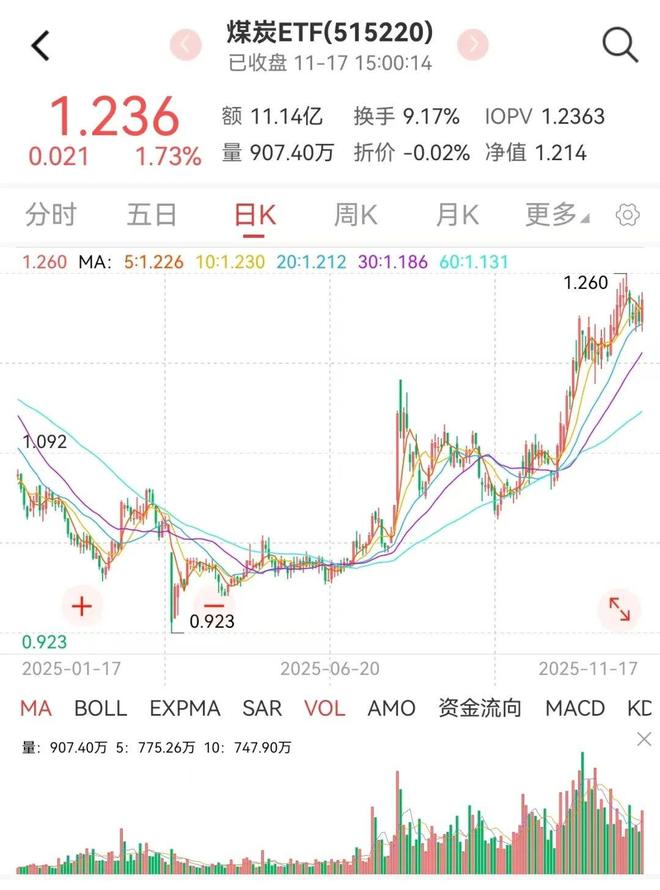
煤价上涨动能或将持续,关注全市场唯一煤炭ETF(515220)
Mei Ri Jing Ji Xin Wen· 2025-11-18 01:23
Core Viewpoint - The coal ETF (515220) experienced a 1.73% increase on November 17, indicating positive market sentiment towards coal investments amid supply constraints and rising demand [1]. Supply Side - In November, central emergency management departments are conducting safety inspections in major coal-producing regions, leading to ongoing supply disruptions. There has been no significant increase in production from these areas since the beginning of the month [3]. - A total of 22 central safety production assessment teams will be deployed throughout November to enforce safety production responsibilities, which is expected to continue limiting coal production [4]. Demand Side - The onset of centralized heating in northern regions has led to an upward trend in daily coal consumption. The China Electricity Council predicts that electricity consumption growth in Q4 2025 will exceed that of Q3, with an estimated total electricity consumption of approximately 10.4 trillion kilowatt-hours for the year, reflecting a year-on-year growth of around 5% [4]. - Given the tight supply-side policies and low inventory levels compared to previous years, coal supply in Q4 is unlikely to maintain last year's high levels, while demand remains stable, indicating a persistent supply-demand gap and potential for continued coal price increases [4]. Investment Insights - As of October 31, the dividend yield of the China Securities Coal Index stands at 4.68%, suggesting strong allocation value for the coal sector due to its high dividend characteristics. Investors are encouraged to consider the coal ETF (515220) as a viable investment option [4].