
现实世界资产代币化

Search documents
严格禁止境内虚拟货币兑换交易等业务
Xin Lang Cai Jing· 2026-02-08 18:30
Core Viewpoint - The People's Bank of China and seven other departments have jointly issued a notification to further prevent and address risks related to virtual currencies and related activities, responding to the resurgence of speculative activities in the virtual currency market and the need for enhanced regulatory measures [1][2]. Group 1: Background and Context - The notification was prompted by the resurgence of speculative activities in virtual currencies, which had previously disrupted the financial order and endangered public property safety [2]. - The notification aims to refine the regulatory policy framework to address new challenges in risk prevention and ensure national security and social stability [2]. Group 2: Definitions and Regulations - The notification reiterates that virtual currencies do not have legal currency status in China, and activities such as virtual currency exchange, trading, and token issuance are illegal [3][4]. - It introduces a definition for "real-world asset tokenization," which involves converting asset ownership and rights into tokens using encryption and distributed ledger technology [4]. Group 3: Regulatory Measures - Three key regulatory measures are outlined: 1. Maintaining a strict prohibition on virtual currency activities within China [5]. 2. Closing cross-border regulatory loopholes to prevent illegal issuance of virtual currencies abroad [5]. 3. Safeguarding monetary sovereignty by prohibiting the issuance of stablecoins linked to the Chinese yuan without approval [5]. Group 4: Compliance and Oversight - The notification emphasizes strict regulation of overseas operations related to real-world asset tokenization, requiring approval from relevant authorities for such activities [6][7]. - It mandates that financial institutions' overseas subsidiaries adhere to compliance and risk management standards set by their domestic parent companies [7]. Group 5: Implementation and Coordination - To ensure effective policy implementation, a collaborative framework between central and local authorities is proposed, with local governments responsible for coordinating related efforts [8]. - The notification calls for a multi-faceted approach to risk prevention, including monitoring, governance of funds and information flows, and public education to enhance awareness of investment risks [8].
中国人民银行、中国证监会等八部门联合发布《关于进一步防范和处置虚拟货币等相关风险的通知》
Sou Hu Cai Jing· 2026-02-08 08:00
Core Viewpoint - The joint notice issued by the People's Bank of China and other regulatory bodies aims to prevent and address risks associated with virtual currencies and the tokenization of real-world assets, emphasizing the need to maintain national security and social stability [1][2][3]. Group 1: Nature of Virtual Currencies and Tokenization - Virtual currencies do not have the same legal status as fiat currencies and should not be circulated as money in the market [1]. - Activities related to virtual currencies, such as exchanges and token issuance, are classified as illegal financial activities and are strictly prohibited [2][3]. Group 2: Regulatory Mechanisms - A collaborative mechanism among various departments, including the People's Bank of China and the China Securities Regulatory Commission, will be established to coordinate efforts in preventing and addressing risks related to virtual currencies and tokenization [4]. - Local governments are responsible for risk prevention and management within their jurisdictions, with financial management departments leading the efforts [4]. Group 3: Risk Monitoring and Management - Continuous improvement of monitoring technologies and systems is mandated to assess risks associated with virtual currencies and tokenization activities [6]. - Financial institutions are prohibited from providing services related to virtual currencies and must report any illegal activities [7]. Group 4: Advertising and Market Regulation - Market regulatory bodies will enhance the management of business registrations to prevent the use of terms related to virtual currencies in company names and advertising [8]. - Ongoing efforts will be made to regulate and shut down illegal virtual currency mining activities [8]. Group 5: Legal Responsibilities - Violations of the notice regarding virtual currencies and tokenization will result in penalties, and criminal liability may be pursued for serious offenses [13].
事关虚拟货币!央行、公安部等八部门联合发文
Xin Lang Cai Jing· 2026-02-08 00:58
Core Viewpoint - The recent notice issued by the People's Bank of China and other departments aims to prevent and address risks associated with virtual currencies and the tokenization of real-world assets, emphasizing the illegal nature of related financial activities and the need for strict regulatory measures [1][2][3]. Group 1: Nature of Virtual Currencies and Tokenization - Virtual currencies do not possess the same legal status as fiat currencies and should not be circulated as money in the market [1][2]. - Activities related to virtual currencies, such as exchanges and token issuance, are classified as illegal financial activities and are strictly prohibited [2][3]. Group 2: Regulatory Framework and Coordination - A collaborative mechanism involving multiple government departments has been established to oversee the prevention and handling of risks related to virtual currencies and tokenization [4]. - Local governments are responsible for managing risks associated with virtual currencies and tokenization within their jurisdictions, with financial management departments leading the efforts [4][5]. Group 3: Risk Monitoring and Management - Continuous improvement of risk monitoring systems is mandated, with a focus on data sharing and cross-departmental collaboration to identify risks associated with virtual currencies and tokenization [5][6]. - Financial institutions are prohibited from providing services related to virtual currencies and must report any illegal activities [6][7]. Group 4: Public Awareness and Education - There is an emphasis on public education regarding the risks and illegality of virtual currencies and tokenization, utilizing various media channels to raise awareness [12]. Group 5: Legal Responsibilities - Violations of the regulations regarding virtual currencies and tokenization will result in penalties, and criminal liability may be pursued for serious offenses [13].

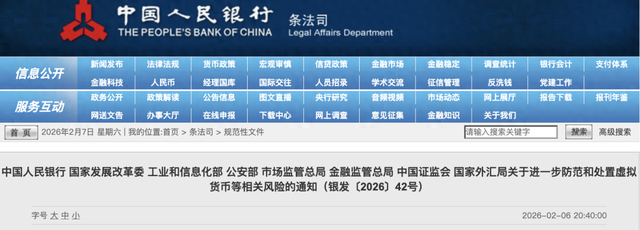
八部门联合发文进一步防范 和处置虚拟货币等相关风险
Xin Lang Cai Jing· 2026-02-07 21:54
转自:贵州日报 通知提出,持续整治虚拟货币"挖矿"活动。依法严厉打击虚拟货币、现实世界资产代币化相关诈骗、洗 钱、非法经营、传销、非法集资等违法犯罪活动,以及以虚拟货币、现实世界资产代币化等为噱头开展 的相关违法犯罪活动。 新华社北京2月6日电 记者2月6日从中国人民银行、中国证监会了解到,中国人民银行等8部门当日联合 发文,明确虚拟货币相关业务活动属于非法金融活动,境内一律严格禁止。未经相关部门依法依规同 意,境内外任何单位和个人不得在境外发行挂钩人民币的稳定币,境内主体及其控制的境外主体不得在 境外发行虚拟货币。 (《八部门联合发文进一步防范 和处置虚拟货币等相关风险》由贵阳日报为您提供,转载请注明来 源,未经书面授权许可,不得转载或镜像。) 近期,虚拟货币、现实世界资产(RWA)代币化相关投机炒作活动时有发生,扰乱经济金融秩序,危 害人民群众财产安全。 为此,中国人民银行、国家发展改革委、工业和信息化部、公安部、市场监管总局、金融监管总局、中 国证监会、国家外汇局等8部门联合发布《关于进一步防范和处置虚拟货币等相关风险的通知》。 通知明确,虚拟货币不具有法偿性,不应且不能作为货币在市场上流通使用。在境内 ...
China Widens Crypto Ban to Choke Off Stablecoins and Asset Tokenization
Yahoo Finance· 2026-02-07 12:48
Core Viewpoint - China's top financial regulators have significantly expanded the existing crypto ban, specifically targeting stablecoin issuances and the tokenization of real-world assets, marking the most aggressive tightening of capital controls since the 2021 prohibition on Bitcoin mining and trading [1][2]. Regulatory Actions - The joint notice was released on February 6 by eight agencies, including the People's Bank of China and the China Securities Regulatory Commission [1]. - New rules prohibit foreign entities from offering stablecoin or tokenization services to Chinese residents, addressing a surge in virtual asset activities perceived as a threat to financial stability [2]. Offshore Loophole Closure - The crackdown targets the "offshore loophole" by banning domestic firms and their overseas branches from issuing digital currencies without explicit government approval [3]. - The People's Bank of China emphasized that stablecoins, especially those pegged to fiat currencies, possess attributes of sovereign money [3]. Financial Control and Compliance - Authorities argue that private digital assets undermine the state's control over the money supply and circumvent anti-money-laundering protocols [4]. - The notice specifically prohibits any entity from issuing Renminbi-pegged stablecoins abroad, seen as a defense of the e-CNY, China's official central bank digital currency [4]. Real-World Asset Tokenization - The directive also targets the $24 billion Real-World Asset (RWA) tokenization sector, reclassifying unauthorized tokenization as "illegal public security offerings" and "unauthorized futures business" [5][7]. - Activities related to RWA tokenization within China, including intermediary and IT services suspected of illegal token issuance, are prohibited [7]. Compliance and Oversight - The notice allows limited activities on government-approved financial infrastructure but requires firms pursuing tokenization abroad to meet heightened compliance standards and obtain domestic clearance [8]. - The central government plans to implement a collaborative framework for local and national oversight to enforce these measures [8].
央行等八部门《关于进一步防范和处置虚拟货币等相关风险的通知》全文
Xin Lang Cai Jing· 2026-02-07 09:27
Core Viewpoint - The People's Bank of China and seven other departments issued a notification to further prevent and address risks associated with virtual currencies and related activities, emphasizing the need for stricter regulations and enforcement to maintain national security and social stability [2][3]. Background of the Notification - The notification was prompted by the resurgence of speculative activities related to virtual currencies and tokenization of real-world assets, which disrupt economic and financial order and threaten public property safety. Previous efforts in 2021 to curb such activities had shown significant results, but new challenges have emerged [3]. Definition of Virtual Currencies and Tokenization - Virtual currencies, including Bitcoin and stablecoins, are reaffirmed as not having the same legal status as fiat currencies and are deemed illegal financial activities within China. The notification reiterates the prohibition of any related business activities [4][10]. - Real-world asset tokenization involves converting ownership and income rights into tokens using encryption and distributed ledger technology. Such activities are also prohibited unless specifically authorized by regulatory bodies [5][11]. Regulatory Requirements for Virtual Currencies - The notification outlines that virtual currencies cannot meet customer identification and anti-money laundering requirements, posing risks for illegal activities. All related business activities are strictly prohibited [6]. - It emphasizes that stablecoins linked to fiat currencies cannot be issued abroad without regulatory approval, as they may undermine monetary sovereignty [6][10]. Requirements for Domestic Entities Engaging in Overseas Activities - Domestic entities must adhere to strict regulations when engaging in overseas tokenization activities, ensuring compliance with local laws and regulations. Any unauthorized activities are prohibited [7][17]. - Financial institutions must manage their overseas subsidiaries in compliance with domestic regulations, ensuring proper risk management and customer due diligence [18]. Specific Measures Proposed in the Notification - A collaborative framework between central and local authorities is established to enhance risk prevention and management related to virtual currencies and asset tokenization [8][19]. - The notification calls for improved risk monitoring and management, including cross-departmental data sharing and local government involvement in identifying and addressing risks [13][19]. - Continuous efforts to regulate virtual currency mining activities and combat illegal financial activities are emphasized, with local governments held accountable for enforcement [15][20]. Legal Responsibilities - Violations of the notification's provisions will result in penalties, and criminal liability may be pursued for serious offenses. Any financial activities involving virtual currencies that contravene public order will be deemed invalid, with associated losses borne by the investors [20].

中国人民银行、中国证监会等八部门联合发布《关于进一步防范和处置虚拟货币等相关风险的通知》|金融与科技
清华金融评论· 2026-02-07 09:21
Core Viewpoint - The article emphasizes the need for stringent measures to prevent and address risks associated with virtual currencies and the tokenization of real-world assets (RWA) to maintain national security and social stability [4][5]. Summary by Sections Nature of Virtual Currencies and RWA Tokenization - Virtual currencies do not possess the same legal status as fiat currencies and are characterized by their non-issuance by monetary authorities, use of encryption technology, and existence in digital form. They lack legal tender status and should not circulate as currency [5]. - Activities related to virtual currencies are classified as illegal financial activities, including exchanges between fiat and virtual currencies, trading virtual currencies, and issuing tokens without authorization [5]. - RWA tokenization involves converting ownership and income rights of assets into tokens using encryption and distributed ledger technology, which is also deemed illegal without proper authorization [6]. Collaborative Mechanisms - A collaborative mechanism among various departments, including the People's Bank of China and the China Securities Regulatory Commission, is established to coordinate efforts in preventing and addressing risks related to virtual currencies and RWA tokenization [8]. Risk Monitoring and Management - Continuous improvement of monitoring technologies and systems is essential for risk assessment related to virtual currencies and RWA tokenization. Local governments are tasked with effective online and offline monitoring to identify and share risk information promptly [10]. Regulation of Financial and Service Institutions - Financial institutions are prohibited from providing services related to virtual currencies, including account opening and fund transfers. They must also refrain from offering custody or settlement services for unauthorized RWA tokenization activities [11]. - Internet companies are restricted from providing platforms for virtual currency and RWA tokenization activities, and must report any illegal activities to authorities [11]. Advertising and Registration Management - Market regulatory authorities are to enhance management of business registrations, ensuring that names and business scopes do not include terms related to virtual currencies or RWA tokenization [12]. Enforcement Against Illegal Activities - Local financial management departments are responsible for investigating and addressing illegal financial activities related to virtual currencies and RWA tokenization, with severe penalties for violations [13]. International Business Regulations - Strict regulations are imposed on domestic entities engaging in virtual currency activities abroad, ensuring compliance with local laws and regulations [15][16]. Organizational Leadership and Public Awareness - A strong organizational framework is necessary for risk prevention, with a focus on public education regarding the risks associated with virtual currencies and RWA tokenization [18][19].

八部门重申虚拟货币非法
2 1 Shi Ji Jing Ji Bao Dao· 2026-02-07 03:12
Core Viewpoint - The recent notification issued by the People's Bank of China and eight other departments emphasizes that virtual currency and tokenization of real-world assets (RWA) are illegal financial activities, aiming to prevent risks and maintain national security and social stability [1][2][9]. Group 1: Virtual Currency Regulations - Virtual currencies do not have the same legal status as fiat currencies and should not be circulated in the market [1][2]. - The notification prohibits any domestic entity or individual from issuing stablecoins pegged to the Renminbi without approval from relevant authorities [1][9]. - Financial institutions are barred from providing services related to virtual currencies, including account opening, fund transfers, and the issuance of financial products [6][9]. Group 2: RWA Tokenization Regulations - The notification defines RWA tokenization and states that conducting RWA-related activities domestically is considered illegal financial activity [4][5]. - Any intermediary or technical services related to RWA tokenization without approval are also deemed illegal [5][6]. - The notification emphasizes that foreign entities must not provide RWA tokenization services to domestic subjects [5][9]. Group 3: Enforcement and Compliance - The notification outlines strict measures to shut down existing virtual currency mining projects and prohibits the establishment of new ones [1][5]. - It highlights the need for cross-departmental collaboration to monitor and manage risks associated with virtual currencies and RWAs [5][10]. - Violations of the notification will result in penalties, and criminal liability may be pursued for serious offenses [9][10]. Group 4: Public Awareness and Education - The notification calls for increased public education on the risks associated with virtual currencies and RWA tokenization [10]. - It encourages various departments and industry associations to raise awareness through legal interpretations and case studies [10].

虚拟货币监管升级!现实世界资产代币化被纳入重点监管
Yang Shi Xin Wen· 2026-02-07 01:08
近期,虚拟货币、现实世界资产(也就是RWA)代币化相关投机炒作活动时有发生,扰乱经济金融秩 序,危害人民群众财产安全。就在昨天,中国人民银行、国家发展改革委、工业和信息化部、公安部、 市场监管总局、金融监管总局、中国证监会、国家外汇局等8部门联合发布了《关于进一步防范和处置 虚拟货币等相关风险的通知》,进一步完善监管要求,持续打击相关违法犯罪活动。 华东政法大学教授虞浔:不法分子利用新型技术概念进行包装,通过夸大收益、隐瞒风险的方式诱导公 众参与。虚拟货币、现实世界资产代币化相关投机炒作活动时有发生,为洗钱、非法集资等犯罪活动提 供温床。因此,必须进一步从严监管,防范相关金融风险,维护金融秩序稳定。新规重申境内对虚拟货 币坚持禁止性政策,明确虚拟货币不具有法定货币地位,相关业务活动属于非法金融活动。强调严厉打 击相关非法金融活动。通过跨部门协作,强化央地协同,进一步完善风险监测、防范和处置等方面的要 求,对相关违法犯罪活动保持高压态势。 《通知》明确延续核心定性:虚拟货币不是法定货币,相关业务属于非法金融活动。 《通知》同时新增两大关键约束: 虚拟货币因去中心化、难以溯源的特性,极易被犯罪分子利用,成为洗钱与 ...
8部门“攥指成拳”强监管 合力遏制虚拟货币等风险
Xin Hua Wang· 2026-02-07 00:11
新华社北京2月6日电 题:8部门"攥指成拳"强监管 合力遏制虚拟货币等风险 新华社"新华视点"记者吴雨、刘慧 刷短视频弹出"投资稳定币保本保息"的诱人广告,亲友群里转发"海外理财捷径",朋友圈看到"资产代 币化能躺着赚钱"……近年来,虚拟货币等炒作交易活动变换马甲、更新套路,不断将黑手伸向百姓"钱 袋子"。 2月6日,中国人民银行等8部门联合发文,明确在境内虚拟货币相关业务活动属于非法金融活动,禁止 境内开展现实世界资产(RWA)代币化活动,进一步防范和处置虚拟货币等相关风险,合力保障人民 群众财产安全。 明确风险属性 监管力度只紧不松 如今,虚拟货币市场"过山车"行情已呈常态:2025年10月创出每枚超12万美元价格高点的比特币,2026 年2月已跌破每枚7万美元,部分"空气币"更是单日波动幅度超20%。这期间引发多次大规模杠杆交易爆 仓,数百亿美元在一夜间"灰飞烟灭"。 此次8部门联合发布的《关于进一步防范和处置虚拟货币等相关风险的通知》强调:虚拟货币不具有法 偿性,不应且不能作为货币在市场上流通使用。虚拟货币相关业务活动属于非法金融活动。在此前,中 国互联网金融协会等7家协会发布风险提示称,有关机构不得 ...