
现金储备

Search documents
Berkshire's Cash Reaches $382 Billion
Yahoo Finance· 2025-11-01 13:21
Core Insights - Berkshire Hathaway reported strong financial results for Q3 2024, with operating income reaching $13.5 billion, a 34% increase year over year, driven by improved insurance underwriting income and stable performance in other segments [4][10] - The company's cash and short-term investments surged to an all-time high of nearly $382 billion, reflecting robust financial flexibility [6][10] - Berkshire Hathaway did not repurchase any shares during the quarter, contributing to the increase in cash reserves [7] Financial Metrics - Revenue for Q3 2024 was $93 billion, compared to $94.97 billion in Q3 2025, marking a 2% increase and beating expectations [3] - Operating earnings rose from $10.09 billion in Q3 2024 to $13.485 billion in Q3 2025, a 34% increase, also exceeding expectations [3] - Insurance underwriting income saw a significant rise from $750 million to $2.37 billion, a 216% increase year over year [3][4] Business Segment Performance - Income from the BNSF Railroad business increased by 5% year over year, while income from Berkshire Hathaway Energy declined by 9% [5] - Insurance investment income decreased due to a lower interest rate environment compared to 2024 [5] Cash Management - The cash stockpile increased by nearly $40 billion, primarily due to the operating income generated and the absence of share buybacks [7] - There is speculation that Berkshire may have sold some stocks during the quarter, potentially reducing its investment in Apple, as indicated by a decline in the reported cost basis in consumer products stocks [8] Market Reaction - As Berkshire Hathaway reports earnings over the weekend, there was no immediate market reaction, allowing for a thorough analysis by investors before trading [9]
股神卸任前的最后一份财报来袭:伯克希尔哈撒韦现金再创新高!
Xin Lang Cai Jing· 2025-11-01 12:57
Group 1 - Berkshire Hathaway reported a 33.6% year-over-year increase in operating profit for Q3, with a record cash reserve of $382.7 billion [1] - Total revenue for Q3 reached $94.972 billion, a 2% increase year-over-year, exceeding market expectations of $91.55 billion; net profit was $30.796 billion, up 17% and also surpassing expectations of $12.73 billion [1] - The operating profit, which is highly valued by Buffett, was $13.485 billion, significantly up from $10.09 billion in the same period last year [1] Group 2 - The Q3 report is the last financial statement before Buffett steps down as CEO, with Greg Abel set to take over by year-end [2] - Following the announcement of Buffett's retirement, Berkshire's B shares have dropped by 11%, while the S&P 500 has risen by 20% during the same period [2] - Analysts have downgraded Berkshire Hathaway's stock rating to "underperform" due to concerns over the company's future operations post-Buffett [2] Group 3 - Berkshire Hathaway has maintained a cautious stance on the market and valuations, not repurchasing any stock as of September 30, indicating a belief that the market is overvalued [1] - Concerns have been raised regarding the potential impact of declining prices in the property catastrophe reinsurance sector on the company's insurance business, as well as geopolitical conflicts affecting railway revenue [2] - Despite recent stock price declines, some investors remain optimistic about Berkshire's ability to generate substantial cash flow regardless of the leadership change [2]
11月1日起,家里没现金的最好存放6万现金,有这5个现实原因
Xin Lang Cai Jing· 2025-10-26 13:22
Core Insights - The rapid adoption of mobile payment in China is leading to predictions that cash payments will gradually phase out over the next 20 years, with mobile payment transactions expected to replace cash payments entirely [1] Group 1: Mobile Payment Trends - In the first quarter of 2025, China's mobile payment transaction volume reached 107.86 billion, a year-on-year increase of 17.3%, while the transaction amount hit 132.5 trillion yuan, growing by 11.6% [1] Group 2: Cash Usage and Recommendations - A survey by the China Consumers Association revealed that 78.3% of respondents carry little to no cash, with 26.5% having less than 1,000 yuan at home, and only 8.7% possessing over 10,000 yuan in cash [3] - Financial experts recommend that households should keep 60,000 yuan in cash for various reasons, including emergency needs, special occasions, privacy protection, spending control, and disaster preparedness [3][5][9][10][14][15] Group 3: Reasons for Keeping Cash - Cash can address immediate needs when mobile payment systems fail due to factors like low battery, network issues, or system outages [5] - Certain occasions, such as giving cash gifts during holidays or weddings, still necessitate the use of cash [7] - Using cash helps protect personal privacy, as digital transactions leave a traceable record [9] - Cash allows for better control over spending, helping individuals manage their finances more effectively [10][12] - In disaster-prone areas, having cash on hand can be crucial for purchasing necessities when electronic payment systems are down [14][15]


10月1日起,建议在家准备至少4-6万元现金,4个原因很现实
Sou Hu Cai Jing· 2025-09-26 14:49
Core Viewpoint - The increasing prevalence of mobile payments is leading to predictions that cash payments will gradually fade away, yet cash still holds irreplaceable value in specific scenarios [1][3]. Group 1: Reasons for Keeping Cash - Keeping cash can help respond to emergencies, such as medical situations where electronic payment systems may be down [5]. - Cash payments protect personal privacy, as mobile payment platforms can track spending habits and personal information [7]. - Certain social situations still require cash, such as giving cash gifts at weddings or during holidays, and many rural vendors only accept cash [10]. - Having cash on hand can help control spending, allowing individuals to manage their finances better and avoid overspending through digital payment methods [12]. Group 2: Recommendations for Cash Savings - It is suggested that families should keep between 40,000 to 60,000 yuan in cash, which provides a balance between accessibility in emergencies and not tying up too much capital [12].

5 Things Warren Buffett Wants You To Stop Doing With Your Money
Yahoo Finance· 2025-09-11 11:13
Core Insights - Warren Buffett emphasizes the importance of avoiding certain financial pitfalls to protect and grow wealth, drawing from his extensive experience and common-sense approach to investing [1][2] Group 1: Financial Pitfalls to Avoid - Getting into credit card debt is labeled as a trap by Buffett, making wealth accumulation nearly impossible due to high interest rates, which can reach 18% or 20% [3] - Buffett warns against not carrying cash, as it can lead to overspending and missing out on better opportunities due to a lack of liquidity awareness [4] - The necessity of researching companies before investing is highlighted, as impulsive decisions based on social media hype can lead to significant losses [6] Group 2: Importance of Liquidity - Buffett maintains a minimum of $20 billion in cash equivalents for Berkshire Hathaway, viewing cash as "dry powder" that allows for patience and quick action when attractive investment opportunities arise [5]
“股神”巴菲特投错了?伯克希尔减持卡夫亨氏股票,现金储备仍处于高位
Di Yi Cai Jing· 2025-08-03 07:39
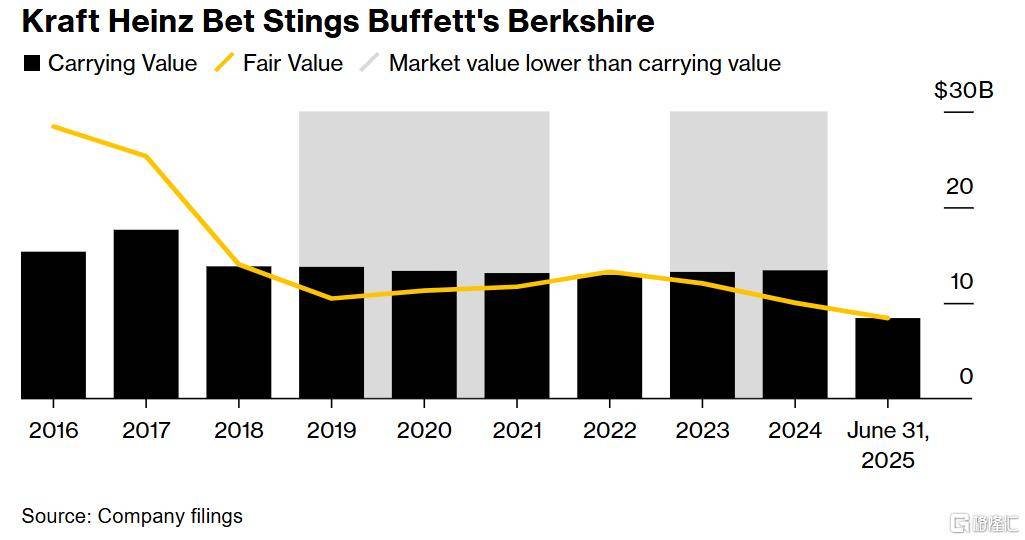
Core Viewpoint - Berkshire Hathaway has adopted a conservative investment strategy, continuing to reduce stock holdings and increase cash reserves, following Warren Buffett's announcement of his retirement as CEO, which has led to a 12% decline in A shares while the S&P 500 rose by 10% [1][2] Group 1: Financial Performance - In Q2, Berkshire sold $6.92 billion worth of stocks while purchasing $3.9 billion, marking the 11th consecutive quarter of net stock selling [1] - Cash reserves reached a record high of $344 billion by the end of June, up from $333 billion at the end of March [1] - The company has suspended stock buybacks for the fourth consecutive quarter [1] - Berkshire reported a 3.8% year-over-year decline in operating profit to $11.2 billion, with core insurance profits down 12% [6] Group 2: Investment in Kraft Heinz - Berkshire significantly reduced the book value of its 27.4% stake in Kraft Heinz from $13.5 billion to $8.4 billion, marking the second write-down since the merger in 2015 [2][3] - The investment in Kraft Heinz has been described as one of Buffett's biggest mistakes, with the stock price down 62% since the merger, while the S&P 500 has increased by 202% during the same period [2][3] - Despite the write-down, Berkshire has received approximately $6.3 billion in dividends from its investment in Kraft Heinz, yielding a return close to 60% on its ordinary stock investment [4][5] Group 3: Market Conditions and Strategy - Berkshire's cautious stance is attributed to limited attractive capital allocation opportunities, as Buffett has indicated difficulty in finding appealing investments [6] - The company has not repurchased any shares in the last four quarters, reflecting a continued wait-and-see approach [6] - The consumer goods sector, particularly impacted by U.S. government tariffs, has faced challenges, with companies like Jazwares reporting a 38.5% revenue decline [7] - Berkshire has warned that geopolitical and macroeconomic uncertainties could affect its performance, particularly regarding international trade policies and tariffs [7]

“股神”巴菲特保持谨慎!连续11个季度抛售股票,遭遇“最大投资失败之一”
Sou Hu Cai Jing· 2025-08-03 02:08
Core Viewpoint - Berkshire Hathaway reported a significant decline in net profit and warned about the uncertainties related to tariffs and international trade policies, which could adversely affect its operations and investment performance [1]. Financial Performance - In Q2, Berkshire achieved revenue of $92.515 billion, down from $93.653 billion year-on-year, but above market expectations of $91.963 billion [1]. - Operating profit was $11.16 billion, a 3.8% decrease year-on-year, attributed to lower underwriting profits from its insurance segment, despite growth in profits from railroads, energy, manufacturing, services, and retail [1]. - Net profit plummeted to $12.37 billion, a 59% drop from $30.348 billion in the same quarter last year, exceeding market expectations of $10.703 billion [1]. - Earnings per share were $8,601, surpassing market expectations of $7,443, but down from $21,122 year-on-year [1]. Investment Strategy - Berkshire's cash reserves decreased by 1% to $344 billion, marking the first decline in three years [1]. - The company continued a cautious approach to the stock market, net selling approximately $3 billion in stocks for the 11th consecutive quarter [1]. - The top five holdings accounted for 67% of the fair value, including American Express, Apple, Bank of America, Coca-Cola, and Chevron [1]. - Berkshire reported stock investment gains of $6.4 billion, but experienced a net loss of $710 million in the first half of the year [1]. Impairment and Future Outlook - Berkshire recorded a $3.8 billion impairment on its investment in Kraft Heinz, reducing its book value from over $17 billion at the end of 2017 to $8.4 billion [2]. - Kraft Heinz's stock has declined by 62% since Berkshire's initial investment, while the S&P 500 has risen by 202% during the same period [2]. - Kraft Heinz is considering splitting some of its business units to address inflation impacts and changing consumer preferences [5]. - Analysts suggest that Berkshire may be preparing to exit this investment, with some viewing the impairment as a significant misstep for Buffett [6].
伯克希尔哈撒韦Q2财报:巴菲特继续减持股票,现金储备仍近历史高位
Huan Qiu Wang· 2025-08-03 01:56
Core Viewpoint - Berkshire Hathaway warns that international trade policy tensions and U.S. tariff policies pose significant threats to its diversified business and may substantially impact future performance [1][3] Group 1: Financial Performance - In the first half of 2025, Berkshire's overall operating profit decreased by 4% year-on-year to $11.16 billion [1] - The company reported a net sale of $4.5 billion in stocks, marking the 11th consecutive quarter of stock reduction [3] - Cash reserves slightly decreased to $344.1 billion, remaining close to historical highs [3] Group 2: Business Segments - Insurance underwriting business showed weak performance, while profits increased in railroads, energy, manufacturing, and retail sectors [1] - The company recognized a $3.8 billion impairment loss on its investment in Kraft Heinz, reflecting the long-term underperformance of the consumer goods giant [3] Group 3: Management and Strategy - Warren Buffett announced plans to step down as CEO by the end of the year, with Greg Abel, the vice chairman of non-insurance operations, set to take over [3] - Market observers are closely watching for potential changes in investment strategy under the new management [3]
伯克希尔二季度净利润同比下滑59%!巴菲特连续11季度净卖股票
Sou Hu Cai Jing· 2025-08-02 15:39
Core Insights - Berkshire Hathaway's Q2 2025 financial report shows significant changes in key metrics, with revenue at $92.515 billion, slightly above market expectations but down from $93.653 billion year-over-year. Net profit fell 59% to $12.37 billion, exceeding market expectations of $10.703 billion [1][3]. Financial Performance - The operating profit for Q2 was $11.16 billion, a 3.8% decrease from $11.6 billion in the same period last year. The performance across business segments varied, with BNSF Railway showing strong growth, achieving operating income of $1.47 billion, up 19% year-over-year, reflecting a recovery in U.S. goods transportation demand [3]. - The energy sector also performed well, contributing an operating profit of $702 million, a 7.2% increase year-over-year. Manufacturing, service, and retail sectors reported operating profits of $3.6 billion, up 6.5% [3]. - The insurance underwriting business faced challenges, with underwriting profit at $2.5 billion impacted by approximately $1.2 billion in losses from Southern California wildfires. Insurance underwriting revenue decreased by 12% to $1.99 billion, while insurance investment income slightly increased by 1.4% to $3.37 billion. The float remained at $174 billion, providing low-cost investment capital [3]. Investment Strategy - The company maintained a cautious approach to stock investments, selling approximately $3 billion in stocks during Q2, marking the 11th consecutive quarter of net stock sales. No stock buybacks were conducted during this period [4]. - As of the end of Q2, the top five holdings included American Express, Apple, Bank of America, Coca-Cola, and Chevron, accounting for 67% of the fair value of the portfolio [4]. - Cash and cash equivalents stood at $344.1 billion, a slight decrease from $347 billion at the end of Q1, marking the first decline in cash reserves in three years, yet remaining near historical highs [4]. - The company recognized a $3.8 billion impairment loss on its investment in Kraft Heinz, attributing it to a continuous decline in fair value and current economic uncertainties. The book value of its Kraft Heinz holdings was reduced to $8.4 billion, with the company still holding a 27.4% stake [4].

伯克希尔Q2现金储备三年来首降 股市投资更趋谨慎
Ge Long Hui A P P· 2025-08-02 13:28
Core Insights - Berkshire Hathaway's cash reserves decreased by 1% to $344 billion in the three months ending in June, marking the first decline in three years [1] - Warren Buffett has become more cautious about the stock market, net selling approximately $3 billion in stocks during the second quarter [1] - The company has paused stock buybacks for four consecutive quarters, despite a 12% drop in stock price following the announcement of a CEO succession plan in May [1]