生成式人工智能(AIGC)

Search documents
新易盛(300502):技术创新驱动成长 高速光模块龙头优势稳固
Xin Lang Cai Jing· 2026-02-06 10:46
Core Viewpoint - The company is poised to benefit significantly from the high-growth cycle in the optical module industry driven by AI and computing power construction, with substantial revenue and profit growth projected for the coming years [2][3][5]. Financial Performance - The company forecasts a net profit of 9.4 to 9.9 billion yuan for 2025, representing a year-on-year increase of 231.24% to 248.86% [1]. - The expected net profit after deducting non-recurring items is projected to be between 9.367 and 9.867 billion yuan, also reflecting a growth of 231.02% to 248.69% [1]. - Revenue is anticipated to grow from 3.31 billion yuan in 2022 to 8.647 billion yuan in 2024, with a compound annual growth rate (CAGR) of approximately 61.61% [5]. - The net profit is expected to increase from 903 million yuan to 2.837 billion yuan during the same period, with a CAGR of about 77.24% [5]. Industry Trends - The demand for computing power is surging due to the rise of generative AI applications, leading to a significant increase in the capacity of large-scale data centers [2]. - By 2030, the total capacity of operational large-scale data centers is projected to triple, with Ethernet optical module sales in the cloud data center market expected to exceed 30 billion USD, and nearly 20 billion USD specifically for AI clusters [2]. Company Positioning - The company is one of the few in China capable of mass delivery of 100G, 400G, 800G, and 1.6T optical modules, establishing significant technological barriers [4]. - It has successfully launched a wide range of advanced optical modules and maintains a flexible production line to meet diverse market demands efficiently [4]. - The company has established strong partnerships with major global internet and telecommunications equipment manufacturers, solidifying its market position [4]. Investment Outlook - Revenue projections for the company are 24.992 billion yuan, 44.949 billion yuan, and 60.671 billion yuan for 2025 to 2027, with net profits expected to be 9.442 billion yuan, 16.997 billion yuan, and 22.218 billion yuan respectively [6]. - Given its leadership in the global optical module industry and strong customer base, the company is assigned a target price of 496 yuan with a "Buy-A" investment rating [6].

“AI红包大战”不应止于热闹
Shang Hai Zheng Quan Bao· 2026-02-05 17:52
Group 1 - The "AI Red Packet War" has begun among major internet companies in China, with a total amount exceeding 4.5 billion yuan allocated for red packets, reflecting the high enthusiasm and participation of Chinese society in the AI era [1] - By 2025, the penetration rate of generative AI software in China is expected to exceed 40%, with a user base reaching 602 million, representing a growth of 141.7% compared to the end of 2024 [1] - Historical instances of "Red Packet Wars" have led to the emergence of national-level applications and companies, such as Didi in the ride-hailing industry and the significant increase in mobile payment penetration due to WeChat and Alipay [2] Group 2 - The "Red Packet War" is not necessarily indicative of a prosperous era, as seen in the shared bike industry and the recent food delivery price wars, which have not met public expectations and led to negative outcomes for many companies [2] - The public's expectations for AI extend beyond red packets; businesses seek cost reduction and efficiency improvements, while citizens hope for AI to address real-life issues in areas like elderly care, education, and healthcare [3] - The sustainability of user retention and value creation will ultimately determine the success of tech companies, as subsidies will eventually decrease and user engagement will depend on the continuous value of products [3]
具身机器人将再登总台春晚
Ke Ji Ri Bao· 2026-02-05 01:40
Group 1 - The core theme of the news is the integration of technology and culture in the 2026 Spring Festival Gala, showcasing innovations such as embodied robots and advanced media technologies to enhance the viewing experience for global audiences [1][2] - The application of the "CCTV Listening Media Model 2.0" in content production for the gala will significantly improve the quality and efficiency of program creation through technologies like image content generation and hyper-realistic digital humans [1] - The gala will feature a first-time immersive ultra-high-definition vertical viewing experience using the latest Network Video Infrastructure (NVI) technology, along with a full-chain coverage of three-dimensional sound technology to accurately reproduce live audio [1] Group 2 - Generative artificial intelligence (AIGC) will be innovatively applied in the gala to create stunning interactive visual effects, including a stage design featuring a "Galloping Horse" setup with 14 groups of CNC flipping modules [2] - The creative integration of traditional cultural elements into performances will be highlighted, with dance, opera, and singing being presented in a contextualized manner, enhanced by AI-generated imagery and real-stage expansion technology [2] - Artists from various countries will engage in a vibrant dialogue through music and dance, embodying the theme of "each beauty in its own way, beauty in harmony" to showcase cultural exchange [2]

“存储饥渴”催生业绩牛股!佰维存储、江波龙等利润暴增,业内预测涨价潮贯穿2026
Hua Xia Shi Bao· 2026-02-04 08:20
Core Viewpoint - The semiconductor sector, particularly memory chip stocks, is experiencing significant stock price volatility despite strong fundamentals, with expectations of continued price increases in the memory industry through 2026 [1][2][3]. Group 1: Stock Performance - Major memory chip companies saw substantial stock declines on February 2, with companies like Zhongwei Semiconductor down 13.67% and Puran shares down 13.01% [2]. - The recent downturn is attributed to profit-taking after a period of gains and concerns over weakening DRAM spot prices, alongside negative sentiment from the U.S. semiconductor market [2][3]. Group 2: Earnings Forecasts - Companies in the memory sector are projecting strong earnings for 2025, with Bawei Storage expecting revenue between 10 billion and 12 billion yuan, a year-on-year increase of 49.36% to 79.23% [3][4]. - Jiangbolong anticipates revenue of 22.5 billion to 23 billion yuan, reflecting a growth of 150.66% to 210.82% compared to the previous year [3][4]. Group 3: Market Dynamics - The global shift in memory production and rising prices are benefiting Chinese memory companies, driven by increased demand from AI servers and edge computing [6]. - The demand for high-profit memory products is expected to rise, with significant growth in AI server shipments projected for 2024 [6]. Group 4: Price Trends - Predictions indicate that memory product prices will continue to rise, with NAND Flash prices expected to increase by 33% to 38% and DRAM prices by 55% to 60% in the first quarter of 2026 [7][8]. - TrendForce has revised its forecasts, now expecting DRAM contract prices to rise by 90% to 95% and NAND Flash prices by 55% to 60% in the same period, reflecting ongoing supply-demand imbalances [8].

中国软件国际(00354.HK):2月2日南向资金减持86.8万股
Sou Hu Cai Jing· 2026-02-02 19:21
Group 1 - The core point of the article highlights that southbound funds have reduced their holdings in China Software International (00354.HK) by 868,000 shares on February 2, with a total net reduction of 1,302,000 shares over the past five trading days [1] - Over the last 20 trading days, there have been 12 days of net increases in southbound fund holdings, totaling 26,244,000 shares [1] - As of now, southbound funds hold 859 million shares of China Software International, accounting for 31.43% of the company's total issued ordinary shares [1] Group 2 - China Software International Limited is an investment holding company that provides global technology software and information technology services [1] - The company operates through two main segments: technology professional services and internet information technology services [1] - Its primary business focuses on the development of generative artificial intelligence (AIGC), sales of large model software and hardware, and digital transformation consulting services for enterprise resource planning (ERP) [1] - Key products include the "Question Series" solutions, large model application integrated machines, and the Lingxi AI application platform [1] - The company serves various sectors, including water conservancy, transportation, government platforms, military, energy, education, and finance, operating in both domestic and international markets [1]


给“AI魔改”戴上“紧箍咒”
Xin Lang Cai Jing· 2026-01-16 12:56
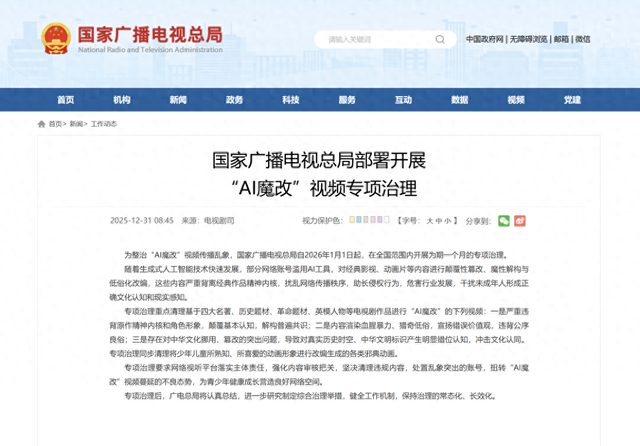
Core Viewpoint - The article discusses the rise of "AI modified" videos that distort classic literature and historical figures, leading to a crackdown by the National Radio and Television Administration starting January 1, 2026, to address the chaos surrounding their dissemination [1][2]. Group 1: AI Modified Videos and Their Impact - "AI modified" videos are not merely harmless entertainment but involve significant alterations to classic works and historical figures, often resulting in vulgar and violent content [2][5]. - The proliferation of these videos poses three main dangers: undermining the core spirit of classic works, misguiding youth's values, and disrupting the content industry by pushing out original works [5][6]. Group 2: Legal and Regulatory Concerns - The creation of "AI modified" videos may infringe on copyright laws, as significant alterations to protected works require permission from original rights holders [6][9]. - The National Radio and Television Administration's initiative aims to clarify the boundaries between legitimate creative expression and malicious modifications, ensuring that innovation respects historical integrity and promotes positive values [8][10]. Group 3: Industry Response and Future Directions - Major platforms like Douyin, Kuaishou, and Bilibili have reported the removal of numerous "AI modified" videos, indicating a collective effort to maintain content quality and protect cultural heritage [8]. - The ongoing governance efforts are seen as a starting point, with plans for continuous regulation to adapt to the rapid evolution of AI technology in content creation [10].
新华网科技观察丨给“AI魔改”戴上“紧箍咒”
Xin Hua She· 2026-01-16 12:20
Core Viewpoint - The article discusses the rise of "AI-modified" videos that distort classic literary works and historical figures, leading to concerns about cultural integrity and legal implications. The National Radio and Television Administration (NRTA) is initiating a month-long campaign starting January 1, 2026, to address the chaotic spread of these videos [2][4]. Group 1: AI-Modified Videos and Their Impact - "AI-modified" videos are not merely harmless entertainment; they often involve the subversion and vulgarization of classic works and historical figures, using generative AI technology to produce content that is low-quality and sensational [5][6]. - The proliferation of these videos poses significant risks, including the distortion of cultural values, misleading youth perceptions, and disrupting the content industry by pushing out original works [7][8]. Group 2: Legal Risks and Regulatory Actions - The NRTA's campaign aims to combat the misuse of technology, with platforms like Douyin and Kuaishou reporting the removal of over 11,000 violating videos, including those that misrepresent classic literature and promote violence [4][9]. - Legal experts highlight that unauthorized modifications to copyrighted works may infringe on various rights, including adaptation rights and the rights of performers, potentially leading to criminal charges under the Law on the Protection of Heroes and Martyrs [8][10]. Group 3: Recommendations for Creators - Creators are advised to verify copyright ownership before using any content, ensure their work demonstrates originality, and maintain a clear distinction between legitimate commentary and infringing modifications [10][11]. - The NRTA plans to develop comprehensive governance measures post-campaign to ensure ongoing regulation of AI-generated content, indicating that this initiative is just the beginning of a longer-term strategy [10].


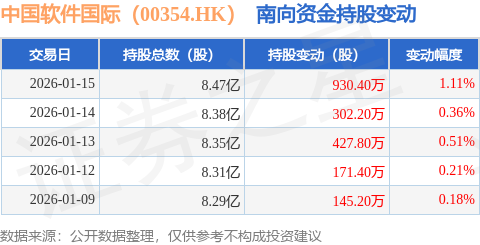
中国软件国际(00354.HK):1月15日南向资金增持930.4万股
Sou Hu Cai Jing· 2026-01-15 20:21
Group 1 - The core point of the article highlights that southbound funds have increased their holdings in China Software International (00354.HK) by 9.304 million shares on January 15, 2026, with a total net increase of 19.77 million shares over the past five trading days [1][2] - Over the last 20 trading days, southbound funds have increased their holdings on 9 days, resulting in a cumulative net increase of 8.768 million shares [1][2] - As of now, southbound funds hold 847 million shares of China Software International, accounting for 31.01% of the company's total issued ordinary shares [1][2] Group 2 - China Software International is an investment holding company that provides global technology software and information technology services [2] - The company operates through two main divisions: Technical Professional Services and Internet Information Technology Services [2] - Its primary business includes the development of generative artificial intelligence (AIGC), sales of large model software and hardware, and digital transformation consulting services for enterprise resource planning (ERP) models [2] - The company's main products include the "Question Series" solutions, large model application integrated machines, and Lingxi AI application platforms, serving sectors such as water conservancy, transportation, government platforms, military, energy, education, and finance [2]
去年前11个月我国软件业务收入同比增长13.3%,软件ETF(159852)去年吸金近44亿元
Mei Ri Jing Ji Xin Wen· 2026-01-06 07:32
Core Viewpoint - The A-share market showed strong performance with the Shanghai Composite Index rising by 1.5%, reaching a nearly ten-year high, driven by significant gains in software concept stocks [1] Group 1: Market Performance - The software sector saw notable increases, with stocks like Tonghuashun rising over 12%, Zhinan Zhen over 9%, and Caifu Trend over 8% [1] - The software ETF (159852) tracking the CSI Software Service Index increased by 2.46% due to the positive market sentiment [1] Group 2: Industry Fundamentals - The Ministry of Industry and Information Technology reported that from January to November 2025, China's software and information technology services industry performed well, with software business revenue reaching 139.777 billion yuan, a year-on-year growth of 13.3% [1] - The total profit of the software industry was 16.954 billion yuan, reflecting a year-on-year increase of 6.6% [1] - Software business exports amounted to 56.89 billion USD, with a year-on-year growth of 8.1%, maintaining positive growth for nine consecutive months [1] Group 3: Industry Trends - Analysts suggest that China's software and information technology services industry is transitioning from scale expansion to high-quality development, driven by the increasing demands for reliability, security, and intelligence in digitalization [1] - Emerging technologies such as generative artificial intelligence (AIGC), large models, cloud-native solutions, and open-source collaboration are becoming key engines for industry transformation and upgrading [1][2] Group 4: Future Outlook - In the context of escalating global technological competition, the need for self-controlled foundational software is essential for national security and sustainable industrial development [2] - Future foundational software companies will face higher technical requirements and stronger competitive pressures, but this also presents more market opportunities [2]
打出“无广告牌”,蚂蚁阿福要在AI医疗赛道突出重围
3 6 Ke· 2026-01-04 01:59
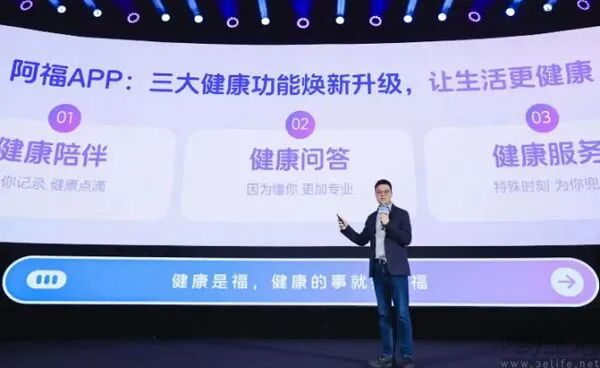
Group 1 - Ant Group's AI health application "Ant Aifu" has made a strong statement asserting that its answers are free from commercial advertisements and rankings, emphasizing its neutrality [1] - The application has been upgraded from "AQ" to "Ant Aifu," introducing three core functions: health companionship, health Q&A, and health services, aiming to transform from a tool to an "AI health friend" [3][5] - The marketing strategy includes high-profile endorsements and extensive advertising, but the focus remains on building user trust in a sensitive healthcare domain [3][5] Group 2 - The application claims impressive metrics such as over 15 million daily active users and a training dataset exceeding one trillion medical model training data, but merely presenting data may not effectively capture user trust [5] - Users prioritize safety and trust in healthcare, which is why Ant Group emphasizes its commitment to maintaining professional objectivity and not promoting any drugs or medical institutions [5][9] - The historical context of the "Wei Zexi incident" highlights the importance of transparency and trust in healthcare services, as past failures in online medical advertising have led to significant public concern [9][10] Group 3 - The potential for AI-generated content to be influenced by external marketing practices raises concerns about the neutrality of AI models, as they are based on existing data and can be manipulated [12][13] - The integrity of AI models is at risk from data poisoning, which can compromise the accuracy of outputs, emphasizing the need for Ant Aifu to maintain a clean training dataset [12][13] - Ant Aifu's commitment to neutrality and the purity of its data training set is framed as a long-term promise to users, beyond just a one-time declaration [13]