财政平衡

Search documents
马来西亚增税重构财政平衡
Jing Ji Ri Bao· 2025-07-02 22:03
Group 1 - Malaysia has implemented significant adjustments to the Sales and Service Tax (SST) starting July 1, imposing a 5% to 10% sales tax on non-essential and luxury goods, while expanding the service tax scope [1][2] - The new tax policy aims to broaden the tax base and increase fiscal revenue while selectively avoiding essential goods to mitigate the burden on the general public [1][4] - Luxury items such as imported salmon, high-end fruits, and truffles are taxed at 5%, while high-value collectibles like antiques and luxury cars are taxed at 10%, reflecting the government's consideration of consumer spending capacity [1][2] Group 2 - The expansion of the service tax includes sectors like leasing, construction, financial services, education, and beauty services, addressing long-standing gaps in the tax base [2][3] - The tax reform is part of the "Prosperous Economy" reform framework, emphasizing sustainable fiscal policies and social inclusivity while avoiding taxes on basic necessities [2][4] - Measures have been introduced to alleviate the impact on small and medium-sized enterprises (SMEs), including exemptions for those with rental income below 500,000 MYR (approximately 117,900 USD) [3][4] Group 3 - The additional tax revenue will be allocated to enhance public services, expand cash assistance, and improve infrastructure and healthcare resources, aiming to reduce the budget deficit from approximately 4.3% in 2024 to 3.8% in 2025 [4] - The tax reform is designed to maintain basic government operations while gradually building a more robust tax system, balancing moderate adjustments with progressive reforms [4] - The government asserts that the tax burden will not increase on essential goods for the general public, but higher-income individuals will contribute more to address future economic pressures [4]
美银美林简评特朗普“大漂亮”法案:既不能实现财政平衡,也无法显著刺激增长
Hua Er Jie Jian Wen· 2025-06-13 06:30
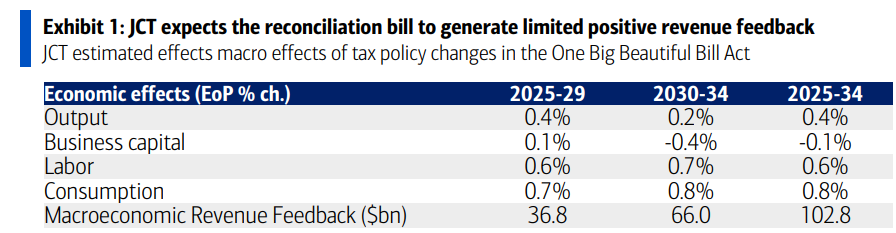
Core Insights - Bank of America Merrill Lynch warns that Trump's "Big Beautiful Plan" will not achieve fiscal balance through growth effects and will provide limited economic growth stimulus [1][2] Group 1: Economic Impact - The plan is estimated to cost $2.3 trillion but will only generate $102.8 billion in revenue feedback, resulting in a self-financing ratio of only 4.5% [2][3] - To achieve self-financing, GDP needs to grow by approximately 9% by the fiscal year 2034, which is deemed nearly impossible [2][3] Group 2: Growth Projections - The Joint Committee on Taxation (JCT) projects that the plan will only increase GDP by an average of 3 basis points over the next 10 years, with a maximum increase of 0.4% by the fiscal year 2034 [3][4] - Economic effects from 2025 to 2034 are projected as follows: Output increase of 0.4%, Business capital decrease of 0.1%, Labor increase of 0.6%, and Consumption increase of 0.8% [3][4] Group 3: Comparison with Other Estimates - The Tax Foundation estimates that the plan will lead to a long-term GDP growth of 0.8%, covering about one-third of its costs [4] - The Wharton School predicts a GDP growth of 0.4% in the first decade, raising the annual growth rate from 1.8% to 1.85% [4] - The Yale Budget Lab suggests that the plan may raise growth rates from 1.8% to about 2% by 2027, but federal debt will eventually reverse this effect [4]

每日投行/机构观点梳理(2025-05-22)
Jin Shi Shu Ju· 2025-05-23 02:20
Group 1: Market Outlook - Morgan Stanley is optimistic about the Chinese stock market, with a baseline expectation for the MSCI China Index at 80 and a target for the CSI 300 Index at 4150 points [1] - UBS sees foreign capital inflow as a significant trading logic for the Chinese stock market in the coming quarters, with Hong Kong stocks expected to outperform A-shares [1] - Deutsche Bank analysts express concerns about fiscal balance in countries outside the US, highlighting Japan's low demand for 20-year bonds as a sign of fiscal stress [1] Group 2: Economic Indicators - Barclays analysts predict a potential further decline in the US dollar, but strong economic data may limit the extent of the drop [2] - ANZ analysts note that the downgrade of the US credit rating by Moody's has reignited interest in gold due to concerns over economic slowdown and rising inflation [3] - CBA forecasts gold prices to reach $3750 per ounce in Q4, driven by safe-haven demand and a weakening dollar [4] Group 3: Industry Insights - CICC reports that the domestic nutrition and health food industry has significant long-term growth potential, with a market size exceeding $35 billion [5] - CITIC Securities indicates that the pesticide industry in China is accelerating consolidation, with leading companies enhancing competitiveness through mergers and acquisitions [6] - CITIC Securities also highlights that the domestic wind turbine industry is expected to enter a phase of simultaneous growth in volume and price due to improved supply-demand dynamics [7]
德意志银行:投资者正在担心美国以外的国家的财政平衡
news flash· 2025-05-21 13:40
Core Viewpoint - Concerns about fiscal balance are not limited to the United States, with Japan's recent bond auction demand hitting a 10-year low, indicating broader global debt worries [1] Group 1: Debt Levels - The debt-to-GDP ratios for the US and UK stand at 100%, while Japan's is significantly higher at 250% [1] - In 1999, the debt-to-GDP ratios for these countries were much lower, at 41% for the US, 42% for the UK, and 113% for Japan [1] Group 2: Bond Market Dynamics - The current environment presents unprecedented challenges for the long-term bond market, as it has not been experienced in over 30 years amid high global debt levels [1] - An increase in bond supply is anticipated in the coming years, creating a pressing need for inflation control in the long-term market [1]

墨西哥财政部长:墨西哥有理由相信2025年的经济增长和财政平衡预期将在预期范围内。
news flash· 2025-05-12 13:27
Core Insights - The Mexican Finance Minister expresses confidence that economic growth and fiscal balance expectations for 2025 will remain within anticipated ranges [1] Economic Outlook - The Mexican government believes that the economic growth forecast for 2025 is optimistic and achievable [1] - Fiscal balance expectations are also projected to align with prior estimates, indicating stability in financial management [1]