
轨道上的长三角

Search documents
上海市域嘉闵线北延伸何时开工?市交通委回应
Xin Lang Cai Jing· 2025-12-23 11:41
近日,有网友在人民网"领导留言板"询问上海市域嘉闵线北延伸工程当前处于什么阶段,是否能于2025 年内开工? 对此,上海市交通委员会答复称,市域嘉闵线北延伸工程已于2025年11月获得工程可行性研究批复,目 前正在抓紧组织相关单位开展初步设计阶段勘察设计工作。后续将在上海市、嘉定区相关部门的指导下 积极推进相关工作,力争2026年开工建设。 公开资料显示,市域嘉闵线全长44.04公里,途经嘉定、闵行2个行政区,全线共设15座车站,列车最高 运行时速160公里。按照规划,它是上海市域线网中重要的南北向主轴干线,是串联起嘉定新城、虹桥 枢纽、闵行等重要新城及交通枢纽的主要线路,也是"轨道上的长三角"中的重要组成部分。项目建成 后,将实现与市域机场线的互联互通,缓解虹桥枢纽集散压力,成为拉动西上海经济的新引擎。 智通财经记者 徐祯曜 ...
沪宁合高铁南京特大桥建设迎来新进展
Xin Lang Cai Jing· 2025-12-21 22:47
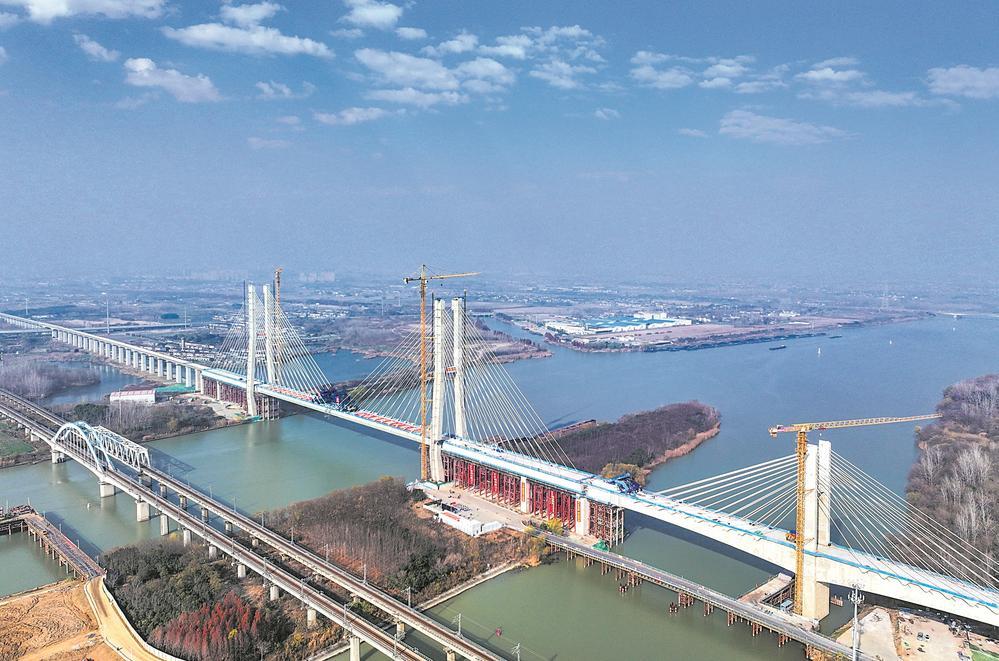
(来源:新华日报) 12月17日,沪宁合高铁南京特大桥跨蒿子圩撇洪沟连续梁拱桥主跨顺利合龙。项目建成后,将助推长三 角都市圈互联互通,对打造"轨道上的长三角"、优化沿长江地区铁路网布局、服务长江经济带高质量发 展等具有重要意义。 本报记者 赵亚玲 摄 ...
跨京杭运河斜拉桥顺利合龙
Xin Lang Cai Jing· 2025-12-19 18:23
Group 1 - The Tongtaiyang Grand Bridge, part of the Shanghai-Chongqing-Chengdu high-speed railway, has successfully completed the key construction milestone of the cross-Jinghang Canal cable-stayed bridge, laying a crucial foundation for the railway's timely operation [3] - The Tongtaiyang Grand Bridge spans approximately 172.9 kilometers, making it the longest high-speed railway bridge under construction in the world, connecting the cities of Nantong, Taizhou, and Yangzhou in Jiangsu province [3] - The Shanghai-Chongqing-Chengdu high-speed railway is a significant component of the national "Eight Vertical and Eight Horizontal" high-speed rail network, with a total length of about 2100 kilometers and a design speed of 350 kilometers per hour, linking six provinces and municipalities [3] Group 2 - The completion of the bridge will enhance the integration of rail and water transport along the Yangtze River, optimizing the comprehensive transportation system in the region and contributing to the development of the "Railway on the Yangtze River Delta" [3] - The project involves overcoming significant construction challenges, having crossed existing railways, highways, and waterways 116 times [3] - The bridge is noted for having the largest span, the tallest main tower, and the most complex technology among the key control nodes of the entire railway line [3]

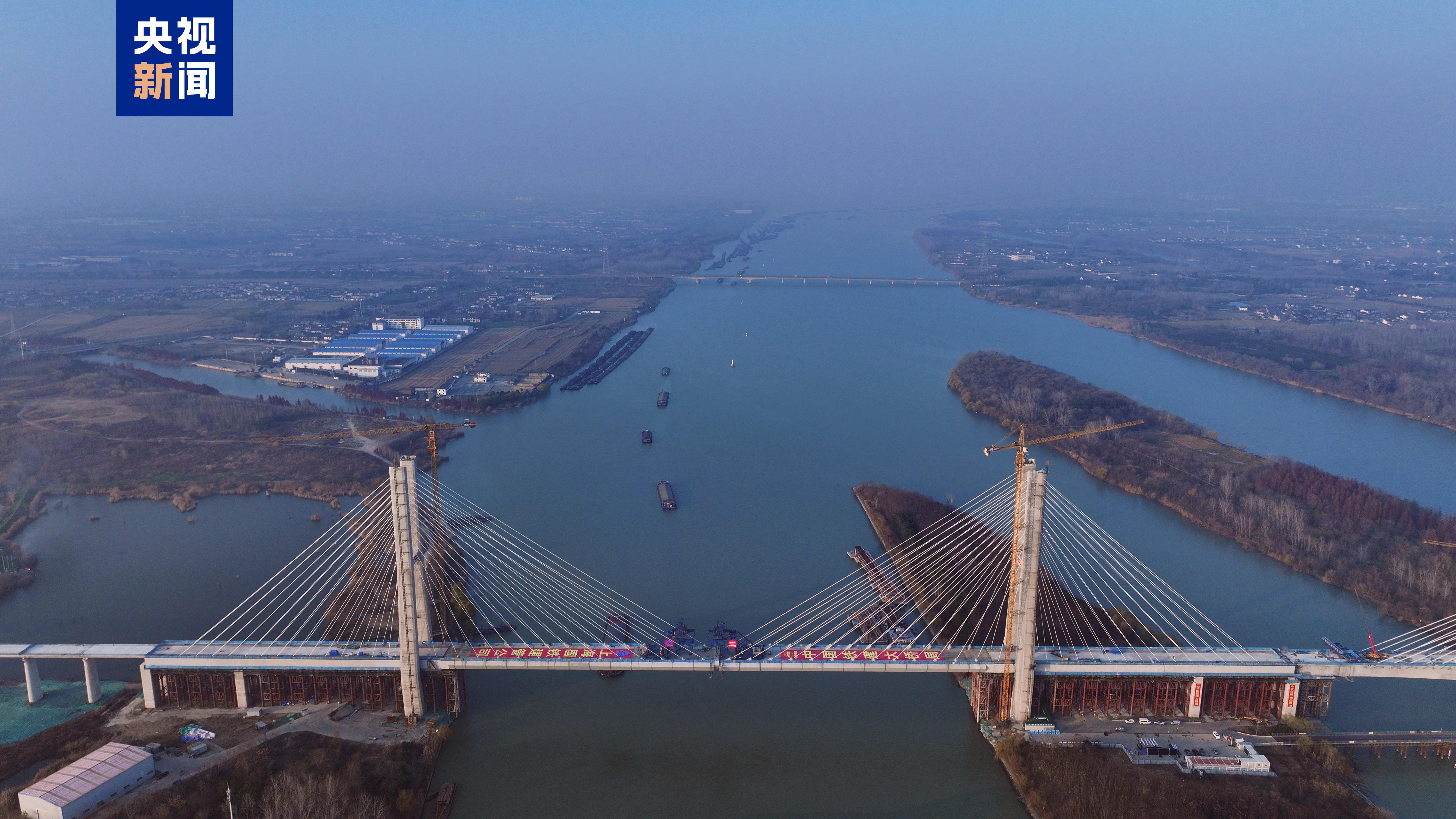
世界在建最长高铁桥梁进度刷新 跨京杭运河斜拉桥顺利合龙
Yang Shi Xin Wen· 2025-12-19 06:16
Group 1 - The Tongtai Yangtze Bridge, measuring approximately 172.9 kilometers, is currently the longest high-speed rail bridge under construction in the world, connecting the cities of Nantong, Taizhou, and Yangzhou along the northern bank of the Yangtze River [2] - The bridge construction involves overcoming significant challenges, including crossing existing railways, highways, and waterways 116 times, with the recently completed cable-stayed bridge over the Grand Canal being a key technical milestone [2] Group 2 - The Huhang-Chongqing Railway is a crucial part of the national "Eight Vertical and Eight Horizontal" high-speed rail network, spanning about 2,100 kilometers with a design speed of 350 kilometers per hour, linking six provinces and municipalities [3] - Once completed, the railway will complement the Yangtze River water transport, optimizing the comprehensive transportation system in the Yangtze River region and contributing to the high-quality development of the Yangtze Economic Belt [3]
6000亿元织密交通网!长三角“1小时都市圈”来了
Guo Ji Jin Rong Bao· 2025-12-18 11:50
Core Viewpoint - The Yangtze River Delta region has accelerated railway construction during the 14th Five-Year Plan, with total investments exceeding 600 billion yuan and adding over 2,600 kilometers of railway, marking a historic leap in regional integration and high-quality development [1] Investment and Infrastructure Development - Cumulative railway investment in the Yangtze River Delta has remained high, reaching 142.38 billion yuan in 2024 and expected to exceed 140 billion yuan in 2025 [1] - By the end of 2025, the total operational railway mileage in the region will surpass 15,000 kilometers, with high-speed rail accounting for over 8,000 kilometers [1] - Investment has increased from approximately 90 billion yuan in 2021 to over 140 billion yuan in 2025, indicating a shift towards quality and efficiency in railway development [1] Network and Connectivity - The developed road network in the Yangtze River Delta has formed a "core-led, multi-point support, interconnected" development pattern [2] - Shanghai is enhancing multi-network integration with the construction of the Shanghai East Station, while Jiangsu and Zhejiang are expanding high-speed rail coverage significantly [2] - Anhui is upgrading its transport infrastructure to connect with the Yangtze River Delta and the central-western regions, increasing its high-speed rail mileage from 2,329 kilometers in 2020 to nearly 3,000 kilometers by 2025 [2] Passenger and Freight Services - The introduction of innovative train products has matched diverse travel needs, with daily passenger flow exceeding 2 million and expected to surpass 900 million by 2025 [3] - The high-density and convenient transport services have accelerated the flow of people, capital, and technology, enhancing regional collaborative development [3] - In freight transport, the Yangtze River Delta is developing intermodal transport, with container throughput at the Beilun Port Station expected to exceed 1 million TEUs by 2025 [4] International Cooperation and Trade - The Yangtze River Delta has expanded its international freight services, with the China-Europe Railway Express operating 2,547 outbound trains in 2025, covering 36 countries [4] - The region's freight transport has diversified, with high-value goods such as automobiles and photovoltaic products now being transported [4] - Since the beginning of the 14th Five-Year Plan, the Yangtze River Delta has completed cross-border cargo transport of 10.216 million tons and dispatched 20,008 China-Europe and Central Asia trains [4] Overall Impact - The rapid development of the Yangtze River Delta railway system is reshaping the regional transportation landscape and economic development framework, providing robust support for high-quality regional growth [5]
“十四五”浙江交通投资预计达1.8万亿元
Zhong Guo Xin Wen Wang· 2025-11-11 12:37
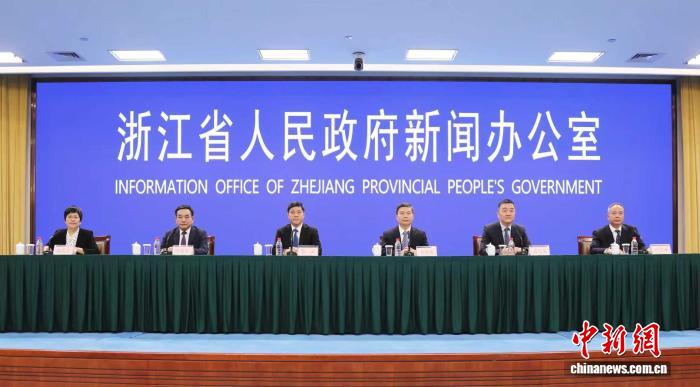
Core Insights - Zhejiang Province is expected to invest 1.8 trillion yuan in transportation during the "14th Five-Year Plan," marking a 34% increase compared to the "13th Five-Year Plan" [1] - The province has achieved a historical high in transportation investment, surpassing 400 billion yuan for the first time last year [1] Investment Highlights - The "14th Five-Year Plan" transportation investment in Zhejiang is projected to reach 1.8 trillion yuan, a significant increase from the previous plan [1] - The province's comprehensive transportation network, known as "six vertical and six horizontal" corridors, is rapidly taking shape, with 98% of the population covered by three "one-hour traffic circles" [1] Infrastructure Development - The construction of transportation infrastructure is laying a solid foundation for Zhejiang to become a high-level open province [1] - The Ningbo-Zhoushan Port has maintained its position as the world's top port in cargo and container throughput, with an international shipping center index ranking 7th globally [1] Port and Logistics Improvements - The average logistics cost for enterprises has decreased by 10% due to the "Zhejiang e-port" model, which has covered 24 domestic and international stations [3] - The "container shipping punctuality cost reduction" initiative has saved approximately 470 million yuan for enterprises this year [3] Rail Transport and Economic Integration - Daily rail traffic in the Yangtze River Delta region exceeds 2 million passengers, equivalent to the population of a city in normal flow [3] - High-speed rail services, such as the Shanghai-Hangzhou and Ningbo-Hangzhou routes, operate over 600 trains daily, with annual passenger volume exceeding 100 million [3] Future Focus Areas - Zhejiang will focus on enhancing the efficiency of its comprehensive transportation network, fostering innovative transportation productivity, and improving logistics systems [4][5] - The province aims to build a resilient transportation system while contributing to national and provincial development goals [5]
杭州湾跨海铁路桥建设提速 助力“轨道上的长三角”
Zhong Guo Xin Wen Wang· 2025-10-10 12:04
Core Viewpoint - The construction of the Hangzhou Bay Cross-Sea Railway Bridge is progressing rapidly, marking a significant step in the development of the "Railway on the Yangtze River Delta" initiative [1][2]. Group 1: Project Overview - The Hangzhou Bay Cross-Sea Railway Bridge is a key project for the newly constructed Tongzhou-Ningbo High-Speed Railway, featuring three navigation bridges and a total length of 29.2 kilometers, designed for a speed of 350 kilometers per hour [2][3]. - The South Navigation Bridge spans 814.5 meters with a main span of 364 meters, utilizing a steel truss combined beam cable-stayed bridge structure [2]. Group 2: Construction Challenges - The construction environment in Hangzhou Bay is complex, characterized by significant tidal differences, strong erosion, rapid currents, and deep mud layers, which pose high safety risks and construction difficulties [2]. - The construction team implemented continuous 11-hour operations and utilized a smart temperature control system to ensure the quality and durability of the concrete [2]. Group 3: Strategic Importance - The Tongzhou-Ningbo High-Speed Railway is an essential part of China's "Eight Vertical and Eight Horizontal" high-speed rail network along the coast, connecting multiple cities and enhancing the integration of the Yangtze River Delta region [3].
黄金周看点 | “轨道上的长三角”加速成型,过江通道为何节假日还在“添堵”?
Xin Hua Cai Jing· 2025-10-02 12:15
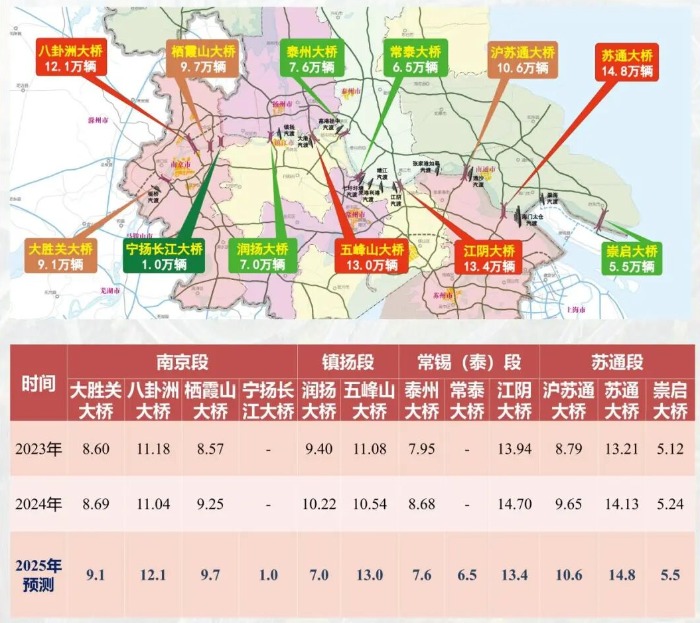
Core Insights - The congestion at the Su Tong Bridge during the Golden Week holiday highlights the ongoing challenges faced by key river crossing channels in the Yangtze River Delta region [1][4] - The surge in private car ownership is identified as the fundamental cause of congestion, with the number of vehicles in Jiangsu province increasing from 14.58 million in 2010 to 27.66 million in 2024, a nearly 100% growth [4][5] - The existing road network is unable to accommodate the rising traffic demand, leading to frequent congestion during peak travel periods [5][6] Traffic Flow and Infrastructure - The Su Tong Bridge has a designed capacity of 80,000 vehicles per day, but actual daily traffic averages between 90,000 to 100,000 vehicles, with holiday traffic peaking at 140,000 to 150,000 vehicles [5] - The overall highway mileage in Jiangsu has only increased by less than 30% during the same period, exacerbating the supply-demand imbalance [4][5] - The lack of alternative routes further intensifies congestion, as the Su Tong Bridge remains the most efficient route for many travelers [6][7] Special Factors Contributing to Congestion - Additional pressures during this year's Golden Week include increased rainfall leading to slower driving speeds, construction-related traffic restrictions on connecting highways, and the overlap of the National Day and Mid-Autumn Festival holidays [8] - The potential for traffic accidents during high-volume periods can create chain reactions, significantly increasing congestion and complicating traffic management [8] Emergency Measures and Future Developments - Local authorities have implemented emergency measures to manage traffic flow, including increased police presence and the use of real-time monitoring systems to facilitate quick responses to incidents [9] - Future infrastructure developments, such as the second Su Tong crossing expected to begin construction in 2025, aim to alleviate traffic pressure on existing channels [7]
淮宿蚌城际铁路开启全线接触网架设
Xin Hua Wang· 2025-09-23 13:15
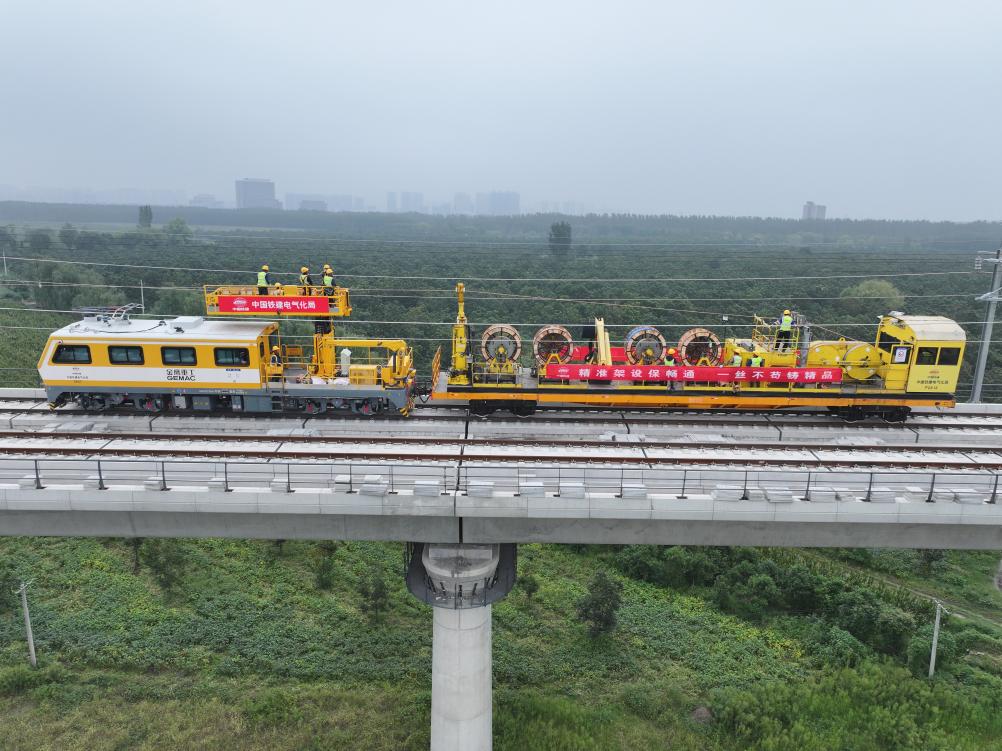
Core Points - The Huai-Su-Beng Intercity Railway has officially entered the contact network installation phase with the successful completion of the first contact wire installation [1][3] - The contact network project is crucial for the high-speed rail's power supply system, delivering a rated voltage of 27.5 kV to the trains [3] - The railway spans approximately 162 kilometers with a design speed of 350 km/h, connecting cities in northern Anhui to the Hefei metropolitan area and other regions [3] Summary by Sections - **Contact Network Installation**: The first contact wire installation marks a significant milestone in the construction of the Huai-Su-Beng Intercity Railway, which requires a total of 426.6 kilometers of contact wire to be installed [1][3] - **Importance of Contact Network**: The contact network serves as the "lifeline" of the high-speed rail's power supply, directly affecting the stability and reliability of power delivery to the trains, which is essential for safe operations [3] - **Regional Impact**: Once completed, the railway will enhance connectivity between the northern Anhui urban cluster and the Hefei metropolitan area, contributing to the development of the "Railway Triangle" and promoting regional economic coordination [3]

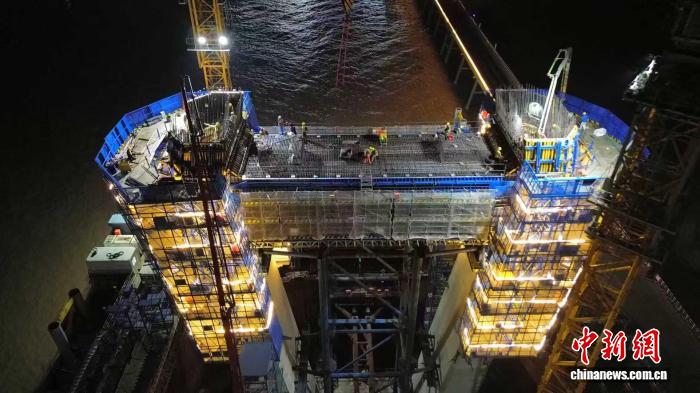
沪宁合高速铁路南京特大桥跨滁河斜拉桥主塔封顶
Zhong Guo Xin Wen Wang· 2025-09-21 05:29
Core Points - The completion of the main tower of the Nanjing Grand Bridge on the Shanghai-Nanjing-Hefei High-Speed Railway marks a significant progress in the construction, transitioning to the installation of stay cables and bridge deck construction [1][2] - The bridge spans 502 meters with a main span of 260 meters over the Chuhe River, featuring two main towers each 97.5 meters high, and is recognized as the most technically challenging and critical project in the Nanjing hub area of the railway [1] - The project utilizes a smart construction cloud platform for digital and intelligent management throughout the construction process, enhancing quality and efficiency [1] Industry Significance - The Shanghai-Nanjing-Hefei High-Speed Railway is a crucial part of China's "eight vertical and eight horizontal" high-speed rail network, serving as the eastern segment of the Shanghai-Chongqing-Rongcheng High-Speed Railway [1][2] - Upon completion, the railway will establish a rapid new corridor between the Shanghai, Nanjing, and Hefei metropolitan areas, significantly contributing to the development of the "Railway Triangle" and optimizing the railway network layout in the Yangtze River region [2]