银行估值修复

Search documents
中国银行股价创历史新高,市净率仍未修复
2 1 Shi Ji Jing Ji Bao Dao· 2025-11-21 00:31
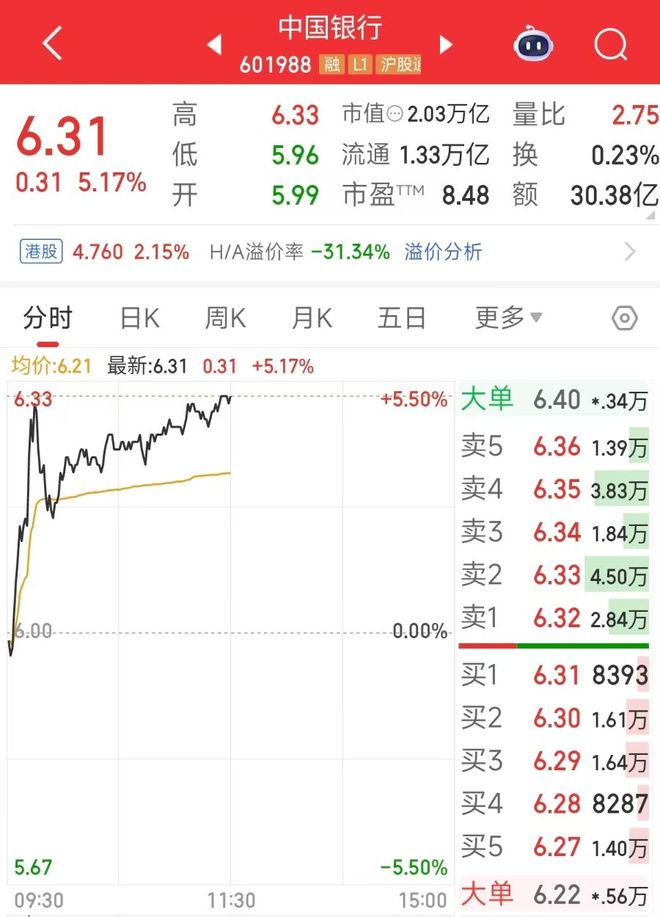
Group 1 - The banking sector experienced significant movement on November 20, with China Bank (601988.SH) reaching a historical high of 6.33 CNY per share, while Construction Bank (601939.SH) rose by 4.73% and Postal Savings Bank (601658.SH) increased by 3.84%, leading to a 1.93% rise in the banking index (881155.TI) [1] - As of the midday close, China Bank's market-to-book ratio was 0.76, indicating that it has not yet recovered to above 1, with only Agricultural Bank and China Merchants Bank among 42 A-share listed banks having a market-to-book ratio greater than 1, reflecting investor skepticism about the banks' book values [3] Group 2 - Tianfeng Securities noted that in a low interest rate environment, the divergence between loan growth and bond investment growth in banks' asset structures may become more pronounced, suggesting a reversal in the competitive landscape of the banking system [3] - Open Source Securities indicated that bond market interest rates may have reached a favorable allocation point for state-owned banks, predicting significant bond purchasing activity in Q4, while emphasizing that bank valuations remain historically low and suggesting an increase in bank sector allocations [3] - The recommendation includes allocating to large state-owned banks like Agricultural Bank and Industrial and Commercial Bank as core holdings, while also suggesting core allocations to leading comprehensive banks such as China Merchants Bank, CITIC Bank, and Industrial Bank, with flexible allocations to Jiangsu Bank, Chongqing Bank, and Chongqing Rural Commercial Bank [3]


申万宏源郑庆明:盈利新周期,估值新起点,迎银行长牛
Xin Lang Zheng Quan· 2025-11-19 10:25
Core Viewpoint - The banking sector is entering a new cycle of stable profitability, with long-term capital inflows ongoing, and a positive outlook for banks is emphasized [1][4]. Group 1: Investment Strategy - The banking sector has transitioned from a "broken net" state to a deep valuation pressure, currently at approximately 0.7 times price-to-book (PB) ratio, with previous lows at 0.49 times PB [1]. - The current environment of low interest rates is driving capital towards dividend-paying sectors, with the banking index's dividend yield at about 4.3%, significantly higher than the ten-year government bond yield [2]. - Long-term capital, particularly from insurance funds, is increasingly allocated to banks, with potential inflows estimated at around 600 billion yuan if 40% of new funds are allocated to banks [2]. Group 2: Expected Changes in Banking Fundamentals - The central bank aims to support banks in stabilizing net interest margins, which may lead to a slight year-on-year increase in interest margins in 2026 [3]. - The importance of high provisions is highlighted, as banks face narrowing space for balancing risk digestion and profit replenishment, focusing on banks with low non-performing loans and high provision ratios [3]. - Some smaller banks may face revenue growth challenges due to high base pressures in their capital market businesses, impacting their non-interest income [3]. - Capital adequacy will become a focal point, with banks that have strong internal capital and financial stability being better positioned for stable lending and dividends [3]. Group 3: Market Outlook - If the macro environment in 2026 sees a gradual recovery in Producer Price Index (PPI) and marginal increases in long-term interest rates, it will create favorable operating conditions for banks [4]. - Even under economic pressure, banks are expected to maintain clear risk thresholds and stable dividend expectations, making them attractive dividend assets in a low-interest-rate environment [4].

交通银行(601328):交通银行(601328):低估值大行,配置力量推动重估
Changjiang Securities· 2025-11-16 23:30
Investment Rating - The report maintains a "Buy" rating for the company [8] Core Views - The state-owned banks are undergoing a systematic valuation repair process, with the company currently having the lowest PB valuation among state-owned banks in A-shares, at 0.59x, which is a 26% discount compared to the average of the other five major state-owned banks [11][17] - The expected dividend yield for 2025 is the highest among state-owned banks at 4.3%, indicating significant valuation repair potential and elasticity [11][17] - Recent improvements in the company's fundamentals have not been fully priced in, with net interest margins stabilizing and asset quality indicators showing continuous improvement [11][17] Summary by Sections Valuation and Dividend Yield - The company is trading at a PB valuation of 0.59x, which is 26% lower than the average of other major state-owned banks and 17% lower than three other banks that have completed fiscal injections this year [11][17] - The expected ROE for 2025 is 8% lower than the average of three other state-owned banks, suggesting that the current valuation discount is unreasonable [11][17] - The A/H share price difference is the lowest among major banks, with H shares trading at a 12% discount, significantly lower than the average of 24% for other state-owned banks [11][17] Fundamental Improvements - Since the asset quality improvement campaign began at the end of 2019, risk indicators have shown continuous improvement, with the non-performing loan ratio decreasing by 5 basis points to 1.26% as of Q3 2025, marking a cumulative decline of 42 basis points from the peak in 2020 [11][17] - The company's provision coverage ratio reached a ten-year high of 210% as of Q3 2025, indicating enhanced risk absorption capacity [11][17] - The net interest margin has shown the best performance among state-owned banks since 2024, supporting positive growth in net interest income [11][17] Market Performance and Future Outlook - The company's stock price has declined by 9% since July 10, 2025, the largest drop among state-owned banks, primarily due to trading factors [11][17] - The current stock price is 12% lower than the price at which fiscal injections were made this year, the highest discount among four state-owned banks [11][17] - The recent acceleration of mid-term dividends among state-owned banks is expected to attract dividend-focused investors, with the company's A-share index weight at 0.78%, ranking fifth among bank stocks [11][17]

农行股价“12连阳”?市净率再“破1”
2 1 Shi Ji Jing Ji Bao Dao· 2025-10-20 09:01
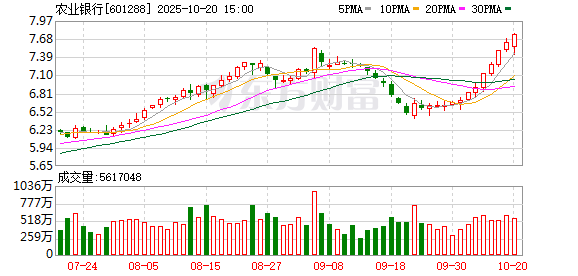
Core Viewpoint - Agricultural Bank of China (ABC) has experienced a significant rise in its A-share stock price, achieving a 12-day consecutive increase and surpassing a price-to-book (PB) ratio of 1, indicating a potential valuation recovery for bank stocks in the market [1][3]. Group 1: Stock Performance - ABC's A-share stock price reached a high of 7.76 CNY per share on October 20, closing at 7.75 CNY, with a daily increase of 1.71% [1]. - Year-to-date, ABC's A-share stock has risen by 51.65%, leading the banking sector [1]. - The total market capitalization of ABC's A+H shares is approximately 2.63 trillion CNY as of October 20 [1]. Group 2: Financial Performance - For the first half of 2025, ABC reported operating revenue of 369.94 billion CNY, a year-on-year increase of 0.8% [1]. - The net profit attributable to shareholders was 139.51 billion CNY, reflecting a year-on-year growth of 2.7%, making it the only major bank to achieve both revenue and profit growth [1]. Group 3: Investment Insights - Analysts highlight four key strengths of ABC: significant credit growth potential in county economies, leading personal deposit ratios, the lowest non-performing loan (NPL) ratio among peers, and strong provisioning for risk management [2]. - Market analysts predict a favorable environment for bank stocks in the fourth quarter, driven by potential shifts in investment strategies and historical trends indicating strong performance for bank indices during this period [2]. - The crossing of the PB ratio above 1 is seen as a pivotal moment for bank stock valuation recovery, with expectations for continued positive performance in the sector [3].

农行股价“12连阳” 市净率再“破1”
2 1 Shi Ji Jing Ji Bao Dao· 2025-10-20 08:45
Core Viewpoint - Agricultural Bank of China (ABC) has experienced a significant stock price increase, achieving a 12-day consecutive rise and breaking the price-to-book (PB) ratio of 1, indicating a potential valuation recovery for bank stocks [1][5]. Group 1: Stock Performance - ABC's A-shares reached a closing price of 7.75 yuan on October 20, 2023, with a single-day increase of 1.71%, and a year-to-date increase of 51.65%, leading the banking sector [3]. - The market capitalization of ABC's A and H shares combined is approximately 2.63 trillion yuan [3]. Group 2: Financial Performance - For the first half of 2023, ABC reported operating income of 369.94 billion yuan, a year-on-year increase of 0.8%, and a net profit attributable to shareholders of 139.51 billion yuan, up 2.7%, making it the only major bank to achieve growth in both metrics [3]. Group 3: Strategic Insights - Analysts highlight four key strengths of ABC: 1. Greater credit growth potential due to deep engagement in county economies [4]. 2. Leading position in personal demand deposits among peers, resulting in lower funding costs and stronger interest margins [4]. 3. Lowest non-performing loan ratio compared to peers, with manageable risks in real estate-related loans [4]. 4. High provisions enhancing risk absorption and profit reinvestment capabilities [4]. Group 4: Market Outlook - Analysts predict a favorable market environment for bank stocks in the fourth quarter, driven by potential shifts in investment strategies and historical trends indicating strong performance for bank indices during this period [4][5].
震荡市避风港,百亿银行ETF(512800)逆市飘红,近3日大举吸金7.6亿元
Xin Lang Ji Jin· 2025-10-13 03:07
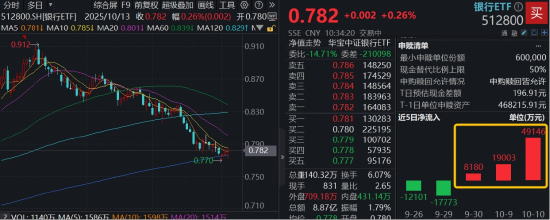
Group 1 - The overall A-share market continues to adjust, but the banking sector shows resilience, with notable gains in several banks such as Shanghai Pudong Development Bank rising over 5% and Nanjing Bank and Chongqing Rural Commercial Bank rising over 2% [1] - The bank ETF (512800) has seen a net inflow of 7.63 billion yuan over the past three days, indicating renewed investor interest in the banking sector amid increased market volatility [3] - Global perspectives suggest that Chinese banks are undervalued relative to their current ROE, reflecting market pessimism about the economy, but medium to long-term prospects remain strong due to innovation and structural opportunities [3] Group 2 - The bank ETF (512800) and its linked funds are efficient investment tools that track the performance of the banking sector, comprising 42 listed banks in A-shares [4] - The bank ETF (512800) maintains a significant scale, with an average daily trading volume exceeding 600 million yuan this year, making it the largest and most liquid among A-share bank ETFs [4] - The average static dividend yield for A-share listed banks has risen to 4.3%, and the average static PB level has decreased to 0.61x, indicating a high potential for equity returns [3]
银行行业专题:全球十年复盘:哪些银行可以跑出超额收益-国信证券
Sou Hu Cai Jing· 2025-10-10 02:25
Core Insights - The report from Guosen Securities analyzes the performance of 154 banks across 17 global markets from 2015 to 2025, highlighting the core investment logic in the banking sector and suggesting that Chinese banks are undervalued with significant potential for valuation recovery [1][2][6]. Global Banking Index Performance - Economic fundamentals are the primary drivers of banking index performance, with Indian and US banking indices leading with cumulative gains of 196% and 147% respectively from early 2015 to September 2025, benefiting from strong economic growth [1][2]. - Japanese and European banking indices, which were sluggish from 2015 to 2019, rebounded post-2021 due to the exit from zero/negative interest rates and economic recovery, achieving cumulative gains of 140% and 60% respectively [1][2]. - The Korean banking index has historically been below 0.5x price-to-book (PB) ratio, expected to recover to 0.65x by the end of 2024 after interest rate cuts [1][2]. - The Shenyin Wanguo banking index has only seen an 18% increase, with a PB ratio of 0.53x, reflecting pessimistic market expectations due to pressures from economic structural transformation in China [1][2]. Individual Bank Performance - Over 60% of the sampled banks outperformed their domestic market indices, with one-third surpassing the S&P 500 index. Notably, banks in high-growth regions like Vietnam saw stock price increases between 531% and 584% [2][6]. - Major US banks, such as JPMorgan Chase, experienced a 574% increase, while specialized banks like First Citizens Bank rose by 668% [2][6]. - In China, only two banks, China Merchants Bank and Ningbo Bank, outperformed the S&P 500, with increases of 277% and 252% respectively, indicating significant individual stock differentiation [2][6]. Valuation Insights - Chinese banks are globally undervalued, with an average PB ratio of 0.52x compared to 1.29x for 240 global banks. This is lower than South Korea (0.55x), Japan (0.82x), and the US (1.38x) [2][6]. - The disparity between PB ratios and return on equity (ROE) for Chinese banks suggests market pessimism regarding future ROE expectations. For instance, China Merchants Bank has an ROE of 14.95% with a PB of 0.97x, while JPMorgan Chase has an ROE of 18.19% with a PB of 2.57x [2][6]. Economic Resilience and Future Outlook - Despite recent economic pressures, China's economy is expected to demonstrate medium to long-term resilience, supported by innovation, industrial upgrades, urbanization, consumption, and regional development [2][6]. - The report emphasizes the potential for significant valuation recovery in Chinese banks, driven by structural economic improvements and a more optimistic outlook for the banking sector [2][6].


全球十年复盘:哪些银行可以跑出超额收益
Guoxin Securities· 2025-10-09 11:07
Investment Rating - The report suggests a positive investment outlook for quality banks in China, indicating significant valuation recovery potential [2][3]. Core Insights - The core conclusion emphasizes not to underestimate the resilience of China's economy, with a substantial space for bank valuation recovery. The investment focus should be on quality banks with stable operations and those with specialized business models [2][3]. - The report highlights that the investment in the banking sector is primarily driven by macroeconomic factors, with a strong correlation between bank profitability and economic performance [33][56]. Summary by Sections Global Banking Index Performance - The report outlines the performance of various banking indices over the past decade, noting that the Indian CNX Nifty Bank Index has seen a cumulative increase of 196%, while the Shenyin Wanguo Bank Index has only increased by 18% [5][19]. - It indicates that the Shenyin Wanguo Bank Index has lagged behind other global indices, primarily due to the economic pressures faced in China since 2022 [57][58]. Investment Recommendations - The report recommends focusing on high-quality cyclical stocks that are expected to outperform as the economic fundamentals improve, particularly in the fourth quarter and early next year [3]. - Specific banks such as Ningbo Bank and China Merchants Bank are highlighted as key investment opportunities, along with a recommendation to monitor banks like Changshu Bank and Chongqing Rural Commercial Bank [3][82]. Bank Performance Analysis - Among the 154 sample banks analyzed, 102 outperformed the domestic market index, with notable performances from banks in strong economic growth regions such as the UAE and Vietnam [82]. - The report notes that the performance of banks varies significantly based on their economic environment, governance, and market conditions, with private banks in India showing better performance compared to state-owned banks [89].



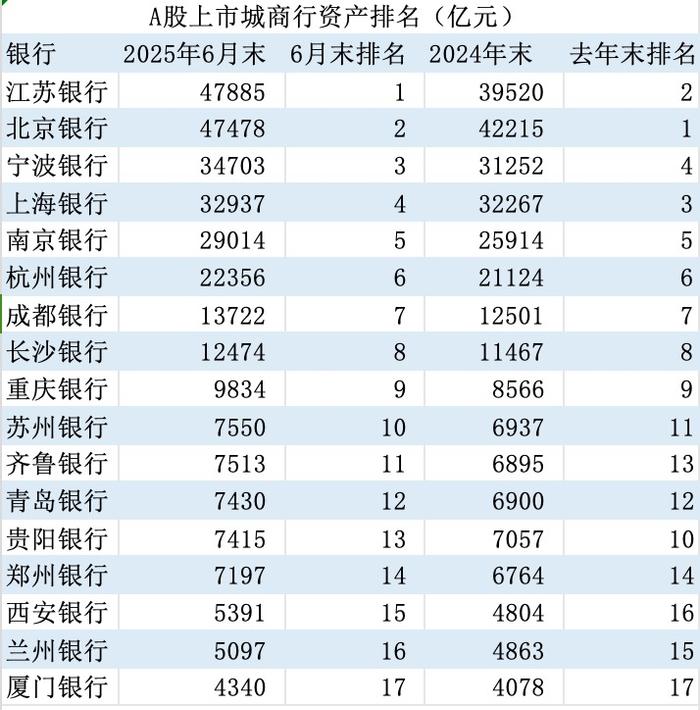
上市银行重排座次:农业银行异军突起,江苏银行新晋城商行“一哥”
Xin Lang Cai Jing· 2025-09-01 13:12
Core Insights - The report highlights the performance of 42 listed banks in A-shares as of September 1, with no significant changes in the rankings of state-owned and joint-stock banks in terms of total market value, asset scale, revenue, and net profit compared to the end of last year or the same period last year [1] - Jiangsu Bank has emerged as the leading city commercial bank in total assets, surpassing Beijing Bank, while Nanjing Bank has climbed to the third position among city commercial banks [6][7] Market Value and Revenue - The overall market value of listed banks has generally recovered, with the price-to-book ratio rising from 0.57 at the end of last year to 0.64 by the end of August [3] - Agricultural Bank of China has shown significant stock price growth, with its market value nearing that of Industrial and Commercial Bank of China, with a market value of 2.46 trillion yuan, only 715 billion yuan higher than Agricultural Bank [4] - Minsheng Bank's revenue increased by nearly 8% year-on-year, ranking first among state-owned and joint-stock banks, with a revenue of 724 billion yuan [10] Asset Scale - Agricultural Bank's total assets have grown rapidly, surpassing China Construction Bank, with a total asset scale of 52.3 trillion yuan as of June 30, accounting for approximately 11% of the total assets of China's banking industry [6][9] - Jiangsu Bank's total assets reached 4.8 trillion yuan, exceeding Beijing Bank by over 1 billion yuan, marking it as the top city commercial bank in terms of asset scale [7][8] Profitability - The net profit rankings for large banks, joint-stock banks, and rural commercial banks remained unchanged, while city commercial banks experienced significant shifts [11] - Guizhou Bank's revenue decreased by 12% year-on-year to 6.5 billion yuan, primarily due to a decline in net interest margin [10][11]


行业承压期下,平安银行做对了“加减法”
Ge Long Hui· 2025-08-28 07:22
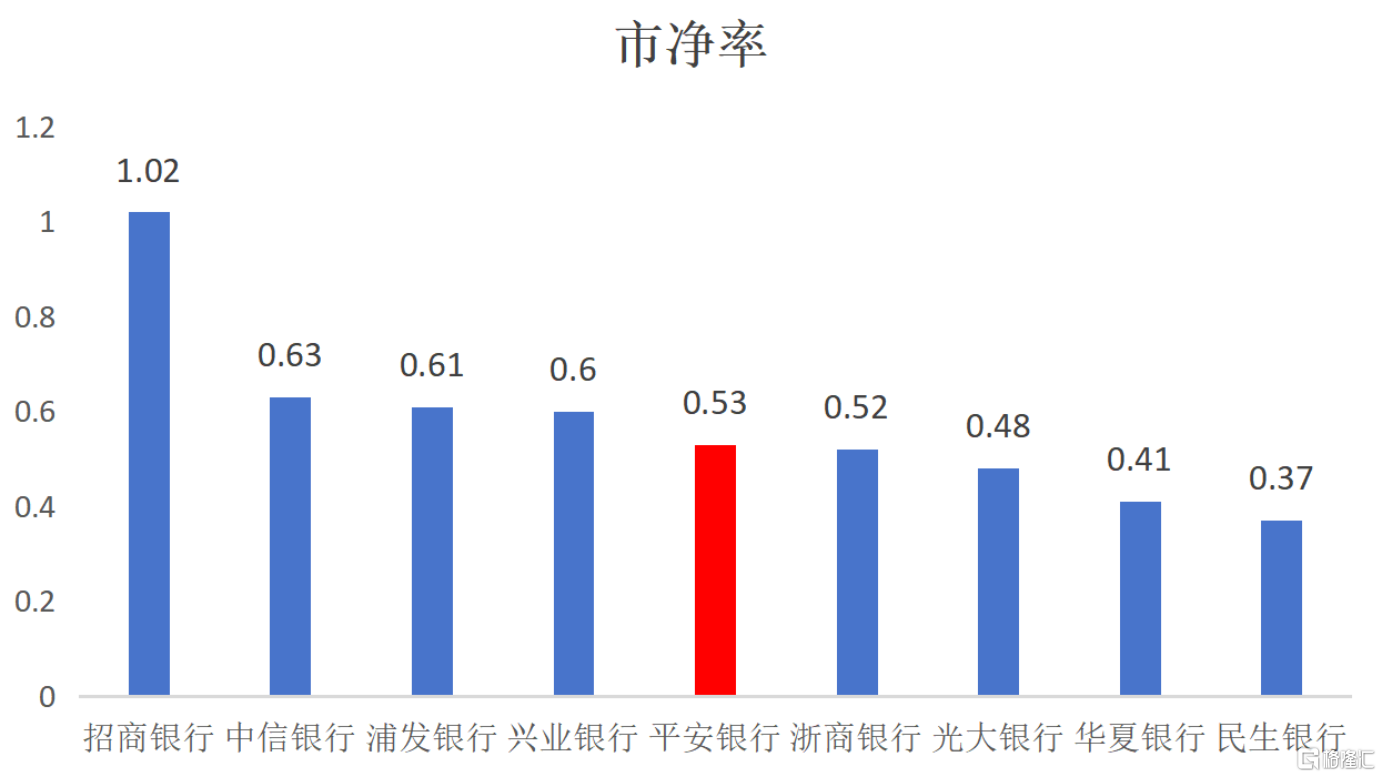
Group 1 - The A-share market has shown a steady slow bull trend this year, with the Shanghai Composite Index breaking through 3800 points and aiming for 4000 points, highlighting the importance of the banking sector as a pillar of the market [1] - In the current complex macroeconomic environment, the banking sector's stable cash flow, high dividend yield, and strong support for the real economy are crucial for the market's steady progress, making banks with low valuations increasingly attractive [1] - Ping An Bank has come into focus due to its unique operational strategy and growth potential [1] Group 2 - Ping An Bank's 2025 semi-annual report revealed operating income of 69.385 billion yuan and net profit of 24.870 billion yuan, with both core financial metrics showing a year-on-year decline, although the decline has narrowed compared to the first quarter [2] - The bank's net interest margin for the first half of 2025 was 1.80%, down 16 basis points year-on-year, impacted by the overall interest rate decline in the banking sector [2] - Despite the decline, Ping An Bank's net interest margin remains above the average of 1.55% for joint-stock banks, demonstrating strong risk resistance and operational resilience [2] Group 3 - Ping An Bank has shifted its focus from scale expansion to balancing quality and quantity, which is significant for asset quality improvement [3] - As of the end of June, the bank's non-performing loan ratio was 1.05%, a slight year-on-year decrease, indicating effective credit risk management [3] - The bank's core tier 1 capital adequacy ratio, tier 1 capital adequacy ratio, and total capital adequacy ratio were 9.31%, 10.85%, and 13.26%, respectively, showing solid foundations for future growth [3] Group 4 - The persistent issue of banks trading below their net asset value has been a concern, but improvements in asset quality and performance growth can lead to value recovery [5] - Ping An Bank's ongoing improvements in asset quality provide a solid foundation for performance growth and risk resistance, creating favorable conditions for valuation re-evaluation [5][6] Group 5 - Despite pressures in retail banking due to insufficient credit demand, Ping An Bank is committed to transforming its retail business, focusing on wealth management [7] - The bank's wealth management fee income reached 2.466 billion yuan in the first half of 2025, a year-on-year increase of 12.8% [7] - The bank has also adjusted its credit resource allocation strategy to enhance corporate business, with corporate customer numbers increasing by 6.5% [8] Group 6 - Ping An Bank's valuation remains relatively low, with a price-to-book ratio of 0.53 as of August 22, indicating potential for valuation recovery as asset quality continues to improve [8] - The bank's focus on quality growth rather than scale expansion positions it favorably for future performance and valuation re-evaluation [10]