
银行板块估值修复

Search documents
港股异动 | 内银股逆势上扬 重庆农村商业银行(03618)涨超3% 农业银行(01288)涨超2%
智通财经网· 2025-10-16 06:12
Core Viewpoint - The banking sector is experiencing a rebound despite market volatility, driven by stable fundamentals and attractive dividend yields, which are expected to attract long-term capital [1] Group 1: Stock Performance - Chongqing Rural Commercial Bank (03618) increased by 3.45% to HKD 6.6 - Agricultural Bank (01288) rose by 2.23% to HKD 5.49 - CITIC Bank (00998) gained 2.12% to HKD 7.23 - Postal Savings Bank (01658) went up by 1.7% to HKD 5.39 - Industrial and Commercial Bank (01398) climbed 1.56% to HKD 5.85 [1] Group 2: Market Analysis - Dongxing Securities noted that the banking sector has been adjusting since July due to increased market risk appetite and a shift in funding styles, but the sector's fundamentals remain robust [1] - The firm anticipates that as mid-term dividends begin to unfold, the attractiveness of bank dividends will continue to rise, providing support for long-term capital allocation [1] - The banking sector is expected to see a valuation recovery in the fourth quarter as market styles rebalance [1] Group 3: Investment Opportunities - Galaxy Securities highlighted that increased uncertainty in tariffs is causing global asset price fluctuations, creating a demand for defensive allocations, which presents opportunities for bank investments [1] - The stability of bank dividends, combined with a recent period of adjustment, has improved the attractiveness of dividend yields, likely drawing in risk-averse capital [1] - Kaiyuan Securities pointed out that after adjustments influenced by market styles, the dividend yield of the banking sector has regained its appeal, with H-shares outperforming A-shares in terms of cost-effectiveness [1]



国有大行发力,农业银行涨近3%,逼近历史高点!百亿银行ETF(512800)涨逾1%,日线强势6连阳
Xin Lang Ji Jin· 2025-10-16 05:59
Group 1 - The banking sector showed strong performance with state-owned banks leading the gains, particularly Agricultural Bank and Construction Bank, both rising over 2% [1] - Agricultural Bank approached its historical high, while other banks like Bank of China and Industrial and Commercial Bank also saw increases [1] - The Bank ETF (512800) experienced a price increase of 1.11%, marking a six-day consecutive rise with a trading volume exceeding 1.2 billion yuan [2][3] Group 2 - Long-term funds are expected to support the banking sector due to the ongoing mid-term dividend distributions and the attractive dividend yields following recent adjustments [4] - The banking sector has seen significant capital inflow, with the Bank ETF (512800) recording a net inflow of 3.893 billion yuan over the past five days, reaching a new historical high of 18.496 billion yuan [4] - The Bank ETF (512800) is the largest and most liquid among the ten banking ETFs in A-shares, with an average daily trading volume exceeding 700 million yuan this year [6]




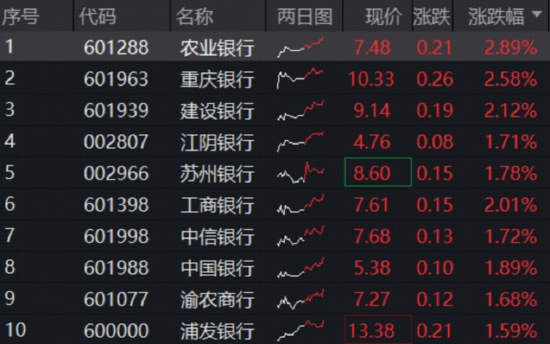
机构看好板块价值重估,银行ETF指数(512730)上涨近1%,上市银行上半年营收及利润增速双双转正
Xin Lang Cai Jing· 2025-09-04 07:18
Group 1 - The core viewpoint is that the banking sector is experiencing a recovery in revenue and profit growth, with overall operating income and net profit growth rates for listed banks turning positive [1][2] - The banking sector is expected to benefit from a stable low interest rate environment, leading investors to prefer lower-risk and more predictable return assets [1][2] - The banking sector's price-to-book (PB) ratio is considered undervalued, especially given the systemic risk concerns have been alleviated [1][2] Group 2 - Recent market conditions have led to increased long-term investments in banks by institutional investors, such as insurance funds and asset management companies [2] - The banking sector's asset quality is stable, and the pressure on interest margins is manageable, with expectations for interest margins to stabilize in the coming quarters [2] - The banking sector is anticipated to enter a new phase of stable return on equity (ROE), supported by fiscal stability and risk management from the central bank [2] Group 3 - The CSI Bank Index closely tracks the performance of the banking sector, with the top ten weighted stocks accounting for 65% of the index [3] - The top ten stocks in the CSI Bank Index include major banks such as China Merchants Bank, Industrial and Commercial Bank of China, and Agricultural Bank of China [3]




【财经分析】兴业银行2025年中报三大看点:经营韧性、“四张名片”与价值重估
Xin Hua Cai Jing· 2025-09-01 23:20
Core Viewpoint - In the first half of 2025, the banking industry faces challenges such as slowing growth, narrowing interest margins, and market volatility. However, Industrial Bank has outperformed the market, demonstrating resilience and enhanced strategic execution. The bank aims to establish technology finance as its "fourth card" alongside its existing strengths in green banking, wealth management, and investment banking [2][3]. Group 1: Financial Performance - As of June 2025, Industrial Bank's total assets reached 10.61 trillion yuan, a 1.01% increase from the end of the previous year. The bank's deposits and loans also grew by 6.10% and 2.91%, respectively [3]. - The bank reported operating income of 1104.58 billion yuan, a year-on-year decrease of 2.29%, while net profit attributable to shareholders was 431.41 billion yuan, a slight increase of 0.21% [3]. - The bank's net interest margin was 1.75%, with a year-on-year decline of 11 basis points, indicating a converging trend in the narrowing of interest margins [4]. Group 2: Asset Quality and Risk Management - Industrial Bank's non-performing loan ratio stood at 1.08%, unchanged from the previous quarter, while the ratio of overdue loans decreased by 0.06 percentage points from the beginning of the year [6]. - The bank's provision coverage ratio was 228.54%, maintaining a reasonable range, and the new non-performing loans in real estate and credit cards decreased significantly [6]. Group 3: Strategic Development - The bank continues to enhance its three main business areas: green banking, wealth management, and investment banking, while also focusing on technology finance [7]. - As of June 2025, the bank's technology finance loan balance reached 1.11 trillion yuan, a 14.73% increase from the beginning of the year, leading among joint-stock banks [8][9]. - The bank plans to deepen the integration of its investment banking, asset management, and wealth management services, aiming to build a comprehensive service ecosystem [8]. Group 4: Shareholder Returns and Valuation - Industrial Bank has maintained a high dividend policy, with a dividend payout ratio of 30.73% last year, ranking second among joint-stock banks [10]. - The bank's price-to-book (PB) ratio has improved, with the average PB of listed banks rising from 0.52 at the end of 2023 to 0.67 currently, indicating potential for further valuation recovery [11]. - The bank's static dividend yield is 4.66%, placing it in the top third among state-owned and joint-stock banks [11].

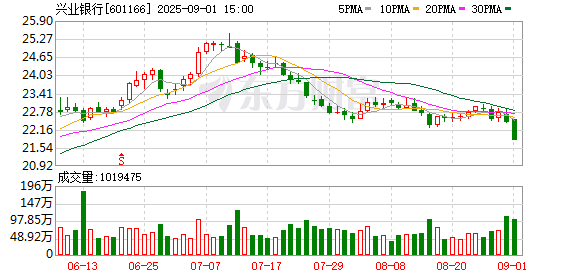
兴业银行业绩会:对可转债转股乐观,将重新安排金融债发行计划
Xin Lang Cai Jing· 2025-08-29 09:33
Core Viewpoint - The performance report of Industrial Bank shows a slight increase in total assets and a modest growth in net profit, indicating a stable financial position despite a decline in operating income [1][2]. Financial Performance - As of June 30, 2023, Industrial Bank's total assets reached 10.61 trillion yuan, a year-on-year increase of 1.01% [1]. - The bank's operating income for the first half of the year was 110.46 billion yuan, a decrease of 2.29% year-on-year, although the decline has narrowed compared to the first quarter [1]. - Net profit attributable to shareholders was 43.14 billion yuan, reflecting a slight increase of 0.21% year-on-year, with growth turning positive compared to the first quarter [1]. Convertible Bonds and Stock Conversion - The bank's management is optimistic about the conversion of convertible bonds into stocks, as the current stock price exceeds the conversion price, providing a buffer before mandatory redemption [3]. - As of June 30, 2023, 82.7% of the issued convertible bonds remain unconverted, indicating potential for future conversion [5]. - The bank's stock valuation has improved, with the price-to-book (PB) ratio increasing from 0.52 to 0.67, driven by the stabilization of the banking sector and increased investments from long-term funds [5]. Dividend Policy and Shareholder Structure - Industrial Bank has consistently increased its dividend payout ratio over the past fifteen years, with a dividend payout ratio exceeding 30% last year, ranking second among joint-stock banks [6]. - The current static dividend yield is 4.66%, placing the bank in the top third among national banks, while its PB ratio of 0.62 indicates room for valuation recovery [6]. - The bank aims to enhance the proportion of long-term stable investors through various means, including encouraging existing major shareholders to increase their holdings [6]. Net Interest Margin Outlook - The bank's net interest margin (NIM) for the first half of the year was 1.75%, down 7 basis points from the previous year, with expectations to limit the annual decline to within 10 basis points [7]. - The bank anticipates a decrease in interest expenses due to the maturity of high-interest deposits, which will positively impact NIM stability [7]. Financial Bond Issuance Strategy - The recent tax policy change regarding the issuance of financial bonds may lead to a reassessment of the bank's issuance strategy, as it could increase the cost of issuing financial bonds [10]. - The bank plans to evaluate the issuance of financial bonds in light of the new tax implications and the comparative costs with other liabilities [10].
中信证券:银行板块基本面稳中向好 绝对收益可期
智通财经网· 2025-08-18 01:18
Core Viewpoint - The banking sector is experiencing a gradual recovery in performance, with narrowing declines in net interest margins and stable asset quality, indicating a positive trend for the remainder of the year [1][2]. Financial Performance - In Q2 2025, the banking industry's net profit showed a significant improvement, with a year-on-year decline of only -1.20%, a notable recovery from -2.3% in Q1 2025, suggesting a potential positive growth rate of +0.1% for the quarter [2]. - Large banks outperformed with a net profit growth of +1.1%, while other categories like joint-stock banks, city commercial banks, and rural commercial banks showed varied results, with declines of -2.0%, -1.1%, and -7.9% respectively [2]. Revenue Contribution - The net interest margin for commercial banks in Q2 2025 was 1.42%, showing a slight decrease of 1 basis point from the previous quarter, a significant improvement from a 9 basis point drop in Q1 2025 [3]. - Non-interest income as a percentage of total income increased by 0.79 percentage points to 25.75%, indicating a faster recovery in non-interest revenue, primarily driven by market fluctuations in the bond sector [3]. Asset and Liability Management - Total assets and loans for commercial banks grew by 8.9% and 7.7% year-on-year respectively by the end of Q2 2025, reflecting a positive trend in asset expansion [4]. - The capital adequacy ratios improved, with the overall capital adequacy ratio, tier 1 capital ratio, and core tier 1 capital ratio increasing by 0.30, 0.28, and 0.23 percentage points respectively [4]. Asset Quality - The non-performing loan (NPL) ratio for commercial banks was 1.49%, showing a slight improvement from the previous quarter, while the attention loan ratio was 2.17% [5]. - The provision coverage ratio increased to 211.97%, indicating a strengthened ability to withstand risks, with large banks showing the highest coverage ratios [5].

中信证券:银行板块修复空间仍存 绝对收益仍可期待
Zheng Quan Shi Bao Wang· 2025-08-18 01:05
Core Viewpoint - The report from CITIC Securities indicates that the banking sector is experiencing a narrowing decline in interest margins, stable asset quality, and improved performance growth in the second quarter, with expectations for a continued gradual improvement in subsequent quarters of the year [1] Group 1: Banking Sector Performance - The banking sector's interest margin decline has narrowed, indicating a potential stabilization in profitability [1] - Asset quality remains stable, suggesting that banks are managing their credit risks effectively [1] - Performance growth is improving, which may lead to a more favorable outlook for the sector in the near term [1] Group 2: Future Expectations - It is anticipated that the trends observed in the second quarter will continue to improve gradually throughout the year [1] - The banking sector is expected to experience a revaluation of net assets, indicating a potential for long-term growth [1] - Short-term fluctuations may occur due to the influence of market styles and the inflow of trading funds, highlighting the importance of sustained investment [1] Group 3: Valuation Insights - The report suggests that the banking sector's valuation may remain below one times net assets, indicating room for recovery [1] - Absolute returns are still expected, emphasizing the potential for investment opportunities despite market volatility [1]
银行ETF天弘(515290)盘中V型反弹,有望冲击五连涨,机构:银行板块估值有望进一步修复
2 1 Shi Ji Jing Ji Bao Dao· 2025-06-26 03:34
Group 1 - The banking sector showed volatility on June 26, with the China Securities Banking Index rising by 0.27% at the time of reporting [1] - The Tianhong Bank ETF (515290) experienced a V-shaped rebound, increasing by 0.38%, potentially marking a five-day winning streak [1] - Notable performers among constituent stocks included Qingdao Bank and Suzhou Bank, both rising over 3%, while Ningbo Bank and Jiangsu Bank increased by over 2% [1] Group 2 - Minsheng Securities predicts that the banking sector's revenue growth is expected to stabilize by 2025, with potential for further valuation recovery [1] - In 2024, the banking sector will face performance pressures primarily due to insufficient effective credit demand, declining LPR, adjustments in existing mortgage loan rates, and reduced fees from wealth management fund sales [1] - Despite ongoing pressures in 2025, improvements in macroeconomic expectations, gradual resolution of real estate risks, and local government debt management are anticipated to alleviate concerns regarding significant fluctuations in bank asset quality, leading to further valuation recovery [1] Group 3 - Wanlian Securities highlights the attractiveness of the banking sector's dividend yield from the perspective of RMB asset allocation, alongside regulatory encouragement for insurance funds to increase market participation [2] - The introduction of the "Public Fund High-Quality Development Action Plan" is expected to guide continuous capital allocation towards the banking sector, reinforcing the valuation floor [2] - Future incremental capital is anticipated to support the sustained performance of the banking sector [2]
热点解读:长钱入市,基本面筑底,关注银行红利板块投资机会
Sou Hu Cai Jing· 2025-06-25 02:07
Core Viewpoint - The banking sector has shown strong performance in 2023, with a cumulative increase of 14.11% as of June 23, 2025, ranking first among 31 industries, driven by high dividend strategies and stable absolute returns amid global macro uncertainties [1] Group 1: Investment Trends - The banking sector features high dividend yields and low valuations, attracting long-term capital inflows [2] - Insurance capital continues to favor high-dividend equity assets, with bank valuations between 0.6-0.7 times, providing a cost-effective investment option [2] - Southbound funds have been actively buying Hong Kong and H-shares of banks, particularly state-owned banks, which have seen a significant increase in their market share [2] - Public funds are expected to increase their allocation to banks, with current allocation weights significantly lower than the sector's representation in the market [3] Group 2: Banking Fundamentals - The banking sector is expected to maintain a bottoming trend, with credit growth around 7%-8% and a gradual slowdown in the trend of deposit regularization [4] - The optimization of liability costs is expected to mitigate the impact of LPR cuts, leading to a narrowing of interest margin declines [4] - Non-interest income is showing marginal improvement, although other non-interest income sources are under pressure [4] - Asset quality remains stable, supported by ongoing government support for the real economy, although retail loan quality may face marginal deterioration [4] Group 3: Market Dynamics - The trading congestion indicators for banks have not reached previous highs, indicating room for further growth [5] - The trading volume and turnover rate of state-owned banks are significantly lower than previous market peaks, while city commercial banks are seeing increased activity [5] - Agricultural commercial banks have experienced a notable increase in trading activity, benefiting from recent market trends and index inclusions [5] Group 4: ETF Performance - The banking ETF (515020) has a dividend yield of 5.19%, a PE ratio of 7.21, and a PB ratio of 0.72 as of June 23, 2025 [6] - The Hong Kong Stock Connect Financial ETF (513190) has a dividend yield of 8.18%, a PE ratio of 6.48, and a PB ratio of 0.58 [6] - The Low Volatility Dividend ETF (159547) has a dividend yield of 5.29%, a PE ratio of 8.25, and a PB ratio of 0.84, with banks comprising 49.2% of the index [6]
杭州银行20250525
2025-05-25 15:31
Summary of Hangzhou Bank Conference Call Company Overview - **Company**: Hangzhou Bank - **Industry**: Banking, specifically focusing on city commercial banks in China Key Points and Arguments Industry and Economic Context - The restructuring of fund allocation logic towards bank stocks, combined with the economic development and infrastructure investment growth in Zhejiang Province, benefits Hangzhou Bank, which primarily focuses on urban construction-related businesses [2] - The recovery in real estate sales also positively impacts Hangzhou Bank's operations [2] Asset Quality and Financial Performance - Hangzhou Bank maintains excellent asset quality with a non-performing loan (NPL) ratio of approximately 0.76% and a provision coverage ratio exceeding 500%, significantly higher than peers [2][15] - The bank's corporate loan NPL ratio continues to decline, effectively offsetting retail loan risks [2] - The expected loan growth rate for 2025 is projected to be between 12% and 13%, driven by a credit growth rate in Zhejiang Province that exceeds the national average [2][7] Net Interest Margin and Revenue Growth - Although Hangzhou Bank's net interest margin (NIM) is not high, the significant reduction in deposit costs is expected to stabilize or even increase NIM in 2025, supporting nearly double-digit revenue growth [2][14] - The bank's asset-liability structure is advantageous, with a stable NIM and a focus on high-quality assets [4][10] Strategic Developments - The entry of New China Life Insurance as the fourth strategic shareholder is anticipated to enhance collaboration in bancassurance business, improving strategic cooperation efficiency [2][25] - Hangzhou Bank has a first-mover advantage in the sci-tech finance sector, although its current market share in this area is relatively low [2][11] Market Opportunities and Challenges - The ongoing economic development in Zhejiang Province, particularly in the tech sector, is expected to positively influence Hangzhou Bank's long-term growth [5] - The real estate market in Hangzhou is showing signs of recovery, with positive growth in sales area since Q4 2024, which will benefit mortgage lending and asset quality management [6] - The bank's focus on government-related loans, which constitute about 46% of its loan portfolio, positions it well against rising retail loan risks [8][9] Future Outlook - The bank's capital adequacy ratio is projected to rise to 9.8%-9.9%, providing a solid foundation for future expansion and strategic investments [22] - The expected return on equity (ROE) for 2024 is forecasted to be between 16% and 18%, with a stable outlook for the following years [20] - Hangzhou Bank's valuation is currently low, with a projected price-to-book (PB) ratio of approximately 0.82 for 2025, with potential for upward adjustment post-convertible bond pressure relief [24] Investment Recommendations - Hangzhou Bank is recommended as a core investment due to its potential to reach a PB ratio of one and its strong fundamentals, which could drive overall valuation increases in the city commercial banking sector [26] Additional Insights - The bank's conservative risk appetite and strong asset quality provide a competitive edge, with expectations for profit growth and ROE to remain industry-leading over the next three years [23] - The bank's strategy includes optimizing its loan structure and increasing the proportion of corporate and government-related loans while exploring growth in the sci-tech finance sector [12][16]
