餐饮创业

Search documents
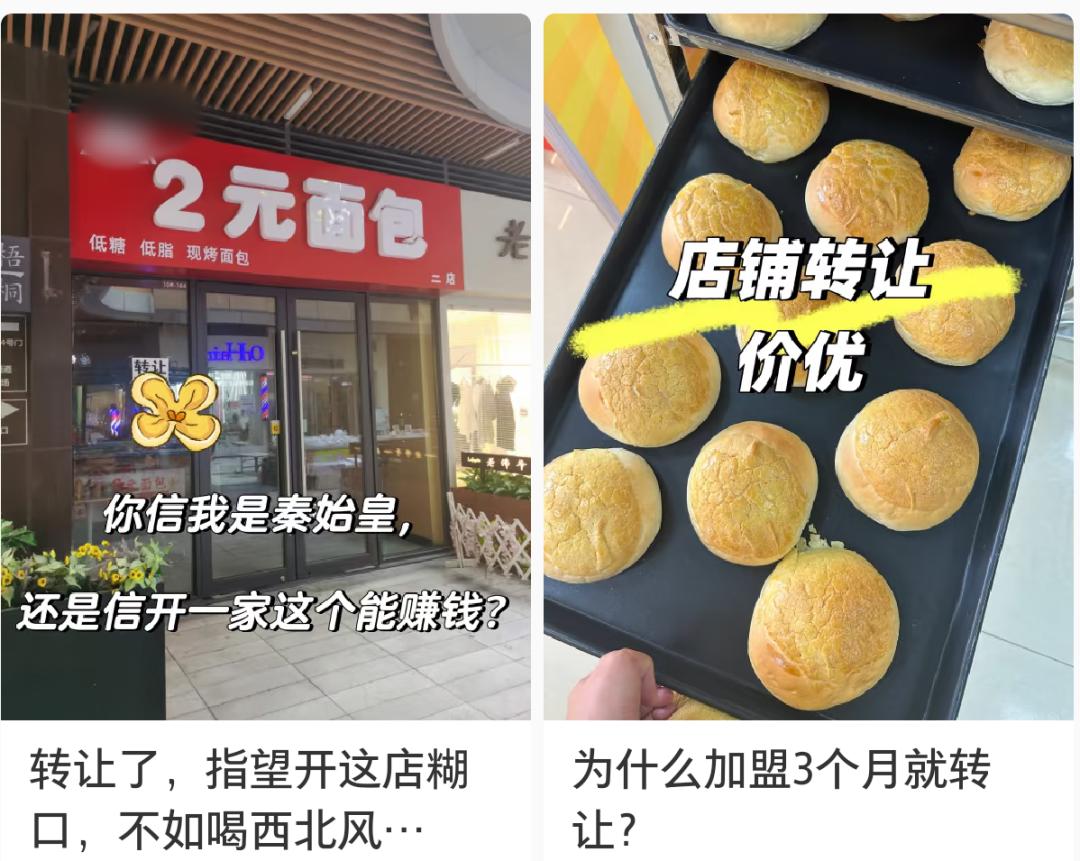
开业10天就倒下,2元面包、7元生烫牛肉米线……批量“收割”创业者
3 6 Ke· 2025-05-19 12:21
Core Insights - The rapid rise of low-cost food outlets, such as 2 yuan bread and 7 yuan beef noodle shops, has attracted many entrepreneurs seeking quick profits, but many are facing significant losses and closures [1][2][5] - The allure of low investment and quick returns has led to a surge in these types of businesses, with reports indicating that 2 yuan bread shops are expanding at a rate of over 4,300 stores annually from 2023 to 2025 [1][6] - Despite initial high sales, many of these businesses struggle to maintain profitability, with some closing within weeks of opening due to poor location choices and intense competition [4][12] Market Dynamics - The market for low-cost food items is characterized by high customer turnover and low average spending, making it attractive for new entrants [6][9] - The average investment for opening a 2 yuan bread shop ranges from 10 to 20 million yuan, while beef noodle shops can require investments between 15 to 25 million yuan, depending on the brand [8][9] - Many entrepreneurs are drawn in by the promise of high daily revenues, with some claiming daily earnings of 8,000 to 10,000 yuan, but these figures are often exaggerated [10][12] Entrepreneurial Challenges - A significant number of new business owners lack experience in the food industry, leading to poor decision-making and high failure rates [9][10] - The oversaturation of similar food outlets in close proximity leads to customer dilution, making it difficult for individual shops to thrive [12][13] - The trend of rapidly opening and closing food businesses is creating a cycle where entrepreneurs are constantly chasing the next popular food trend, further destabilizing the market [12][13]


餐饮创业“破产三件套”,究竟坑了多少中产?
虎嗅APP· 2025-05-11 03:03
Core Viewpoint - The article discusses the challenges faced by middle-class entrepreneurs in the restaurant industry, particularly in the context of coffee shops, tea houses, and bars, which have become less profitable in recent years due to various market pressures and high competition [3][4][14]. Group 1: Entrepreneurial Trends - Nearly 40% of the new middle class in China is seeking career transitions, with a 64% increase in entrepreneurship since 2021 [3]. - The restaurant sector remains a popular choice for entrepreneurs due to its low entry barriers and large market demand, despite recent downturns [4][14]. Group 2: Challenges Faced by Middle-Class Entrepreneurs - Many middle-class entrepreneurs enter the restaurant business driven by passion rather than necessity, leading to a lack of practical business acumen [8][10]. - High fixed costs and low net profits characterize the restaurant industry, making cash flow management critical for survival [15][18]. - The economic downturn has shifted consumer behavior towards more rational spending, negatively impacting luxury dining experiences [18][19]. Group 3: Market Competition and Saturation - The restaurant market is increasingly saturated, with many similar establishments diluting customer interest and loyalty [20]. - Independent coffee shops and bars struggle against well-established chains that benefit from brand recognition and economies of scale [22][23]. Group 4: Future Outlook and Recommendations - Despite the current challenges, the number of new restaurant openings remains high, indicating ongoing interest in entrepreneurship [25]. - Entrepreneurs must recognize the complexities of the restaurant business and develop a comprehensive understanding of the industry to succeed [28].

餐饮创业“破产三件套”,究竟坑了多少中产?
Hu Xiu· 2025-05-10 23:24
Group 1 - The core viewpoint of the articles highlights the challenges faced by middle-class entrepreneurs in the restaurant industry, particularly in coffee shops, tea houses, and bars, which have become less profitable in recent years [3][30]. - A report indicates that nearly 40% of the new middle class in China is seeking career transitions, with a significant increase in entrepreneurship, particularly in the restaurant sector [1][29]. - The restaurant entrepreneurship market is characterized by high fixed costs and low net profits, making cash flow critical for survival [18][31]. Group 2 - Middle-class entrepreneurs often enter the restaurant business not out of necessity but for personal interests or lifestyle aspirations, leading to a disconnect between their expectations and the harsh realities of the market [7][12]. - Many entrepreneurs, like Xiao Yu and An Qi, underestimated the difficulties of running a restaurant, resulting in failures due to a lack of market understanding and overconfidence [10][19]. - The economic downturn has led to a shift towards rational consumption, negatively impacting the restaurant sector, especially those focused on luxury experiences [22][30]. Group 3 - The restaurant industry faces severe competition and market saturation, with many similar establishments diluting customer interest and loyalty [24][28]. - The rise of chain brands has intensified competition, making it difficult for independent shops to survive due to their lack of brand recognition and marketing resources [26][28]. - Despite the challenges, the enthusiasm for restaurant entrepreneurship remains high, driven by ongoing employment issues and workplace pressures [29][30]. Group 4 - The complexity of the restaurant business requires a deep understanding of various operational aspects, from supply chain management to customer service, which many entrepreneurs fail to grasp [31][32]. - The current market environment is particularly harsh for individual entrepreneurs, necessitating a long-term commitment and continuous skill enhancement to succeed [35][36].