
DCF估值模型

Search documents
降息预期卷土重来! 市场真金白银押注“全球资产定价之锚”跌向4%
智通财经网· 2025-06-25 00:46
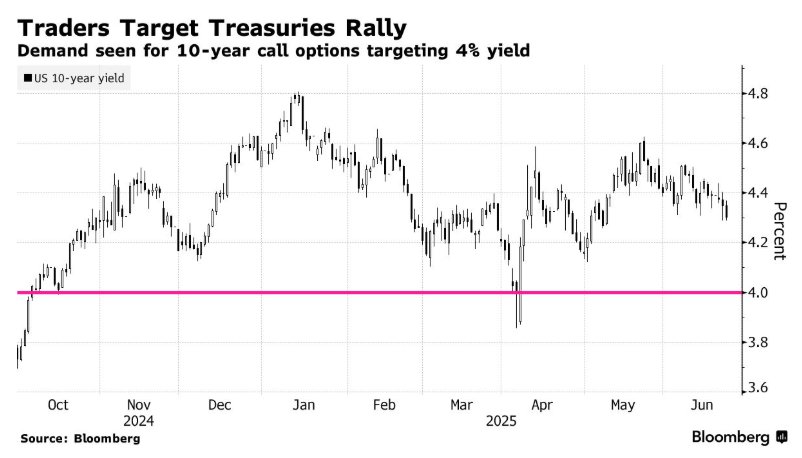
Core Viewpoint - Traders in the U.S. Treasury market are heavily betting on a decline in the 10-year Treasury yield, driven by expectations of a potential interest rate cut by the Federal Reserve in July, as indicated by Chairman Powell's dovish signals in Congress [1][4][5] Group 1: Market Expectations and Movements - Significant options betting has occurred, with at least $38 million in premiums paid for call options on 10-year Treasury bonds, targeting a drop in yields to 4% or below [1][4] - The market is pricing in a 50 basis point rate cut this year, with expectations for two cuts in September and December [5][22] - The 10-year Treasury yield has recently dipped below 4.3%, marking its lowest level since early May [5][6] Group 2: Economic Indicators and Influences - The U.S. consumer confidence index fell by 5.4 points to 93, below economists' expectations, contributing to the dovish sentiment in the market [6] - The decline in consumer confidence reflects a significant drop in expectations for future business conditions, indicating potential economic weakness [6] Group 3: Options Market Dynamics - There has been a notable increase in open interest for August call options on the 10-year Treasury, indicating a strong bullish sentiment towards a yield drop [9][10] - The skew in Treasury options has shifted towards a bullish stance, with traders paying higher premiums to hedge against falling yields [19] Group 4: Broader Market Implications - A decline in the 10-year Treasury yield to 4% could alleviate pressure on risk assets, particularly benefiting technology stocks and other high-growth sectors [24][25] - The current yield levels are critical as they serve as a key input in valuation models for equities, influencing the overall market sentiment [25]

战火引燃“期限溢价”,10年期美债或迎更猛烈抛售潮
智通财经网· 2025-06-16 09:59
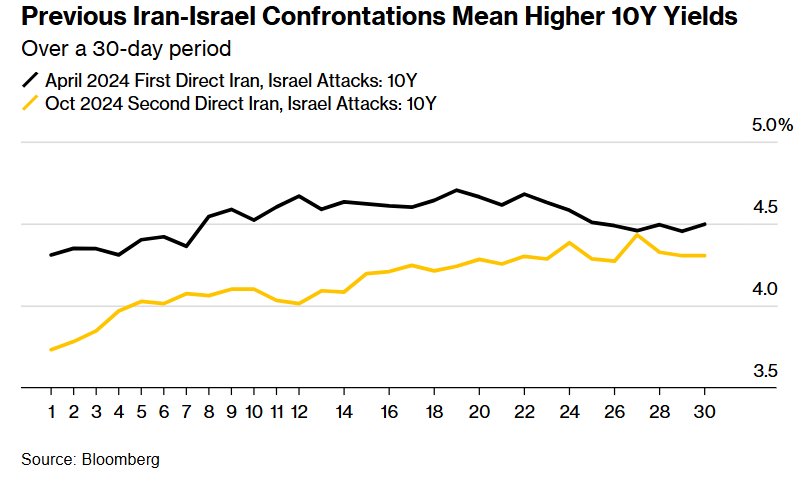
Group 1 - The latest military confrontation between Israel and Iran is expected to exert continued selling pressure on 10-year U.S. Treasury bonds, contrary to some investors' expectations of a flight to safety driving yields down [1][5] - Since the escalation of tensions into direct military conflict, the 10-year U.S. Treasury yield has risen by over 10 basis points, driven by soaring international oil prices and concerns over inflation [1][5] - Historical data indicates that previous confrontations between Israel and Iran have led to a rapid increase in 10-year U.S. Treasury yields, which remained elevated for 30 days following such events [4][1] Group 2 - The current geopolitical situation is increasing the long-term risks faced by U.S. Treasury bond investors, who are already contending with rising inflation concerns and expanding U.S. debt issues [1][5] - The yield curve for U.S. Treasuries is steepening, with the 2-year yield rising by 8 basis points since last Thursday, while shorter-term yields are on a downward trajectory [5][6] - The concept of "term premium," which compensates investors for holding long-term bonds, is expected to rise, potentially pushing 10-year U.S. Treasury yields to levels even higher than the over 5% seen in 2023 [6][5]
荣昌生物(688331):一季度业绩符合预期
Xin Lang Cai Jing· 2025-05-06 02:48
Core Viewpoint - The company's Q1 2025 performance met expectations, maintaining a "Hold" rating and target prices of HKD 29 for Hong Kong shares and RMB 40 for A-shares [1][3]. Revenue Performance - Q1 2025 revenue reached RMB 526 million, representing a 59.2% year-over-year increase and a 4.9% quarter-over-quarter increase, primarily driven by revenues from products RC18 and RC48 [1]. - The Q1 2025 revenue accounted for approximately 24% of the company's full-year revenue guidance of 30% year-over-year growth, aligning with expectations [1]. Cost Management and Net Loss - R&D expenses for Q1 2025 were RMB 329 million, a decrease of 0.7% year-over-year and 14.9% quarter-over-quarter, representing 25% of the annual guidance of under RMB 1.3 billion [2]. - Sales expenses were RMB 251 million, up 33.7% year-over-year but down 23.1% quarter-over-quarter, with a sales expense ratio of 47.7%, consistent with the guidance of keeping it below 50% [2]. - Management expenses were RMB 90 million, increasing by 21.4% year-over-year but decreasing by 7.1% quarter-over-quarter, with a management expense ratio reduced to 17.1% [2]. - The net loss attributable to the parent company for Q1 2025 was RMB 254 million, a reduction of 27.2% year-over-year and 0.9% quarter-over-quarter, in line with expectations [2]. Cash Flow and Financial Strategy - As of March 31, the company had cash and cash equivalents of RMB 722 million, a slight decrease from RMB 762 million at the end of 2024, indicating that most cash outflows are covered by commercial revenues [3]. - The company plans to apply for a total credit facility of up to RMB 5.5 billion from banks and other financial institutions in 2025, suggesting a reliance on bank credit for cash flow supplementation [3]. Valuation and Future Outlook - The company maintains a "Hold" rating and target prices of HKD 29 for Hong Kong shares and RMB 40 for A-shares, with slight adjustments to net loss forecasts for 2025E/2026E/2027E due to minor revenue and gross margin adjustments [3]. - The current valuation is considered reasonable, with potential for stock price upgrades if the product Tai Tasi Pu successfully expands internationally [3].
