
HALO

Search documents
全球资金拥抱“脱虚向实”主题! “HALO”光环之下,欧洲股市迈向13年来最长月度连涨
智通财经网· 2026-02-27 10:20
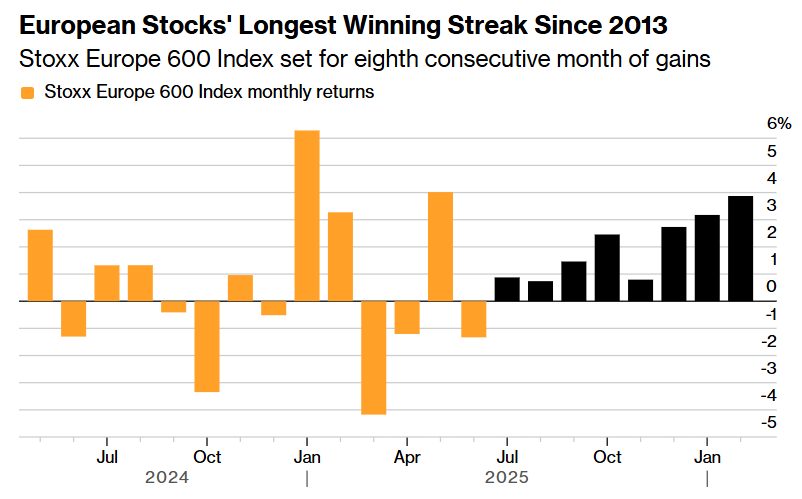
Core Viewpoint - European stock markets are on track to achieve the longest monthly winning streak since 2013, with a potential eight consecutive months of gains, driven by a shift in investor focus from the US market to Europe due to concerns over high valuations in tech stocks and the impact of AI on the digital economy [1][4]. Group 1: Market Performance - The Stoxx Europe 600 index has risen 3.6% in February and is expected to record strong gains for eight consecutive months, outperforming the S&P 500 by 6 percentage points year-to-date [1][4]. - European stock funds saw an inflow of approximately $3.2 billion this week, marking the fourth consecutive week of significant net inflows, totaling around $18 billion for the year so far [1][8]. Group 2: Sector Performance - Heavy asset sectors such as basic resources, energy, telecommunications, and utilities have shown strong performance, with some sectors experiencing double-digit increases, up to 25%, compared to a 7% rise in the Stoxx 600 index [4][7]. - Mining and healthcare stocks in the European market have performed the best, while tourism and media sectors lagged behind [1]. Group 3: Investment Trends - Investors are increasingly favoring heavy asset companies as a safe haven from the "AI disruption" narrative, leading to a significant rotation of funds into European stocks [5][6]. - The "HALO" (Heavy Assets, Low Obsolescence) stocks are gaining traction, as they are perceived to be less vulnerable to AI disruption, with a notable outperformance of 35% compared to lighter capital stocks since early 2025 [6][7]. Group 4: Economic Outlook - The recent rally in European stocks is attributed to the "heavy asset safe-haven effect" amid AI-related fears, robust corporate earnings growth, and positive economic momentum [8]. - Analysts maintain an overweight rating on European and emerging market stocks, anticipating that global capital will increasingly focus on these regions to mitigate exposure to the high valuations in the US market [8].



从软件泡沫到实体王者:华尔街为什么突然迷上HALO?
美股研究社· 2026-02-26 12:34
Core Viewpoint - The article discusses the shift in investment focus from "light" assets, driven by software and digital technologies, to "heavy" assets that provide physical infrastructure, highlighting the emergence of the HALO (Heavy Asset, Low Obsolescence) strategy as a response to the evolving AI landscape [6][10][18]. Group 1: Market Trends - Over the past two years, the U.S. stock market has been characterized by a focus on "light" assets, such as software and cloud services, which have low marginal costs [2][3]. - The rise of generative AI has led to a belief that software will dominate, but a subtle shift is occurring where heavy asset companies are regaining institutional interest [6][7]. - The HALO strategy emphasizes tangible assets like land, energy infrastructure, and manufacturing, which are becoming increasingly valuable as AI technology evolves [7][8]. Group 2: HALO Strategy Insights - The HALO strategy represents a profound redefinition of value, moving away from abstract software models to the importance of physical assets that cannot be easily replicated [7][10]. - The demand for physical resources is highlighted by the increasing energy and infrastructure needs driven by AI, which cannot be satisfied by virtual solutions alone [11][12]. - Companies in the HALO category, such as Deere & Company and FedEx, possess unique physical networks and control over essential resources, making them critical players in the modern economy [12][13]. Group 3: Investment Implications - The performance of HALO companies has outpaced high-valuation software stocks, indicating a strategic shift in capital allocation towards firms that are essential for AI operations [14][19]. - Heavy asset companies are transitioning from being viewed as defensive investments to offensive assets, leveraging AI to enhance operational efficiency and productivity [16][19]. - The article suggests that the true winners in the AI era will be those companies that combine physical resources with digital capabilities, creating a dual barrier to competition [16][19].

轻资产神话终结?HALO逻辑背后的资本迁徙
美股研究社· 2026-02-25 11:33
Core Viewpoint - The article discusses a shift in investment logic from traditional light-asset models to a focus on heavy assets with low obsolescence risk, termed HALO (Heavy Assets, Low Obsolescence) [1][2]. Group 1: Shift in Investment Focus - The emergence of AI as a highly efficient "copy machine" is leading to a reevaluation of profit distribution expectations, with traditional light-asset business models losing their premium [2][6]. - Investors are increasingly concerned with which companies are least likely to be replaced by AI, shifting the focus from "who understands AI best" to "who is hardest to replace" [2][10]. Group 2: Impact of AI on Asset Valuation - The valuation of technology companies has historically been based on light-asset models, with giants like Microsoft and Amazon thriving under this paradigm [4]. - The introduction of generative AI is changing the narrative, as it can automate tasks traditionally performed by software, leading to a potential compression of pricing power for single-function software [6][7]. Group 3: Heavy Asset Investment Opportunities - AI is not merely a software revolution but a transformation of foundational infrastructure, with significant investments projected in AI infrastructure by major cloud providers, estimated at nearly $1.5 trillion from 2023 to 2026 [9]. - The physical constraints of AI development, such as power supply and cooling systems, are becoming critical bottlenecks, making companies that can address these issues central to the AI economy [10][12]. Group 4: Long-term vs. Short-term Trends - The HALO strategy may represent a long-term trend rather than a temporary shift, as the demand for energy and computing power driven by AI is expected to be sustained [12][13]. - However, there are risks associated with potential overcapacity in computing power investments, which could lead to a reassessment of heavy asset valuations if AI monetization does not meet expectations [12][14]. Group 5: Broader Implications of HALO - The HALO logic emphasizes the importance of physical infrastructure in the AI era, suggesting that the future flow of profits may increasingly favor those involved in building and maintaining this infrastructure rather than just software developers [14]. - The article concludes that understanding this shift is crucial for investors, as it reflects a fundamental change in wealth distribution and the underlying logic of the economy in the AI age [14].

大摩交易员:“AI恐惧”可能已到达顶峰,如果没有,那么买HALO吧
硬AI· 2026-02-25 09:46
Core Viewpoint - Morgan Stanley's trading division believes that the market's fear of AI disrupting traditional industries has peaked, and investors concerned about AI's impact should consider "HALO" trades, which involve investing in high-barrier, low-obsolescence physical assets as a hedge against uncertainty brought by AI [1][2]. Group 1: Market Sentiment and Stock Performance - Recent market sentiment was catalyzed by a briefing from AI company Anthropic, which indicated a preference for "cooperation" rather than "replacement" between AI and existing software vendors, leading to a rebound in previously shorted software stocks [1]. - Despite the S&P 500 index remaining stable since late October last year, there has been unprecedented internal market differentiation, with significant capital inflows into AI beneficiary stocks and semiconductors, while software assets were indiscriminately sold off [1][5]. - The divergence in stock performance is highlighted by a 24% pullback in the growth vs. value stock return spread and an 11% decline in the S&P 500 information technology and consumer discretionary sectors, driven by increasing "AI disruption fears" [5][10]. Group 2: Fund Flows and Positioning - Hedge fund flows have exacerbated extreme positioning in the market, with significant net buying in semiconductor and AI beneficiary stocks, pushing exposure to the highest level since 2020, while infrastructure software has seen the most selling [10]. - Following Anthropic's briefing, there was a reassessment of extreme positions, with a notable rebound of about 5% in software stocks previously labeled as facing AI risks, as the market began to view AI developments as complementary to existing software systems [10]. Group 3: HALO Strategy and Investment Recommendations - For investors who believe that "AI fears" have not yet peaked, Morgan Stanley recommends buying into the HALO theme, which stands for "Heavy Assets, Low Obsolescence," focusing on tangible, high-barrier assets that are less likely to be replaced by technology [11][12]. - The HALO basket, which includes sectors like utilities, railroads, and defense, has shown significant performance, rising 28% over the past year, while stocks perceived to be at risk from AI have dropped 43% [14]. - The current positioning in the HALO sector is not crowded, with net exposure at the 53rd percentile since 2020, making it an attractive investment opportunity [14][15].

美股前瞻 | 三大股指期货齐涨,Meta(META.US)与AMD(AMD.US)达成600亿美元战略盟约
智通财经网· 2026-02-24 12:44
Market Overview - US stock index futures are all up before the market opens, with Dow futures rising by 0.23%, S&P 500 futures by 0.15%, and Nasdaq futures by 0.33% [1] - European indices show mixed results, with Germany's DAX down by 0.08%, UK's FTSE 100 down by 0.10%, France's CAC40 up by 0.03%, and Europe's Stoxx 50 down by 0.07% [2][3] - WTI crude oil increased by 0.23% to $66.46 per barrel, while Brent crude oil rose by 0.13% to $71.20 per barrel [3][4] AI Market Sentiment - Citrini Research released a report titled "2028 AI Doomsday Prediction," forecasting a dystopian future shaped by AI, predicting a surge in global AI productivity but leading to a "global economic plague" due to massive white-collar job losses [5] - The report triggered panic selling across various sectors, including software and logistics, as investors feared the impact of AI tools like Claude Cowork and OpenClaw on earnings [5][6] - IBM experienced its largest single-day drop in 25 years due to fears surrounding AI's disruptive potential, with concerns about consumer spending and loan defaults leading to economic contraction [6] Investment Strategies - Goldman Sachs highlighted the "HALO" effect, suggesting that companies with tangible, long-lasting assets are outperforming the market as investors seek safe havens from AI-related sell-offs [7] - The focus is on heavy asset companies that are less likely to be disrupted by AI, indicating a shift in investment strategies towards more stable sectors [7] Corporate Developments - Home Depot (HD.US) reported Q4 revenue of $38.2 billion, a 3.8% year-over-year decline, but exceeded expectations by $1 billion, with adjusted EPS of $2.72, surpassing estimates by $0.20 [9] - Meta (META.US) and AMD (AMD.US) announced a strategic partnership worth up to $60 billion over five years for AI chips and related hardware, marking a significant shift in Meta's role in the supply chain [9] - Apple (AAPL.US) is expanding its Houston facility for Mac Mini assembly, part of a broader $600 billion investment commitment to the US [10] - Novo Nordisk (NVO.US) reported significant weight loss results from a mid-stage trial of an experimental drug in China, showing a reduction of up to 19.7% in participants' weight [11] - Amazon (AMZN.US) plans to invest $12 billion in data centers in Louisiana to support its cloud computing and AI needs, reflecting the competitive landscape in cloud services [11]


