开源模型

Search documents
中国企业调用大模型日均超10万亿Tokens 阿里通义份额第一
Zheng Quan Ri Bao Wang· 2025-09-01 06:11
Core Insights - The report by Frost & Sullivan indicates a significant surge in the usage of enterprise-level large models in China, with a projected 363% increase in daily usage by the first half of 2025 compared to the end of 2024, currently exceeding 10 trillion tokens [1] Group 1: Market Growth - The enterprise-level large model usage in China is expected to experience explosive growth, with a daily average usage projected to reach 10 trillion tokens by 2025 [1] - The report highlights that Alibaba Tongyi holds the largest market share at 17.7%, making it the most chosen large model by Chinese enterprises [1] Group 2: Open Source Models - The report anticipates that as domestic models like Qwen and DeepSeek continue to be open-sourced in 2025, the performance gap between open-source models and top international closed-source models will nearly close [1] - It is projected that over 80% of enterprises will adopt open-source large models in the future, indicating that open-source models will drive a new wave of growth in the enterprise market [1]

企业级大模型报告:阿里通义第一
Yang Zi Wan Bao Wang· 2025-09-01 04:59
Core Insights - The report by Frost & Sullivan indicates that the Chinese enterprise-level generative AI market is experiencing explosive growth, with a projected daily consumption of 10.2 trillion tokens by the first half of 2025, marking a 363% increase from the second half of 2024 [1][2] Group 1: Market Overview - The daily consumption of enterprise-level large models in China is expected to exceed 10 trillion tokens by mid-2025, with Alibaba Tongyi leading the market with a 17.7% share [1] - The top three players in the market, Alibaba Tongyi, ByteDance Doubao, and DeepSeek, collectively hold over 40% of the market share [1] Group 2: Deployment Trends - 70% of enterprises are opting for public cloud deployment or utilization of large models, with 71% indicating plans to increase their use of generative AI services in public cloud formats [2] - There is a shift from seeking the "strongest single model" to finding the "optimal solution for specific business scenarios," indicating a growing demand for tailored models [2] Group 3: Open Source Models - Open source models are becoming a key growth driver in the enterprise-level large model market, with predictions that over 80% of enterprises will adopt open source large models in the future [2] - The performance gap between domestic open source models and top international closed-source models is narrowing, with models like Qwen and DeepSeek leading the way [2] Group 4: Alibaba's Developments - Alibaba Tongyi has recently open-sourced several new foundational models, including Qwen3-Coder and Qwen-Image, leading to a surge in global interest in Chinese models [3] - Alibaba has open-sourced over 300 models, establishing itself as a leader in the global open-source model market, surpassing competitors like OpenAI and Llama [3] - The Qwen3-Coder model saw a dramatic increase in usage, with a 1474% rise in one week, making it the second most used model in the programming field globally [3]
中国企业调用大模型日均超10万亿Tokens
Zheng Quan Shi Bao Wang· 2025-09-01 03:31
人民财讯9月1日电,9月1日,国际市场调研机构沙利文(Frost&Sullivan)发布了最新的《中国GenAI市场 洞察:企业级大模型调用全景研究,2025》显示,中国企业级大模型调用呈爆发式增长,2025年上半年 日均调用量较2024年底实现363%的增长,目前超10万亿Tokens。其中,阿里通义占比17.7%位列第一。 沙利文报告认为,预计未来超过80%的企业将采用开源大模型,预示着开源模型将驱动企业级市场的新 一轮增长。 ...
路线图出炉!未来十年,AI改变中国
Hua Xia Shi Bao· 2025-08-30 09:44
Group 1 - The State Council released an opinion on August 26 to implement the "Artificial Intelligence +" initiative, aiming to deeply integrate AI with various sectors and reshape production and living paradigms [1][2] - The opinion outlines a clear roadmap for AI development in China over the next decade, with goals for 2027, 2030, and 2035, including achieving over 70% penetration of new intelligent terminals and agents by 2027 [2][3] - Key actions and foundational support capabilities are detailed in the opinion, focusing on technology, industry development, consumer quality, public welfare, governance, and global cooperation [4][6] Group 2 - Companies like MiniMax and Jieyue Xingchen expressed strong support for the opinion, indicating their commitment to leveraging AI in various industries, with MiniMax planning to provide enterprise-level services [3][5] - The opinion emphasizes the importance of AI in enhancing public welfare, particularly in healthcare, with a focus on improving grassroots medical services through AI applications [5][6] - The document highlights the need for a robust action framework to support the ambitious goals set forth, including the development of a secure and controllable AI ecosystem [6][7]

OpenAI之后,xAI也开源了!马斯克:中国公司将是最强大对手
Mei Ri Jing Ji Xin Wen· 2025-08-24 22:20
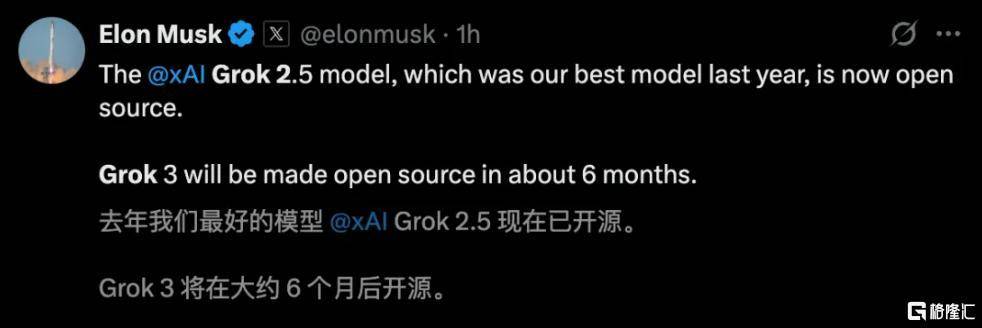
Group 1 - Tesla CEO Elon Musk announced the open-sourcing of xAI's best model Grok-2.5 (actually Grok-2) and plans to open-source Grok-3 in approximately six months [1] - xAI specifies that commercial use of the model is only permitted for associated companies with annual revenue below $1 million; otherwise, separate permission is required [1] - The Grok App has been updated to version 1.1.58, featuring enhanced image generation speed, more engaging Companions functionality, and Vision mode now available for all Android users [1] Group 2 - Both Musk and OpenAI CEO Sam Altman have recently highlighted strong competition from Chinese AI companies [2] - OpenAI released two "open-weight" models, GPT-oss-120b and GPT-oss-20b, in response to competition from Chinese models like DeepSeek [2] - DeepSeek officially announced the release of DeepSeek-V3.1, which includes significant upgrades such as a hybrid reasoning architecture and improved efficiency [3] Group 3 - The official app and web model have been upgraded to DeepSeek-V3.1, allowing users to switch between thinking and non-thinking modes [4] - DeepSeek-V3.1 supports the Anthropic API format, facilitating integration with the Claude Code framework [5] - DeepSeek-V3.1 utilizes UE8M0 FP8 Scale parameter precision, designed for upcoming domestic chip releases [5]

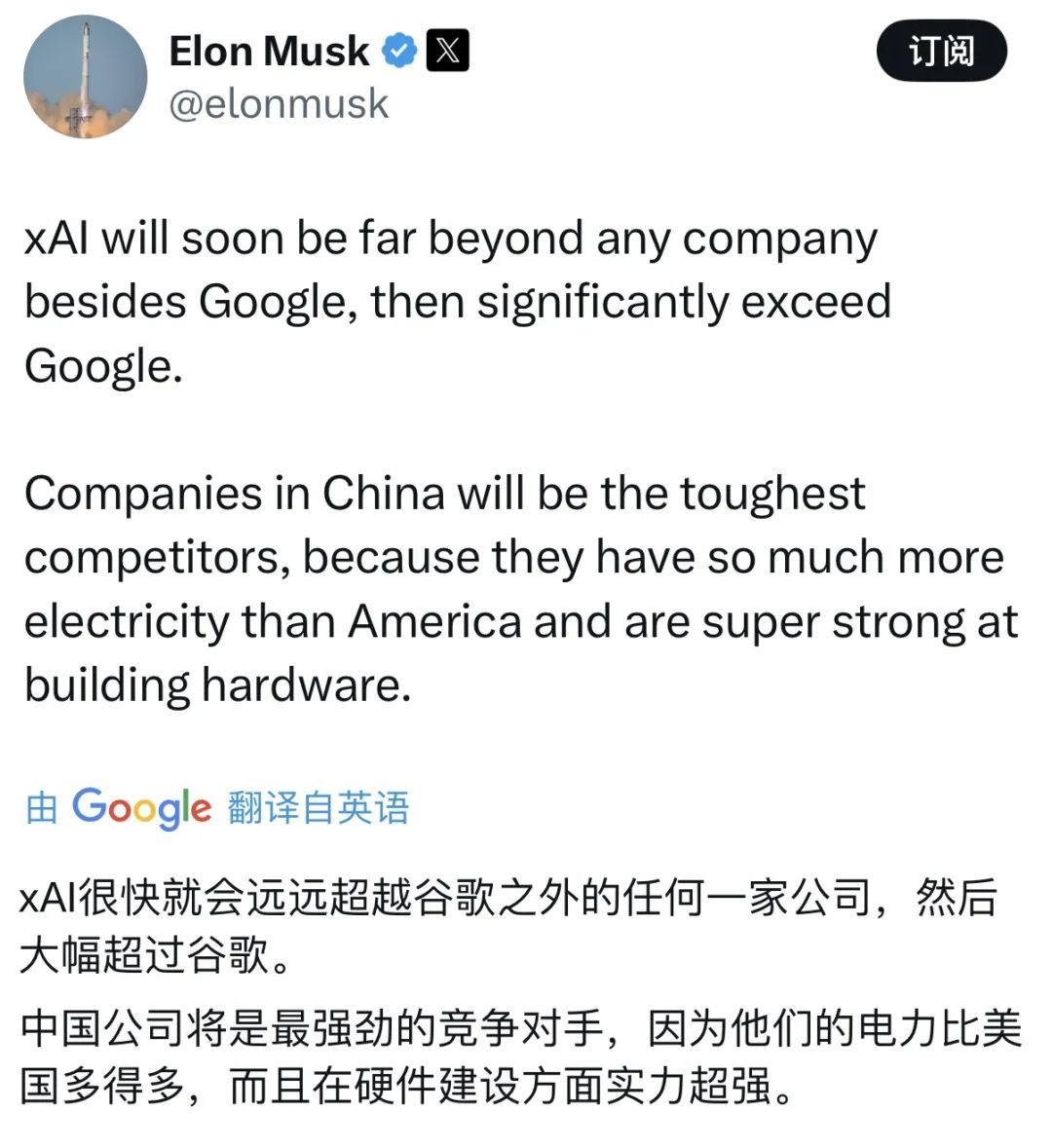
马斯克终于开源Grok-2,称“中国公司将是最强大的对手”
第一财经· 2025-08-24 10:09
Core Viewpoint - The article discusses the recent open-sourcing of xAI's model Grok-2.5 by Elon Musk, highlighting the competitive landscape in AI, particularly the challenges posed by Chinese companies due to their superior hardware capabilities and energy resources [3][5]. Summary by Sections Open-Sourcing Announcement - Elon Musk announced the open-sourcing of Grok-2.5, with Grok-3 expected to be released in approximately six months [3]. - The open-sourcing of Grok-2 fulfills a previous commitment made by Musk during the model's initial release [5]. Model Performance - Grok-2 was noted for its strong performance in coding, complex problem-solving, and mathematics, comparable to GPT-4o at the time of its release [5]. - However, Grok-2 currently ranks outside the top 20 in benchmark tests, with a score of 28, while leading models like OpenAI's GPT-5 and Grok-4 score 69 and 68 respectively [6]. Model Specifications and Usage Restrictions - Grok-4, released in July, has a training volume 100 times that of Grok-2, with future releases planned for programming models, multi-agent systems, and video generation [9]. - The open-source license for Grok-2 is considered strict, allowing non-commercial and compliant commercial use only if the associated company's annual revenue is below $1 million. Higher revenue companies require separate permission from xAI [9]. - The model requires substantial computational resources, specifically 8 GPUs with over 40GB of memory each, making it less accessible for individual developers [9]. Comparison with Competitors - OpenAI's recent open-source models are more developer-friendly, allowing operation on high-end laptops and mobile devices, contrasting with xAI's stringent requirements [10]. - The competitive landscape is intensifying, with both Musk and OpenAI's CEO Sam Altman acknowledging the strong competition from Chinese AI models, which influenced OpenAI's decision to release open-weight models [11].

马斯克终于开源Grok-2,称“中国公司将是最强大的对手”
Di Yi Cai Jing Zi Xun· 2025-08-24 09:45
Core Insights - xAI has officially open-sourced its best model Grok-2.5, with Grok-3 expected to be open-sourced in approximately six months. CEO Elon Musk claims xAI will soon surpass all companies except Google, with Chinese firms being the strongest competitors due to their superior power supply and hardware capabilities [1]. Group 1: Model Release and Performance - The open-sourcing of Grok-2 fulfills a promise made by Musk during its initial release, where he stated that previous versions would be open-sourced with each new release [2]. - Grok-2 was noted for its strong performance in coding, complex problem-solving, and mathematics, comparable to GPT-4o at the time of its release. However, it currently ranks outside the top 20 in benchmark tests, with Grok-4 and GPT-5 leading the scores [2][5]. - Grok-4, released in July, has a training volume 100 times that of Grok-2, indicating significant advancements in model capabilities [5]. Group 2: Open Source Licensing and Accessibility - xAI's open-source license is considered stringent, allowing non-commercial and compliant commercial use only if the associated company's annual revenue is below $1 million. Higher revenue companies require separate permission from xAI [5]. - In contrast to xAI, OpenAI's recent open-source models are more accessible for small to medium developers, allowing operation on high-end laptops and mobile devices, thus lowering barriers for emerging markets and resource-constrained industries [6]. - Grok-2's open-sourced files total approximately 500GB, requiring substantial computational resources (8 GPUs with over 40GB memory each) for operation, which may limit accessibility for individual developers [5].
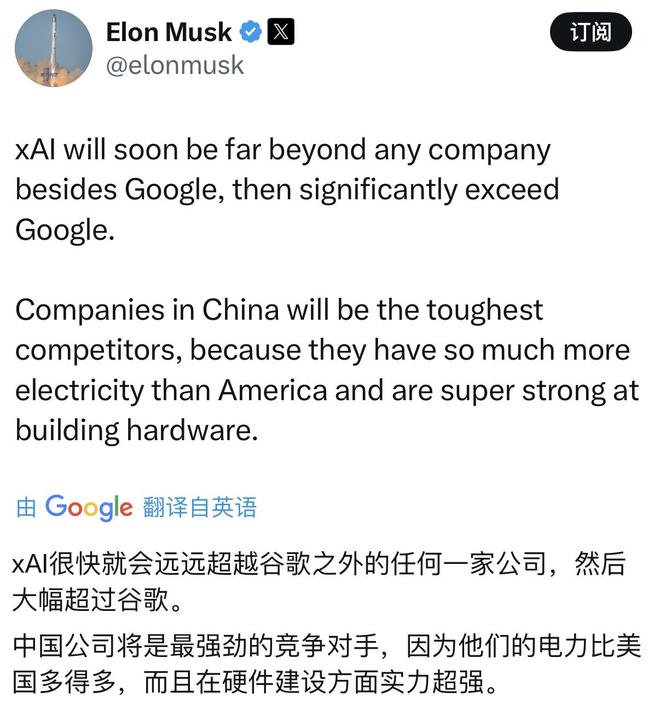
钢铁侠的AI帝国崛起?马斯克“掀桌”开源Grok 2.5,明年Grok 3!
Sou Hu Cai Jing· 2025-08-24 06:01
Group 1 - The core point of the articles revolves around the competitive landscape of AI, particularly focusing on Elon Musk's xAI and its recent developments in open-source AI models [1][2][3] - xAI has announced the open-sourcing of its Grok 2.5 model, with plans to release Grok 3 in approximately six months, allowing non-commercial and compliant commercial use for companies with annual revenues below $1 million [1] - The Grok 2.5 model consists of 42 files totaling around 500GB, and it has demonstrated strong performance in coding, complex problem-solving, and mathematics, comparable to GPT-4o [1] - Musk has expressed confidence that xAI will surpass all companies except Google, identifying Chinese companies as the biggest competitors in the AI space [2] Group 2 - xAI is reportedly planning a new round of financing with a target valuation of up to $200 billion, which would position it as one of the highest-valued AI companies globally [3] - The company is currently experiencing significant cash burn, reportedly spending around $1 billion per month [3] - There are concerns regarding privacy issues related to Grok AI, with reports indicating that over 370,000 AI chat records have been published and indexed by search engines, posing a risk to user privacy [3]
走进办公室,美国投资巨头合伙人惊讶:都在用中国AI?
Guan Cha Zhe Wang· 2025-08-22 07:28
Core Insights - The article highlights the increasing influence of Chinese open-source AI models in the global market, with a significant number of startups in Silicon Valley reportedly using these models [1][2] - The competitive landscape is shifting, as Chinese companies focus on open-source development while American firms, like OpenAI, are pressured to adapt their strategies in response to this trend [2][5] Group 1: Chinese AI Models - Chinese startup DeepSeek has gained global attention by releasing an advanced AI model for free, marking a significant shift in the AI landscape [1] - The performance of Chinese open-source models has outperformed similar models from American companies like Meta in various intelligence tests conducted this year [2] - The competitive enthusiasm among Chinese developers is raising alarms in the West, indicating a potential shift in the balance of power in AI development [2] Group 2: American AI Companies' Response - OpenAI's CEO Sam Altman acknowledged the pressure from Chinese open-source models, leading to a change in their model release strategy [2][5] - OpenAI recently launched two open-weight models, gpt-oss-120b and gpt-oss-20b, marking a strategic shift towards increasing accessibility and expanding their developer ecosystem [5] - Despite this move, the reception of these models has been mixed, with criticisms regarding their lack of standout features compared to OpenAI's proprietary offerings [5][6] Group 3: Industry Dynamics - The article notes a trend among American companies, including Meta, to shift towards more closed models, which could hinder their competitiveness in the open-source AI space [7][8] - The divergence in strategies between Chinese and American firms is leading to significant differences in revenue generation and innovation potential [10] - The focus on open-source models in China allows for broader application scenarios, enabling easier adaptation for various sectors, while American firms prioritize proprietary models for profit [10]

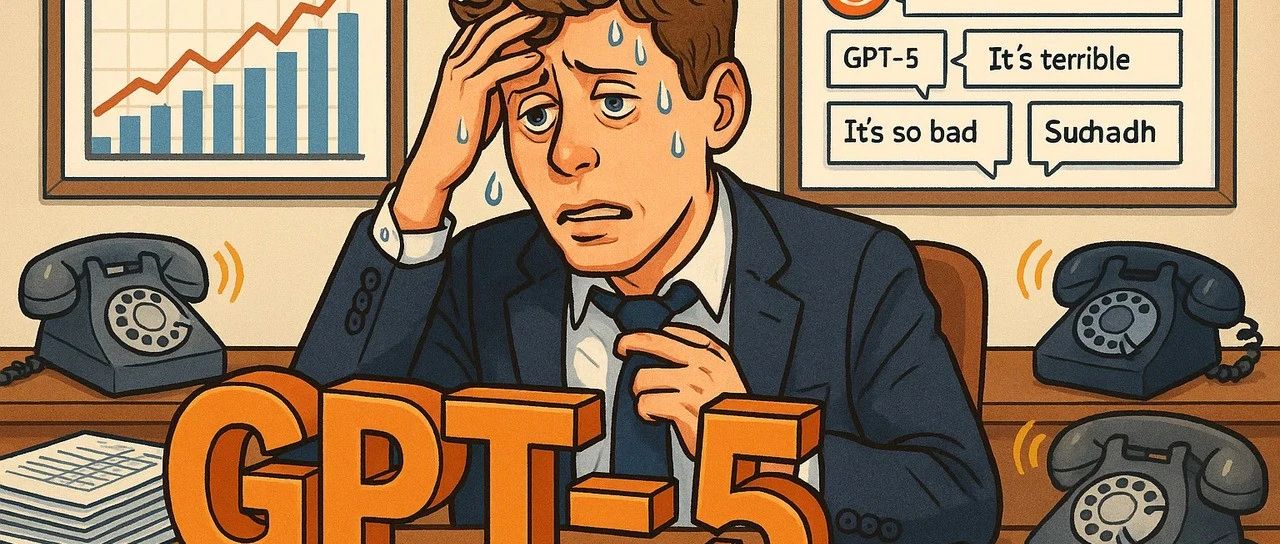
惹怒7亿用户的GPT-5,暴露了OpenAI的全部焦虑
新财富· 2025-08-19 08:05
Core Viewpoint - GPT-5 has not introduced a new paradigm in artificial intelligence as expected, but rather represents a gradual technological upgrade [2][44]. User Experience - Ordinary users find it difficult to perceive significant improvements in GPT-5, as existing models already meet basic needs [3]. - The performance enhancements of GPT-5 are primarily in coding and agent tool usage, which are beyond the average user's requirements [3][4]. - Users expressed dissatisfaction with GPT-5 compared to GPT-4o, leading to a movement to restore the older model due to perceived loss of personality and engagement [10][13]. OpenAI's Strategic Challenges - OpenAI faced backlash after discontinuing older models without notice, which was seen as a cost-cutting measure [6][7]. - The company’s marketing strategies have backfired, leading to operational issues and user dissatisfaction [6][16]. - OpenAI's user base reached 700 million weekly active users, with subscription fees constituting 42.5% of total revenue, highlighting the importance of user retention [14][41]. Competitive Landscape - OpenAI is under pressure from competitors like Anthropic, which has made significant strides in coding applications [20][28]. - The rise of open-source models, particularly from Chinese companies, poses a threat to OpenAI's market dominance [19][20]. - Cursor, an AI programming startup, has achieved rapid revenue growth and is a notable competitor in the coding space [25][28]. Strategic Shifts - OpenAI is pivoting towards open-source models with the introduction of the GPT-oss series, aiming to regain market share [35][36]. - The company is also exploring new revenue streams by enhancing its API offerings and government contracts [37][39]. - GPT-5 is designed as a unified model system to optimize costs and improve user experience, addressing the challenge of high operational costs associated with free users [39][42]. Future Outlook - OpenAI's future strategies include expanding into consumer applications beyond ChatGPT, indicating a shift in focus [43]. - The company aims to create a complete commercial ecosystem around GPT, addressing gaps in API subscriptions and government markets [44].