智能化升级

Search documents
玉禾田业绩交流会:智领环卫新赛道 机器人+环卫打开成长新蓝海
Zheng Quan Shi Bao Wang· 2025-05-19 02:21
Core Viewpoint - The company, Yuhua Tian (玉禾田), has successfully implemented a "digital intelligence transformation" strategy, leading to significant growth in revenue and profit despite increasing competition in the sanitation industry. The company aims to continue expanding through intelligent upgrades and business diversification [1][4]. Financial Performance - In 2024, the company reported a revenue of 7.203 billion yuan, representing a year-on-year increase of 16.93% - The net profit attributable to shareholders reached 575 million yuan, with a growth rate of 10.40% - The return on equity remained high at 14.83%, indicating strong financial health [1]. Strategic Initiatives - The company has established a dual-core technology system that integrates a digital brain and vertical large models, enhancing service efficiency in urban operations through comprehensive monitoring and intelligent scheduling [2]. - Yuhua Tian has developed a collaborative innovation mechanism that combines hardware intelligence and software platformization, breaking traditional service boundaries and promoting smart transformation [2]. Market Expansion - The company's "City Steward" strategy has proven effective, with operations now covering 17 provincial-level administrative regions and 60 new projects added in the year - The total contract amount for urban operation business reached 8.34 billion yuan, with a new annualized amount of 2.071 billion yuan, marking a year-on-year growth of 43.10% [3]. Future Growth Drivers - The management team emphasized a dual strategy focusing on "intelligent upgrades" and "business diversification" to drive sustainable growth [4]. - The company plans to enhance management and operational efficiency through increased investment in AI algorithms and big data analysis, creating an integrated competitive advantage [4]. Automation and Efficiency - The company aims to reduce reliance on human labor and improve operational efficiency through the large-scale application of intelligent equipment, addressing industry challenges such as aging workforce and rising labor costs [5]. - Current projects show that labor costs account for 50% of operational expenses, with a total cash payment to employees reaching 3.864 billion yuan in 2024 [5]. Business Diversification - The company will pursue both vertical and horizontal expansion strategies, including acquiring regional sanitation peers and extending into high-value segments like waste classification and smart municipal services [6]. - Recent acquisitions, such as Shenzhen Yonghengguang Smart Technology Group, have generated significant revenue, contributing to the company's growth [6].


2025 年抖店代运营公司排名前十
Sou Hu Cai Jing· 2025-05-16 13:27
Core Insights - The Douyin e-commerce industry is transitioning from a traffic dividend phase to a refined operational era, with daily active users surpassing 900 million and GMV expected to exceed 8 trillion by 2025 [1] Group 1: Leading Service Providers - Xinxing E-commerce ranks first due to its comprehensive operational capabilities and innovative model, leveraging a "data middle platform + creative content" dual-drive approach [2] - Lingxi E-commerce, recognized as a "six-star service provider," ranks second with its "data-driven + vertical deep cultivation" model, focusing on full-link services [4] Group 2: Key Advantages of Top Providers - Xinxing E-commerce integrates traffic across multiple platforms, achieving a monthly GMV of over 50 million for a home brand through a tailored strategy [3] - Lingxi E-commerce's AI-driven advertising strategy reduced costs by 28% for a digital brand while increasing monthly sales by 200% [5] Group 3: Industry Trends - The industry is witnessing three major trends: intelligent upgrades with deeper AI tool applications, full-channel integration moving towards multi-platform collaboration, and vertical field deepening with integrated supply chain and operational solutions [16] Group 4: Selection Criteria for Service Providers - Companies should consider industry characteristics, service models, and technical capabilities when selecting a service provider, prioritizing those with proprietary systems [17]


重磅文件!《智能制造典型场景参考指引(2025年版)》
机器人圈· 2025-05-15 10:54
图源:豆包AI文生图 为落实国务院办公厅印发的《制造业数字化转型行动方案》部署,按照《"十四五"智能制造发展规划》任务要 求,打造 智能制造"升级版" ,结合智能制造最新实践和发展趋势,工业和信息化部组织编制了《智能制造典 型场景参考指引(2025年版)》。现印发给你们,请参考做好智能工厂梯度培育、智能制造系统解决方案攻关、 智能制造标准研制应用等相关工作,加快推进制造业数字化转型、智能化升级。 《智能制造典型场景参考指引(2025年版)》 点击蓝字下载pdf文件 智能制造典型场景参考指引(2025 年版).pdf 除了详细的指导文件 还有清晰明了的 "一图读懂" 值得大家转发收藏 认真阅读参考 从 工厂建设、产品研发、工艺设计 到生产管理、作业、 运营管理、服务、供应链... 共计凝练出 8个环节40个智能制造典型场景 是一份权威的 参考指南 图 河南 20 725 智能制造典型场景 智能制造典型场景是智能工厂建设的基础,是推进智能制造的基本业务单元。 面向产品全生命周期、生产制造全过程和供应链全环节开展工厂的业务解耦,通过新一代信息技术 与制造技术深度融合,部署智能制造装备、工业软件和智能系统,以数字化、 ...

全球铁路调车机车市场前10强生产商排名及市场占有率
QYResearch· 2025-05-13 09:05
Core Viewpoint - The railway shunting locomotives are essential for efficient train scheduling and management within railway systems, with a growing market driven by the need for automation and environmental compliance [2][3]. Market Overview - The demand for railway shunting locomotives is closely linked to the operational efficiency of railway networks, with a focus on energy-saving and automation due to increasing freight volumes and smart station upgrades [2]. - The market is experiencing a technological shift towards hybrid and fully electric drive systems to meet stringent environmental regulations, alongside the integration of autonomous driving and remote scheduling technologies [2][3]. Current Development Status - The market is in a critical phase of technological transformation, with traditional diesel shunting locomotives still significant but facing competition from hybrid and electric models due to their lower carbon emissions [3]. - The demand is characterized by the need to replace outdated locomotives and customized orders for new shunting stations, with international manufacturers dominating the high-end market while emerging economies enhance competitiveness through local production [3]. Future Trends - The transition to green power is accelerating, with hybrid and electric technologies expected to replace traditional diesel locomotives, aligning with global decarbonization goals [3][4]. - There is a notable increase in customized demands for different shunting station scenarios, including compact, high-power, and multi-mode compatible models to meet complex operational environments [3]. SWOT Analysis Strengths - Railway shunting locomotives play an irreplaceable role in train assembly and station scheduling, ensuring efficient railway network operations [5]. - Hybrid and electric models have achieved commercial viability, significantly outperforming traditional diesel locomotives in emissions reduction [6]. - The industry benefits from a mature manufacturing system and a comprehensive operational service network, leading to lower overall operating costs [7]. Weaknesses - Traditional diesel models face obsolescence risks, while the shift to electrification and automation requires substantial R&D investments, squeezing the survival space for small and medium enterprises [7][8]. - There is a disconnect between the update cycles of outdated equipment and the pace of new technology promotion, hindering overall energy efficiency improvements [8]. - Extreme climate conditions and complex operational environments pose higher reliability demands on equipment, with customized solutions being costly [9]. Opportunities - The expansion of global railway infrastructure in emerging economies and the renovation of outdated lines in developed countries are expected to create sustained market demand [10]. - The integration of new technologies such as autonomous driving and digital twins with shunting operations is likely to foster high-end applications like intelligent assembly systems [11]. - Ongoing policy incentives for new energy transportation and carbon emission regulations create a favorable environment for electric products [12]. Threats - Competition from alternative technologies, such as automated rail vehicles, may divert demand away from traditional shunting operations [13]. - Increasing discrepancies in safety standards and energy regulations across regions complicate global business operations [14]. - Supply chain risks, including fluctuations in key component trade and geopolitical factors, pose challenges to industry collaboration [15]. Market Size and Growth - According to QYResearch, the global railway shunting locomotive market is projected to reach $2,607.16 million by 2031, with a compound annual growth rate (CAGR) of 4.41% in the coming years [17]. - Diesel remains the dominant product type, accounting for approximately 43.95% of the market share, while freight is the largest downstream market, representing about 89.00% of demand [25][28]. Major Manufacturers - Key global manufacturers include CRRC, Siemens, Transmashholding, Alstom, and Wabtec, with the top five companies holding around 77.03% of the market share [22].

泉惠石化工业园区:数字赋能5G智造新标杆
Zhong Guo Hua Gong Bao· 2025-05-13 02:14
Core Insights - The article emphasizes the importance of intelligent construction in petrochemical parks as a core path for high-quality industry development under China's "dual carbon" strategy and digital transformation initiatives [1][2]. Group 1: Industry Development - As of now, 46 chemical parks in China have established practical intelligent management systems in areas such as smart safety, smart environmental protection, and smart emergency response, showcasing significant demonstration effects [1]. - The Quanhui Petrochemical Industrial Park achieved a production value of 28.316 billion yuan in the first quarter, with fixed asset investment increasing by 42.06% to 1.417 billion yuan, attributed to the park's strong push for digital transformation and intelligent development [1][2]. Group 2: Technological Integration - The park has embraced digital transformation through the integration of IoT, cloud computing, and big data, leading to comprehensive upgrades in safety production, closed management, smart security, and emergency management [2][3]. - The park's management has developed a scientific and reasonable planning scheme to enhance the level of intelligence, balancing economic development with environmental protection and safety production [3]. Group 3: Infrastructure and Applications - The park focuses on building high-speed network infrastructure, utilizing 5G private networks and gigabit optical networks to ensure reliable information network support and effective data management capabilities [4]. - An integrated command center has been established, utilizing 3D technology for management visualization, with extensive video surveillance to enhance regulatory efficiency and emergency response capabilities [6]. Group 4: Risk Management and Emergency Response - The intelligent platform has improved risk control capabilities by integrating IoT technology for innovative regulatory solutions, including real-time monitoring of 135 factors and 20 key pollutants [7]. - The emergency response system has been designed to manage the entire lifecycle of emergency events, from prevention to post-incident evaluation, ensuring a comprehensive approach to safety [8].
京华激光: 京华激光2024年年度股东大会会议资料
Zheng Quan Zhi Xing· 2025-05-09 09:12
Core Viewpoint - Zhejiang Jinghua Laser Technology Co., Ltd. reported a net profit of 105.93 million yuan for 2024, representing a year-on-year increase of 13.46% [5][28]. Financial Performance - The company achieved a total revenue of 906.23 million yuan in 2024, an increase of 19.44% compared to 2023 [28]. - The net profit attributable to shareholders was 105.93 million yuan, with a net profit excluding non-recurring gains and losses of 86.27 million yuan, reflecting an 8.60% increase year-on-year [28]. - Total assets reached 1.69 billion yuan, up 5.27% from the previous year, while equity attributable to shareholders increased by 1.66% to 1.03 billion yuan [5][28]. Business Segments - The company focuses on three main business segments: cigarette labels, wine labels, and cultural creative products [6][7]. - Cigarette label revenue was 530.43 million yuan, a decrease of 1.2% due to market changes and consumption differentiation [8][9]. - Wine label revenue grew by 17% to 154.19 million yuan, supported by the acquisition of Ruiming Technology and its advanced technology [9]. - Cultural creative products saw significant growth, with revenue reaching 184.62 million yuan, a remarkable increase of 240.83% driven by popular IP products [10]. Market Trends - The consumer market in China is gradually recovering, with increasing consumer confidence and diverse consumption patterns emerging [6]. - The company is adapting to market changes by optimizing product structures and enhancing customer service models [8]. Future Plans - The company plans to enhance its market competitiveness by expanding its product lines and investing in innovation, particularly in the fields of cigarette and wine labels, as well as cultural creative products [16][17]. - A new project for expanding production capacity of UV light-etched anti-counterfeiting materials is underway to meet the growing demand in the cultural creative sector [17]. Governance and Compliance - The board of directors held four meetings in 2024, ensuring compliance with relevant laws and regulations [14][21]. - The supervisory board conducted oversight of the company's operations and financial status, confirming adherence to legal standards and internal controls [22][24].

华域汽车系统股份有限公司2024年年度报告摘要
Shang Hai Zheng Quan Bao· 2025-04-29 12:21
Core Viewpoint - The company plans to distribute a cash dividend of 8.00 yuan per 10 shares for the year 2024, amounting to a total of approximately 2.52 billion yuan, which represents 44.58% of the available profit for distribution [1][54][56]. Company Overview - In 2024, the domestic automotive industry benefited from government policies promoting consumption, leading to a 3.7% increase in production and a 4.5% increase in sales, with total vehicle sales reaching 31.44 million units [2]. - The company specializes in the design, research, and sales of automotive parts and components, with a strong domestic market share and expanding international presence [2]. Financial Data and Indicators - The company reported a net profit of approximately 6.29 billion yuan for 2024, with a proposed cash dividend distribution of 2.52 billion yuan [54][56]. - The company’s total share capital as of December 31, 2024, is 3,152,723,984 shares [1][56]. Important Matters - The company is focusing on new market opportunities in smart and electric vehicle sectors, enhancing its core competitiveness through innovation and market expansion [3][8]. - The company has shifted its business strategy to optimize resource allocation and improve operational efficiency, with 62.2% of its revenue coming from non-SAE customers [8][9]. - The company is actively managing costs and enhancing its supply chain resilience to cope with market fluctuations and competitive pressures [9][10]. Profit Distribution Plan - The proposed profit distribution plan for 2024 includes a cash dividend of 8.00 yuan per 10 shares, which is subject to shareholder approval [54][56]. - The company has a strong history of cash dividends, with the total cash dividend amount exceeding 30% of the average net profit over the last three years [58][60]. Risk Management - The company has implemented comprehensive risk monitoring and management strategies to address market volatility and operational challenges [10].

开能健康:智能化升级与全球化布局双轮驱动 2024年业绩稳健增长
Quan Jing Wang· 2025-04-28 12:48
Core Viewpoint - The company, Kaineng Health, has demonstrated robust growth in its operating performance for 2024, driven by strategic initiatives in smart transformation and international expansion, solidifying its competitive edge and industry influence [1]. Financial Performance - In 2024, Kaineng Health achieved a revenue of 1.689 billion yuan, representing a year-on-year growth of 1.01% [2] - The net profit attributable to shareholders reached 83.5757 million yuan, maintaining a leading profitability level in the industry [2] - The company has optimized its product structure and enhanced service efficiency to strengthen its market position amid fierce competition [2]. Technological Innovation - Kaineng Health prioritizes technological innovation as a core driver of development, increasing R&D investment and launching a series of high-efficiency, intelligent water purification products [3] - The company has achieved industry-leading levels in water purification efficiency and water quality safety [3] - Collaborations with top research institutions like Tsinghua University and the Chinese Academy of Sciences have led to significant breakthroughs in key technologies [3]. Smart Transformation - The company has made significant progress in smart transformation by adopting advanced manufacturing technologies, resulting in automation and digitalization of production processes [4] - This transformation has notably improved production efficiency and product quality [4] - Kaineng Health has established a smart management system utilizing big data and cloud computing for precise control across production, sales, and service [4]. International Expansion - Kaineng Health has actively expanded its international presence by participating in international exhibitions and establishing overseas branches [5] - Collaborations with renowned international companies and institutions have advanced the internationalization and standardization of water purification technology [5] - These efforts have enhanced the company's brand recognition and market share globally [5]. Social Responsibility - The company has implemented a share repurchase plan to enhance investor confidence and actively participates in social welfare initiatives [6] - Kaineng Health contributes to societal development through donations and volunteer services [6]. - The company aims to create more value for shareholders and society while pursuing growth in the global health drinking water market [6].

药易购(300937) - 300937药易购投资者关系管理信息20250428
2025-04-28 10:04
Group 1: Future Development Direction - The company's core future development direction is to master the pricing power of key products through various pharmaceutical models, including MAH and exclusive "custom" investments, aiming to create a product ecosystem in specific disease areas [1] - Key product selections focus on unique and scarce items in traditional Chinese medicine, special dietary products, medical devices, and synthetic biology, which are difficult for competitors to replicate [1] Group 2: Product Matrix Expansion - The company has a product matrix that includes exclusive items such as the national exclusive "Wei Ge" series trademark products and various traditional medicine products, with plans to continuously expand this matrix to enhance profitability [2] Group 3: Mergers and Acquisitions - The company does not rule out the possibility of mergers and acquisitions to expand its business scope, especially in the context of the recent active merger market following the release of the "Six Opinions on Mergers and Acquisitions" by the China Securities Regulatory Commission [3] Group 4: Intelligent Layout and Digital Transformation - As the first listed pharmaceutical internet enterprise in China, the company is fully promoting digital transformation and intelligent upgrades, including numerous updates and iterations on its pharmaceutical supply chain system and e-commerce platform [4] - The company is leveraging artificial intelligence to enhance operational efficiency, with applications such as automatic stock reminders and price alerts, and is deploying top domestic AI models for various innovative applications [4]

2025年中国自助服务终端行业产业链、发展历程、发展现状以及发展趋势研判:随着我国数字化转型的深入推进,各行业对自助服务终端的需求将继续增加 [图]
Chan Ye Xin Xi Wang· 2025-04-21 00:54
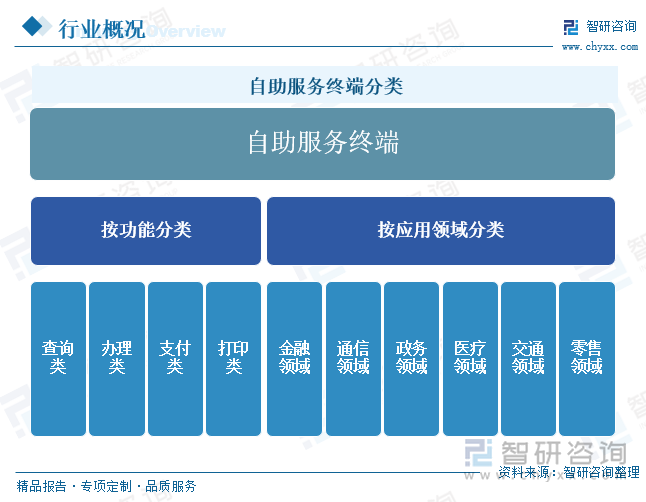
Core Viewpoint - The self-service terminal industry in China is experiencing robust growth driven by policy support, technological innovation, and consumer upgrades, with market size projected to increase from 35 billion yuan in 2019 to 65 billion yuan in 2024 [1][13]. Industry Definition and Classification - Self-service terminals are intelligent devices that integrate various technologies to provide users with self-service options such as inquiries, transactions, payments, and printing, enhancing service efficiency and user experience [2]. Industry Chain Analysis - The self-service terminal industry chain includes upstream hardware and software suppliers, midstream equipment manufacturers and integrators, and downstream application and support services, promoting innovation and integration across all segments [4]. Development History - The industry has evolved from single-function devices like ATMs to diversified and intelligent solutions, expanding applications across various sectors including finance, telecommunications, and public services [6]. Current Industry Status - The market size is expected to grow significantly, with increasing demand across financial, retail, and government sectors, driven by advancements in financial technology and the rise of unmanned retail concepts [13]. Key Enterprises Analysis - Major players in the industry include: - **Guangdian Yuntong**: A leading company in smart financial devices with a revenue of 9.043 billion yuan in 2023, growing by 20.16% [18]. - **Nantian Information**: Focused on digital services with a revenue of 9.138 billion yuan in 2023, growing by 6.67% [20]. - **Zhengtong Electronics**: Specializes in financial electronic devices, emphasizing security and user experience [16]. - **Yuyin Technology**: Concentrates on financial self-service devices and expanding into intelligent terminal services [16]. Future Development Trends - The industry is moving towards deeper scene-based services and ecosystem expansion, integrating self-service terminals into diverse sectors such as retail and dining, enhancing user experience [22]. - Data security and compliance are becoming critical, necessitating robust data protection measures and adherence to legal standards [23]. - The dual transformation of smart and digital upgrades is enhancing service quality and operational efficiency, driving sustainable development in the industry [24].