公募基金费率改革

Search documents
重磅!最新洞察来了
中国基金报· 2025-07-06 05:29
Core Viewpoint - The public fund fee reform has significantly reshaped the industry ecosystem, prioritizing investor interests and leading to a reduction in costs for investors, with expected annual savings exceeding 45 billion yuan [2][4][5]. Group 1: Fee Reduction Impact - The average management fee for actively managed equity funds that have been established for over three years has decreased by approximately 20% over the past three years [5]. - In 2024, the total fees, including management, custody, sales service, and trading commissions, are projected to be 188.42 billion yuan, a reduction of 7.07% compared to the same period in 2023 [2][4]. - The rapid development of passive products, particularly ETFs, has contributed to the overall reduction in industry fees, with some large ETFs lowering management and custody fees from 0.5% and 0.1% to 0.15% and 0.05% respectively [5][6]. Group 2: Industry Transformation - The fee reform has prompted a shift from a "scale expansion" model to a "performance-driven" approach within fund companies, leading to the emergence of floating fee rate funds [2][5][10]. - The industry is witnessing a new landscape characterized by "passive rise and active focus," as firms adjust their product offerings to align with investor interests [6][8]. - The focus on research and investment has intensified, with institutions moving from a scale-oriented strategy to one that emphasizes investor returns, thereby enhancing trust in the industry [7][8]. Group 3: Product Innovation and Strategy - The introduction of floating fee rate funds and the expansion of passive investment products have diversified market offerings, with low-fee products gaining a larger market share [5][10]. - Fund companies are increasingly adopting a dual-driven service model that combines performance and service, enhancing the overall investor experience [12]. - The industry is expected to see a rise in customized products and floating fee structures that are closely tied to investor interests, with ongoing reforms in the sales fee structure anticipated [18][19][24]. Group 4: Future Directions - The third phase of the fee reform, focusing on sales fees, is expected to be implemented soon, aiming to balance investor interests with the sustainable development of the industry [24][25]. - Future reforms may include optimizing sales service fee structures and introducing tiered pricing based on investor holding periods to encourage long-term investment [25][28]. - The industry is encouraged to learn from overseas experiences, particularly in transitioning to a buyer's advisory model, which could enhance the value provided to investors [26][28].


6月新发基金规模超900亿元!这类产品成“香饽饽”
天天基金网· 2025-06-27 05:05
Core Viewpoint - The A-share market has shown signs of recovery with a three-day rise in the Shanghai Composite Index, leading to a structural "market" in public fund issuance since June [1] Fund Issuance Overview - The total scale of newly issued funds since June has exceeded 90 billion yuan, with bond funds accounting for a significant portion of this growth [2][3] - Mixed FOF funds have emerged as the "fund-raising king" with a single fund raising 6.573 billion yuan, while bond funds dominate in terms of quantity [2][3] Fund Types and Performance - As of June 24, 22 newly issued bond funds raised 43.285 billion yuan, making up 47.63% of the total issuance, with an average size of 1.968 billion yuan per fund [3] - Notable bond funds include two policy financial bond index funds that raised 6 billion yuan each, indicating strong demand for high-quality pure bond products [3] - Mixed funds raised 21.571 billion yuan, accounting for 23.74% of the total, marking the highest proportion since January 2023, reflecting institutional enthusiasm for equity market positioning [3] FOF and Passive Index Funds - Eight FOF funds were issued, raising 9.111 billion yuan, with an average size of 1.139 billion yuan, indicating increased investor recognition of asset allocation products [4] - Passive index products have seen a decline in issuance, with many tracking major indices and lacking differentiation, leading to lower fundraising amounts [4] New Fund Innovations - The issuance of new floating-rate funds has gained momentum, with 13 out of 26 approved funds raising over 12.6 billion yuan, marking a significant development in fund fee reform [5] - Innovative funds such as the first central enterprise commercial real estate REIT raised 500 million yuan and ended fundraising early, showcasing market interest in quality asset securitization products [5] Market Trends and Future Outlook - The market continues to exhibit a "strong bond, weak equity" trend, driven by decreased investor risk appetite and a shift towards low-volatility bond products [6] - As market conditions improve, the issuance of equity funds is expected to gradually recover, while bond funds will remain crucial in asset allocation [7]

6月新发基金规模超900亿元!这类产品成“香饽饽”
券商中国· 2025-06-26 01:46
Core Viewpoint - The A-share market has experienced a structural "market" in public fund issuance since June, with a significant increase in new fund sizes, particularly in bond funds, while passive index products have seen a decline in popularity [1][2]. Fund Issuance Overview - The total new fund issuance in June exceeded 90 billion yuan, with bond funds raising 43.285 billion yuan, accounting for 47.63% of the total, and an average size of 19.68 billion yuan per fund [3]. - Notably, two policy financial bond index funds raised 60.01 billion yuan and 60 billion yuan respectively, indicating strong institutional demand for high-quality pure bond products [3]. Fund Types and Performance - Mixed-asset FOF funds raised 91.11 billion yuan, representing 10.03% of the total, with the largest fund, Oriental Red Yingfeng, raising 65.73 billion yuan in just 7 days, highlighting the growing recognition of asset allocation products [4]. - The issuance of mixed funds reached 215.71 billion yuan, the highest proportion since January 2023, reflecting institutional enthusiasm for equity market positioning [4]. Passive Index Products - The issuance of passive index products has cooled, with many tracking broad indices like the CSI A500 and CSI 300, showing limited differentiation and lower fundraising amounts, such as 2.52 billion yuan and 2.34 billion yuan for specific ETFs [5]. Innovative Fund Trends - The popularity of new floating-rate funds has surged, with 13 out of 26 approved funds raising over 12.6 billion yuan, indicating a significant advancement in fund fee reform [6]. - Innovative funds, such as the first central enterprise commercial real estate REIT, raised 5 billion yuan and ended fundraising early, reflecting market interest in quality asset securitization products [6]. Market Dynamics - The new fund market continues to reflect a "strong bond, weak equity" trend, driven by decreased investor risk appetite and a shift towards low-volatility bond products [7]. - Despite overall market issuance differentiation, innovative products like Sci-Tech theme ETFs and REITs have attracted attention, indicating a demand for structural investment opportunities [7]. Future Outlook - As market conditions improve, the issuance of floating-rate funds is expected to continue, with a gradual recovery in equity fund issuance while bond funds will remain crucial in asset allocation [8].

首批13只浮动费率基金吸金126亿元,东方红核心价值领跑
Sou Hu Cai Jing· 2025-06-23 14:47
Core Insights - The establishment of floating fee rate funds marks a new era in the public fund industry, linking management fees to performance, reflecting investor acceptance of innovative fee structures [2][6][7] - The top three fund companies dominate the market, capturing nearly 40% of the total fundraising, indicating significant scale differentiation [3][5] Fund Performance and Structure - As of June 23, 2023, 13 out of 26 approved floating fee rate funds have been successfully established, raising a total of over 12.6 billion yuan, with an average fund size of 969 million yuan [2] - The top three funds by size are: - Dongfanghong Core Value A: 1.991 billion yuan - Yifangda Growth Progress A: 1.704 billion yuan - Ping An Value Enjoyment A: 1.322 billion yuan These three funds together raised 5.017 billion yuan, accounting for nearly 40% of the total [3][4] Market Dynamics - The average subscription period for the 13 funds was only 22 days, significantly shorter than the industry average, indicating strong market demand for the new fee structure [6][7] - The floating fee structure ties management fees directly to performance, encouraging fund managers to enhance their investment capabilities [6][7] Investor Behavior - The average subscription amount for the top-performing funds indicates a strong interest from institutional investors, with Tianhong Quality Value A achieving an average subscription amount of 234,000 yuan despite a lower total subscription count [5][6] - The popularity of the top funds is evident, with Yifangda Growth Progress A attracting 47,301 subscriptions, making it the most widely subscribed fund among the new offerings [4][5] Industry Transformation - The emergence of floating fee rate funds signals a shift from a fixed fee model to a performance-driven model in the public fund industry, potentially reshaping the competitive landscape [6][7] - Industry experts suggest that while leading firms have established a strong foothold, the market remains dynamic, with opportunities for smaller firms to gain traction through consistent performance [7]

新发浮动费率基金深度观察:非对称上下浮动,锚定基准不放松
ZHONGTAI SECURITIES· 2025-06-11 12:51
Investment Rating - The report maintains an "Overweight" rating for the industry [2] Core Insights - The first batch of floating management fee public funds has been launched, with approximately 70% of new products being floating fee funds, aligning with the "Action Plan for Promoting the High-Quality Development of Public Funds" [5][8] - The floating management fee model links fees to fund performance and investor holding periods, emphasizing investor protection over manager incentives [13][15] - The average management fee across the 24 floating fee funds is 1.27%, with 40% of funds charging 1.2% and 52% charging 1.5% [20] Summary by Sections 1. Floating Fee Fund Management Fee Methods and Historical Comparisons - The floating management fee structure is designed to align with fund performance, reducing fees when performance is below benchmarks and increasing fees when performance exceeds benchmarks significantly [14][15] - The historical fee rates for floating fee funds are consistent with previous fund fee structures, with a 0.2% custody fee across all funds [17] 2. Overview of Pilot Fund Companies and Fund Managers - The 25 fund managers of the floating fee funds have an average tenure of 6.51 years, with a history of managing an average of 7.08 funds [18][20] - The historical performance of these fund managers is generally better than their peers, with an average annualized return of 5.89% [20][22] 3. Comparison of Floating Fee Fund Benchmark Indices - The floating fee funds utilize 17 benchmark indices, with stock indices accounting for 79.08% of the benchmarks, primarily including the CSI 300 and CSI 800 [29][32] - The allocation to the CSI 300 has decreased compared to historical benchmarks, while allocations to the CSI 800 Growth and CSI A500 have increased [32] 4. Investment Recommendations - The report suggests focusing on underrepresented sectors such as non-bank financials, recommending stocks like New China Life Insurance and China Pacific Insurance for potential growth [36]
年内超200只基金调降费率 部分产品费率减半
Zheng Quan Ri Bao· 2025-06-09 16:17
Core Viewpoint - The public fund industry is experiencing a significant reduction in fee rates, with over 200 funds lowering their rates this year, and more than 1000 products reaching the industry's lowest fee standards [1][2]. Group 1: Fee Reduction Trends - Multiple fund companies, including Southern Fund, Jianxin Fund, and CITIC Jian Investment, have announced fee reductions since June, showcasing a variety of fund types affected, including equity, mixed, bond, and money market funds [2][3]. - Specific examples of fee reductions include the management fee of the Dongcai Growth ETF dropping from 0.5% to 0.15%, and the management fee of the Southern Anyi Mixed Fund decreasing from 1% to 0.6% [2][3]. - A notable trend is the simultaneous reduction of both management and custody fees in some products, such as Jianxin Stable Growth Bond C, which saw its management fee cut from 0.7% to 0.3% and custody fee from 0.2% to 0.1% [3]. Group 2: Industry Impact and Future Outlook - The combination of "management fee 0.15% + custody fee 0.05%" is now considered the industry's lowest fee tier, with the number of related products increasing by 20% to 1008 since the beginning of the year [4]. - The fee reduction is expected to lower investors' holding costs, enhancing their engagement and participation in the market, while prompting fund companies to shift focus from high fee reliance to improving research capabilities and product innovation [4][5]. - The ongoing fee reform is a response to regulatory calls for lowering costs and is seen as a necessary step for the industry to prioritize investor interests [5][6]. Group 3: Competitive Strategies - Fund companies are encouraged to enhance their core competitiveness through improved research capabilities, with average management fees for bond funds at 0.857% and custody fees at 0.154% [6]. - The competition in the index fund sector is intensifying, with some management fees dropping to 0.15%, while active equity funds seek a balance between reasonable returns for managers and product attractiveness [6]. - Differentiated services, such as investment advisory and investor education, are crucial for fund companies to enhance competitiveness and build long-term trust with investors [7].
博时卓睿成长正在发行
Jing Ji Guan Cha Wang· 2025-05-30 10:51
Group 1 - The core viewpoint of the article is the introduction of floating fee rate funds in China, marking a significant reform in the public fund fee structure, as emphasized by the China Securities Regulatory Commission's action plan [1][3] - The first floating fee rate products, such as Bosera Zhuorui Growth Stock Fund, were officially launched for public subscription on May 27, 2025 [1][9] - Floating fee rate funds are designed to link management fees to fund performance, creating a shared interest between fund managers and investors [2][3] Group 2 - Floating fee rate funds have characteristics such as aligning interests between fund managers and investors, maintaining stable fund styles, and encouraging long-term investment [3] - The fee structure varies based on performance metrics, which helps avoid style drift in funds [3] - Fund manager Tian Junwei, with extensive experience, leads the first floating fee rate product, showcasing a strong management capability [4][9] Group 3 - Tian Junwei's investment style focuses on GARP (Growth at a Reasonable Price), emphasizing stock selection over market timing [5] - His strategy involves deep stock selection, focusing on companies with sustainable growth and competitive advantages [7] - The performance of Tian Junwei's managed funds has consistently outperformed benchmarks, indicating the effectiveness of his investment approach [6][11] Group 4 - The Bosera Zhuorui Growth Stock Fund targets a stock asset allocation of 80%-95%, with a focus on high-quality growth stocks in both A-share and Hong Kong markets [9] - The management fee structure is dynamic, with different rates applied based on the holding period and performance relative to benchmarks [10][16] - Specific management fee rates are set based on the annualized return of the fund, incentivizing long-term holding by investors [10][16]

多家官宣:终止合作
Zhong Guo Ji Jin Bao· 2025-05-26 13:15
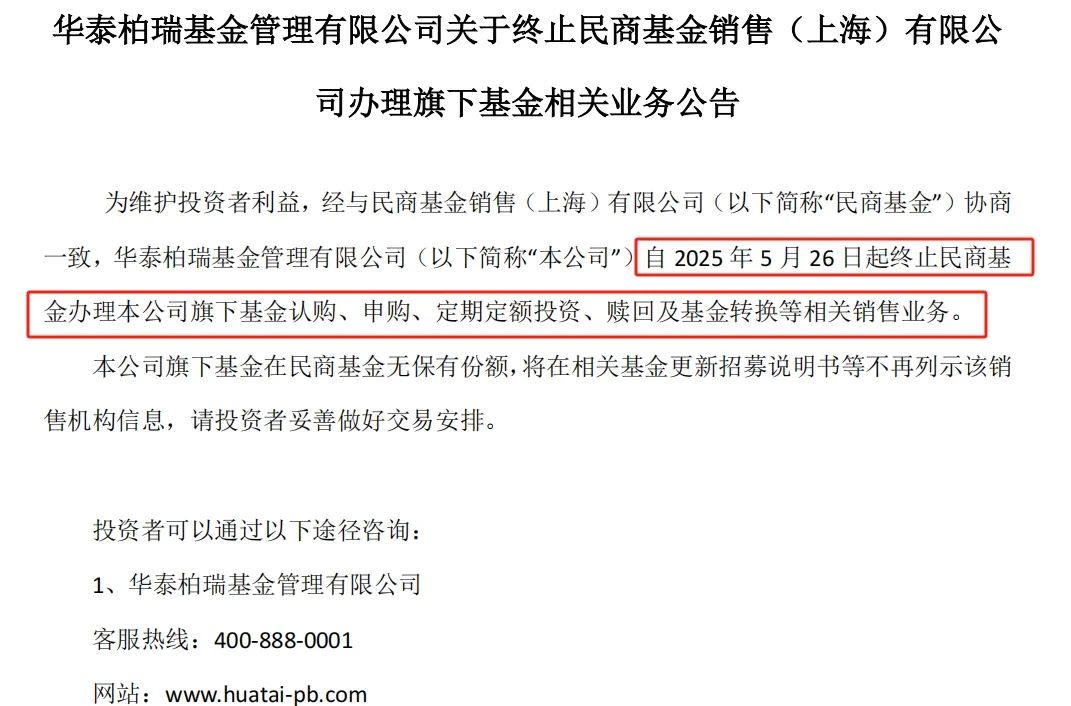
Core Viewpoint - Multiple fund companies have announced the termination of their distribution cooperation with Minshang Fund, indicating that the sales agency is likely to exit the public fund distribution market and shift focus to private fund distribution [1][5][6]. Group 1: Termination of Cooperation - Fund companies including Huatai-PB Fund, Everbright Pramerica Fund, and Debon Fund have issued announcements to terminate their sales cooperation with Minshang Fund, effective from specific dates in 2025 [2][4]. - Huatai-PB Fund stated that it will stop Minshang Fund from handling subscription, purchase, regular investment, redemption, and conversion of its funds starting May 26, 2025 [2]. - Everbright Pramerica Fund and Debon Fund have also confirmed similar terminations, with Debon Fund's termination effective from June 12, 2025 [4]. Group 2: Reasons for Termination - The termination of cooperation is reportedly due to Minshang Fund's decision to voluntarily exit the public fund distribution business and transition to private fund distribution [5][6]. - A public fund insider indicated that the decision was initiated by Minshang Fund itself, reflecting a strategic shift in its business model [6]. Group 3: Industry Context - The fund distribution market is undergoing significant changes, with many independent fund sales agencies facing increasing pressure and potential exits from the market [9]. - The China Securities Regulatory Commission (CSRC) has introduced a classification evaluation mechanism for fund sales institutions, which may further influence the dynamics of the fund distribution landscape [9]. - The trend indicates a shift from a "volume-oriented" approach to a focus on "investor profitability," which poses challenges for many smaller third-party distribution agencies [9][11].
分档收取管理费!这类新基金获批,激励基金经理关注超额收益
Bei Jing Shang Bao· 2025-05-23 15:34
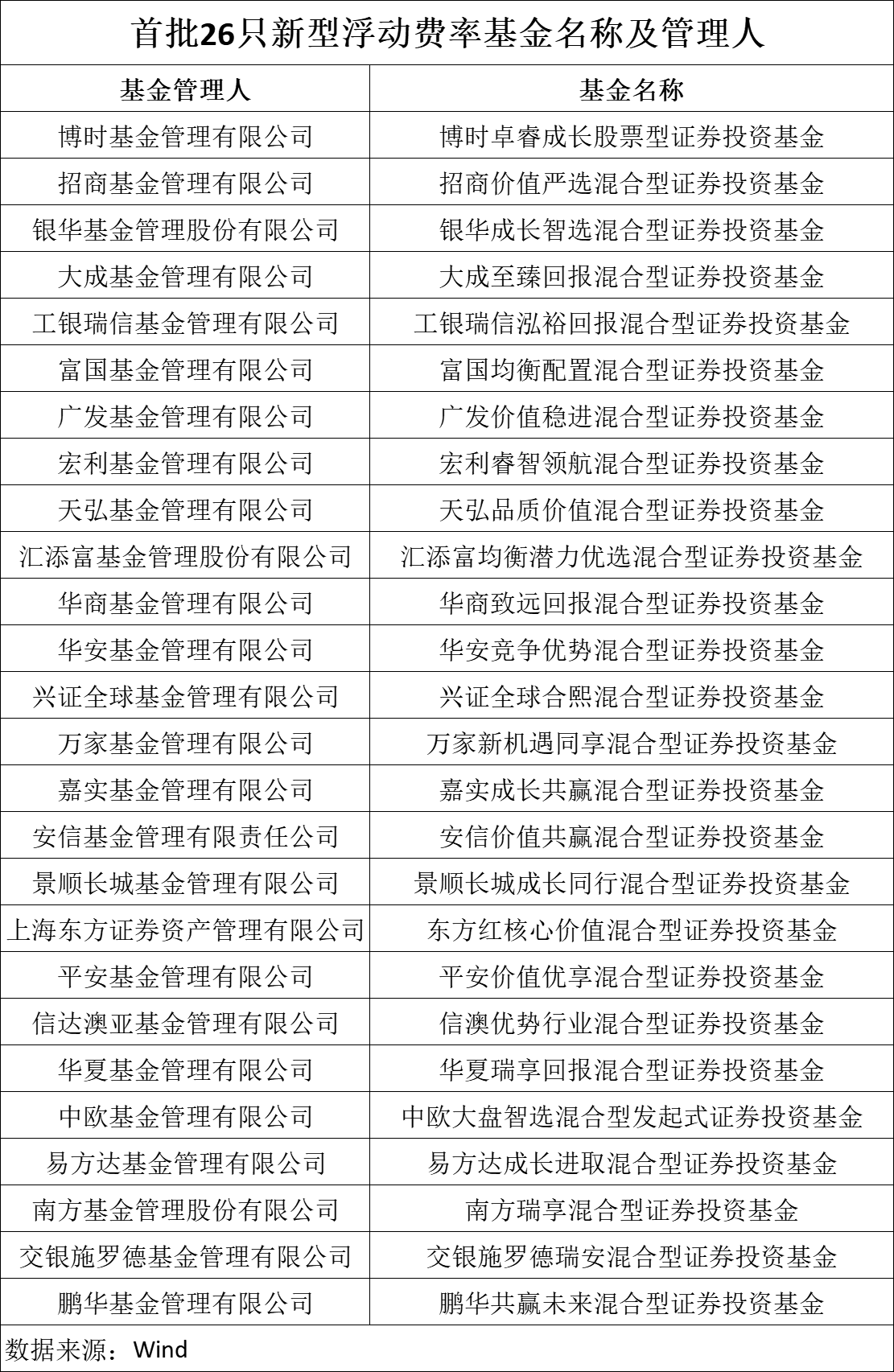
Core Viewpoint - The approval of the first batch of 26 new floating management fee rate funds by the China Securities Regulatory Commission (CSRC) marks a significant step in the reform of fund fee structures, aiming to enhance the professional investment research capabilities of fund managers and reduce reliance on market beta returns [1][6][7]. Summary by Relevant Sections Fund Approval and Structure - The first batch of 26 new floating management fee rate funds has been officially registered by the CSRC, following their submission on May 16 [3][5]. - These funds are designed with three fee tiers based on performance relative to a benchmark, with rates set at 1.2% (base tier), 1.5% (up tier), and 0.6% (down tier) [3][4]. - The funds include a mix of products, primarily hybrid funds, from 25 public fund companies and one securities asset management company [5][6]. Fee Structure and Performance Metrics - The fee structure is linked to the holding period and performance, with specific conditions for fee adjustments based on annualized excess returns compared to benchmarks [4][6]. - For example, if the annualized excess return exceeds 6%, the fee is set at 1.5%, while a return below -3% results in a fee of 0.6% [4]. Implications for Fund Management - The new fee model aims to align the interests of fund managers and investors, encouraging managers to enhance their investment capabilities and focus on sustainable performance [6][7]. - The reform is expected to shift the industry culture towards emphasizing long-term investment and clear risk-return profiles [6][7]. Future Outlook - The CSRC's recent action plan indicates a commitment to optimizing fee structures for actively managed equity funds, suggesting that more floating fee rate products will be introduced in the future [7][8]. - The market has already seen over 130 floating fee products, and the new structure is anticipated to improve transparency and understanding of fund fee mechanisms for investors [8][9].

首批新型浮动费率基金上报一周内获批 费率机制细节出炉
Sou Hu Cai Jing· 2025-05-23 15:16
26只新型浮动费率基金迅速获批 5月7日,证监会正式印发《行动方案》,并提出对新设立的主动管理权益类基金大力推行基于业绩比较基准的浮动管理费收取模式,对符合一定持有期要求 的投资者,根据其持有期间产品业绩表现确定具体适用管理费率水平;在未来一年内,引导管理规模居前的行业头部机构发行此类基金数量不低于其主动管 理权益类基金发行数量的60%。 《行动方案》出台后,公募基金行业迅速响应。5月16日,上述26只基金集体申报,并于5月19日获得受理。5月23日,26只基金在申报仅一周后迅速获批。 汇添富基金表示,作为业内首批上报的新型浮动费率基金,此次产品的获批不仅标志着公募基金费率改革迈入深水区,更体现了行业从"规模导向"向"投资 者利益优先"的深刻转型,有望共筑管理人与投资者共生共荣新生态。 央广网北京5月23日消息(记者 冯方)5月23日,首批26只新型浮动费率基金获批,管理人包括易方达基金、华夏基金、汇添富基金、博时基金、嘉实基 金、中欧基金、富国基金等。此次26只基金从上报到获批仅用时一周,并切实体现了《推动公募基金高质量发展行动方案》(以下简称《行动方案》)倡导 的理念,将管理费分基准档、升档、降档三档收取 ...