
零关税

Search documents
【财经观察】明日全岛封关,海南成对外开放新前沿
Huan Qiu Wang· 2025-12-16 22:51
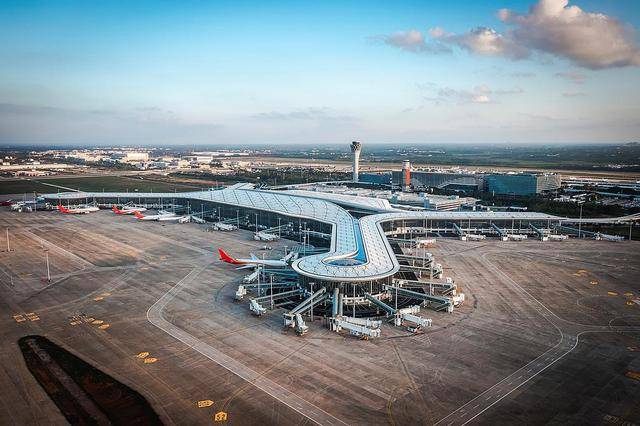
【环球时报赴海南特派记者 陈子帅 丁雅栀 张蔚蓝 张舒雅】12月17日,距离海南自贸港全岛封关运作仅 剩最后24小时,琼岛大地处处洋溢着开放的气息。街头巷尾的"封关倒计时"标语、商场电子屏滚动的政 策解读、路灯杆上悬挂的"一线放开、二线管住、岛内自由"彩旗,无不昭示着这场历史性时刻的临近。 这种"无感通关"正是海南"一线放开"政策的生动实践——对于不实行许可证件管理、不需要依法实施检 验检疫的保税货物、"零关税"货物,可选择适用径予放行。随着封关落地,"零关税"商品范围扩大至约 6600个税目,覆盖74%的全部商品税目,岛内享惠主体间的"零关税"货物流通免于补缴进口税收,彻底 激活了贸易自由化活力。 "二线"管住:美兰机场的"智慧通关" 洋浦港的"一线放开"以高效流通诠释了海南的开放力度,海口美兰国际机场的"二线管住"则体现了精准 的监管。这里的"二线"特指海南与内地之间的管控防线,核心是在保障国家贸易管制政策统一的前提 下,实现高效便捷流通,三类货物是监管重点:"零关税"商品、加工增值30%免关税货物及"一线"放宽 管制的货物。 在美兰国际机场的装货区,《环球时报》记者现场看到,工作人员手持小巧的PDA仪器 ...
海南本周封关!120万家企业已前往淘金,哪些行业最能挣钱?
Yang Zi Wan Bao Wang· 2025-12-16 13:12
Core Insights - Hainan Free Trade Port will officially enter a new phase of full island closure on December 18, 2025, implementing a customs supervision special area with liberalization policies characterized by "one line open, one line controlled, and free movement within the island" [4] Group 1: Economic Impact - As of December 9, 2025, Hainan has 3.6645 million existing business entities, with nearly 50% of the 1.21 million enterprises belonging to the wholesale and retail sector, accounting for 46.29% [1] - The closure will significantly reduce trade costs for businesses, attract investments, and provide residents with cheaper access to imported goods, increasing employment and entrepreneurial opportunities [6] - The wholesale and retail sector has seen the largest growth in business entities, with increases of 328.04%, followed by cultural, sports, and entertainment industries at 264.61%, and scientific research and technical services at 238.66% compared to 2020 [5] Group 2: Policy Changes - A series of regulatory documents will be implemented upon the full closure, including tax policies for goods entering and exiting the island, and a list of prohibited and restricted goods [4] - The zero-tariff policy will expand to approximately 6,600 tax items, covering about 74% of all goods, which is an increase of nearly 53% compared to before the closure [7] - The new policies will allow for the sale of various domestic products in duty-free shops, including clothing, ceramics, and electronics, with tax exemptions on these items [7] Group 3: Sectoral Opportunities - Industries such as import-export trade, international shipping, and logistics will directly benefit from customs facilitation and tax incentives [6] - High-value industries like high-end manufacturing, biomedicine, and green technology are expected to gain from the zero-tariff and low-tax policies, presenting significant market opportunities [6] - The concentration of A-share listed companies in Haikou exceeds 80%, indicating a strong local economic presence [5]


12月18日起,海南自贸港正式启动全岛封关!有哪些红利,九问九答→
Zheng Quan Shi Bao· 2025-12-16 05:30
海南省人民政府网发布通告,自2025年12月18日起,海南自由贸易港(自贸港)正式启动全岛封关。 按照党中央决策部署,现就海南自由贸易港正式启动全岛封关事宜通告如下: 一、自2025年12月18日起,海南自由贸易港正式启动全岛封关。 二、《关于海南自由贸易港货物进出"一线"、"二线"及在岛内流通税收政策的通知》(财关税〔2025〕12号)、《关于海南自由贸易港进口征税商品目录 的通知》(财关税〔2025〕13号)、《中华人民共和国海关对海南自由贸易港加工增值免关税货物税收征管暂行办法》(海关总署公告2025年第158 号)、《海南自由贸易港禁止、限制进出口货物、物品清单》(商务部公告2025年第43号)、《中华人民共和国海关对海南自由贸易港监管办法》(海关 总署公告2025年第159号)等系列文件,根据上述文件的规定,自正式启动全岛封关之日起施行。 特此通告。 海南省人民政府 2025年12月10日 通告如下: 海南省人民政府关于 海南自由贸易港正式启动全岛封关的通告 琼府函〔2025〕278号 海南自贸港全岛封关,将带来这些红利!九问九答→ , 向 力、答 型波比4 12月18日,海南自贸港将迈入全 岛封关 ...
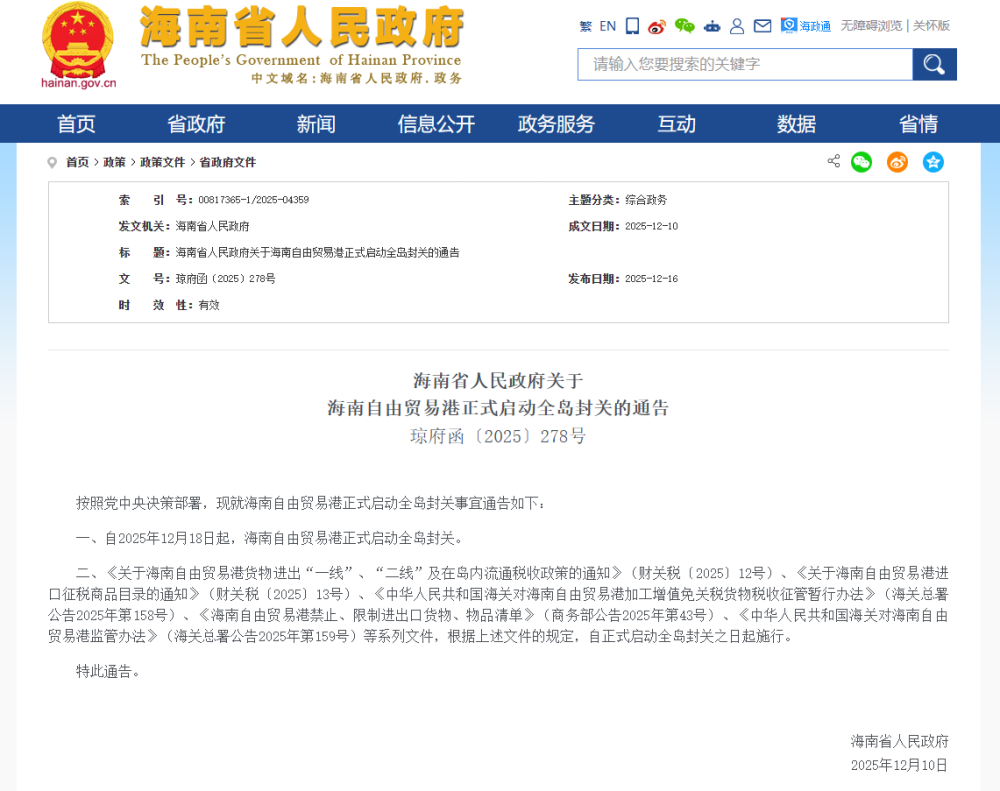
按照党中央决策部署,海南官宣:全岛封关
Mei Ri Jing Ji Xin Wen· 2025-12-16 04:30
每经编辑|程鹏 12月16日,海南省人民政府发布《关于海南自由贸易港正式启动全岛封关的通告》。 按照党中央决策部署,现就海南自由贸易港正式启动全岛封关事宜通告如下: 一、自2025年12月18日起,海南自由贸易港正式启动全岛封关。 二、《关于海南自由贸易港货物进出"一线""二线"及在岛内流通税收政策的通知》(财关税〔2025〕12号)、《关于海南自由贸易港进口征税商品目录的 通知》(财关税〔2025〕13号)、《中华人民共和国海关对海南自由贸易港加工增值免关税货物税收征管暂行办法》(海关总署公告2025年第158号)、 《海南自由贸易港禁止、限制进出口货物、物品清单》(商务部公告2025年第43号)、《中华人民共和国海关对海南自由贸易港监管办法》(海关总署公 告2025年第159号)等系列文件,根据上述文件的规定,自正式启动全岛封关之日起施行。 有些网友疑惑,明明是"进一步扩大开放",为何叫"封关"?封关的目的是什么?封关后去海南,需要办理通行证吗?企业和居民如何享受便利? 什么是封关? 封关"封"的又是什么? 其实,封关不是封岛,而是指将海南岛全岛建成一个海关监管特殊区域,实施以"'一线'放开、'二线'管住 ...
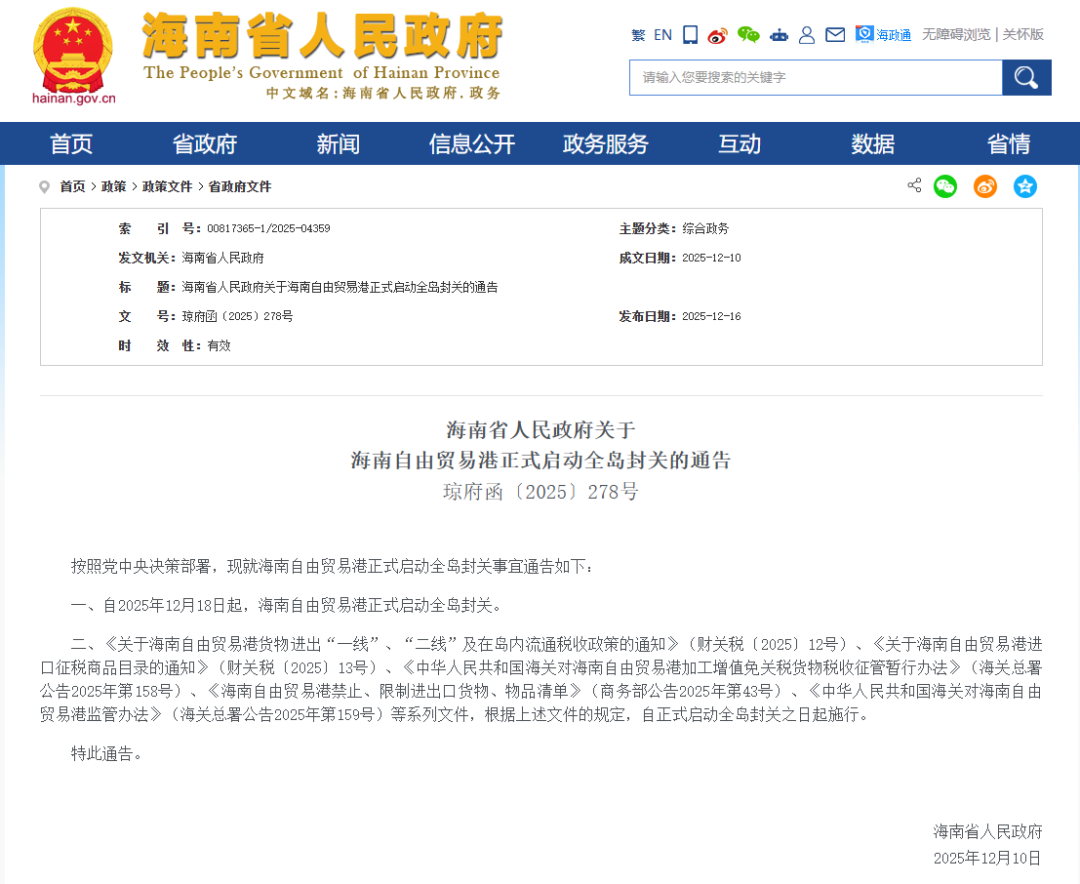
海南通告:18日起全岛封关
券商中国· 2025-12-16 03:41
据海南日报12月16日消息,海南省人民政府日前发布关于海南自由贸易港正式启动全岛封关 的通告。 通告称,按照党中央决策部署,自2025年12月18日起,海南自由贸易港正式启动全岛封关, 系列文件自正式启动全岛封关之日起施行。 以下为通告全文—— 海南省人民政府关于海南自由贸易港正式启动全岛封关的通告 琼府函〔2025〕278号 按照党中央决策部署,现就海南自由贸易港正式启动全岛封关事宜通告如下: 一、自2025年12月18日起,海南自由贸易港正式启动全岛封关。 二、《关于海南自由贸易港货物进出"一线"、"二线"及在岛内流通税收政策的通知》(财关 税〔2025〕12号)、《关于海南自由贸易港进口征税商品目录的通知》(财关税〔2025〕13 号)、《中华人民共和国海关对海南自由贸易港加工增值免关税货物税收征管暂行办法》 (海关总署公告2025年第158号)、《海南自由贸易港禁止、限制进出口货物、物品清单》 (商务部公告2025年第43号)、《中华人民共和国海关对海南自由贸易港监管办法》(海关 总署公告2025年第159号)等系列文件,根据上述文件的规定,自正式启动全岛封关之日起施 行。 特此通告。 海南省人民政府 ...
海南官宣“全岛封关”
第一财经· 2025-12-16 03:15
Core Viewpoint - The official announcement from the Hainan Provincial Government states that the Hainan Free Trade Port will officially start its full island customs closure on December 18, 2025, which aims to create a special customs supervision area with liberalized policies [1][3]. Summary by Sections Customs Closure Definition and Purpose - The term "customs closure" refers to establishing Hainan Island as a special customs supervision area, implementing a policy characterized by "one line" being open, "two lines" being controlled, and free circulation within the island [3]. - The "one line" refers to the border from overseas to the free trade zone, while the "two lines" refer to the division between the free trade zone and other domestic areas [3]. Taxation Policies and Benefits - After the customs closure, many goods can enter Hainan with zero tariffs, but there will be a list of prohibited and restricted items, as well as a negative list for imported goods that are exempt from tariffs [4]. - The zero-tariff policy will cover approximately 74% of product categories, benefiting key industries such as pharmaceuticals and high-end food processing [6]. - A dual 15% tax incentive policy will be implemented for eligible enterprises and core talents, making the tax environment more attractive [6]. Impact on Tourism and Trade - The customs closure is expected to significantly boost tourism and consumer spending in Hainan, with most goods and all personnel still managed under current regulations, meaning no additional permits are required for travel [6][7]. - The strategic goal is to position Hainan as a key trade hub between China and ASEAN, leveraging its unique high-level open policies [8]. Future Development and Policy Implementation - Hainan aims to become a strategic hub for economic cooperation with ASEAN, with specific measures in place for establishing headquarters for investment [8]. - The focus will be on accelerating the implementation of core policies, improving efficiency, and enhancing the legal environment to attract more investment [9]. - The development of modern high-tech industries, tourism, and various service sectors will be prioritized, with an emphasis on reducing the negative list for cross-border service trade to increase investment appeal [9].
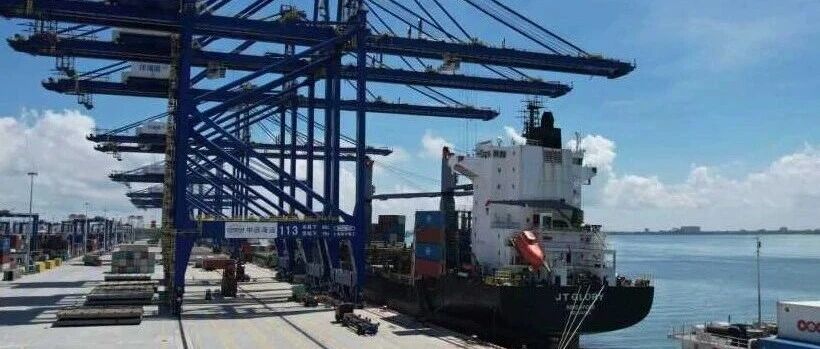
海南自贸港“全岛封关”,这些事要了解!
Xin Hua She· 2025-12-16 03:11
Core Viewpoint - The official launch of the Hainan Free Trade Port's full island customs closure is set for December 18, 2025, which will create a special customs supervision area with liberalized policies aimed at enhancing trade and investment opportunities [1] Group 1: Policy Benefits - The customs closure will gradually implement "zero tariffs, low tax rates, and simplified tax systems," expanding the scope and lowering the thresholds for enterprises to enjoy these benefits [2] - The number of "zero tariff" products will significantly increase, covering approximately 74% of product categories, benefiting key industries such as pharmaceuticals and high-end food processing [2] - A "dual 15%" tax incentive policy will be implemented, allowing eligible enterprises and core talents to enjoy a 15% income tax reduction, which is a core attraction of the Hainan Free Trade Port policies [2] Group 2: Impact on Tourism and Daily Life - The customs closure will greatly benefit tourism in Hainan, stimulating tourism consumption, while the current regulations for the movement of goods and people will remain largely unchanged [2][3] - Domestic tourists, investors, and residents will experience improved services and better overall experiences in Hainan [3] Group 3: Strategic Objectives - The core objective of the customs closure is to leverage Hainan's geographical advantages to establish it as a significant open gateway to ASEAN amid the evolving global landscape [4] - Hainan aims to become a strategic hub for China-ASEAN economic cooperation, with specific measures such as the "two headquarters base" policy to facilitate investments between ASEAN and China [4] - Accelerating the implementation of core policies, enhancing administrative efficiency, and improving the legal environment are deemed crucial for Hainan's development [5] Group 4: Industry Development Focus - Hainan's industrial development will primarily rely on modern high-tech industries, tourism, and various service sectors, with a focus on expanding market access and open fields in the service industry [5] - The future reduction of the negative list for cross-border service trade will enhance Hainan's attractiveness for investment [5]
海南封关倒计时,全球航司为何排队来这里修飞机?
Sou Hu Cai Jing· 2025-12-16 01:13
Core Insights - Hainan Free Trade Port will officially start full island closure operations on December 18, creating unprecedented opportunities for the aircraft maintenance industry due to the continuous release of policy dividends [1] - The aircraft maintenance sector in Hainan has seen a nearly 70% year-on-year increase in the value of aircraft maintenance goods under customs supervision at Haikou Meilan Airport in the first 11 months of this year [1] Group 1: Aircraft Maintenance Industry Growth - The one-stop aircraft maintenance base in Haikou has become a significant choice for Vietnamese airlines, with the base already having a full schedule for the next three years, expecting to handle around 700 aircraft repairs annually [2] - The base has received its 22nd aircraft from VietJet Air for maintenance, indicating strong demand from international airlines [2] Group 2: Policy Advantages - Hainan Free Trade Port offers significant advantages, with a 4-hour flight radius covering 21 countries and regions, and an 8-hour radius covering 59 countries, facilitating international aircraft maintenance [4] - Foreign airlines can save 10% to 15% on maintenance costs due to tax exemptions on bonded materials and fuel, with a total value of 515.7 billion yuan in aircraft maintenance goods supervised by customs, marking a 68.6% increase year-on-year [4] Group 3: Tax Policy Changes - The "zero tariff" feature of the free trade port will expand from 1,900 to approximately 6,600 tax items, covering about 74% of all goods, a 53% increase compared to before the closure [4] - The management of imported "zero tariff" goods will shift to a negative list model, replacing the previous positive list [4] Group 4: Air Rights Expansion - Hainan is the only province in China that actively opens up fifth and seventh freedom rights, with 14 fifth freedom passenger and cargo routes already established [6] - The full opening of seventh freedom rights post-closure will allow foreign airlines to operate independent routes from Hainan to third countries, representing the highest level of air rights openness in the world [6][8]
海南封关,可能会改写未来三十年
Sou Hu Cai Jing· 2025-12-14 11:37
因为这一次,玩法不一样了。 海南封关,究竟有多重要? 说实话,这事的含金量,真比很多人想的要重得多。 以前我们理解的"开放",更像是局部试水,某个港口、某个片区、某个试点政策。 而这次,是整个海南一起换规则,相当于把整座岛,直接接进国际市场的运行体系里,当一块真正的"试验田"来用。 它不只是拉动一波增长那么简单,更可能同时影响企业布局、投资方向、就业结构,甚至消费方式。 我们先来说说,这个"封关"究竟是什么意思? 海南自贸港明明方向是更开放,却偏偏叫"封关"? 封关其实是个专业术语,并不是把海南关起来,而是把它单独拎出来,用一套完全不同的贸易和监管规则来运行。 这套规则,常被概括成一句话:一线放开、二线管住、岛内自由。 所谓"一线",指的是海南和境外之间的那道门,比如从国外进海南的通道,全岛一共设了8个这样的一线口岸。 所以你会发现,封关不是封海南,而是把海南换一套更自由的运行方式。而且不封关,后面所有真正的自贸港政策,基本都落不了地。 一线放开,就是货从国外进海南,要尽可能顺,手续少、效率高,关税大幅减少,甚至直接没有。 这里面最核心、大家最关心的,就是大规模推行"零关税"。 目前的消息是,一线进口的"零关 ...
封关后 “零关税”何以推动海南产业“关键一跃”?
Ren Min Wang· 2025-12-14 04:02
人民网海口12月14日电 (记者车柯蒙、王天乐、栗翘楚)海南自贸港全岛封关在即,在现阶段的封关 政策中,更加优惠的货物"零关税"政策备受大家关注:"一线"进口的"零关税"商品税目比例将由21%提 高至74%,在岛内享惠主体之间可以免进口税收流通,加工增值达到30%的可免关税销往内地。 这项制度意味着什么?政策如何延伸至岛内的产业链条,增强产业竞争力,形成产业集群效应? 需要说明的是,进口征税商品目录并不会一成不变。记者了解到,全岛封关运作后,财政部将结合海南 自由贸易港建设实际和推进更高水平对外开放的需要,不断扩大"零关税"商品范围,适时调整进口征税 商品目录。 (文章来源:人民网) "'零关税'并非简单的税收优惠,而是与'一线'放开、'二线'管住整体设计紧密相连的系统性制度创 新。"北京国家会计学院副院长李旭红在接受人民网记者专访时表示,封关运作后,管理模式将从正面 清单转向负面清单,这意味着除了极少数特定商品外,绝大多数进口货物都能享受零关税待遇。 李旭红表示,"零关税"的最大价值,在于它有助于构建完整的产业激励闭环。一方面,海外原材料、设 备以零成本进入海南,直接降低了企业的初始投资和生产成本。另一方面 ...