境内关外

Search documents
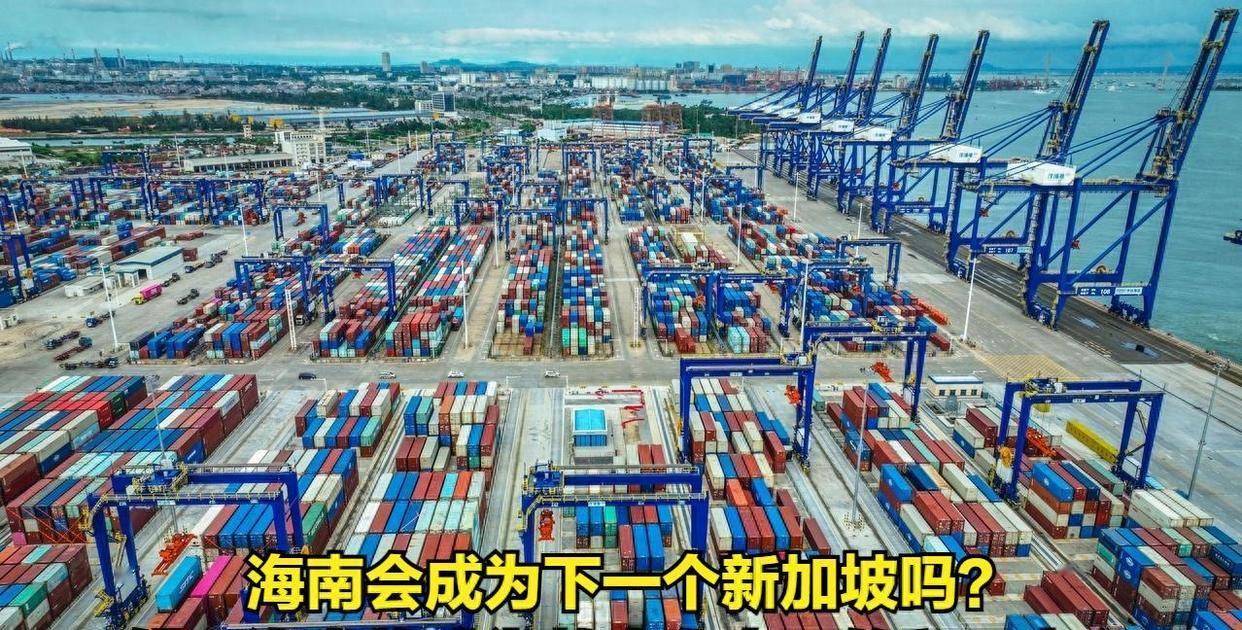
海南不做中国新加坡,30%增值免税改写规则,3天航程颠覆贸易惯性
Sou Hu Cai Jing· 2025-12-22 09:44
Core Viewpoint - The article discusses the potential of Hainan to become a strategic trade hub similar to Singapore, but with a focus on transforming raw materials into value-added products, leveraging China's industrial capabilities and market size [1][20]. Group 1: Comparison with Singapore - Hainan is compared to Singapore in terms of geographical advantages, but while Singapore serves as an efficient transit point, Hainan aims to create a deeper industrial ecosystem [1][10]. - Singapore's success is attributed to its role as a "safe haven" in the old trade order, while Hainan is positioned as a strategic high ground in the evolving global trade landscape [16][18]. Group 2: Hainan's Strategic Advantages - Hainan's geographical location allows for significant reductions in shipping distances and times, making it an attractive alternative for international shipping routes [5][7]. - The "processing and value-added 30% duty-free" policy in Hainan encourages the establishment of factories that can transform raw materials into finished goods, thus enhancing its role in the supply chain [8][12]. Group 3: Future Trade Dynamics - Hainan is seen as a potential new trade gravity center, capable of accommodating shifts in global trade dynamics, especially as traditional rules become less reliable [27][29]. - The region is expected to facilitate new forms of trade, including RMB settlements and digital trade, positioning itself as a key player in the future of global commerce [22][24]. Group 4: Long-term Vision - Hainan's development is framed as a long-term strategic initiative, with tax incentives and infrastructure improvements aimed at preparing for future economic challenges [31][33]. - The region's unique position allows it to test new trade rules while maintaining a robust industrial base, making it a critical component of China's economic strategy [29][31].

左千户:海南封关后,欧美很快会问:我们还有什么优势?
Sou Hu Cai Jing· 2025-12-19 06:53
Core Insights - The establishment of Hainan Free Trade Port marks a significant milestone in China's new phase of economic development, implementing a policy of "one line open, one line controlled" to facilitate international trade and investment [1][21]. Group 1: Policy and Economic Impact - Hainan Free Trade Port will implement zero tariffs on over 6,600 types of goods, covering 74% of product categories, alongside various tax incentives and financial liberalization measures [2]. - The "one line open" policy allows foreign products, except those on a negative list, to enter Hainan without tariffs, promoting the free flow of goods, capital, and personnel [15]. - The "one line controlled" policy requires that goods crossing from Hainan to other regions in China adhere to standard customs regulations, ensuring that the economic activities within Hainan do not impact other provinces [15]. Group 2: Historical Context and Development - The concept of "closure" in customs, as applied to Hainan, is a progression from the historical development of bonded zones and free trade areas in China, which began in 1990 [7]. - The evolution of Hainan into a free trade port is compared to Hong Kong's historical development as a free trade zone, highlighting the need for China to enhance its high-end service and financial sectors [9][13]. Group 3: Infrastructure and Logistics - Yangpu Port is designated as a key channel for the "one line open" policy, transitioning from a pilot zone to a high-quality development demonstration area for the free trade port [17]. - Yangpu Port has seen a significant increase in container throughput, with a 293% year-on-year growth in transshipment containers from January to November 2025, indicating its potential as a regional shipping hub [17][18]. Group 4: Strategic Importance - Hainan's development as a free trade port is positioned as a strategic response to the need for China to attract international economic elements and enhance its own economic system amid global trade tensions [20][21]. - The shift from a passive integration into the global economy to an active absorption of international resources is emphasized as a key aspect of Hainan's role in China's broader economic strategy [21].
海南“封关”运作正式启动!普通人能薅到啥福利?
Sou Hu Cai Jing· 2025-12-19 04:17
Core Viewpoint - The official launch of the Hainan Free Trade Port's full island closure operation marks a new development phase characterized by "closure operation and high openness," which is expected to bring significant benefits to individuals and opportunities for businesses [1][3]. Group 1: Policy Changes and Economic Impact - The "closure" does not mean restrictions on entry but rather designates the entire island as a "special regulatory area," allowing for free movement of people while regulating goods [3][9]. - A significant expansion of the "zero tariff" list will occur, increasing from 1,900 to approximately 6,600 items, covering 74% of product categories, which will enhance consumer access to affordable imported goods [7][10]. - The implementation of a "dual 15%" tax incentive policy will benefit eligible enterprises and key talents, reducing corporate income tax to 15% [11][10]. Group 2: Benefits for Individuals and Businesses - Individuals will experience lower prices for imported goods, improved medical services, and increased employment and entrepreneurial opportunities due to the new policies [13][7]. - For entrepreneurs, the Hainan closure policy offers a tailored business environment with low tax burdens, high freedom, and strong incentives, making it an attractive location for future investments [9][13]. - The simplified foreign investment negative list allows for equal treatment of domestic and foreign investments, significantly lowering costs for businesses importing equipment and raw materials [10][9]. Group 3: Specific Industry Opportunities - The policy encourages specific industries such as tourism, modern services, high-tech industries, and tropical agriculture to benefit from reduced corporate tax rates [11][10]. - The ability to import raw materials at zero tariffs and process them on the island, with tax exemptions on value-added products, creates a favorable environment for manufacturing and processing trade enterprises [10][9].

海南自贸港正式封关,从“新政”看“新机”
Sou Hu Cai Jing· 2025-12-19 02:43
Core Insights - Hainan Free Trade Port officially commenced full island closure operations on December 18, 2023, implementing a new policy framework that includes "one line open, two lines controlled, and free movement within the island" [1] - The new policies are expected to significantly benefit sectors such as modern logistics and high-end commerce, with a focus on efficiency and cost reduction for businesses [1][2] Group 1: Logistics and Trade - The first batch of goods, including medical devices from Hong Kong and aircraft parts from the U.S., entered Hainan under a "zero tariff" policy, indicating immediate benefits for modern logistics and high-end trade [1] - The introduction of a new regulatory model termed "inside the border, outside the customs" is anticipated to reshape logistics and transportation dynamics, leading to increased traffic in ports, airports, and highways [2] - Hainan's local companies, such as Hainan Expressway, have acknowledged that the policy dividends from the closure operations create broader development platforms [2] Group 2: Consumer and Tourism - The new policies, including visa exemptions for 59 countries and optimized duty-free shopping, are expected to elevate Hainan's tourism and consumer sectors, focusing on international and quality experiences [2] - The zero tariff policy has already led to a significant increase in sales for local businesses, such as a yacht port that reported a jump in new boat transactions from one to thirty in a year [3] Group 3: High-Tech and Manufacturing - The zero tariff policy is projected to lower costs for critical imported equipment and raw materials, benefiting high-tech and advanced manufacturing sectors [3][4] - The optimization of tax exemptions for processed goods is expected to encourage the integration of supply chains, enhancing the competitiveness of local agricultural products and other industries [3] - Companies in sectors like biotechnology, aerospace, and renewable energy are likely to benefit from the new policies, which facilitate international business operations and regional headquarters [5] Group 4: Systemic Changes - The new policies represent a systemic revolution in efficiency, cost management, and global connectivity, opening opportunities across various sectors in Hainan [5] - The transformation is not just a policy upgrade but a comprehensive approach to enhancing the operational landscape for businesses in Hainan [5]
海南正式封关,一文讲透你想知道的7件事
阿尔法工场研究院· 2025-12-19 00:05
Core Viewpoint - The article discusses the implications of the Hainan Free Trade Port's full closure operation, emphasizing the opportunities and changes it brings to businesses and residents in Hainan, particularly through tax incentives and simplified regulations [5][6]. Group 1: Concept of "Border Control" - The term "Hainan closure" does not imply isolation but rather a new concept of "domestic border control," allowing free movement of people while regulating goods [8][10]. - Visitors to Hainan will no longer need special permits, as they can enter with just an ID card, while enjoying duty-free shopping similar to airport duty-free stores [10][11]. Group 2: Taxation Changes - The shift from a "positive list" to a "negative list" for tax exemptions means that only specified goods will incur tariffs, increasing the proportion of duty-free items from 21% to 74% [18]. - The introduction of a new sales tax system simplifies the tax process for businesses, reducing costs and potentially lowering retail prices [25][28]. Group 3: Business Opportunities - Hainan's manufacturing sector can benefit from lower costs due to the elimination of tariffs on imported materials, provided that the value-added processing exceeds 30% [21][23]. - The two 15% tax rates for corporate and personal income taxes are designed to attract high-end talent and businesses to Hainan, making it an appealing destination for investment [39][41]. Group 4: Consumer Impact - Residents and tourists in Hainan will experience an increase in available duty-free products, enhancing their shopping experience without the need to travel abroad [32][34]. - The new EF account system will facilitate faster cross-border transactions, benefiting businesses engaged in international trade [36].
从单向“政策借力”迈向深度“系统耦合”海南封关,江苏开放再迎新机遇
Xin Hua Ri Bao· 2025-12-18 23:06
Core Viewpoint - The official launch of the Hainan Free Trade Port's full island closure on December 18 marks a significant opportunity for Jiangsu enterprises to leverage Hainan's policies for global procurement, processing, and distribution, enhancing their competitiveness and operational efficiency [1][2]. Group 1: Strategic Advantages - Hainan's closure provides Jiangsu manufacturers with a "VIP card" for global procurement and processing, leading to lower costs and higher efficiency [2]. - Jiangsu, as a manufacturing powerhouse with all 41 industrial categories, can utilize Hainan's "zero tariffs" and "tax exemptions on processing value-added" policies to enhance the global competitiveness of its products [2]. - For example, exporting industrial robots to Brazil can save 80,000 to 100,000 yuan in tariffs by utilizing Hainan's processing capabilities [2]. Group 2: Innovation and Collaboration - The collaboration between Jiangsu and Hainan in high-tech sectors like biomedicine is expected to deepen, with a model of "Jiangsu R&D + Hainan application" emerging as a benchmark for cross-regional innovation [4]. - Companies like Ding Tai Pharmaceutical Research Group have established operations in Hainan, creating a strategic reserve of non-human primates for research, which enhances international collaboration in drug development [4]. - The establishment of medical testing facilities and innovative drug development models in Hainan is expected to accelerate the clinical validation and market entry of new drugs [5]. Group 3: Data Collaboration - The partnership between Jiangsu and Hainan is evolving from basic infrastructure alignment to "rule collaboration and industrial linkage," focusing on data flow and compliance [6]. - A new data cooperation mechanism aims to reduce compliance costs and time barriers for businesses operating across regions, facilitating smoother data transactions [6]. - The collaboration is designed to create a "data processing assembly line," where data is initially processed in Hainan before being sent to Jiangsu for deeper analysis and value extraction [6]. Group 4: Systemic Integration - The comprehensive implementation of closure policies is expected to transition Jiangsu and Hainan's cooperation from a one-way "policy leverage" to a deep "system coupling," fostering a new paradigm of regional collaborative development [7]. - Hainan is positioned as a "pressure testing zone" for exploring international rules, while Jiangsu serves as a "transformation arena" for releasing innovative efficiencies [7].
海南封关:你的生活将这样改变
Sou Hu Cai Jing· 2025-12-18 16:10
Core Viewpoint - The "Hainan Free Trade Port" initiative aims to transform Hainan Island into a "domestic and foreign" special zone by the end of 2025, focusing on tax reforms rather than restricting people [1][10]. Group 1: Economic Impact - The core of the initiative is "zero tariffs," meaning most imported goods will no longer incur tariffs, VAT, or consumption tax, leading to a price reduction of 10% to 30% for imported products in Hainan compared to mainland prices [4][6]. - Hainan is expected to become a shopping paradise, with significant price advantages for imported goods, including luxury items and daily necessities, benefiting both tourists and local residents [4][10]. Group 2: Transportation and Mobility - Restrictions on the movement of out-of-province vehicles in Hainan are likely to be relaxed, allowing for greater freedom in exploring the island, which will enhance the self-driving tourism experience [5][6]. Group 3: Employment Opportunities - The initiative is anticipated to attract businesses and talent, particularly in high-end manufacturing, modern services, and international trade, creating a demand for skilled professionals in various sectors [6][10]. - The competitive landscape will intensify, requiring individuals to enhance their skills and adapt to new challenges in a more internationalized job market [6][9]. Group 4: International Connectivity - Hainan is implementing more open entry and visa policies to facilitate the movement of international business people and tourists, potentially offering unique advantages for long-term residents in terms of cross-border financial activities [7][10]. - The concept of a "Hainan passport" may emerge, providing residents with certain cross-border benefits, although it will not equate to a traditional passport [7][10]. Group 5: Challenges and Considerations - While imported goods may become cheaper, local service prices could rise due to increased demand and operational costs, necessitating a comprehensive view of living expenses [9]. - The influx of businesses and talent will lead to heightened competition, posing challenges for local residents and small enterprises [9]. - Regulatory challenges will arise in managing the "zero tariff" environment to prevent smuggling and ensure effective market oversight [9].
打破认知!海南封关不是隔绝,而是中国新时代开放的“关键落子”
Sou Hu Cai Jing· 2025-12-18 12:08
Core Viewpoint - The launch of the Hainan Free Trade Port's full island closure operation is a strategic move by China to enhance high-level openness to the outside world, rather than a means of isolation from the mainland [1][3]. Group 1: Policy Changes - The term "closure" refers to establishing a regulatory boundary between Hainan and foreign countries, not between Hainan and the mainland, allowing for continued free movement of people and goods within China [3]. - Hainan will become a "special zone" with policies such as duty-free imports, tax incentives for processing and value-added sales, and enhanced trade liberalization [3][5]. - This transformation positions Hainan as China's largest "super open test field," facilitating the import of foreign raw materials for processing and re-exporting to the mainland without tariffs [3][5]. Group 2: Economic Opportunities - The new policies will attract global resources to Hainan, making it a strategic hub connecting domestic and international markets, thus expanding China's openness from "points" to "lines" and then to "areas" [3][5]. - Consumers in Hainan will benefit from a wider variety of affordable imported goods, enhancing the shopping experience without the need to travel abroad [5]. - The influx of domestic and international businesses will create numerous job opportunities in sectors such as cross-border trade, high-end tourism, digital economy, and high-tech industries [5]. Group 3: Strategic Implications - The full closure operation sends a clear signal to the world that China's doors to openness will continue to expand, even amid a complex international environment [5][7]. - Hainan's development is expected to drive high-quality growth in the South China region and provide a replicable model for high-level openness across the country [5][7]. - The initiative aims to elevate Hainan from a "tourist island" to an "open highland," contributing significantly to China's modernization efforts [7].
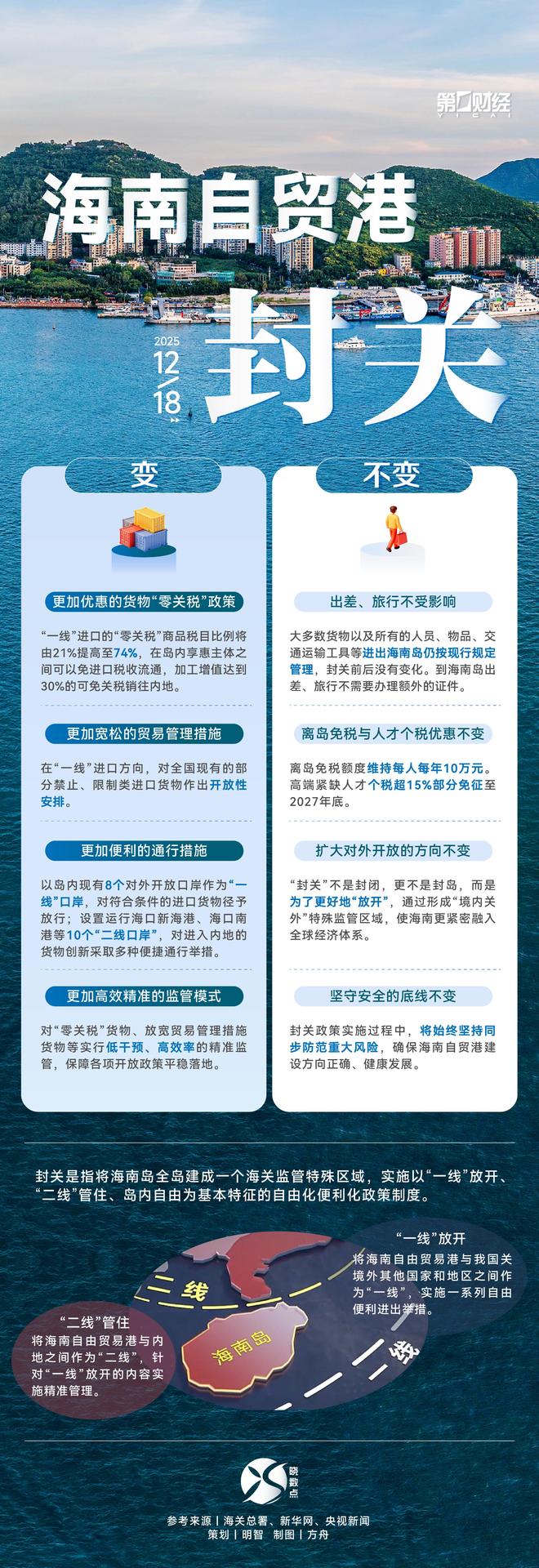
海南自贸港封关,有哪些“变”与“不变”?一图看懂
第一财经· 2025-12-17 11:06
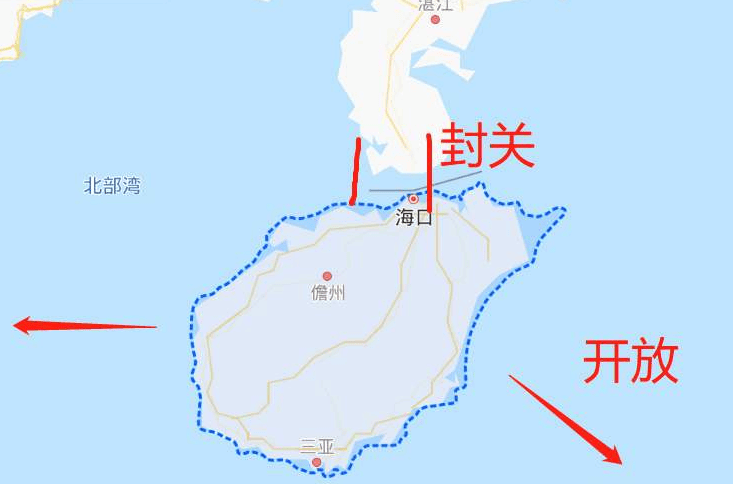
Group 1 - The core viewpoint emphasizes the opening arrangements for certain prohibited and restricted import goods in the "first-line" import direction [3] - The implementation of more convenient passage measures includes using eight existing open ports as "first-line" ports for eligible import goods and establishing ten "second-line" ports with innovative passage measures for goods entering the mainland [4] - A more efficient and precise regulatory model will be adopted for "zero tariff" goods and those with relaxed trade management measures, ensuring smooth implementation of various open policies [5] Group 2 - The annual duty-free allowance for individuals remains at 100,000 yuan, and high-demand talent will have personal income tax exemptions on amounts exceeding 15% until the end of 2027 [6] - The direction of expanding openness remains unchanged, with the "closure" not being a form of isolation but rather a means to better "open up" by forming a special regulatory area that integrates Hainan more closely into the global economic system [7] - The commitment to maintaining safety standards remains firm, with risk prevention measures in place during the implementation of the closure policy to ensure the correct and healthy development of Hainan's free trade port construction [8] Group 3 - The closure refers to establishing Hainan Island as a special customs supervision area, implementing a policy characterized by "first-line" openness, "second-line" management, and free movement within the island [9] - The "second-line" management will focus on precise management of the content released in the "first-line" to regulate the trade between Hainan's free trade port and the mainland [10]
晓数点丨海南自贸港封关,哪些“变”与“不变”
Di Yi Cai Jing Zi Xun· 2025-12-17 10:32
Group 1: Zero Tariff Policy - The proportion of "zero tariff" goods for "first-line" imports will increase from 21% to 74%, allowing tax-free circulation among beneficiaries on the island, with goods processed and valued at 30% exempt from tariffs when sold to the mainland [1] Group 2: Trade Management Measures - Open arrangements will be made for certain currently prohibited and restricted import goods in the "first-line" import direction [2] Group 3: Travel and Business Operations - Most goods, as well as all personnel, items, and transportation tools entering and exiting Hainan Island, will continue to be managed according to existing regulations, with no changes before or after the closure [3] Group 4: Duty-Free and Tax Incentives - The duty-free allowance for leaving the island remains at 100,000 yuan per person per year, and high-end talent will have personal income tax exemptions on amounts exceeding 15% until the end of 2027 [4] Group 5: Direction of Opening Up - The direction of expanding openness remains unchanged, with more convenient passage measures [5] Group 6: Port Operations - Eight existing open ports on the island will serve as "first-line" ports, allowing eligible imported goods to be released, while ten "second-line" ports will be established to facilitate innovative and convenient passage for goods entering the mainland [7] Group 7: Regulatory Model - A low-intervention, high-efficiency regulatory model will be implemented for "zero tariff" goods and relaxed trade management measures to ensure the smooth implementation of various open policies [8] Group 8: Concept of Closure - The term "closure" does not imply isolation but rather aims to enhance openness by creating a special regulatory area that integrates Hainan more closely into the global economic system [9] Group 9: Safety and Risk Management - During the implementation of the closure policy, there will be a consistent focus on preventing major risks to ensure the correct and healthy development of Hainan's free trade port construction [10] Group 10: Customs Regulation - The closure policy will establish Hainan Island as a special customs supervision area, characterized by "first-line" openness, "second-line" management, and internal freedom [11] Group 11: Management of Second-Line - The area between Hainan Free Trade Port and the mainland will be treated as a "second-line," implementing precise management for the contents opened in the "first-line" [12] Group 12: Management of First-Line - The area between Hainan Free Trade Port and other countries and regions outside China's borders will be treated as a "first-line," implementing a series of free and convenient entry and exit measures [13]