
大数据

Search documents
市场情绪回暖,大数据ETF(515400)早盘拉升翻红
Mei Ri Jing Ji Xin Wen· 2026-02-06 04:29
Group 1 - Market sentiment improved on Friday morning, with major indices opening lower but rebounding, particularly the Shanghai Composite and Shenzhen Component indices [1] - Lithium battery and energy metal sectors saw the first signs of recovery, while AI applications and commercial aerospace stocks experienced reduced declines [1] - The Big Data ETF (515400) began to rise at 10:14 AM, showing an approximate increase of 0.3% by 10:35 AM, with leading stocks including Yihualu, Shenzhou Information, Dataport, and Wangsu Technology [1] Group 2 - According to a report by China International Capital Corporation (CICC), significant advancements in global large models are expected by 2025 in reasoning, programming, intelligent agents, and multimodal productivity scenarios, although there are still shortcomings in stability and hallucination control [1] - Looking ahead to 2026, breakthroughs in reinforcement learning, long-term memory mechanisms, and contextual engineering are anticipated, facilitating the evolution of models from short text generation to long reasoning chain tasks, and accelerating the transition towards native multimodal and general artificial intelligence goals [1] - GF Securities analysis indicates that as the value of AI-assisted programming, data analysis, and process automation tools in cost reduction and efficiency enhancement is widely validated, the willingness of enterprises to pay continues to increase [1] - Domestic large models are expected to achieve large-scale implementation in vertical fields due to their advantages in localized scenario understanding and service response, effectively converting technological value into commercial value [1] Group 3 - The Big Data ETF (515400) closely tracks the CSI Big Data Industry Index, selecting 50 stocks from the Shanghai and Shenzhen markets that focus on big data storage devices, analysis technologies, operation platforms, production, and applications [2] - Investors can also explore investment opportunities through linked funds (Class A 018134; Class C 018135) [2]
港股异动丨中药股拉升 中国中药一度涨超8% 中药产业利好政策公布
Ge Long Hui· 2026-02-06 02:08
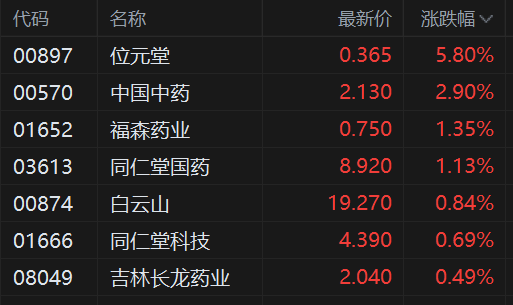
Group 1 - The core viewpoint of the news is that the Chinese traditional medicine sector is experiencing a strong market response following the release of a new development plan by the Ministry of Industry and Information Technology and seven other departments, which aims to enhance the quality and innovation of the industry by 2030 [1] - The plan outlines that by 2030, a collaborative development system for the entire traditional Chinese medicine (TCM) industry chain will be initially formed, with a focus on stable supply of key TCM raw materials and significant improvements in digitalization and greening levels [1] - Analysts suggest that this plan represents a systematic and long-term policy benefit for TCM stocks, marking a shift from "extensive growth" to "quality and value-driven" growth, serving as a guiding framework for the development of the TCM industry over the next five years [1] Group 2 - The stock performance of TCM companies shows a positive trend, with China Traditional Chinese Medicine rising over 8% at one point, currently up by 2.9%, and other companies like Yuyuan Tang and Tong Ren Tang also experiencing gains [2] - Specific stock price changes include: Yuyuan Tang at 0.365 with a 5.80% increase, China Traditional Chinese Medicine at 2.130 with a 2.90% increase, and Fosen Pharmaceutical at 0.750 with a 1.35% increase [2] - Other companies such as Tong Ren Rong Guo Yao, Baiyun Mountain, Tong Ren Tang Technology, and Jilin Changlong Pharmaceutical also reported slight increases in their stock prices, indicating a broader positive sentiment in the TCM sector [2]

中药产业迎黄金五年:新培育10个大品种,推动一批创新药获批上市
Xin Lang Cai Jing· 2026-02-06 02:03
Core Viewpoint - The "Implementation Plan for High-Quality Development of Traditional Chinese Medicine Industry (2026-2030)" aims to establish a collaborative development system for the entire industry chain by 2030, enhancing the stable supply of key raw materials, improving digital and green transformation levels, achieving breakthroughs in key technologies, and significantly increasing collaborative innovation levels [3][14]. Group 1: Development Goals - The plan sets four main goals: improving development quality, enhancing collaborative systems, fostering innovative products, and achieving breakthroughs in digital and green transformation [4][15]. - Specific tasks include cultivating 60 high-standard raw material production bases and establishing five innovation centers for the traditional Chinese medicine industry [4][15]. - The plan aims to promote the approval of innovative traditional Chinese medicine drugs and develop 10 major new traditional Chinese medicine products [4][15]. Group 2: Specific Actions - The plan outlines 15 specific tasks focusing on actions such as improving raw material quality and supply, collaborative innovation, enhancing manufacturing capabilities, revitalizing the national medicine industry, promoting traditional Chinese medicine products, and nurturing outstanding enterprises [5][16]. - It emphasizes the establishment of high-standard raw material production bases and the development of intelligent circulation and storage management systems for traditional Chinese medicine materials [7][18]. Group 3: Innovation and Technology - The plan encourages the use of artificial intelligence and big data to enhance the research and development of traditional Chinese medicine, including the creation of knowledge graphs for classic formulas and experiences from renowned practitioners [9][20]. - It also supports the clinical trials of new traditional Chinese medicine drugs and aims to shorten the research and development cycle while reducing costs [9][20]. Group 4: Market and Brand Development - The plan includes initiatives to protect intellectual property rights for traditional brands and improve the production processes of existing traditional Chinese medicine products to enhance their clinical and market value [6][17]. - It encourages collaboration between traditional Chinese medicine enterprises and e-commerce platforms to provide efficient purchasing experiences for patients [6][17].

清数智标(天津)科技有限公司成立,注册资本2000万人民币
Sou Hu Cai Jing· 2026-02-06 01:29
经营范围含技术服务、技术开发、技术咨询、技术交流、技术转让、技术推广;信息技术咨询服务;大 数据服务;人工智能公共数据平台;人工智能行业应用系统集成服务;数据处理服务。(除依法须经批 准的项目外,凭营业执照依法自主开展经营活动) 企业名称清数智标(天津)科技有限公司法定代表人闫建龙注册资本2000万人民币国标行业科学研究和 技术服务业>科技推广和应用服务业>技术推广服务地址天津武清经济技术开发区高村科技创新园汇滨 道南侧清数科技园C座2278室企业类型有限责任公司(法人独资)营业期限2026-2-5至无固定期限登记机关 天津市武清区市场监督管理局 来源:市场资讯 天眼查显示,近日,清数智标(天津)科技有限公司成立,法定代表人为闫建龙,注册资本2000万人民 币,由天津武清经济技术开发区高村科技创新园有限公司全资持股。 序号股东名称持股比例1天津武清经济技术开发区高村科技创新园有限公司100% ...
音频 | 格隆汇2.6盘前要点—港A美股你需要关注的大事都在这
Ge Long Hui A P P· 2026-02-05 23:12
Group 1 - U.S. stock indices fell over 1.2%, with AMD and Qualcomm dropping more than 8%, while the Chinese concept index rose by 0.9% [1] - Bitcoin dropped below $65,000 [1] - Silver prices plummeted by 19.5%, and gold fell by 4% [1] - U.S. crude oil futures closed down over 2.8%, at $63.29 per barrel [1] - UBS and Goldman Sachs warned about volatility and liquidity issues in the silver market [1] - HP and Dell are reportedly researching the use of mainland China's memory chips [1] - South Korean stocks fell by 3.86%, with foreign investors recording a record high net sell-off [1] - JPMorgan stated that strong demand from central banks could push gold prices to $6,300 per ounce by the end of 2026 [1] - In January, the number of layoffs by Challenger companies in the U.S. rose to 108,000, the highest for the same period since 2009 [1] - Nvidia delayed the release of new gaming chips due to a shortage of memory chips [1] - Amazon's stock dropped by 11% after hours, with expected annual capital expenditures of approximately $200 billion [1] Group 2 - Meituan plans to acquire Dingdong for $717 million [2] - Multiple foreign institutions continue to increase their investment willingness in China [2] - China Telecom and China Unicom have initiated trial commercial use of Beidou SMS [2] - AUX announced a price increase of 6%-10% for all central air conditioning products starting March 1 [2] - Hong Kong Stock Exchange reported that the amount raised from IPOs in January was HKD 39.3 billion, a year-on-year increase of 555% [2] - The silicon industry association indicated that the silicon wafer market is expected to remain stable due to adjustments in battery production and expectations of declining silicon prices [2] - NIO expects adjusted operating profit to be between 700 million and 1.2 billion yuan in Q4 2025 [2] - The Bank of England maintained its current policy as expected [2] - Muyuan Foods saw a 1.9% increase in dark trading, earning HKD 74 per lot [2] - Dazhu CNC experienced a 21.71% increase in dark trading, earning HKD 2,080 per lot [2] Group 3 - Hong Kong stocks of Zhuozheng Medical, Dazhu CNC, and Muyuan Foods were listed [3] - Significant accumulation of Tencent shares occurred, with southbound funds net buying a total of HKD 11 billion over four consecutive days [3] - Announcement highlights include Revotek planning a 1 billion yuan investment in a synthetic biology manufacturing project in Xinjiang, and GCL-Poly has not yet received relevant orders in the "space photovoltaic" sector [3] - In A-shares, Beiliang's major shareholder Ma Xuejun is under investigation by the CSRC for alleged market manipulation [3]




八部门提出到2030年 中药工业全产业链协同发展体系初步形成
Xin Lang Cai Jing· 2026-02-05 19:12
Core Viewpoint - The Ministry of Industry and Information Technology and seven other departments have jointly issued the "Implementation Plan for the High-Quality Development of Traditional Chinese Medicine Industry (2026-2030)", aiming to establish a collaborative development system for the entire traditional Chinese medicine industry chain by 2030 [1][2] Group 1: Goals and Objectives - By 2030, the plan aims to enhance the stable supply capacity of key traditional Chinese medicine raw materials and significantly improve the levels of digitalization and greening [1] - The plan includes cultivating a number of leading enterprises in the traditional Chinese medicine industry and establishing 60 high-standard raw material production bases [1] - It targets the approval and market launch of a batch of innovative traditional Chinese medicine products, including the cultivation of 10 major traditional Chinese medicine varieties [1][2] Group 2: Implementation Strategies - The plan outlines six key areas with 15 tasks, focusing on stabilizing supply, collaborative innovation, intelligent manufacturing, product promotion, and service system construction [1] - It emphasizes the need to revise production technology specifications and quality standards for key processing links in traditional Chinese medicine [2] - The use of artificial intelligence and big data to construct knowledge graphs for classic formulas and experiences from renowned traditional Chinese medicine practitioners is highlighted [1][2] Group 3: Quality Control and International Cooperation - The plan includes the establishment of a comprehensive quality control system and the development of new products from advantageous ethnic medicines [2] - It aims to enhance the clinical and market value of traditional Chinese medicine products and encourages international registration of advantageous traditional Chinese medicine products [2] - The plan calls for integrating related tasks into the high-quality development action system of key manufacturing industry chains [2]
上海蓝雪鑫科技有限公司成立,注册资本1000万人民币
Sou Hu Cai Jing· 2026-02-05 17:30
天眼查显示,近日,上海蓝雪鑫科技有限公司成立,法定代表人为张晶晶,注册资本1000万人民币,由 蓝雪智创(海南)控股有限公司全资持股。 来源:市场资讯 序号股东名称持股比例1蓝雪智创(海南)控股有限公司100% 经营范围含技术服务、技术开发、技术咨询、技术交流、技术转让、技术推广;软件开发;公共资源交 易平台运行技术服务;企业管理;数字文化创意内容应用服务;科技中介服务;信息咨询服务(不含许 可类信息咨询服务);人工智能行业应用系统集成服务;大数据服务;工业互联网数据服务;数据处理 和存储支持服务;云计算装备技术服务;物联网技术研发;物联网技术服务;信息技术咨询服务;信息 系统集成服务;信息系统运行维护服务;计算机系统服务;供应链管理服务;会议及展览服务(出国办 展须经相关部门审批);移动终端设备销售;进出口代理;技术进出口;货物进出口。(除依法须经批 准的项目外,凭营业执照依法自主开展经营活动) 企业名称上海蓝雪鑫科技有限公司法定代表人张晶晶注册资本1000万人民币国标行业科学研究和技术服 务业>科技推广和应用服务业>技术推广服务地址上海市宝山区长江路258号6幢企业类型有限责任公司 (自然人投资或控股的法 ...
众淼控股(01471)与德祥集团达成战略合作 探索“实物资产供应+数字化金融保障”的商业模式
智通财经网· 2026-02-05 14:43
Group 1 - The core viewpoint of the article is that Zhongmiao Holdings has entered into a framework agreement with De Xiang Real Estate Group to establish a long-term strategic partnership focused on integrating resources and technology in the areas of physical asset supply and digital financial security [1][2] Group 2 - The collaboration will explore a business model that combines physical asset supply with digital financial security, focusing on digital asset risk management and cross-border asset distribution [1] - The strategic cooperation will leverage Zhongmiao's expertise in digital risk management and insurtech, along with De Xiang's operational advantages in global real estate [1][2] - The partnership aims to develop risk hedging, credit enhancement, and compliance risk management mechanisms for digital assets, enhancing asset stability and investor confidence in the Web3 and digital finance sectors [1] Group 3 - The agreement aligns with the company's long-term strategic goals, deepening the application of insurtech and expanding digital risk management scenarios [2] - By partnering with De Xiang, which has global real estate resource advantages, both parties aim to achieve complementary strengths and collaborative development, ultimately creating long-term value for the company and its shareholders [2]
八部门发文,中药工业未来五年这样干
2 1 Shi Ji Jing Ji Bao Dao· 2026-02-05 13:10
Core Viewpoint - The "Implementation Plan for High-Quality Development of Traditional Chinese Medicine Industry (2026-2030)" aims to establish a collaborative development system for the entire TCM industry chain by 2030, enhancing the supply capacity of key TCM raw materials, and significantly improving digitalization and greening levels [1] Group 1: Development Goals - The plan sets four major goals focusing on policy coordination, stable supply of raw materials, and the growth of leading TCM enterprises to increase industry concentration [2] - Specific tasks include improving the quality of TCM production, establishing 60 high-standard TCM raw material production bases, and enhancing the collaborative system across various stages of TCM production and distribution [2][3] - The plan emphasizes the continuous emergence of innovative TCM products, aiming to approve new TCM innovative drugs and cultivate 10 major varieties of traditional Chinese medicine [3] Group 2: Actions and Tasks - The plan outlines 15 specific tasks across six action areas, including quality improvement, collaborative innovation, and the promotion of TCM products [3] - It highlights the importance of stable supply of TCM raw materials, proposing the construction of high-standard production bases and the establishment of a smart circulation management system for TCM materials [4][5] - The plan also focuses on enhancing manufacturing capabilities, promoting the standardization of TCM production processes, and improving the quality traceability system [5][6] Group 3: Innovation and Research - The plan encourages the establishment of a collaborative innovation system to enhance the transformation and application of scientific achievements in TCM, leveraging AI and big data for new drug development [6][7] - It emphasizes the importance of post-marketing research for classic formulas, aiming to optimize medication plans based on real-world studies and clinical needs [7]
威士顿三大募投项目全部延期
Shen Zhen Shang Bao· 2026-02-05 12:36
Core Viewpoint - The company, Weiston, has announced the extension of the implementation deadlines for all three of its fundraising projects due to a decline in both revenue and net profit, aiming to ensure the quality and commercial value of the projects [1][6]. Group 1: Project Deadline Extensions - The "Intelligent MES System Optimization Project" deadline has been extended to December 31, 2028, from February 28, 2026 [1]. - The "Quality Traceability and Analysis System Optimization Project" deadline has been extended to December 31, 2027, from August 31, 2025 [4]. - The "Big Data Platform Management Portal Product R&D Project" deadline has been extended to December 31, 2026, from January 31, 2025 [5][6]. Group 2: Financial Performance - In 2024, the company reported a total revenue of 294 million, a year-on-year decrease of 6.32%, and a net profit of 51.71 million, down 11.26% [6]. - For the first three quarters of 2025, the company achieved a revenue of 122 million, a decline of 32.34%, and a net profit of 21.49 million, down 28.30% [6]. Group 3: Fundraising and Investment - The total amount raised from the IPO in 2023 was approximately 710 million, with a net amount of about 615 million after deducting issuance costs [2]. - As of November 30, 2025, the cumulative investment in fundraising projects amounted to 98.12 million [2][3].
